
On this page
Start here
Quick answer
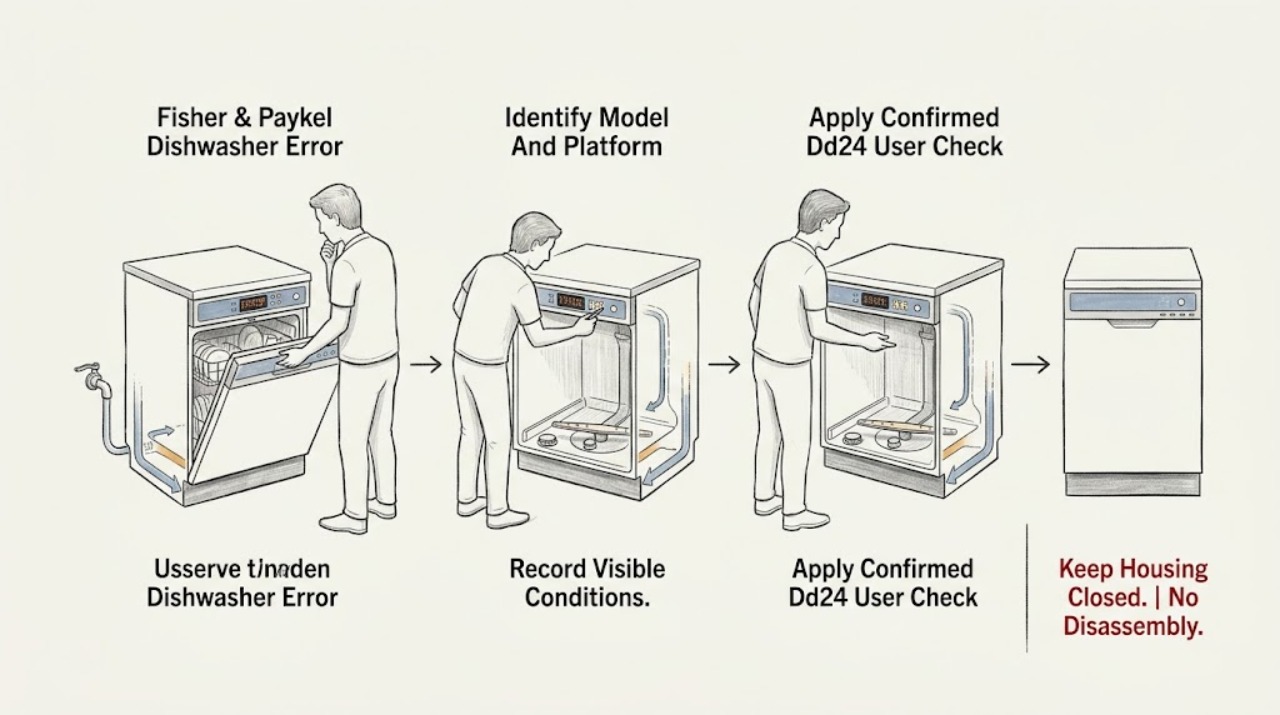
Do not diagnose a Fisher & Paykel dishwasher from a generic code list. First record the complete model code, whether the appliance is a DishDrawer or a drop-door dishwasher, the exact letters/numbers or flashing indicators, any beeps, and which drawer or door is affected. Fisher & Paykel publishes separate product documentation for its different dishwasher platforms, and its DishDrawer DD24DT2NX9 guide says that its F and A faults can differ by drawer. In that named DD24 model, the guide maps A1 to a water-supply fault, A3 to a drain fault, A6 to a loose spray arm, A7 to excess foam, and A09 to a sanitize-temperature issue; those meanings must not be copied to an unidentified model. Use only the exact model guide for any user check or reset. If the code is unknown, returns after the model-approved step, appears with flooding, a damaged cord, smoke, burning odor, or unsafe water near electrics, stop using the dishwasher and contact Fisher & Paykel or an authorized service technician. Do not open a running drawer/door, bypass a lock or flood switch, remove panels, or perform live electrical tests.
Before you begin
Safety first
- This article covers model identification, recording the display, and only the external checks explicitly allowed by the exact user guide. Qualified service must handle internal wiring, controls, pumps, valves, sensors, flood protection, hard-wired connections, and live testing.
Work through in order
Diagnostic checks
Use only checks that match the exact appliance or system and its official guide.
-
Check 1
With the dishwasher idle, photograph or transcribe the complete model code from the rating label and identify whether the unit is a DishDrawer with one or two drawers or a conventional drop-door dishwasher. Note the affected drawer or door, the exact display text or flashing indicators, and the beep pattern without pressing random buttons.
Expected result: The model and platform are clear, only one drawer is affected, both drawers show faults, the unit is a drop-door model, or the model/code cannot be read.
Next step: Open the Fisher & Paykel resource search for the exact model and use the matching user guide. If the code or model cannot be identified, stop at identification and arrange Customer Care rather than borrowing another model's button sequence.
Stop if: Do not remove the control panel, pull an integrated dishwasher from cabinetry, or operate with a damaged cord, plug, drawer, or door.
Why this matters
Why: Fisher & Paykel documents DishDrawer and drop-door platforms separately, and the opened DD24 guide says a double model can have different faults in each drawer. An unreadable model or incomplete indicator pattern is not enough to select a code meaning.
-
Check 2
Keep the exact code or indicator pattern in your notes, including any additional code that appears after stopping the beeping, and record whether it belongs to the upper or lower drawer on a double DishDrawer. Do not clear the display until the record is complete.
Expected result: The code is a readable F/A pattern on a confirmed DD24-family DishDrawer, a numeric/letter code on a different model, an unlisted pattern, or different drawers report different patterns.
Next step: For a confirmed DD24DT2NX9, use only its fault-code table. For every other model, find the exact manual first; provide the code, platform, drawer/door, and all indicators to Customer Care if the manual does not list it.
Stop if: Do not enter a diagnostic mode, hold a lock or door switch closed, or repeatedly clear a code to keep the machine running.
Why this matters
Why: The DD24DT2NX9 guide explicitly distinguishes F and A faults and allows codes to differ by drawer; another model may use a different display vocabulary. An unlisted or changing pattern needs the exact manual or service diagnosis, not an internet-wide code translation.
-
Check 3
Only if the rating label matches the opened DD24DT2NX9 guide, compare the recorded A code with that guide and perform only its external, user-level check: A1—confirm the water supply is on; A3—inspect the accessible drain hose/connection for an obvious blockage as the guide directs; A6—check that the spray arm is seated and turns freely; A7—let the automatic foam-recovery program finish and verify the correct detergent; A09—check whether the water supply was off or the program was interrupted. Do not treat these meanings as universal.
Expected result: The matching user-level condition is found, the condition is absent, the code is F or another code, the model is not DD24DT2NX9, or water/foam remains after the documented step.
Next step: Follow the exact model guide for a matching code once, then reassess the display. If the code persists or the condition is not listed, stop and contact Fisher & Paykel service with the recorded evidence.
Stop if: Do not reach into a moving spray arm, run with panels missing, use excess detergent to test foam, or touch internal pumps, valves, wiring, or electronics.
Why this matters
Why: For that exact DD24 guide, the observed conditions correspond to the listed A-code causes and actions. A different model, an F fault, an unlisted code, or a persistent condition leaves the cause unresolved and may involve internal sensing, pump, inlet, flood, or control circuitry.
-
Check 4
If the exact user guide authorizes a reset after the check, use that guide's normal controls once while the drawer/door is closed and the appliance is not running. For the DD24DT2NX9 guide, its F-fault procedure is to stop the beeping, turn the DishDrawer off, wait a few seconds, and turn it back on; the listed A faults have their own code-specific clear/resume steps.
Expected result: The code clears and the dishwasher completes a normal cycle, the code returns immediately, another code appears, the drawer/door will not close, or water remains/leaks.
Next step: Stop using the affected drawer or dishwasher for a recurring or unresolved code. If there is a leak or flooding indication, turn off the water supply and disconnect power only from a dry, safe position; otherwise leave isolation and service to a qualified technician.
Stop if: Do not repeat resets, run a cycle to see whether a flood fault returns, defeat a door/lock or flood switch, or work inside a hard-wired connection box.
Why this matters
Why: A single recovery supports a temporary, documented user-level condition but does not identify a failed part. Recurrence, a second code, a closure problem, retained water, or a leak means the fault remains active or another safety condition is present.
-
Check 5
Prepare the complete model code, serial number if available, platform, affected drawer/door, exact code and indicators, cycle stage, water/foam/drain observations, and the result of the one model-approved check for Fisher & Paykel Customer Care or an authorized service partner.
Expected result: The fault is unlisted, returns after the documented step, involves flooding or a damaged cord, or requires access behind panels, under cabinetry, to wiring, or to pumps/valves/controls.
Next step: Leave the dishwasher off and arrange qualified Fisher & Paykel service. Use the recorded code and model to avoid an incorrect part or procedure.
Stop if: Stop immediately for smoke, burning odor, sparking, a hot plug or cord, uncontrolled water, a damaged enclosure, or water near electrical connections; do not touch the appliance while standing in water.
Why this matters
Why: Fisher & Paykel directs owners to product help and trained or authorized service, and its DishDrawer guide says persistent faults should be recorded and escalated. Internal diagnosis is not justified by the visible code alone.
Use your observations
Decision map
Find the observation that best matches what you see, then follow the next safe action.
-
PATH 01Safety boundary
What you see
The model code, platform, exact display text, or flashing-indicator pattern cannot be identified, or the code is not listed in the exact user guide.
Do this next
Keep the dishwasher off if it is malfunctioning, capture the display and label, and contact Fisher & Paykel Customer Care or an authorized service partner with the record.
Why this path and its safety boundary
Why it matters: The visible symptom has no reliable cross-model interpretation. Fisher & Paykel's resource and contact guidance requires the specific model documentation, and a code table from a different DishDrawer or drop-door platform may point to the wrong component or reset.
Safety stop: Do not guess the code meaning, enter diagnostics, or repeatedly reset the appliance.
-
PATH 02Safety boundary
What you see
The model label matches DD24DT2NX9 and the display matches one of its listed A1, A3, A6, A7, or A09 faults without an immediate leak or electrical hazard.
Do this next
Perform only the corresponding guide step once, clear/resume as that guide specifies, and monitor. Escalate if the code returns, another code appears, or the condition persists.
Why this path and its safety boundary
Why it matters: The named guide provides a limited user-level path: water-supply, drain, spray-arm seating, foam-recovery, or sanitize-cycle context respectively. This is a model-specific mapping, not a Fisher & Paykel-wide code list.
Safety stop: Do not dismantle the pump, inlet valve, drain assembly, spray-arm mount, flood sensor, or control electronics.
-
PATH 03Safety boundary
What you see
A confirmed DishDrawer shows an F fault, an A fault remains after the listed step, the code changes, or the dishwasher will not resume normally.
Do this next
Stop the affected drawer or dishwasher and arrange qualified service with the code, drawer, and observations. On a double DishDrawer, do not assume the other drawer has the same fault or is safe to run if water or electrical symptoms are present.
Why this path and its safety boundary
Why it matters: The manual treats a persistent fault as requiring the code to be recorded and Customer Care contacted; an internal sensor, pump, inlet, drain, flood, motor, or electronics issue is possible but cannot be selected from the symptom alone.
Safety stop: Do not bypass a lock, flood protection, or drawer interlock, and do not perform live voltage or continuity tests.
-
PATH 04Safety boundary
What you see
There is uncontrolled water or flooding, a damaged cord/plug, smoke, burning odor, sparking, hot electrical parts, or water near electrical connections.
Do this next
Stop using the appliance. If it can be done without touching water or electrical parts, close the water supply and isolate power from a safe, dry location; otherwise leave it isolated and call qualified service or an electrician as appropriate.
Why this path and its safety boundary
Why it matters: The immediate hazard overrides code interpretation. The user guide requires service escalation for persistent faults and warns against operation with damage or unsafe conditions.
Safety stop: Do not touch the appliance while standing in water, open panels, move a hard-wired unit, or restore power to test it.
Helpful context
Understand the symptom
The display pattern is part of the fault code
A Fisher & Paykel error may be a number, an F or A code, or a combination of flashing program, modifier, lock, or drawer indicators. Record the screen or indicator pattern before switching anything off. On the opened DD24DT2NX9 guide, the drawer indicator identifies which drawer has the fault and the two drawers may show different codes. That does not establish the same code system for every Fisher & Paykel dishwasher.
Architecture changes the safe decision
Fisher & Paykel's current range separates DishDrawer models, which have independently operating drawers, from full-capacity drop-door models. A step that names a drawer, drawer indicator, or DishDrawer button cannot be assumed to apply to a drop-door unit. Find the model code and use the matching user guide from Fisher & Paykel's resource search before interpreting an unfamiliar code.
A reset is a conditional test, not a code meaning
Some model guides allow a normal off/on or code-clear sequence after a user-level cause is corrected. The DD24DT2NX9 guide gives different responses for its listed A faults and says to record the code and contact Customer Care when the fault remains. A reset that makes the display disappear does not prove the underlying fault is repaired; recurrence, a second code, water left in the tub, or a new leak is a service boundary.
Safety boundary
Stop conditions
- Do not interpret an unknown Fisher & Paykel code from a different model, platform, drawer, or online list; record the exact model and display pattern first.
- Do not open a DishDrawer or drop-door dishwasher while it is operating, bypass a door/drawer lock or flood switch, enter diagnostics, or operate with panels missing.
- Stop for flooding, uncontrolled water, smoke, burning odor, sparking, a hot or damaged cord/plug, or water near electrical connections; isolate power and water only from a safe, dry position.
- Do not perform live electrical tests or access pumps, valves, wiring, control boards, hard-wired junctions, or sealed internal assemblies; use Fisher & Paykel or qualified service.
When checks do not resolve it
Need a professional?
Safety scope: This article covers model identification, recording the display, and only the external checks explicitly allowed by the exact user guide. Qualified service must handle internal wiring, controls, pumps, valves, sensors, flood protection, hard-wired connections, and live testing.
Common questions
FAQ
Can I use a Fisher & Paykel dishwasher error-code list found online?
Only if it is the exact model guide. Fisher & Paykel has DishDrawer and drop-door platforms, and the DD24DT2NX9 guide uses drawer-specific F/A faults. An identical-looking display on another model can have a different meaning or clear sequence.
What should I do if the displayed code is not in my manual?
Record the complete model code, exact display/indicator pattern, affected drawer or door, beeps, and cycle stage. Keep the dishwasher off if it is malfunctioning and contact Fisher & Paykel Customer Care or an authorized service partner; do not guess or repeatedly reset it.
Does an error clear mean the dishwasher is fixed?
No. A model-approved reset may clear a temporary or documented user-level condition, but a returning code, changed code, retained water, leak, or failure to resume means the fault remains unresolved and should be serviced.
Is it safe to keep using the other drawer on a double DishDrawer?
The DD24DT2NX9 guide says a fault can occur in one or both drawers and that the other drawer may remain usable when only one has a fault. Do not use either drawer if there is flooding, a leak, an electrical hazard, or a shared symptom, and follow the exact model guide or service advice.
Read the exact guide
Official sources
- Help & Support | Fisher & Paykel USAFisher & Paykel · Applies to Fisher & Paykel appliances generally; the actual help path depends on the registered/product model.
- Contact Us | Fisher & Paykel USAFisher & Paykel · Applies to Fisher & Paykel product support in the listed region; service availability varies.
- Dishwashing | Fisher & Paykel USAFisher & Paykel · Establishes the current DishDrawer and Drop Door platform distinction; it does not provide a universal fault-code table.
- Fisher & Paykel DD24DT2NX9 DishDrawer Dishwasher User GuideFisher & Paykel · Only the DD24DT2NX9 model guide; do not generalize its F/A display or A-code mapping to other Fisher & Paykel models.
- Resources | Fisher & Paykel USAFisher & Paykel · Applies as the model-documentation lookup route; the returned guide varies by product and model.
Community feedback
Share a repair observation
Share a plain-text repair observation. Accepted observations are published automatically; this page may take a moment to update.