
On this page
Start here
Quick answer
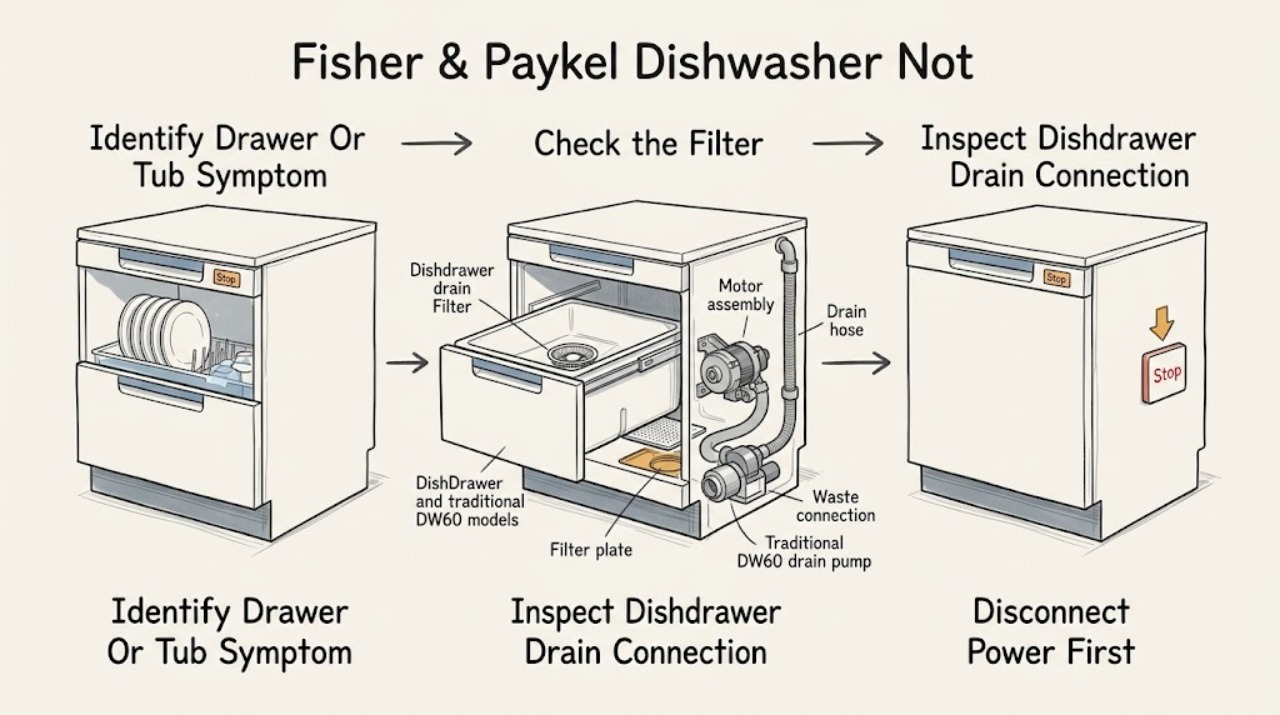
First decide whether this is a normal small amount of water in a DishDrawer filter area or true standing water across a drawer or traditional tub. On a DishDrawer, switch off and allow it to cool before cleaning the user-accessible drain filter and filter plate, then check the drawer's drain hose and waste connection for a kink or blockage. On a traditional DW60, the official guide points to blocked filters, a crimped or blocked drain hose or connection, foaming, or a jammed pump; some DW60 models show A20 for a drain fault. DishDrawer models may show A3 when a drawer cannot drain. A code that returns, water under the appliance, a jammed pump, or a blockage beyond the user-accessible path requires Fisher & Paykel service. Do not remove the motor or pump, work on a powered appliance, disconnect plumbing with water present, or apply an A3/A20 procedure to a different model.
Before you begin
Safety first
- The user may identify the model, distinguish filter-area residue from standing water, disconnect power and cool the appliance before permitted DishDrawer maintenance, clean user-accessible filters, and inspect visible hose/connection routing. A qualified technician must handle the pump or motor assembly, concealed hoses, sensors, controls, flood protection, internal wiring, and energized testing.
Work through in order
Diagnostic checks
Use only checks that match the exact appliance or system and its official guide.
-
Check 1
Read the complete model number and identify the architecture before touching the water: a single or double DishDrawer with independent drawers, or a traditional DW60 dishwasher with one tub. Note whether water is only in a filter recess or covers the drawer/tub, whether one drawer or both are affected, when the water remains, and any exact A3, A20, F-code, beeps, or flashing indicators.
Expected result: There is only a small amount in a DishDrawer filter area, one drawer has standing water, both drawers have standing water, a traditional DW60 tub remains full, or a model-specific drain code is displayed.
Next step: Use the matching DishDrawer or DW60 path below and keep a photo or written record of the indicators. If water is leaking toward electrical parts or the appliance is unsafe to approach, stop and isolate it only from a dry, safe location before calling service.
Stop if: Do not open a running drawer, reach into hot water, repeatedly restart a flooded appliance, or use a fault-code reset from another Fisher & Paykel model.
Why this matters
Why: A small filter-area residue on an applicable DishDrawer is not the same as a failed drain. One-drawer symptoms keep that drawer's filter, motor assembly, hose, or connection in view; both drawers or a traditional tub require the matching shared plumbing and model guide. A3 and A20 are not universal codes and must be tied to the exact family.
-
Check 2
For a DishDrawer only, switch it off, disconnect the power, and allow the filter plate to cool. Remove the rack as the exact guide permits, then remove the drain filter and filter plate from the affected drawer. Rinse food particles from them, check the recess for visible debris, and refit the filter plate, drain filter, and spray arm exactly as shown; the filter arrows must align and the spray arm must turn freely.
Expected result: Food or foreign material blocks the drain filter or plate, a filter is not seated or aligned, the recess is clear and the drawer still holds water, or the filter plate is hot/damaged.
Next step: Refit only the parts the exact guide identifies and continue to the visible hose and waste-connection check. If the plate, filter, or recess is damaged, inaccessible, or still hot, leave the drawer out of service and arrange service.
Stop if: Do not remove the motor assembly or impeller, run the drawer with the filter plate, drain filter, spray arm, or enclosure panels missing, or use sharp tools to clear the recess.
Why this matters
Why: A blocked or incorrectly refitted DishDrawer filter path can restrict drainage. A clear, correctly seated path that still leaves standing water does not prove that the motor assembly or pump is defective; it moves the next check to the external hose/connection or service boundary.
-
Check 3
With the appliance off and the area dry, inspect only the visible DishDrawer drain hose route and its waste connection under the sink or cabinet. Look for a kink, sag, crushing, blockage at the connection, or a drain hose that was installed without the model's required high loop. On a double DishDrawer, identify which hose belongs to the affected drawer; do not pull the appliance out or disconnect a water-filled connection.
Expected result: The hose is kinked or sagging, the waste connection is visibly blocked, the high-loop/connection does not match the installation guide, or the visible route is clear.
Next step: Correct only a plainly accessible hose bend or loose external routing according to the exact installation guide, then stop and arrange service if the connection is blocked, concealed, leaking, or the fault returns. Do not disconnect a hose to test flow.
Stop if: Do not dismantle the sink trap, remove cabinetry, pour chemicals into the dishwasher, run an open-hose test, or work on plumbing with standing water near electrical parts.
Why this matters
Why: Fisher & Paykel identifies the drainage hose and drainage-pipe connection as the primary causes of an A3 DishDrawer fault, while the installation guide says the hose must not sag and gives a model-specific high-loop requirement. A clear visible route with persistent water leaves a concealed blockage, pump, motor assembly, or control fault possible.
-
Check 4
For a traditional DW60 model, use its own user guide: with power and water safely isolated for maintenance, check and clean the user-accessible filters, then inspect the visible drain hose and drain connection for a crimp, bend, or blockage. If the exact model displays A20, match the guide's drain-fault procedure; do not substitute DishDrawer A3 steps.
Expected result: The filter is blocked, the hose or connection is restricted, the exact DW60 guide reports A20, the water is accompanied by excessive foam, or the accessible path is clear.
Next step: Clean or correct only the accessible condition permitted by the exact DW60 guide. If foam persists, use only the detergent guidance for that model and do not run further cycles while water remains. If the path is clear or A20 returns, contact Fisher & Paykel service.
Stop if: Do not remove the drain pump, turbidity sensor, internal hoses, or wiring; do not perform live tests; and do not keep running cycles to force a drain.
Why this matters
Why: The DW60 guide treats filters, hose/connection, foaming, and a jammed pump as separate possibilities. A20 on applicable DW60 models supports a drain-path investigation, but it does not identify which part failed. Foam can prevent normal draining without being a pump diagnosis.
-
Check 5
After one exact-model filter and visible hose/connection check, record whether the water cleared, which drawer or tub remains affected, and whether the code or indicator returned. Check from outside for water under the unit, an unusual pump sound, repeated beeping, or a drawer that cannot close; do not open the appliance to identify the pump.
Expected result: Drainage returns to normal, only a normal DishDrawer filter-area residue remains, the same drawer/tub remains full, A3/A20 or another fault returns, the pump is jammed/silent, or water is leaking toward electrical parts.
Next step: Stop using the affected drawer or dishwasher, turn off the water supply and disconnect power only from a safe dry location when the exact guide directs it, and contact Fisher & Paykel or a qualified appliance technician with the model, drawer, code, and observations.
Stop if: Do not restart to reproduce the fault, bypass flood protection, remove panels, access the pump or motor, or perform energized electrical or plumbing tests.
Why this matters
Why: A stable result after a model-approved accessible correction supports a local restriction or setup issue. Persistent standing water, a returning drain code, a jammed pump, or leakage makes an internal pump/motor, concealed hose, flood protection, control, or plumbing fault more likely and cannot be safely isolated by the user checks.
Use your observations
Decision map
Find the observation that best matches what you see, then follow the next safe action.
-
PATH 01Safety boundary
What you see
An applicable older DishDrawer ends a programme with a small amount of water confined to the drain-filter area, with no rising water, leak, or drain fault indicator.
Do this next
Confirm the exact model and keep the filter, filter plate, and spray arm correctly fitted. Seek service only if water spreads through the drawer, accumulates between cycles, leaks, or a fault code appears.
Why this path and its safety boundary
Why it matters: The DD605 user guide describes some water in the drain-filter area as normal, so this observation alone does not establish a blocked drain.
Safety stop: Do not remove the motor assembly or alter the drain path simply because the filter recess is damp.
-
PATH 02Safety boundary
What you see
A DishDrawer displays the applicable A3 fault or one drawer ends with standing water while the other drawer is normal.
Do this next
Power off safely, clean and refit that drawer's filter path, then inspect its visible hose and waste connection once. If A3 returns or the path is concealed, stop and arrange service; on double models record which drawer indicators flash.
Why this path and its safety boundary
Why it matters: The model guide makes a blocked or kinked drainage hose or drainage-pipe connection more likely for the affected drawer; one-drawer behavior does not identify a failed pump by itself.
Safety stop: Do not run repeated cycles, swap hoses between drawers, or remove the pump/motor to compare drawers.
-
PATH 03Safety boundary
What you see
A traditional DW60 tub remains full after the wash, or an applicable DW60 guide shows A20.
Do this next
Follow the exact DW60 guide for user-accessible filters and visible hose/connection checks. If the path is clear, the code returns, or the guide identifies a jammed pump, isolate water and power as directed and call service.
Why this path and its safety boundary
Why it matters: The official DW60 path keeps a blocked filter, drain hose or connection, foaming, and a jammed pump as separate possibilities; A20 does not select a replacement part.
Safety stop: Do not apply DishDrawer filter-plate or A3 reset instructions to a traditional DW60, and do not access the pump or sensor.
-
PATH 04Safety boundary
What you see
The water is accompanied by excessive foam, a visible waste-connection backup, or a hose that is kinked, sagging, or incorrectly routed.
Do this next
Stop adding detergent and correct only the accessible routing or model-approved detergent condition. Do not run another loaded cycle until water clears; arrange service or plumbing help if the connection is blocked, leaking, or inaccessible.
Why this path and its safety boundary
Why it matters: A detergent/foam condition or external drainage restriction can prevent normal emptying without proving an internal pump fault.
Safety stop: Do not pour drain cleaner into the appliance, disconnect a water-filled hose, or test an open drain line while the dishwasher is powered.
-
PATH 05Safety boundary
What you see
The correct filter and visible hose/connection checks pass, but a drawer or tub remains full, a drain code returns, the pump is jammed/silent, or water reaches electrical parts.
Do this next
Keep the affected appliance out of service, isolate water and power only from a safe dry position, and contact Fisher & Paykel or qualified service with the full model, drawer/tub, code, and symptom history.
Why this path and its safety boundary
Why it matters: A concealed hose, pump/motor assembly, control, flood-protection, or plumbing fault is more likely; the user checks cannot safely distinguish the component.
Safety stop: Do not open panels, remove the motor or pump, bypass flood protection, perform live measurements, or repeatedly restart a flooded appliance.
Helpful context
Understand the symptom
Confirm that it is standing water, not normal DishDrawer residue
A DishDrawer is not a conventional full-height tub. Fisher & Paykel's earlier DD605 guide says that some water may remain in the drain-filter area after a programme, and that both drawers may drain at the same time on that model. Water spread across the drawer, a rising level, or a drawer that ends with an A3 indication is a different symptom. Record which drawer is affected before cleaning or resetting anything.
The first user path is different on each architecture
On a DishDrawer, the removable drain filter and filter plate sit at the base of each drawer and must be cleaned and refitted correctly. On a traditional DW60, the official troubleshooting path separates the filters, the external drain hose and connection, foaming, and a jammed pump. A filter check cannot prove that a pump or internal motor is healthy, and a DishDrawer instruction should not be transferred to a traditional DW60.
Water and power make the stop boundary important
Before cleaning a DishDrawer, disconnect it from power and let the hot filter plate cool as the user guide directs. If water is around electrical parts, a fault persists after the exact model's external checks, or the diagnosis would require the motor, pump, internal wiring, or concealed plumbing, turn off the water supply where safe and arrange Fisher & Paykel service.
Safety boundary
Stop conditions
- Stop immediately for water near electrical parts, a damaged cord or plug, smoke, burning odor, a flooding condition, or an appliance that is unstable or partially disassembled.
- Disconnect power and allow the DishDrawer filter plate to cool before cleaning or maintenance, as directed by the exact Fisher & Paykel guide.
- Do not open a running drawer, remove the motor/pump or concealed hoses, bypass flood protection, use drain chemicals, or perform live electrical tests.
- Do not continue wash cycles while standing water, heavy foam, a returning A3/A20 or other fault, or a leak is present.
- If the exact-model filter and visible drain-route checks do not restore drainage, leave the appliance out of service and arrange Fisher & Paykel or qualified appliance service.
Only after diagnosis
Potential parts
- DishDrawer model-matched drain filter or filter plate
Consider this category only if the exact model's user-accessible filter or plate is damaged or cannot be correctly refitted after cleaning; standing water alone does not prove a replacement is needed.
Confirm the full DishDrawer model and exact part fit with Fisher & Paykel before ordering. - Model-matched drain hose or drain pump/motor assembly
Consider a hose only when the exact model and service diagnosis confirm a damaged or blocked hose; consider a pump or motor assembly only after a qualified technician confirms an internal fault following the accessible drain-path checks.
Fisher & Paykel lists different hose and motor components for DishDrawer and traditional dishwasher families. Verify the complete model, drawer configuration, and professional diagnosis before ordering.
When checks do not resolve it
Need a professional?
Safety scope: The user may identify the model, distinguish filter-area residue from standing water, disconnect power and cool the appliance before permitted DishDrawer maintenance, clean user-accessible filters, and inspect visible hose/connection routing. A qualified technician must handle the pump or motor assembly, concealed hoses, sensors, controls, flood protection, internal wiring, and energized testing.
Common questions
FAQ
Is a little water in a Fisher & Paykel DishDrawer filter area normal?
It can be normal on some models. The official DD605 guide says some water may remain in the drain-filter area after a programme. Water covering the drawer, rising between cycles, leaking, or accompanied by A3 is not the same observation; confirm the exact model and follow its drain path.
What does A3 mean on a Fisher & Paykel DishDrawer?
On the DishDrawer families covered by the PH9 guide, A3 means the drawer cannot drain. The guide points first to a blocked or kinked drainage hose or a blocked drainage-pipe connection. Because fault displays vary by model, verify the full model before using that interpretation.
What does A20 mean on a Fisher & Paykel DW60 dishwasher?
In the applicable DW60 user guide, A20 is a drain fault. The listed possibilities include a crimped or bent hose, blocked drain connection, dirty turbidity sensor, or incorrectly connected drain hose. It does not identify a pump or other replacement part by itself.
Can I remove the pump to make a Fisher & Paykel dishwasher drain?
No. The user guides reserve a jammed pump, motor assembly, concealed hoses, internal controls, and electrical work for Fisher & Paykel or qualified service. Limit home checks to the exact model's permitted filters and visible drain route with power and water safety addressed.
Read the exact guide
Official sources
- DISHWASHER DW60 models USER GUIDEFisher & Paykel · Official Fisher & Paykel traditional freestanding DW60 guide; fault codes and troubleshooting apply only to the relevant DW60 model variants.
- DISHWASHER DW60 models INSTALLATION GUIDEFisher & Paykel · Official installation guide for the named DW60 model; high-loop and connection details must be checked against the exact model and local installation.
- DISHDRAWER™ DISHWASHERFisher & Paykel · Official Fisher & Paykel user guide for the named DD60 DishDrawer models; maintenance layout and safety boundary are not universal to traditional DW60 dishwashers.
- SINGLE DISHDRAWER™ DISHWASHERFisher & Paykel · Official single-DishDrawer installation guide; drain connection and high-loop examples are limited to the listed models and must not be treated as a universal plumbing specification.
- 529551BDD605userguideGBIE.inddFisher & Paykel · Official older DD605 guide; the residual-water and simultaneous-drawer behavior is limited to the named model and must not be generalized to every DishDrawer.
- 591150F DISHDRAWER PH9 userguide USCANZAUGBIE.inddFisher & Paykel · Official Fisher & Paykel DishDrawer fault guidance; A3 interpretation is limited to the DD*A/DD*C or DD*D/DD*I model families identified in the guide.
Community feedback
Share a repair observation
Share a plain-text repair observation. Accepted observations are published automatically; this page may take a moment to update.