
On this page
Start here
Quick answer
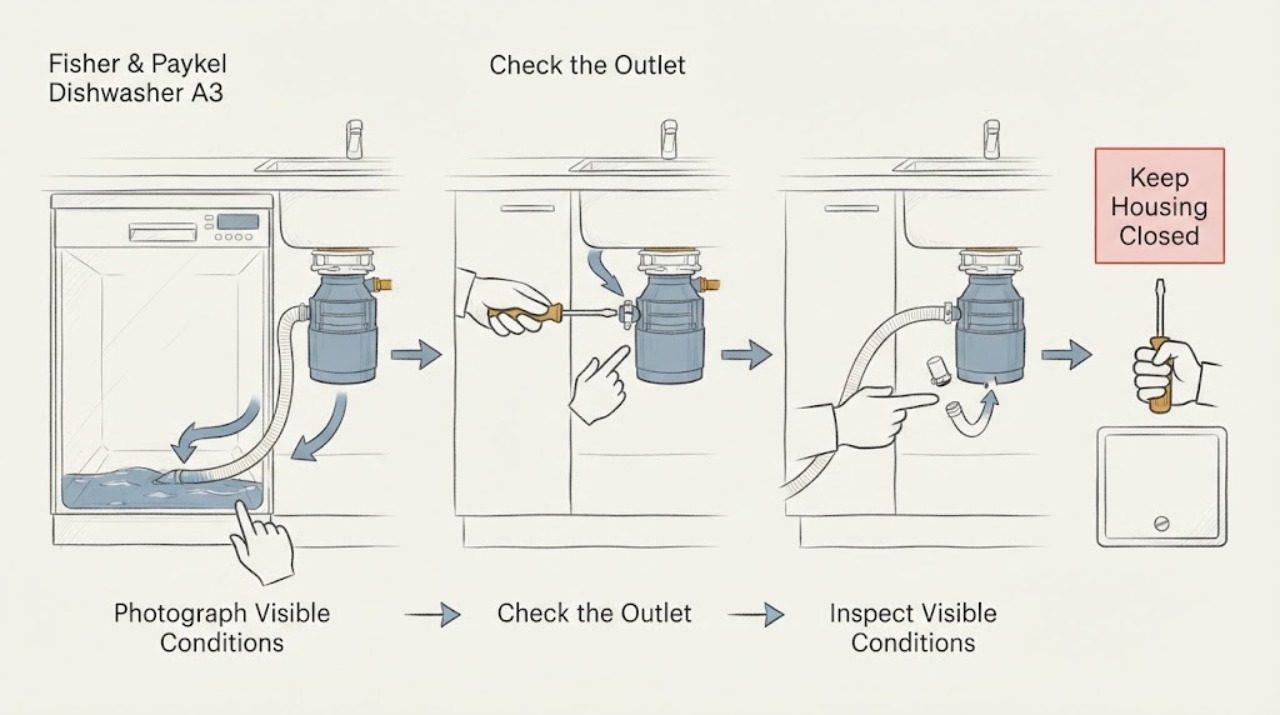
Do not treat A3 as a universal Fisher & Paykel code. The opened Fisher & Paykel guides show that A3 is used on particular DishDrawer platforms for a drain condition, but the exact model, drawer or door platform, display pattern, and market must be matched before any code instruction is used. With the dishwasher stopped, keep people away from standing water, stop the cycle, and close the water supply if it is safe. Do not disconnect public plumbing, remove a garbage-disposal connection, enter diagnostics, or repeatedly clear the code. From a dry ordinary-access position, record whether the sink or disposal backs up by itself, whether the visible connection is wet, and whether the dishwasher leaves water behind. A plumber should handle an independent sink, disposal, trap, air-gap, or household-drain blockage; Fisher & Paykel Customer Care or an authorized appliance technician should assess an unverified A3, persistent no-drain condition, or any water inside or beneath the appliance.
Before you begin
Safety first
- Do not disconnect public plumbing, remove a garbage-disposal fitting or knockout, enter diagnostics, repeatedly clear A3, open the base, remove a pump or drain assembly, pull out an integrated dishwasher, or work on a hard-wired connection. Do not touch wet electrical parts. Stop for flooding, water near electricity, smoke, sparks, a hot or damaged cord, or an unstable appliance.
Work through in order
Diagnostic checks
Use only checks that match the exact appliance or system and its official guide.
-
Check 1
With the dishwasher idle, photograph the complete rating-label model code, serial information if available, the exact A3 display or flashing-light pattern, and the affected drawer or door. Record the market and whether the appliance is a single or double DishDrawer or a conventional drop-door dishwasher. Do not clear the indication yet.
Expected result: The model and platform match a Fisher & Paykel guide that actually lists A3, or the model, platform, display pattern, or market remains unknown.
Next step: If identity is not an exact match, keep the appliance off and send the label and display record to Fisher & Paykel Customer Care. Do not borrow the DD60 A3 instructions merely because the code looks the same.
Stop if: Do not enter diagnostics, repeatedly reset the display, or operate a hard-wired or damaged appliance to obtain a clearer code.
Why this matters
Why: Fisher & Paykel's resource system requires product selection before using a guide, and its opened guides do not establish one A3 meaning for every platform. An unknown match makes any A3-specific button sequence or component conclusion unreliable.
-
Check 2
If the dishwasher is running or has standing water, stop it with the normal control only from a dry safe position and close its water supply if that valve is safely reachable. Look from outside the wet area for flooding, water near an outlet, plug, cord, or wiring, a damaged connection, smoke, sparks, or a hot electrical part. Do not touch wet electrical equipment.
Expected result: The floor and electrical area are dry and stable, or water is near the appliance base or electrical connection.
Next step: Keep the water supply closed and leave the dishwasher off. If the electrical area is wet, do not unplug it or reset a breaker from the wet area; arrange qualified electrical and appliance help from a safe location.
Stop if: Do not run another cycle, force a drain, stand in pooled water, reach under the unit, or restore water to test whether A3 clears.
Why this matters
Why: An A3 display with water near electricity or active flooding is an immediate stop-use condition. A dry exterior does not establish that the internal base or leak-protection area is dry.
-
Check 3
With the dishwasher isolated and the area dry, observe whether the sink or garbage disposal backs up when used independently. From ordinary access, record whether water or wastewater is present at the visible disposal, air-gap, trap, or dishwasher drain connection and whether the connection is wet. Do not disconnect the hose, remove a disposal fitting, or reach into the dishwasher base.
Expected result: The sink or disposal backs up by itself, the visible connection is wet, only the dishwasher retains water, or no external water source is visible.
Next step: Keep the dishwasher off. Arrange a plumber for independent sink, disposal, trap, air-gap, or household-drain symptoms, and report the A3 event separately to Fisher & Paykel service. If the source cannot be seen without moving the appliance, do not move it.
Stop if: Do not pour drain chemicals into the sink or dishwasher, plunge against a connected appliance as a test, disconnect a wet connection, or pull out an integrated unit.
Why this matters
Why: Independent sink backup supports a household plumbing or disposal branch; visible water at a connection supports an installation or plumbing check. Neither finding proves that A3 has no internal appliance cause.
-
Check 4
Use the installation record or a dry, visible cabinet opening to note whether the drain route appears to follow the exact model's required high-loop or air-gap arrangement and whether it enters a disposal connection or sink-trap connection. Note any recent disposal replacement or plumbing work. Do not reroute or detach the drain hose yourself.
Expected result: The drain route is unknown, lacks the installation feature shown in the matching guide, the disposal connection was recently changed, or the visible route appears intact.
Next step: Have the plumber or installer verify the disposal port, any knockout or drilled waste connection, hose routing, and local plumbing compliance. Keep the dishwasher isolated until appliance service assesses any persistent A3 or retained water.
Stop if: Do not remove a disposal knockout, loosen clamps, open the appliance base, access a pump, or restore water as an installation test.
Why this matters
Why: Fisher & Paykel's opened installation material links poor flow or plumbing blockage, backflow prevention, high-loop or air-gap routing, and a blocked or incorrectly drilled waste connection to drain performance. A plausible route still does not validate A3 across models.
-
Check 5
Prepare the full model code and serial information, exact A3 indicators, platform and affected drawer or door, amount and location of retained water, sink-backup timing, disposal or plumbing history, and the result of the safe external observations for Fisher & Paykel Customer Care or an authorized service partner.
Expected result: The code remains unverified, the appliance will not drain, water returns, a second fault appears, or the suspected cause requires moving, opening, or disconnecting the appliance.
Next step: Leave the dishwasher off and keep the water supply closed while appliance service assesses the code and appliance drain path. Coordinate plumber service for any independent sink or disposal blockage.
Stop if: Do not approve a replacement part based only on A3, repeatedly clear the indication, run an empty cycle, or work on a hard-wired connection.
Why this matters
Why: The opened guides route persistent or unresolved faults to Customer Care or a service technician. A3 and a disposal connection are not enough to name a pump, hose, valve, sensor, or control part.
Use your observations
Decision map
Find the observation that best matches what you see, then follow the next safe action.
-
PATH 01Next step
What you see
The complete model and platform are unknown, or the display is not an exact A3 pattern listed in that model's guide.
Do this next
Keep the dishwasher off, record the label and display, and contact Fisher & Paykel Customer Care. Do not enter diagnostics or apply another platform's reset or drain procedure.
Why this path and its safety boundary
Why it matters: There is no reliable model-matched A3 interpretation; Fisher & Paykel code tables cannot be safely generalized across DishDrawer and drop-door products.
-
PATH 02Next step
What you see
A sink or garbage disposal backs up independently, while the dishwasher is isolated and the electrical area is dry.
Do this next
Use a plumber for the sink-side blockage and have the plumber or installer verify the model-required drain routing and disposal connection. Keep the A3 appliance event open with Fisher & Paykel service.
Why this path and its safety boundary
Why it matters: A household drain, disposal, trap, air-gap, or drain-connection restriction is plausible. The external backup does not rule out water in the dishwasher or an internal appliance fault.
-
PATH 03Next step
What you see
Only the dishwasher retains water, the sink is clear, the visible route appears normal, or A3 returns after any exact-model user check.
Do this next
Leave the water supply closed and arrange Fisher & Paykel or qualified appliance service. Do not remove the pump, open the base, clear the code repeatedly, or run another cycle.
Why this path and its safety boundary
Why it matters: The disposal or household drain observation did not explain the no-drain condition. An internal drain, sensing, or water-protection issue remains possible, but the visible code does not identify a part.
-
PATH 04Next step
What you see
There is flooding, water near electricity, a damaged cord or connection, smoke, sparks, a hot electrical part, or an unstable appliance.
Do this next
Keep people away, close the water supply only if safely reachable, and arrange qualified appliance and electrical help. Do not touch wet electrical equipment or move an integrated unit.
Why this path and its safety boundary
Why it matters: The immediate water or electrical hazard overrides A3 interpretation and ordinary drain checks.
Helpful context
Understand the symptom
Why the model comes before the A3 explanation
A3 is not safe to decode from the brand name alone. Fisher & Paykel sells DishDrawer and drop-door platforms with different controls and guides. One opened DD60 guide uses A3 for a drawer that cannot drain, but that is evidence about that guide's platform—not permission to apply its code table to an unidentified unit. Capture the complete model code and the exact indicators before clearing anything.
A garbage-disposal connection creates a separate plumbing decision
A sink that backs up can point to a household drain or disposal restriction, and a drain hose that is routed without the model-required high loop or air gap can permit poor-flow or backflow conditions. Those observations do not prove that the dishwasher's pump, flood protection, or internal drain is healthy. Keep the plumbing and appliance service paths separate.
When checks do not resolve it
Need a professional?
Contact Fisher & Paykel Customer Care or an authorized appliance technician when the exact model cannot be matched to an A3 guide, A3 persists or returns, water remains in the appliance, the source is internal or inaccessible, or the dishwasher will not drain. Contact a plumber for an independent sink, disposal, air-gap, trap, or household-drain backup, and involve an electrician for a wet or damaged electrical connection.
Safety scope: Do not disconnect public plumbing, remove a garbage-disposal fitting or knockout, enter diagnostics, repeatedly clear A3, open the base, remove a pump or drain assembly, pull out an integrated dishwasher, or work on a hard-wired connection. Do not touch wet electrical parts. Stop for flooding, water near electricity, smoke, sparks, a hot or damaged cord, or an unstable appliance.
Have this ready
- Provide the complete model code, serial information, market, exact A3 display or indicator pattern, platform and affected drawer or door, retained-water location, sink and disposal behavior, visible connection condition, drain-routing details, recent disposal or plumbing work, and safe dry-position photographs.
Common questions
FAQ
What does A3 mean on a Fisher & Paykel dishwasher?
It cannot be answered reliably without the complete model and platform. One opened DD60 DishDrawer guide uses A3 for a drawer that cannot drain, but that mapping must not be applied to an unidentified Fisher & Paykel unit.
Can I clear A3 after unclogging the garbage disposal?
Do not clear or resume the dishwasher until the exact model guide is confirmed and the water-safety situation is clear. A disposal blockage may be external, but it does not prove that the dishwasher base or drain path is safe.
Should a plumber or Fisher & Paykel service handle this?
Use a plumber for a sink, disposal, trap, air-gap, or household-drain backup. Use Fisher & Paykel Customer Care or an authorized appliance technician for an unverified or persistent A3, retained water inside the appliance, or any inaccessible appliance-side cause.
Read the exact guide
Official sources
- FP Install Guide DD24DAX9 N Double DishDrawer CA-USFisher & Paykel Appliances · Specific DD24 installation guide used only for conditional drain-routing evidence; exact model must be matched before applying its dimensions or connection details.
- Resources | Fisher & Paykel USAFisher & Paykel Appliances · Official resource page requiring product/model selection before using user and installation guides.
- Help & Support | Fisher & Paykel EuropeFisher & Paykel Appliances · Official Fisher & Paykel support page directing owners to product help and technician or authorized service partner assistance; regional contact path varies.
- DishDrawer Dishwasher User Guide DD60Fisher & Paykel Appliances · Specific DD60 DishDrawer guide only; its A3 table is not a universal Fisher & Paykel code mapping.
Community feedback
Share a repair observation
Share a plain-text repair observation. Accepted observations are published automatically; this page may take a moment to update.