
On this page
Start here
Quick answer
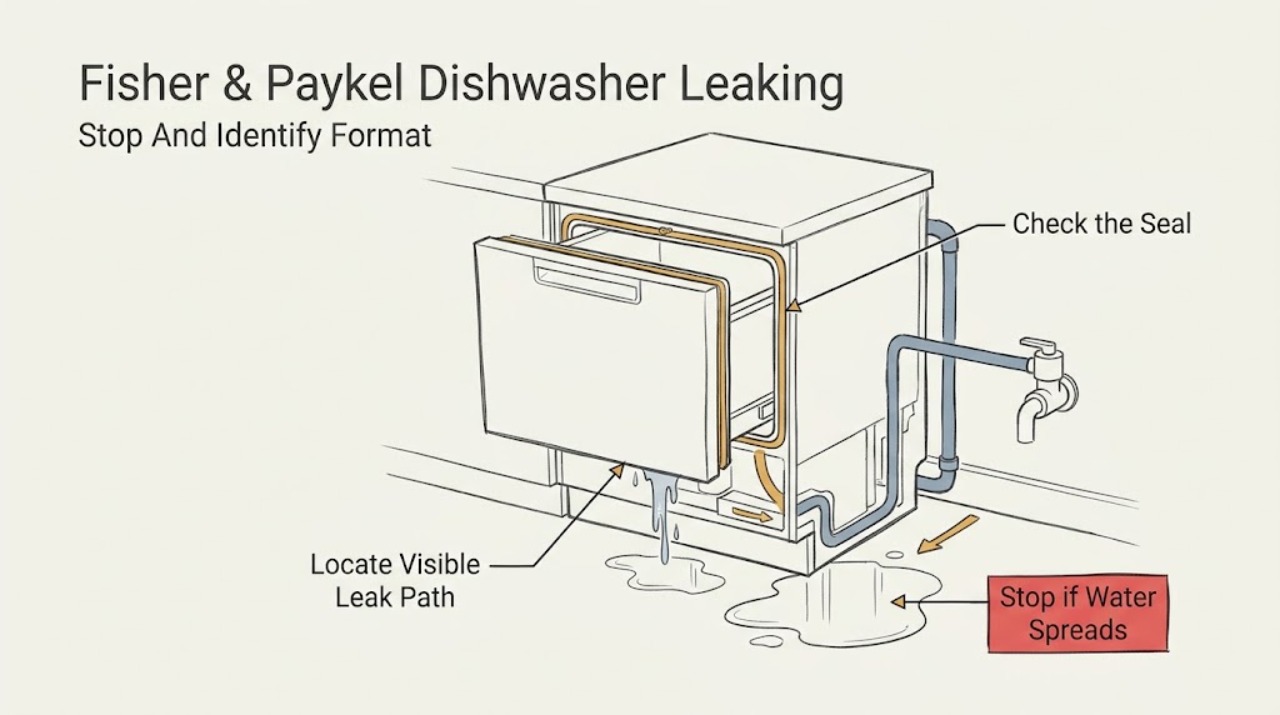
For a leaking Fisher & Paykel dishwasher, first identify whether it is a DishDrawer with one or two sliding drawers or a conventional drop-door dishwasher, and note whether water is leaking from the inlet, drain, drawer or door perimeter, or from underneath. Stop the cycle, keep hands out of hot water, wipe up accessible water, and turn off the water and power if the leak is active, heavy, near electrical parts, or accompanied by a flood indication. Fisher & Paykel DishDrawer guides list a disconnected drain hose, an incorrectly connected inlet hose, and other leaks as separate paths; for other leaks they direct the owner to turn water and power off and call service. A DishDrawer F1 flood code is model-specific, while an official DW60U2I1 drop-door guide uses F30 for a flood switch; do not apply either code to another model. A small visible hose or connection issue can be checked only where the manual permits, but drawer-lid seals, flood switches, pumps, valves, wiring, and leaks inside the base are service work. Do not run another cycle to reproduce a leak, tilt or pull out an integrated unit, bypass flood protection, or disconnect a pressurized hose.
Before you begin
Safety first
- The user may identify the architecture and code, close the water supply, isolate power safely, inspect visible hose connections, correct an obvious loading or rinse-aid-plug issue, and follow an exact manual's accessible guidance. Drawer lids, seals, pumps, valves, flood switches, wiring, base access, integrated-unit removal, and energized testing belong to trained service.
Work through in order
Diagnostic checks
Use only checks that match the exact appliance or system and its official guide.
-
Check 1
Stop the wash programme without opening into hot spray or steam. From a dry position, identify DishDrawer versus drop-door construction, note whether one drawer or the whole machine is affected, photograph any displayed code, and locate the water supply shutoff if water is active. Turn water and power off when the leak is heavy, persistent, near electrical parts, or associated with a flood code; disconnect power only from a safe, dry location.
Expected result: The appliance is a DishDrawer or drop-door model; one drawer or tub leaks; water is still flowing; a flood code or continuous drain response is present; or a hazard is visible.
Next step: Keep the water supply closed and the appliance out of use for an active leak, flood code, or hazard. For a small stopped leak with no hazard, continue only with the visible checks that match the exact manual.
Stop if: Do not open a hot drawer or door, reach under a wet appliance, tilt an integrated unit, or run another cycle to reproduce the leak.
Why this matters
Why: Architecture and code scope determine the correct manual. Active water entry or a flood response takes priority over finding the exact internal source.
-
Check 2
With water and power safely isolated where required, inspect only visible, accessible areas: the inlet hose connection, drain hose at the waste pipe, drawer or door perimeter, rinse-aid-plug area, and the floor immediately around the appliance. Do not remove a toe kick, base panel, lid, pump cover, or permanently installed unit.
Expected result: Water appears at the inlet connection, drain connection, drawer or door edge, inside the tub after foaming, or beneath the base with no visible external source.
Next step: For a visible loose connection, follow the exact manual's connection check without disconnecting a pressurized line. For water beneath the base or an unexplained edge leak, leave water and power off and arrange service.
Stop if: Do not pull on hoses, tighten hidden fittings, remove panels, or wipe inside an energized base.
Why this matters
Why: The location makes a hose/connection, seal/loading/foam, or internal/flood-protection path more likely, but it does not prove a part failure.
-
Check 3
For a DishDrawer only, with the drawer safely open and not in operation, check that dishes do not project above the drawer, the internal lid can close, the spray arm and filter are in their documented positions, the rinse-aid plug is fully closed, and only the specified detergent was used. Do not force the lid or drawer.
Expected result: A dish obstructs the lid, the lid or drawer seal is visibly damaged or displaced, the rinse-aid plug is not closed, excess foam is present, or loading and consumables appear normal.
Next step: Remove only the visible loading obstruction and correct the documented rinse-aid closure or detergent use. Clean accessible foam only as the manual permits; if leakage returns or the seal is damaged, keep the drawer unused and call service.
Stop if: Do not remove the lid, motor assembly, filter plate, flood switch, or drawer seal, and do not use non-dishwasher detergent or chemical defoamer.
Why this matters
Why: Dishware or a plug/seal condition can allow water or foam to escape from a DishDrawer. A normal visible seal and loading pattern makes a hose, flood-switch, pump, valve, or internal leak more likely.
-
Check 4
Compare the visible inlet and drain hose routing with the exact installation guide. Check for an obvious disconnected drain hose at the waste pipe, a visible kink, or a visibly loose inlet connection without loosening the fitting. For an integrated unit, observe from the cabinet opening only; do not remove the dishwasher to reach the rear.
Expected result: The drain hose is disconnected, an inlet hose is visibly not seated, a hose is kinked or damaged, or the visible connections are dry and correctly routed.
Next step: Reconnect only a hose that the exact manual identifies as user-accessible and safe to reseat, then check for leakage with water handled cautiously. Replace or service a damaged hose, inaccessible connection, or recurring leak; do not restore power until water is controlled.
Stop if: Do not disconnect a pressurized inlet, pull out an integrated unit, use a damaged hose, or run a cycle while watching a leak from a wet cabinet.
Why this matters
Why: Fisher & Paykel identifies disconnected drain hoses and incorrectly connected inlet hoses as specific DishDrawer leak causes. A dry external path makes an internal leak or flood-protection condition more likely.
-
Check 5
Match the complete code and indicator pattern to the exact Fisher & Paykel model guide. Treat F1 as a DishDrawer code only where the exact guide lists it, and treat F30 as the DW60U2I1 conventional-dishwasher code only where that guide lists it. Record whether the code clears after the single documented action and whether water remains or the pump continues.
Expected result: A model-specific flood code persists, a different code appears, water remains under the base, the pump continues as a protective response, or no code appears but the leak returns.
Next step: Turn the water supply and power off, do not use the dishwasher, and arrange an authorized Fisher & Paykel service visit for a persistent flood indication, unexplained base leak, or recurring leak. Provide the model, drawer/tub, code, and leak location.
Stop if: Do not repeatedly reset the appliance, bypass a flood switch, open the base, test a pump or valve live, or leave the water supply on unattended.
Why this matters
Why: A persistent flood response indicates water detection or an unresolved leak, but the code does not identify a universally compatible pump, valve, sensor, or seal. A different code must be interpreted only from its own manual.
Use your observations
Decision map
Find the observation that best matches what you see, then follow the next safe action.
-
PATH 01Safety boundary
What you see
The appliance is a DishDrawer and water is visibly coming from a disconnected drain hose or incorrectly seated inlet hose, with no flood code and no water beneath the base.
Do this next
Follow the exact model's installation guidance to safely reseat an accessible hose, then keep water off until the connection is dry and secure. Arrange service for damage, inaccessible fittings, or any recurrence.
Why this path and its safety boundary
Why it matters: An external hose or connection issue is more likely than a drawer-lid or internal component leak.
Safety stop: Do not disconnect a pressurized line, pull out an integrated DishDrawer, or run a cycle to prove the repair.
-
PATH 02Safety boundary
What you see
A DishDrawer leaks at the drawer edge or lid area and visible loading, rinse-aid closure, or excess foam is present, without water continuing while OFF.
Do this next
Correct only the visible loading or consumable issue specified by the manual, clean and dry accessible surfaces, and keep the drawer unused if the seal is damaged or the leak returns.
Why this path and its safety boundary
Why it matters: A lid-sealing, loading, rinse-aid-plug, detergent, or foaming condition is more likely than a base flood fault.
Safety stop: Do not remove the lid or seal, force the drawer closed, add chemicals to suppress foam, or run repeated cycles.
-
PATH 03Safety boundary
What you see
A DS605/DD605 DishDrawer displays F1, or the DW60U2I1 drop-door guide's model displays F30, especially with water beneath the appliance or a continuous protective drain response.
Do this next
Turn the water and power supplies off, do not use the dishwasher, and call an authorized service center with the exact model and code. Do not attempt to dry or reset the base as a repair.
Why this path and its safety boundary
Why it matters: The model's flood switch has detected water or a flooding condition; the code is not a universal Fisher & Paykel error meaning.
Safety stop: Do not apply F1 instructions to a different model, apply F30 to a different drop-door model, bypass the switch, or open the base.
-
PATH 04Safety boundary
What you see
A conventional drop-door dishwasher leaks at a visible inlet or drain connection, while its exact guide does not show a flood code and the tub/door is not visibly overflowing.
Do this next
Close the water supply, follow the exact installation guide for a safe visible connection check, and arrange service for a damaged hose, hidden connection, or recurring leak.
Why this path and its safety boundary
Why it matters: An installation or external hose problem is more likely than a failed flood-protection component, but the connection remains a water hazard.
Safety stop: Do not pull out a built-in unit, loosen the inlet fitting under pressure, or restore power with a wet base.
-
PATH 05Safety boundary
What you see
The leak returns after visible loading, consumable, and external hose checks, appears under the base, or occurs with an unknown or persistent code.
Do this next
Leave water and power off, keep the dishwasher out of service, and arrange authorized Fisher & Paykel diagnosis with the model, drawer/tub, code, leak location, and timing.
Why this path and its safety boundary
Why it matters: An internal seal, lid/door, pump, valve, flood switch, wiring, tub, or installation fault is more likely; no single part is established by the symptom.
Safety stop: Do not dismantle, tilt, probe, dry with energized equipment, bypass flood protection, or repeatedly run the dishwasher.
Helpful context
Understand the symptom
Identify the dishwasher architecture first
A DishDrawer has a sliding drawer, a moving lid or seal, and often separate upper and lower tubs. A drop-door dishwasher has one hinged front door and a single tub. Their fault-code tables and safe access points differ. Do not use the DishDrawer F1 meaning on a drop-door unit, or the DW60U2I1 F30 meaning on a different model. Photograph the display and rating label before changing anything.
A leak location narrows the safe next step
Water at the rear connection can indicate an inlet or drain hose issue; water at a drawer or door edge can involve loading, lid or door sealing, rinse-aid-plug closure, or foam; water under the base can activate flood protection or reflect an internal leak. Fisher & Paykel's DishDrawer guides provide a user-level check for correctly connected hoses but direct other leaks to service. Never reach underneath a powered appliance to find the source.
Treat a flood indication as a stop condition
A DishDrawer F1 and the F30 code in one conventional DW60U2I1 guide both refer to flood protection, but their model scopes are different. If the code persists, the water supply should be closed and power disconnected from a safe, dry location. A pump may continue running as a protective response; do not silence it by opening the base, removing the flood switch, or repeatedly resetting the machine.
Foam and loading can look like a component leak
Fisher & Paykel DishDrawer guides list incorrect detergent, excessive detergent, high rinse aid, and a rinse-aid plug that is not closed as foaming or leak-related conditions. Use only the model's detergent and rinse-aid instructions and check that dishes do not protrude above the drawer or prevent the lid from sealing. A recurring leak after those visible corrections needs qualified diagnosis.
Safety boundary
Stop conditions
- Turn the water supply and power off for an active, heavy, recurring, or unexplained leak, a persistent flood code, or water beneath the base; isolate power only from a safe, dry location.
- Do not open a drawer or door into hot water or steam, reach beneath a wet appliance, tilt or pull out an integrated unit, or run another cycle to reproduce the leak.
- Do not disconnect pressurized hoses, remove the base, lid, pump, valve, flood switch, or wiring, or perform live electrical tests.
- Do not bypass or jumper flood protection, apply F1 or F30 meanings to another model, or repeatedly reset a flood response.
- Stop for smoke, burning odor, sparks, a hot plug, damaged cord, water near electrical parts, or repeated breaker operation and arrange urgent qualified service.
Only after diagnosis
Potential parts
- inlet or drain hose
Consider only when the exact model and installation guide identify the hose and inspection confirms a damaged, disconnected, or leaking hose after the water supply is safely closed.
Hoses differ between DishDrawer drawers and drop-door models; verify the full model and installation documentation before replacement. - DishDrawer lid or drawer seal
Consider only when qualified diagnosis confirms a damaged or displaced DishDrawer seal after loading, rinse-aid, detergent, and hose checks are normal.
DishDrawer lid and seal parts vary by drawer generation and model; seal removal and calibration belong to trained service. - flood switch or water-level sensing component
Consider only when the exact model's F1/F30 or other documented flood response persists and qualified diagnosis confirms a sensing component fault rather than active water leakage.
Flood-protection components are model-specific safety parts; never bypass, jumper, or replace them by code alone. - drain pump or inlet valve
Consider only after qualified diagnosis confirms a pump or valve fault following safe checks of loading, hoses, and flood conditions.
Pump and valve fitment differs across DishDrawer and drop-door architectures; internal water and electrical work requires trained service.
When checks do not resolve it
Need a professional?
Arrange authorized Fisher & Paykel service when the leak is from under the base, the source is not visible, a DishDrawer lid or door seal is damaged, a hose or connection is inaccessible or damaged, a flood code persists, the leak returns after one safe visible correction, or the machine leaks while OFF. Turn the water and power supplies off for active or heavy leakage, water near electrical parts, smoke, burning odor, damaged cord, or repeated breaker operation.
Safety scope: The user may identify the architecture and code, close the water supply, isolate power safely, inspect visible hose connections, correct an obvious loading or rinse-aid-plug issue, and follow an exact manual's accessible guidance. Drawer lids, seals, pumps, valves, flood switches, wiring, base access, integrated-unit removal, and energized testing belong to trained service.
Common questions
FAQ
What should I do first if my Fisher & Paykel DishDrawer is leaking?
Stop the drawer, keep clear of hot water or steam, and turn the water and power supplies off for an active leak or water beneath the unit. Identify whether water is at the drain hose, inlet hose, drawer edge, or base. DishDrawer guides specifically separate hose causes from other leaks; unexplained or recurring leaks need service.
Does Fisher & Paykel F1 always mean a dishwasher flood?
No universal code table should be assumed. The DS605/DD605 DishDrawer guide lists F1 as an activated flood switch, but another model may use a different code or indicator. Match the complete code to the exact model guide and turn water and power off for a persistent flood response.
Is F30 the Fisher & Paykel dishwasher flood code?
F30 is listed as Flooding for the specific DW60U2I1 conventional dishwasher guide opened here. It is not evidence for every Fisher & Paykel drop-door or DishDrawer model. Use the exact manual; if the code persists, turn water and power off and arrange service.
Can detergent or loading cause a Fisher & Paykel dishwasher to leak?
For DishDrawer models, incorrect detergent, excess foam, a rinse-aid plug that is not closed, or dishes that prevent the lid from sealing can allow water or foam to escape. Correct only the visible issue described by the manual and call service if the leak returns or the seal is damaged.
When should I stop troubleshooting a leaking Fisher & Paykel dishwasher?
Stop for water under the base, a persistent flood code, an inaccessible or damaged hose, a leak while the dishwasher is off, water near electrical parts, smoke, burning odor, sparks, or repeated breaker operation. Keep water and power off and use authorized service.
Read the exact guide
Official sources
- DW60U2I1 dishwasher user guide and fault codesFisher & Paykel · Supports F30 flooding/flood-switch behavior for DW60U2I1 only; it must not be used as a universal Fisher & Paykel code table.
- Drop Door DishwashersFisher & Paykel · Supports the distinction that drop-door products have built-in flood protection that detects leaks and stops the cycle; it does not provide model-specific repair steps.
- Integrated DishDrawer dishwasher user guide DD60DHI9/DD60SHTI9Fisher & Paykel · Supports loading, lid sealing, rinse-aid plug, visible hose leak causes, and service boundaries for the listed integrated DishDrawer architecture.
- DishDrawer DS605/DD605 user guideFisher & Paykel · Supports the F1 flood-switch meaning and shutoff/service instruction only for the listed DS605/DD605 family.
- DishDrawer dishwasher user guide DD60 and DD24Fisher & Paykel · Supports DishDrawer leak causes and safe escalation for the identified guide; not a universal guide for every DishDrawer generation.
- Help & Support | Book A Service | Repair | TechnicianFisher & Paykel · Supports using Product Help and exact manuals and escalating unresolved appliance problems to authorized service; it is not a leak diagnosis by itself.
Community feedback
Share a repair observation
Share a plain-text repair observation. Accepted observations are published automatically; this page may take a moment to update.