
On this page
Start here
Quick answer
First identify whether your Fisher & Paykel dishwasher is a single or double DishDrawer, an integrated or built-under installation, and when the sound occurs. A fan running after a wash, a quiet phase during a program, a pulsing sound while rinse aid dispenses, and some water-softener or drain sounds can be normal on the DishDrawer models covered by Fisher & Paykel guides. A new grinding, scraping, rattling, repeated knocking, or loud motor sound is different: stop or pause the cycle using the model's documented control, note whether the sound follows filling, washing, draining, or drying, and inspect only safe, accessible items after the drawer is safe to open. Check for a loose spray arm, blocked filter, protruding dishware, bent drain hose, or a foreign object without reaching into moving parts. If the sound persists, is accompanied by a fault code, poor draining, leaking, smoke, burning odor, or electrical damage, turn off water and power as appropriate and arrange Fisher & Paykel service. Do not dismantle the motor, pump, fan, wiring, or secured installation.
Before you begin
Safety first
- The user may listen from outside, use documented pause or stop controls, and after the appliance is safely stopped inspect only model-permitted loading, filter, spray-arm, and visible hose conditions. Installation, pump, motor, fan, wiring, controls, secured panels, water connections under the appliance, and energized testing are for a Fisher & Paykel trained and supported technician.
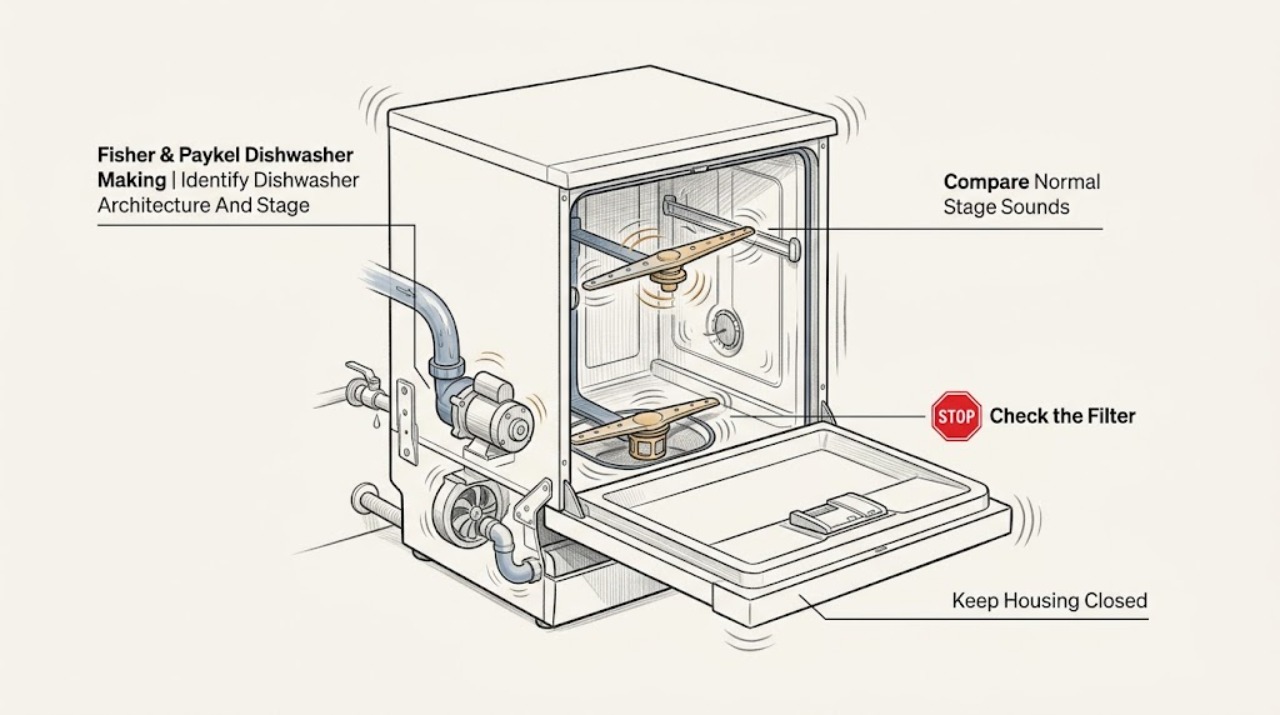
Work through in order
Diagnostic checks
Use only checks that match the exact appliance or system and its official guide.
-
Check 1
Record the exact Fisher & Paykel model and identify whether the dishwasher has one or two DishDrawer drawers and whether it is integrated or another installation. Note whether the noise starts at closing, filling, washing, draining, drying, or after the cycle ends.
Expected result: The sound occurs only after a program, during a quiet-to-audible transition, while rinse aid or water is being handled, during the wash motor stage, during draining, or whenever the drawer or cabinet moves.
Next step: Follow the normal-sound branch if the sound matches a documented program stage and stops as described. Follow the abnormal-sound checks if it is new, harsh, metallic, repetitive, or unrelated to a documented stage.
Stop if: Do not open an operating drawer or continue a cycle with smoke, burning odor, a leak, exposed wiring, a damaged cord or plug, or a severe impact or grinding sound.
Why this matters
Why: Stage-linked fan, quiet-phase, or rinse-aid sounds may be normal on applicable DishDrawer models. A noise tied to spray-arm rotation, draining, movement, or every motor run is more likely to need a physical or service check.
-
Check 2
Without interrupting a running cycle, listen from outside and compare the sound with the documented stage: fan after a wash or after closing, a quiet phase that later becomes audible, pulsing during rinse-aid dispensing, or water-softener operation on equipped models.
Expected result: The sound appears only in one documented stage, is steady and non-metallic, and stops or changes when that stage ends; or it is loud, harsh, scraping, knocking, or present throughout the cycle.
Next step: For a documented normal sound, allow the stage to finish and monitor it on one subsequent cycle. For an abnormal sound, pause or stop using the model's documented controls and continue only with the safe inspection after the drawer is no longer operating.
Stop if: Do not put hands or tools inside a running dishwasher or force a drawer open while the appliance is operating.
Why this matters
Why: A predictable stage sound supports normal operation on the applicable DishDrawer guide. A new or escalating sound that does not follow the stage is not explained by the normal fan, quiet-phase, or rinse-aid examples.
-
Check 3
After the cycle is safely paused or complete, open the drawer only as the exact model guide permits. Check that dishes do not protrude into the internal lid or spray-arm path, inspect the filter and spray arm for accessible debris, and confirm the spray arm is seated and can turn freely without forcing it.
Expected result: A dish is contacting the spray arm or lid, the spray arm is loose or obstructed, the filter is blocked or incorrectly seated, or these accessible areas are clear.
Next step: Reposition only the protruding item and clean or refit the user-accessible filter or spray arm exactly as the model guide shows. Run one supervised cycle only if no hazard exists; arrange service if the sound returns.
Stop if: Do not reach through moving parts, use sharp tools to dislodge debris, remove secured assemblies, or operate with the motor assembly, filter plate, filter, wire rack, or spray arm missing where the model requires them.
Why this matters
Why: Contact or a loose, blocked spray arm can create rattling or repeated impact during washing; a blocked filter can contribute to drainage symptoms. A clear and correctly seated wash system with continuing motor noise points further toward an internal pump, motor, or mounting fault.
-
Check 4
If the sound occurs during draining or is an excessive motor noise on first use or after long storage, note the water level and any A3 or other fault indication. Check from outside that the drain hose is not kinked; only if the exact guide for your model gives the long-idle motor-area instruction, follow that instruction rather than improvising.
Expected result: The drawer has excess water, the drain hose is bent or the drain connection is blocked, a fault code is present, or an applicable guide identifies no water in the motor area after first use or long inactivity.
Next step: Straighten an accessible kink only, record the complete code, and follow the exact model guide. If a leak, repeated drain noise, code, or excessive motor noise remains, turn off water and power as directed and call service.
Stop if: Do not disconnect plumbing under a powered or water-connected appliance, remove a pump, pour water into a model not covered by the applicable guide, or continue with a leak or electrical hazard.
Why this matters
Why: A bent or blocked drain path can make the appliance work harder and leave water in the drawer. Fisher & Paykel also documents a model-specific excessive-motor-noise condition after first use or long inactivity; the same remedy cannot be generalized to every dishwasher.
-
Check 5
After the safe external and accessible checks, classify the sound as normal and stage-limited, resolved after repositioning or cleaning, persistent motor or pump noise, or a hazard-associated noise. Record the drawer, cycle, timing, fault indicators, water level, and checks completed.
Expected result: The noise follows a documented stage and stops normally; it disappears after an accessible correction; it persists or worsens; or it accompanies a leak, fault code, burning odor, smoke, or electrical symptom.
Next step: Use the dishwasher only when it runs normally and safely. Otherwise leave it off, turn off water and power when the guide calls for that, and give Fisher & Paykel service the exact model, sound recording or description, cycle stage, and observations.
Stop if: Do not dismantle the motor, pump, fan, wiring, secured installation, or control; do not perform energized testing or keep restarting a machine with a hazard.
Why this matters
Why: A stage-limited sound or resolved dish/filter issue is less suggestive of an internal fault. Persistent or escalating noise, especially with a code, drain problem, or leak, makes an internal pump, motor, fan, bearing, control, mounting, or installation issue more plausible but does not identify a replaceable part.
Use your observations
Decision map
Find the observation that best matches what you see, then follow the next safe action.
-
PATH 01Next step
What you see
The sound is a fan after a wash or after closing the drawer, a quiet phase that later becomes audible, a pulsing sound while rinse aid dispenses, or a documented water-softener sound on an applicable DishDrawer model.
Do this next
No repair is needed for that sound alone. Confirm the exact model guide if the noise changes character, continues indefinitely, or appears with a fault, leak, poor draining, or a burning odor.
Why this path and its safety boundary
Why it matters: Fisher & Paykel identifies these sounds as normal behaviors on the covered DishDrawer guides when they follow the stated program stage and stop as described.
-
PATH 02Next step
What you see
A rattle or repeated contact occurs only during washing and a dish protrudes into the spray-arm or lid path, or the accessible spray arm is loose, blocked, or cannot rotate freely.
Do this next
With the appliance safely stopped, reposition the dish and clean or refit the spray arm according to the exact guide. Run one supervised cycle; call service if the noise returns or the arm is not user-serviceable on your model.
Why this path and its safety boundary
Why it matters: Loading interference or a spray-arm mounting or blockage issue is more likely than a failed motor. The sound should change after the accessible correction if that was the cause.
-
PATH 03Next step
What you see
Noise is strongest during draining, the drawer retains excess water, the drain hose or connection is kinked or blocked, or an applicable guide identifies excessive motor noise after first use or long inactivity.
Do this next
Correct only an accessible hose kink or the exact guide's documented step, record any fault code, and stop for leaks. Turn off water and power and contact Customer Care or an authorised service centre when the condition persists.
Why this path and its safety boundary
Why it matters: A drain-path restriction or the model-specific long-idle motor-area condition is more likely than a normal fan or quiet-phase sound. A persistent noise after the documented, model-matched check needs service.
-
PATH 04Safety boundary
What you see
The noise is grinding, scraping, repeated knocking, or loud motor noise after the accessible checks, or it occurs with a fault code, leak, smoke, burning odor, damaged cord, or repeated electrical trip.
Do this next
Stop the cycle, keep the dishwasher off, turn off water and power where the model guide directs, and arrange Fisher & Paykel service. Provide the exact model, drawer, cycle stage, sound pattern, fault code, water level, and safe checks completed.
Why this path and its safety boundary
Why it matters: An internal pump, motor, fan, bearing, control, mounting, or installation fault is possible, but sound alone cannot select a part. Hazard symptoms take priority over diagnosis.
Safety stop: Do not operate a damaged or partially disassembled dishwasher, open secured panels, dismantle the pump or motor, bypass a safety device, or perform live electrical testing.
Helpful context
Understand the symptom
The timing of the sound matters more than volume alone
Write down whether the sound begins when a drawer closes, during filling, while the spray system is washing, during draining, or after the program ends. A DishDrawer can have a quiet phase and can run a fan after a wash to assist drying. A sound that is repeatable only during one stage points to a different subsystem than a noise present whenever the drawer or cabinet moves. If your Fisher & Paykel appliance is not a DishDrawer, use its exact model guide rather than assuming the drawer guidance applies.
Sounds that can be normal on applicable DishDrawer models
Fisher & Paykel guides describe a fan continuing after a wash, or starting when a closed drawer is left after a program, as normal drying behavior. They also describe a quiet wash phase that later becomes more audible and a pulsing sound while rinse aid dispenses. Water-softener sounds may also occur on models equipped with that system. These sounds should taper or follow the program stage; a new harsh, metallic, scraping, or repeated impact sound should be treated as a separate symptom.
Separate loading and accessible wash-system causes from internal faults
After pausing or ending the program through the model's documented control and waiting until it is safe to open, check that dishes are not protruding into the spray arm or internal lid area. Look at the filter and spray arm for an obvious blockage or loose mounting, and inspect the drawer for a small object that can rattle. Do not reach into a running dishwasher. A clear, firmly seated spray arm and filter with a continuing grinding or motor-like noise makes a pump, motor, bearing, mounting, or control issue more plausible and is not a reason to remove the motor assembly yourself.
Excessive motor noise and long-idle models need model-specific handling
One Fisher & Paykel DishDrawer guide identifies excessive motor noise with no water in the motor area, especially on first use or after a long period unused, and gives a model-specific instruction to add three cups of water before a wash. Do not apply that instruction to a different model unless its own guide says so. If the sound is loud on every cycle, returns after the documented step, or is accompanied by poor washing, poor draining, a code, or a leak, stop and contact Customer Care or an authorised service centre.
Stop immediately for leaks, electrical damage, or a burning smell
For a leak or water near electrical equipment, turn off the water and power supplies as the Fisher & Paykel guide directs and arrange service. Do not operate a dishwasher that is damaged, malfunctioning, partially disassembled, or has a damaged power cord or plug. Smoke, a burning smell, exposed wiring, repeated tripping, or a grinding sound that worsens is a stop condition; keep the appliance off and do not remove secured panels or test energized components.
Only after diagnosis
Potential parts
- spray arm or filter assembly
Consider this only if the exact model guide identifies the item as user-replaceable or qualified diagnosis confirms damage after a loose, blocked, or contacting spray system is found.
Confirm the complete Fisher & Paykel model and the manufacturer's fit information; DishDrawer generations and drawer positions are not interchangeable by appearance. - drain hose or pump assembly
Consider this only after the drain path is clear and qualified service confirms a failed hose, pump, or motor rather than a normal stage sound or a filter issue.
Verify the exact model, drawer configuration, and authorized fit information. Pump and hose work may require trained service and water or electrical isolation.
When checks do not resolve it
Need a professional?
Arrange Fisher & Paykel service when a new grinding, scraping, knocking, or loud motor sound persists after the exact model's safe loading, spray-arm, filter, and drain checks, or when a fault code, poor draining, repeated beeping, or a leak is present. Turn off water and power as the model guide directs for leaks or unsafe conditions. Stop immediately for smoke, burning odor, a damaged cord or plug, repeated electrical trips, or a damaged or partially disassembled dishwasher. Do not open secured panels, dismantle the pump or motor, bypass protection, or perform live electrical testing.
Safety scope: The user may listen from outside, use documented pause or stop controls, and after the appliance is safely stopped inspect only model-permitted loading, filter, spray-arm, and visible hose conditions. Installation, pump, motor, fan, wiring, controls, secured panels, water connections under the appliance, and energized testing are for a Fisher & Paykel trained and supported technician.
Common questions
FAQ
Is fan noise after a Fisher & Paykel DishDrawer wash normal?
On the DishDrawer models covered by Fisher & Paykel guides, a fan may continue after a wash to assist drying, and may start when a closed drawer is left after a program. It should stop after the model's set period or when the drawer is opened. A new grinding or scraping sound is not explained by this normal fan behavior.
Why does my Fisher & Paykel dishwasher sound quiet, then become louder?
A DishDrawer program may have a quiet phase needed for performance and then transition to a more audible phase. If the sound is harsh, metallic, repetitive, or unrelated to the program stage, stop the cycle safely and check the exact model's troubleshooting guidance.
What should I check if the noise happens only during washing?
After the dishwasher is safely stopped, check that dishes are not touching the spray arm or internal lid, and inspect the user-accessible spray arm and filter for an obvious blockage or loose mounting. Refit only what the exact guide identifies as user-serviceable. Persistent motor or grinding noise needs service.
What does excessive motor noise mean on a Fisher & Paykel DishDrawer?
One Fisher & Paykel DishDrawer guide links excessive motor noise to no water in the motor area, especially on first use or after a long period unused, and gives a model-specific instruction to add three cups of water before a wash. Use that instruction only when the exact guide covers your model. If noise persists, or there is poor draining, a fault code, or a leak, contact service.
When should I stop using a noisy Fisher & Paykel dishwasher?
Stop for a leak, smoke, burning odor, a damaged cord or plug, repeated electrical trips, severe grinding or knocking, or a fault code that returns. For a leak, turn off water and power as the exact model guide directs. Do not open secured panels or dismantle the pump, motor, fan, wiring, or controls.
Read the exact guide
Official sources
- DishDrawer™ Dishwasher - Care Guide and TroubleshootingFisher & Paykel · Model-family guidance for the listed DD60 models; the exact model guide controls applicable controls and repair steps.
- DishDrawer™ Dishwasher - User GuideFisher & Paykel · Model-family guidance for listed DD24 integrated, built-under, and double or single DishDrawer variants; other models may have different controls and service procedures.
- Double DishDrawer™ Dishwasher, Tall, SanitizeFisher & Paykel · Specific US DD24DCTB9_N product page used only to establish a current double-drawer architecture and product-family context; noise behavior and controls remain model-specific.
- DishDrawer™ Dishwasher - User GuideFisher & Paykel · Model-family guidance for listed DD60 DishDrawer models; market, drawer, and control variations require the exact local model guide.
Community feedback
Share a repair observation
Share a plain-text repair observation. Accepted observations are published automatically; this page may take a moment to update.