
On this page
Start here
Quick answer
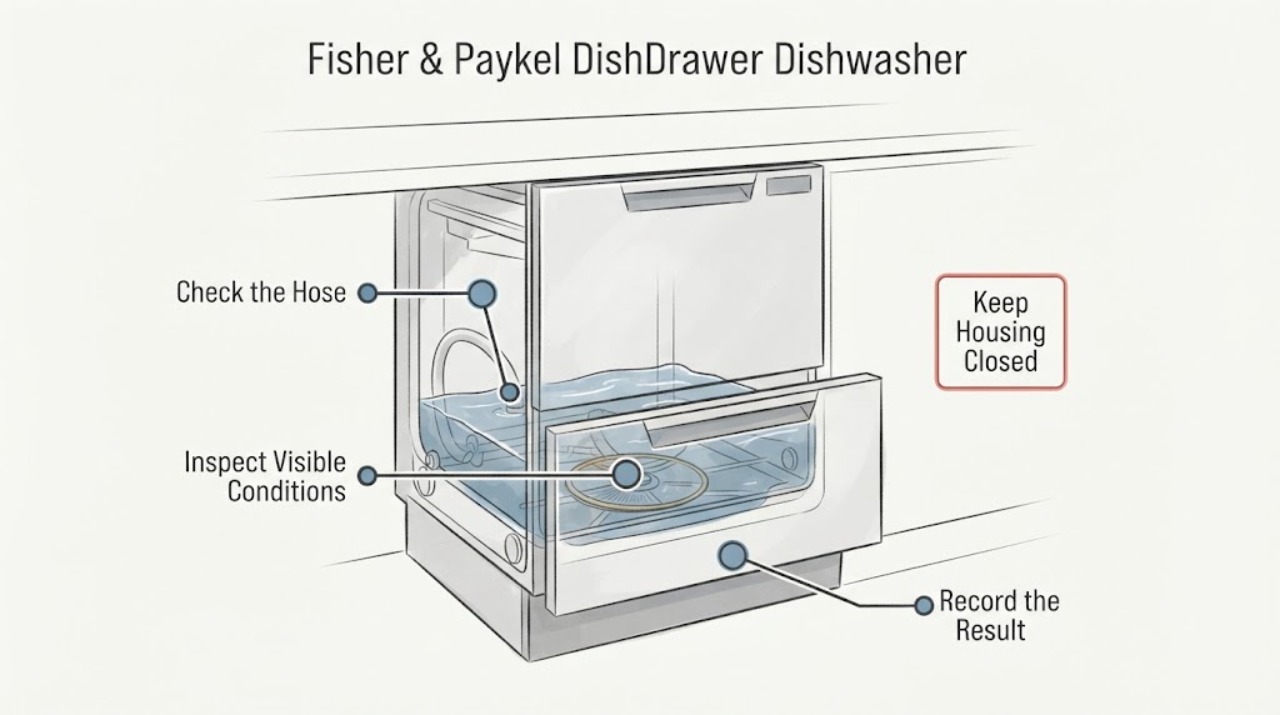
For a Fisher & Paykel DishDrawer dishwasher with a drainage issue, first make the area safe and identify whether water is simply remaining above the filter plate after a rinse, leaking at a visible connection, or refusing to drain. The opened Fisher & Paykel installation guides list a kinked drain hose, blocked waste connection, an incorrectly formed high loop, incorrect hose routing, and connection problems as checks for excess water; they do not support diagnosing a pump or motor from the symptom alone. With the appliance stopped, inspect only the accessible hose route and waste connection, record which drawer is affected, and follow the exact model manual. If there is water near electrical parts, an active leak, or no improvement after the model-matched external checks, stop using the dishwasher and arrange authorised service. Do not pull the drawer apart, open the pump area, or perform live testing.
Before you begin
Safety first
- Do not pull the drawer apart, open the pump area, bypass a protection device, disconnect wet plumbing, perform live electrical tests or repeatedly run the dishwasher with a leak.
Work through in order
Diagnostic checks
Use only checks that match the exact appliance or system and its official guide.
-
Check 1
Stop the dishwasher and keep hands away from wet electrical areas. If there is an active leak, water under the appliance, a damaged hose, burning smell or visible electrical damage, isolate the water supply and power only from a safe, dry position and leave the appliance out of service.
Expected result: The area is wet or leaking, or the appliance and surrounding floor remain dry.
Next step: For a leak or wet electrical area, arrange authorised service and do not restart the dishwasher. If the area is dry, continue with the external drain-path check without opening the appliance.
Why this matters
Why: Water at a connection or near electrical parts is a safety condition; a dry exterior does not prove that the drainage system or internal parts are healthy.
-
Check 2
After a completed rinse or stopped cycle, observe the accessible filter-plate area without reaching into moving or sharp parts. Note whether excess water remains and whether the issue affects one drawer or both.
Expected result: Water remains above the filter plate after rinse, the drawer did not complete draining, or no abnormal water remains.
Next step: If excess water remains, continue to the visible hose and waste-connection checks. If no water remains, do not create a component diagnosis from a single sound or slow cycle; document the conditions for service if the issue recurs.
Why this matters
Why: The Fisher & Paykel guides identify excess water above the filter plate as a prompt to check the drain hose, waste connection, high loop and hose routing; the symptom alone does not identify a failed pump or motor.
-
Check 3
With power off and the drawer closed, inspect the visible drain hose from the cabinet side for a kink, sag, incorrect route, blocked waste connection or missing high loop. Compare it with the exact installation guide; do not disconnect the hose or pull the drawer to reach hidden fittings.
Expected result: A hose is visibly kinked or sagging, the waste connection appears blocked, the high loop is missing/low, or the accessible route looks correct.
Next step: Correct only an accessible routing issue that the exact model guide explicitly covers, then use the guide's documented rinse check. If the waste connection is not safely accessible or the route is correct, stop and arrange service rather than opening the dishwasher.
Why this matters
Why: Fisher & Paykel lists these drain-path and installation conditions as causes to check when water remains above the filter plate. A correct-looking visible route does not rule out a concealed restriction or internal fault.
-
Check 4
Inspect visible water-supply and drain connections for a wet joint, loose-looking hose, damaged hose, displaced rubber washer or missing/loose clamp without placing hands into standing water.
Expected result: Water is present at a connection, or all visible connections remain dry.
Next step: If a connection is wet, stop use, close the water supply if safe and arrange repair. If connections are dry but the drainage issue persists, use the exact model manual and authorised service route.
Why this matters
Why: The installation guides separate connection leakage from an unexplained drainage failure and call out the hose, washer and clamp as visible checks. A dry connection does not prove the internal drain path is clear.
-
Check 5
Record the full model and serial number, affected drawer, amount of water left, cycle stage, visible hose/high-loop findings and any leak location for Fisher & Paykel or authorised service.
Expected result: The external checks resolve the issue, or the dishwasher still leaves water / will not drain.
Next step: If unresolved, keep the dishwasher out of service and arrange authorised service. Do not open the pump area, bypass a protection device, or perform live electrical tests.
Why this matters
Why: A successful documented rinse after a model-approved accessible correction is different from a persistent fault with no visible installation cause. The latter cannot be narrowed to a pump, motor or board without model-specific evidence.
Use your observations
Decision map
Find the observation that best matches what you see, then follow the next safe action.
-
PATH 01Next step
What you see
Excess water remains above the filter plate after a rinse and the visible drain hose is kinked, sagging, incorrectly routed, or lacks the required high loop.
Do this next
Correct only the accessible route required by the exact model guide, then use its documented rinse check; if water remains, stop and arrange authorised service.
Why this path and its safety boundary
Why it matters: This matches the installation-related drainage conditions Fisher & Paykel lists before an internal component diagnosis.
-
PATH 02Next step
What you see
Water is visible around a supply or drain connection, under the appliance, or near an electrical area.
Do this next
Stop use, close the water supply and isolate power only if safe from a dry location; keep the dishwasher out of service until qualified service checks it.
Why this path and its safety boundary
Why it matters: The immediate problem is a leak or water-safety condition, and the visible water does not identify a failed pump or motor.
-
PATH 03Next step
What you see
The visible hose route, waste connection and fittings look correct, but the dishwasher still leaves water or does not complete draining.
Do this next
Use the exact model manual and arrange authorised service; do not open the pump area, choose a generic replacement part or perform live testing.
Why this path and its safety boundary
Why it matters: The available official evidence does not narrow this symptom to a particular internal part, especially without the complete model number.
-
PATH 04Next step
What you see
The rinse completes and no abnormal water remains, but the owner is concerned about a single slow or noisy drain event.
Do this next
Record the cycle, drawer and conditions, then follow the exact model guide if the symptom recurs; stop using the appliance if a leak, burning smell or electrical damage appears.
Why this path and its safety boundary
Why it matters: The observation alone is not enough to prove a drainage component failure or repeatable fault.
Helpful context
Understand the symptom
Start with the water pattern, not a guessed pump fault
Note what the dishwasher actually does after a rinse: is water left above the filter plate, does water appear around a hose connection, or does the drawer stop before draining? The Fisher & Paykel guides treat those observations as different plumbing or service clues. Record whether one drawer or both are affected, but do not turn that observation into a component diagnosis without the exact model manual.
Inspect only the accessible drain path
With the appliance stopped and the area dry, look under the sink or cabinet for a visibly kinked or sagging drain hose, a blocked waste connection, an incorrectly formed high loop, or a hose that is not routed as the model installation guide requires. The guides specify a high loop and warn against allowing the drain hose to sag or carry excess unsupported hose. Do not pull out the drawer, disconnect plumbing under standing water, or open the appliance base to reach a pump.
Treat connection water as a leak first
If water is around the water-supply or drainage connection, stop using the dishwasher and avoid contact with wet electrical areas. Fisher & Paykel lists the connections, existing plumbing, hoses, rubber washer and hose clamp as visible leak checks. A wet joint does not prove that the dishwasher motor failed; it needs safe isolation and a model-appropriate repair decision.
Use the exact model manual when the external checks do not resolve it
The supplied title does not provide a complete model number, and the inaccessible Reddit lead cannot establish the exact drawer configuration or the reported repair outcome. Read the rating label without dismantling the appliance and give the full model and serial details to Fisher & Paykel or authorised service. If the hose route, waste connection and visible fittings are sound but water still remains, stop there rather than selecting a pump, motor or filter from a generic listing.
When checks do not resolve it
Need a professional?
Stop and arrange authorised service for an active leak, water near electrical parts, damaged hose, burning smell, repeated excess water after the model-matched external checks, or any need to open the appliance or diagnose an internal pump or motor.
Safety scope: Do not pull the drawer apart, open the pump area, bypass a protection device, disconnect wet plumbing, perform live electrical tests or repeatedly run the dishwasher with a leak.
Have this ready
- Full model and serial number, affected drawer, cycle and timing, amount/location of remaining water, whether the issue is repeatable, visible hose/high-loop and waste-connection observations, and any leak or damage photographs taken from a safe dry position.
Common questions
FAQ
Does water left above the filter plate prove the drain pump or motor failed?
No. Fisher & Paykel's opened installation guides first list a kinked hose, blocked waste connection, high-loop and hose-routing problems, then direct the owner to service if the checks do not resolve the issue. The symptom alone is not a component diagnosis.
Can I order a generic drain hose, filter or pump for this drainage issue?
Do not guess a part from the title. The complete model number and region determine the applicable manual and parts; the available evidence does not establish compatibility or a failed component.
What should I do if water is leaking at the drain connection?
Stop using the dishwasher, close the water supply if safe, keep away from wet electrical areas and arrange authorised service. Do not keep running cycles to see whether the leak clears.
What if the hose and waste connection look correct but the drawer still will not drain?
Use the exact model manual and arrange authorised service. Do not open the pump area, bypass a protection device or perform live testing; a generic drainage symptom does not identify the internal part.
Read the exact guide
Official sources
- DishDrawer Series 9 Installation Guide — DoubleFisher & Paykel · Official brand-hosted installation guide for the named Series 9 double DishDrawer family. It supports the shared hose, waste-connection, high-loop and visible-leak checks in this article; it does not establish the reader's unprovided model or authorize transfer of a model-specific part or internal repair.
- DishDrawer DD605 Installation GuideFisher & Paykel · Official brand-hosted installation guide for the named DD605 family, used as a second family-specific confirmation of common drainage-installation checks. It does not identify the assigned appliance model or prove compatibility of parts or internal procedures.
Community feedback
Share a repair observation
Share a plain-text repair observation. Accepted observations are published automatically; this page may take a moment to update.