
On this page
Start here
Quick answer
Do not assume every Fisher & Paykel dishwasher uses F1 the same way because the model is not identified. In the Fisher & Paykel DishDrawer care guide opened for this research, F1 is a flood fault and the guide says to drain the dishwasher; the same guide treats excess foam as a separate A7 condition and says to stop, wipe away foam, and run a rinse cycle with the correct detergent. Too much hand dish soap can create foam and may be associated with a flood response, but that is not proof of the cause on an unknown model. Stop the cycle, record the exact model and display, avoid adding more detergent, and follow only the matching guide. Keep water and electricity isolated when safe, and arrange service for a persistent F1, a leak, a locked drawer, or any fault that requires access below or inside the appliance.
Before you begin
Safety first
- Do not open the base, remove drawers, bypass a flood or door interlock, disconnect hard-wired connections, or perform live electrical or water-system tests. Keep water and power isolated from a dry safe location for active leaks, persistent F1, water near electrical parts, smoke, burning odor, sparking, or damaged cords.
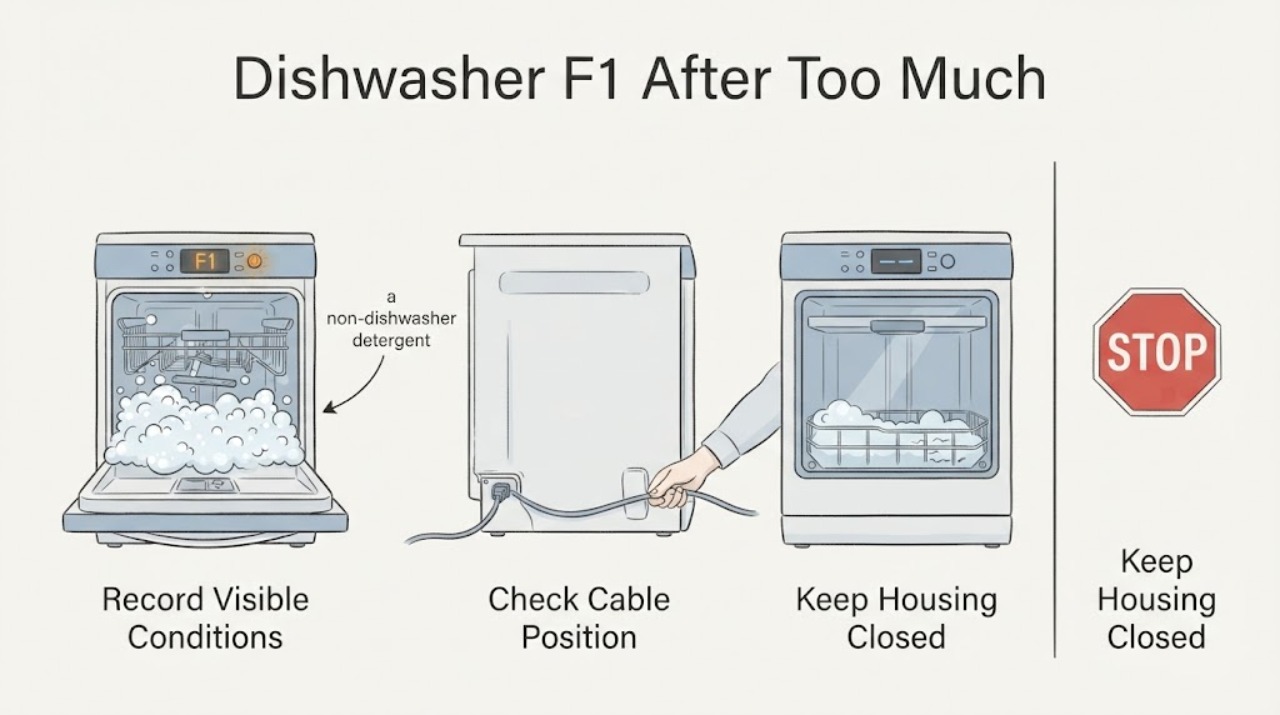
Work through in order
Diagnostic checks
Use only checks that match the exact appliance or system and its official guide.
-
Check 1
Stop the dishwasher with its normal control if it responds, and record the full model code, whether it is a single or double DishDrawer or a drop-door unit, the exact F1 display or flashing pattern, the affected drawer or door, and whether the appliance is beeping, locked, continuously draining, foaming, leaking, or showing standing water.
Expected result: The model and platform are clear, the model is a DishDrawer, the model is a conventional dishwasher, or the identity and indicator pattern remain uncertain.
Next step: Find the exact Fisher & Paykel guide before using a code-specific button sequence. If the model cannot be identified, keep the appliance off and contact Customer Care with the display record rather than borrowing another model's F1 meaning.
Stop if: Do not enter diagnostics, hold a lock or drawer switch closed, pull an integrated unit from cabinetry, or open a panel to identify the code.
Why this matters
Why: Fisher & Paykel documents dishwasher platforms separately. The opened DishDrawer guide maps F1 to flood and A7 to excess foam, but that mapping cannot safely be applied to an unidentified conventional or older model.
-
Check 2
If hand dish soap, a non-dishwasher detergent, or an unusually large amount of detergent was added, do not add more product. From a safe, accessible opening only, note whether foam is present in the drawer or tub and whether the detergent was placed in the correct compartment; do not open a locked drawer or reach into a running appliance.
Expected result: Excess foam is visible, no foam is visible, the wrong detergent was used but the interior is not accessible, or a leak or overflow is present.
Next step: For an exact model whose guide lists A7/excess foam, stop the cycle, remove accessible foam as the guide directs, and run only the documented rinse recovery. For F1 or an unknown model, do not substitute the A7 procedure; isolate water/power safely and arrange service if the fault persists.
Stop if: Do not pour more detergent, hand soap, oil, bleach, or an improvised neutralizer into the dishwasher, and do not run repeated rinse cycles to hide a leak.
Why this matters
Why: Fisher & Paykel's DishDrawer guide treats excess foam as a separate A7 fault and attributes it to incorrect detergent use or rinse-aid conditions. Foam makes a detergent-related event plausible, but no foam does not rule out a leak, valve, drain, or sensor fault.
-
Check 3
If the exact matching guide identifies F1 as a flood fault, keep the dishwasher off and inspect only for an obvious, safely visible external leak or water source. Close the water supply and isolate power from a dry location if this can be done without touching water, a wet plug, or hard-wired connections.
Expected result: Water is actively leaking or flooding, the appliance is continuously draining with no visible external leak, the area is dry, or the model's guide does not define F1 as a flood fault.
Next step: Stop use and arrange qualified Fisher & Paykel service for persistent F1, active leakage, or inaccessible water in the base. If F1 has a different meaning in the exact guide, follow only that guide and do not use the flood procedure.
Stop if: Do not stand in water, touch a wet cord or outlet, move the appliance, remove drawers, or access the base tray as an ordinary user check.
Why this matters
Why: The current DishDrawer guide directs the owner to drain for F1 and separately directs water and power to be turned off for other leaks. Continuous draining can be protective, but its presence does not identify whether foam, an actual leak, an inlet valve, a drain path, or a flood sensor caused the response.
-
Check 4
Use a reset or recovery sequence only if the exact model guide authorizes it after the detergent or flood condition has been corrected. Record whether the F1 clears, the appliance unlocks, and a normal empty rinse completes without new foam, water, or alarms; do not repeat resets continuously.
Expected result: The code clears and a normal rinse completes, F1 returns immediately, the drawer remains locked or drains indefinitely, or another code appears.
Next step: Stop the affected drawer or dishwasher for a recurring or unresolved fault and provide the exact model, display, detergent history, foam/leak observations, and recovery result to Customer Care or an authorized service partner.
Stop if: Do not bypass a flood switch, door or drawer interlock, repeatedly restore power, or run a cycle to see whether a suspected leak returns.
Why this matters
Why: A single successful recovery supports a temporary condition but does not prove the base is dry or the flood cause is gone. Recurrence, a locked drawer, indefinite draining, or another code requires model-specific service diagnosis.
-
Check 5
Prepare a service record with the full model and serial information if available, DishDrawer versus drop-door platform, affected drawer, exact F1 or other indicators, detergent type and amount, whether foam or water was seen, whether the pump kept running, and the result of the one model-approved recovery.
Expected result: The code is unlisted for the model, returns after the documented step, involves flooding or a leak, or requires access below drawers, behind panels, or to pumps, valves, sensors, or wiring.
Next step: Leave the appliance off and arrange qualified Fisher & Paykel service. Use a plumber for an independent household drain or supply problem and an electrician for unsafe electrical connections.
Stop if: Stop immediately for smoke, burning odor, sparking, hot electrical parts, uncontrolled water, a damaged cord or enclosure, or water near electrical connections.
Why this matters
Why: Fisher & Paykel's model-specific documentation and service route are needed because F1 is not a safe cross-platform part diagnosis. The history of excess soap is useful evidence but does not establish that a flood sensor or valve is defective.
Use your observations
Decision map
Find the observation that best matches what you see, then follow the next safe action.
-
PATH 01Next step
What you see
The exact guide is for a DishDrawer that lists F1 as a flood fault, the F1 appeared after hand dish soap or excess detergent, and foam, continuous draining, or water in the base is present.
Do this next
Stop the cycle, isolate water and power from a dry safe location when possible, and follow only the matching guide's F1 drain instruction. Arrange service if the code persists or the water source is not clear.
Why this path and its safety boundary
Why it matters: The detergent event can plausibly have produced excess foam or overflow that activated flood protection, but the visible evidence does not rule out a leak or inlet/drain fault.
-
PATH 02Next step
What you see
The exact DishDrawer guide identifies excess foam as A7 rather than F1, and no flood, leak, or electrical hazard is present.
Do this next
Stop the cycle, wipe away accessible excess foam, and run the guide's rinse recovery with the correct dishwasher detergent. If the indication changes to F1 or returns, stop and arrange service.
Why this path and its safety boundary
Why it matters: The model-specific guide has a lower-level foam-recovery branch distinct from F1 flood protection.
-
PATH 03Next step
What you see
The model is unknown, the unit is not the DishDrawer family covered by the opened guide, F1 is unlisted, or the code returns after the model-approved recovery.
Do this next
Keep the appliance off, preserve the exact display and model record, and contact Fisher & Paykel Customer Care or an authorized service partner. Do not select a flood sensor, pump, valve, or control part from F1 alone.
Why this path and its safety boundary
Why it matters: The F1 meaning and reset path are not established at the required identity scope; a generic flood or foam procedure could worsen a different fault.
-
PATH 04Next step
What you see
There is active flooding, a leak that cannot be safely stopped, water near electrical connections, a damaged cord or plug, smoke, burning odor, sparking, or a locked appliance that would require force to open.
Do this next
Stop using the appliance, isolate water or power only from a safe dry location if possible, and obtain qualified appliance, plumbing, or electrical service. Do not move the dishwasher or open panels.
Why this path and its safety boundary
Why it matters: The immediate water or electrical hazard overrides any attempt to identify whether soap foam caused F1.
Helpful context
Understand the symptom
F1 and excess foam are not interchangeable across every model
Fisher & Paykel publishes separate documentation for DishDrawer and conventional dishwashers. The opened DishDrawer care guide lists F1 as a flood fault and A7 as excess foam, while the task does not identify a model or platform. The safe conclusion is therefore conditional: if the exact guide lists F1 as flood, treat it as a water-safety response; if it lists a different meaning or the code is not present, do not transfer the DishDrawer procedure. Dish soap can create foam, but a foam event does not prove that the appliance has no leak or that a flood sensor is the only cause.
What to do with a locked or continuously draining appliance
Fisher & Paykel guidance and the exact-model community report both describe an F1 situation in which the appliance may keep trying to drain or prevent normal operation. That behavior is a protective response, not permission to hold a drawer switch, pull the unit from cabinetry, or reach into the base. Isolate water and power only from a dry, safe location, keep the appliance off, and let qualified service determine whether foam, a leak, an inlet valve, a drain path, or a flood sensor caused the fault.
Only after diagnosis
Potential parts
- flood sensor or float protection assembly
Consider this class only after the exact model guide confirms a flood-fault meaning and qualified diagnosis finds a sensor or float problem after foam, leak, inlet, and drain causes are addressed. F1 on an unknown model does not establish fit.
Confirm the full Fisher & Paykel model, platform, drawer, market, and manufacturer fit information before ordering; do not substitute a DishDrawer component for a drop-door dishwasher. - inlet valve or drain-path component
Consider this class only if service finds an actual leak, unwanted filling, blocked drain, or hose fault rather than detergent foam or a false flood indication. The F1 display alone cannot choose a valve or pump.
Confirm the exact model and platform before selecting a part; no compatibility claim is made from the F1 code alone.
When checks do not resolve it
Need a professional?
Arrange Fisher & Paykel or qualified appliance service when F1 persists after the exact model's permitted recovery, when foam returns, when the appliance drains indefinitely or stays locked, when the model-specific meaning is unavailable, or when a leak or flood source is not safely visible.
Safety scope: Do not open the base, remove drawers, bypass a flood or door interlock, disconnect hard-wired connections, or perform live electrical or water-system tests. Keep water and power isolated from a dry safe location for active leaks, persistent F1, water near electrical parts, smoke, burning odor, sparking, or damaged cords.
Have this ready
- Provide the complete model and serial information, platform, affected drawer or door, exact code and indicators, detergent type and amount, visible foam or water, pump behavior, cycle stage, and the result of the one model-approved recovery.
Common questions
FAQ
Can too much dish soap cause F1 on a Fisher & Paykel dishwasher?
It can plausibly create excess foam and, on DishDrawer models whose guide defines F1 as a flood fault, may be associated with a flood response. It is not proof of the cause on an unknown model: confirm the exact guide and rule out a real leak, valve, drain, or sensor fault.
What should I do immediately after Fisher & Paykel F1 appears?
Stop the cycle, record the model and display, and do not add more detergent. If the exact DishDrawer guide lists F1 as flood, follow its drain instruction and isolate water and power from a dry safe location when possible. Do not open the base or bypass a lock.
Can I just run a rinse cycle to clear the F1?
Only if the exact model guide assigns a rinse recovery to an excess-foam code such as A7 and no flood or electrical hazard exists. Do not use a generic rinse or repeated reset for F1 on an unknown model; persistent or recurring F1 needs qualified service.
Read the exact guide
Official sources
- DISHDRAWER™ DISHWASHERFisher & Paykel · Official Fisher & Paykel DishDrawer care guide used conditionally because the task model is unknown; it explicitly distinguishes F1 flood fault from A7 excess foam and provides different immediate actions.
- Fisher & Paykel Dishwasher F1 ErrorReddit r/Plumbing · Community report matching the task condition: Fisher & Paykel dishwasher F1 after accidental hand dish soap, with prolonged draining and later reported recovery after drying.
Community feedback
Share a repair observation
Share a plain-text repair observation. Accepted observations are published automatically; this page may take a moment to update.