
On this page
Start here
Quick answer
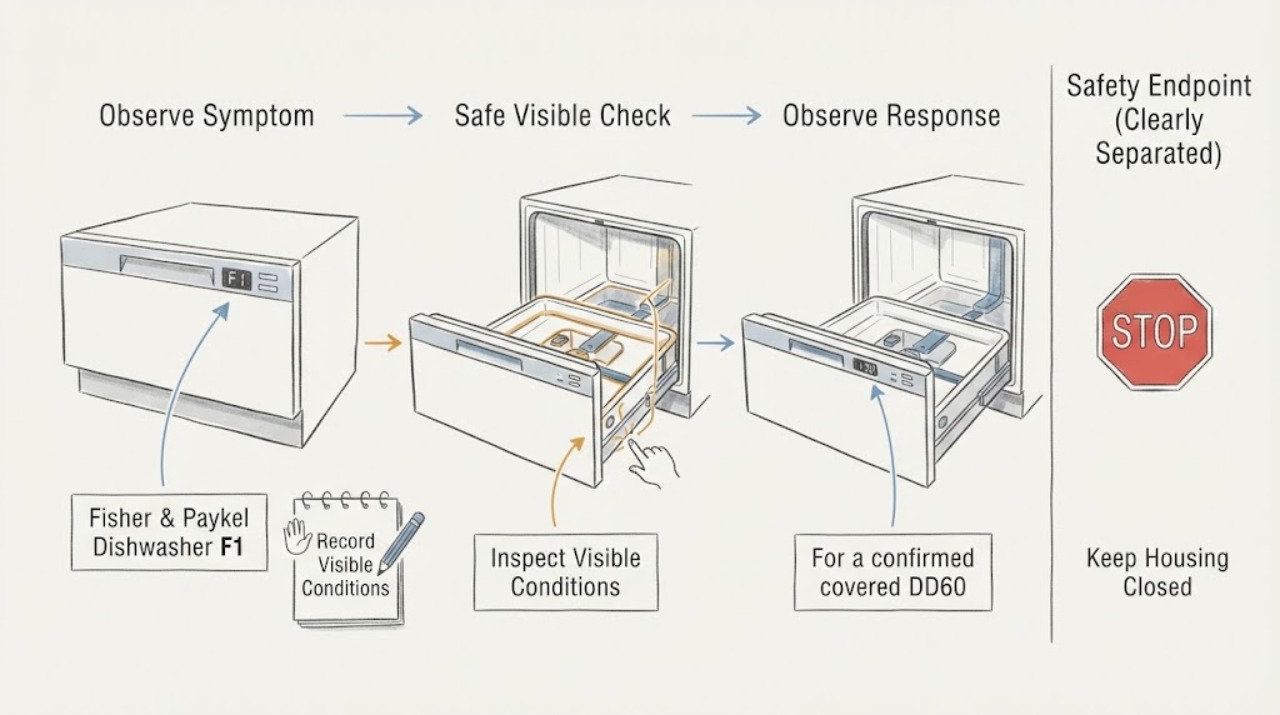
On the Fisher & Paykel DishDrawer DD60 models listed in the opened care guide, F1 means a flood fault: the appliance has detected a flooding or leak condition. It does not identify a failed pump, inlet valve, hose, sensor, or control board. Because no model was supplied, first read the rating label and match the exact regional manual; do not carry this F1 meaning to another Fisher & Paykel dishwasher family. If water is visible or the fault returns, stop the dishwasher, isolate water and power only when safely accessible, and arrange qualified service. For a confirmed covered DD60 model with only a small leak, follow that model's care guide, which says drying can take up to 48 hours; a large leak needs a technician.
Before you begin
Safety first
- This no-model guide is limited to confirming the code and model, observing accessible water, following a matching care guide's stated fault handling, and preparing a service handoff. Do not open panels, touch wiring, disconnect hidden hoses, bypass flood protection, force a drawer, or select a pump, valve, sensor, board, or other part from F1 alone.
Work through in order
Diagnostic checks
Use only checks that match the exact appliance or system and its official guide.
-
Check 1
Read the complete model number from the dishwasher label and record the exact display or indicator pattern, including which drawer is affected on a double DishDrawer. Compare it with the regional Fisher & Paykel manual for that appliance.
Expected result: The label identifies a DD60 or DD24 DishDrawer and the display is F1, the display is a different code, or the model does not match the opened DD60/DD24 documentation.
Next step: Use the F1 branch only after the family and code match. Otherwise stop at model identification and follow the exact manual or contact Fisher & Paykel Customer Care.
Why this matters
Why: The opened care guide supports F1 as a flood fault only for its documented DD60 models, while the opened user guide is scoped to DD60/DD24 DishDrawer models. A different family, region, or code needs its own manual; an assumed match can produce the wrong repair path.
-
Check 2
With the dishwasher stopped, look at the accessible drawer rim, floor, and visible supply or drain connection area for standing water, a fresh trail, or dampness. Do not pull out the appliance, remove a panel, or disconnect a hose.
Expected result: There is a visible or returning leak, only a small residual damp area is visible, or no accessible water is visible.
Next step: If water is present or returning, isolate the water supply and power only when safely accessible and arrange service. If no water is visible, continue only with the exact model manual's permitted fault handling; do not infer a component from the code.
Why this matters
Why: A visible or returning leak supports the flood-safety branch but does not identify the failed component. No visible water does not disprove a stored flood condition or an inaccessible leak.
-
Check 3
For a confirmed covered DD60 model, read the fault section in that model's care guide and follow only its stated waiting or fault-handling instruction. Do not substitute a generic reset, drying, drain, or part-replacement procedure.
Expected result: The exact guide identifies a small leak and gives a drying interval, identifies a large leak, or the F1 condition remains or returns after the guide's permitted handling.
Next step: For a large, returning, or unresolved fault, keep the dishwasher out of use and contact an authorised Fisher & Paykel service provider. Do not repeatedly run or reset a leaking appliance.
Why this matters
Why: The opened DD60 care guide says a small leak may take up to 48 hours to dry and directs a large leak to a technician. A persistent or recurring F1 remains a service condition; the code alone does not distinguish pump, valve, hose, sensor, or control causes.
-
Check 4
Give service the complete model and serial information, region, affected drawer, exact F1 display or indicator pattern, when it appeared, and any visible water or recent installation change.
Expected result: The manual is missing or mismatched, the fault returns, water has reached the floor or an electrical area, or diagnosis would require hidden access.
Next step: Leave the appliance off, protect the surrounding floor, and use Fisher & Paykel Customer Care or an authorised service provider. Do not open the enclosure, touch wiring, bypass flood protection, or disconnect hidden water lines.
Why this matters
Why: The no-model evidence is insufficient to select a compatible part or internal repair. Fisher & Paykel's guide reserves installation and service for a qualified technician.
Use your observations
Decision map
Find the observation that best matches what you see, then follow the next safe action.
-
PATH 01Next step
What you see
The label and regional manual confirm a listed DD60 DishDrawer model, and the display is F1.
Do this next
Follow the exact care guide's flood-fault instruction and inspect only accessible water. Do not diagnose or order an internal part from F1 alone.
Why this path and its safety boundary
Why it matters: The opened Fisher & Paykel care guide supports interpreting F1 as a flood fault for that documented DD60 family.
-
PATH 02Next step
What you see
The display is not confirmed as F1, or the model is not a documented DD60/DD24 DishDrawer match.
Do this next
Stop using this interpretation, obtain the exact model and regional manual, and contact Fisher & Paykel support if the code remains unclear.
Why this path and its safety boundary
Why it matters: The code meaning is out of scope; this article cannot safely transfer the DD60 F1 definition to another Fisher & Paykel dishwasher family.
-
PATH 03Next step
What you see
Water is visible, returning, spreading onto the floor, or near an electrical area.
Do this next
Stop the dishwasher, close the water supply and disconnect power only when safely accessible, keep away from wet electrical areas, and arrange qualified service. Do not continue testing.
Why this path and its safety boundary
Why it matters: This is an active water-damage and electrical-safety condition rather than a routine code lookup.
-
PATH 04Next step
What you see
No water is visible but a confirmed, model-matched F1 persists or returns after the model guide's permitted handling.
Do this next
Leave the dishwasher out of use and give the service provider the model, drawer, code, and timing details; do not open the enclosure or replace a part by code alone.
Why this path and its safety boundary
Why it matters: A stored or inaccessible flood condition remains possible, but F1 does not identify the failed pump, valve, hose, sensor, or board.
Helpful context
Understand the symptom
F1 is a flood-fault indication only within the Fisher & Paykel DishDrawer family documented by the opened care guide. That guide lists specific DD60 models and labels F1 “Flood fault.” The code tells you that the appliance detected a flooding or leak condition; it does not prove which water component caused it. A model number is essential because this task does not identify the dishwasher family or region.
Start by confirming the exact model from the appliance label and checking whether the display really shows F1 rather than another code or indicator pattern. If the model is one of the covered DD60 DishDrawer variants, use the matching care or user guide. If the model is different, stop using this code meaning and use that model's manual instead.
Treat water as the priority. Observe only accessible water around the drawer, floor, and visible connections; do not remove panels or disconnect hidden hoses. If water is present, returning, or near electrical areas, stop the dishwasher and obtain service. Do not use F1 to choose a pump, inlet valve, hose, sensor, or board before a qualified technician identifies the leak or flood condition.
When checks do not resolve it
Need a professional?
Call Fisher & Paykel Customer Care or an authorised appliance technician when F1 persists or returns, water is visible or recurring, the model or regional manual does not match, the leak is large, or diagnosis would require opening panels, disconnecting hidden hoses, or touching wiring.
Safety scope: This no-model guide is limited to confirming the code and model, observing accessible water, following a matching care guide's stated fault handling, and preparing a service handoff. Do not open panels, touch wiring, disconnect hidden hoses, bypass flood protection, force a drawer, or select a pump, valve, sensor, board, or other part from F1 alone.
Common questions
FAQ
What does F1 mean on a Fisher & Paykel dishwasher?
The opened Fisher & Paykel DishDrawer care guide labels F1 as a flood fault for its listed DD60 models. Confirm the model and region first; the code does not identify a particular valve, pump, hose, sensor, or control board.
Can I use this F1 meaning on any Fisher & Paykel dishwasher?
No. This evidence is scoped to the documented DishDrawer DD60 family, with a related user guide covering DD60 and DD24 models. Match the rating label and regional manual before applying the code.
Should I keep running the dishwasher if F1 clears?
Do not keep testing a unit with visible or returning water. For a confirmed covered DD60 model, follow the care guide's stated instruction for the observed leak; a large leak or a recurring fault requires a technician.
Does F1 tell me which part to replace?
No. F1 identifies a flood-fault condition in the documented family, not the cause. A service provider must identify whether the condition is a visible connection, inaccessible leak, drain or inlet issue, detection system, or another model-specific fault.
Read the exact guide
Official sources
- DishDrawer Dishwasher Care GuideFisher & Paykel Appliances · The opened official care guide lists DD60D2NX9, DD60D2NB9, DD60SCTX9, DD60SCX9, DD60DCX9, DD60D4NX9, DD60D4NB9, DD60D4ZB9, DD60ST4NX9, DD60ST4NB9, and DD60ST4ZB9. Its fault-code section labels F1 as Flood fault and distinguishes small and large leaks.
- DishDrawer Dishwasher User Guide: DD60 and DD24Fisher & Paykel Appliances · The opened official guide cover identifies DD60 and DD24 DishDrawer double and single models across NZ, AU, US, CA, GB, and IE. It says installation and service must be performed by a qualified technician, recommends Customer Care for servicing, and requires power disconnection before maintenance.
Community feedback
Share a repair observation
Share a plain-text repair observation. Accepted observations are published automatically; this page may take a moment to update.