
On this page
Start here
Quick answer
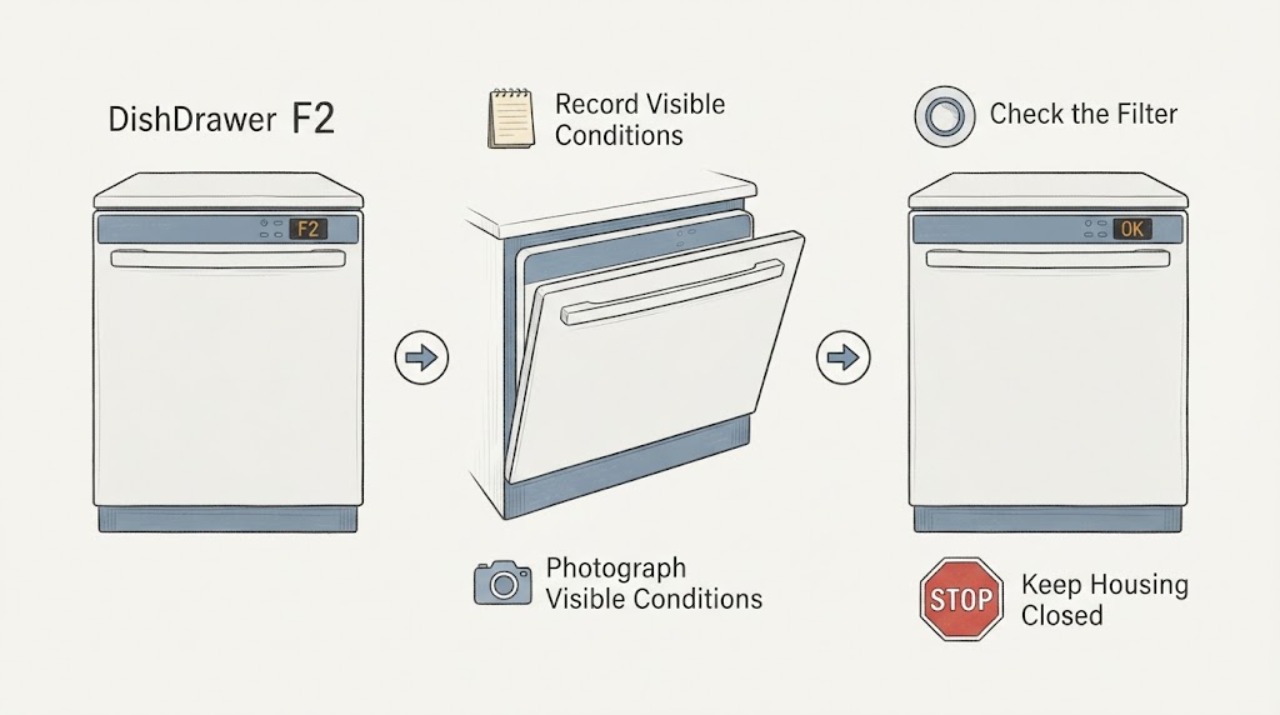
For a Fisher & Paykel DD603 DishDrawer, the opened legacy NZ/AU user guide lists F2 as a motor problem and directs the owner to an Authorised Service Centre. That mapping is tied to the DS603/DD603 guide published for this older generation; do not borrow an F2 explanation or reset sequence from a newer DishDrawer or another dishwasher. Because this unit came with a newly purchased house, first photograph the complete model label, identify the affected drawer, and record the exact F2 display or indicator pattern and beeps. With the unit cool and not running, only note visible filter-plate or drain-filter seating, the visible water level, and any leak. A small amount of water in the drain-filter area can be normal, but excess water, a leak, a damaged cord, or a persistent F2 requires the water and power to be isolated only from a dry, safe location and qualified Fisher & Paykel service. Do not remove the drawer, open panels, run live tests, or choose a motor, sensor, or other part from F2 alone.
Before you begin
Safety first
- Do not remove the drawer, open panels, reach into the motor area, defeat a lid or drawer interlock, perform live electrical tests, or disconnect water connections under pressure. Stop immediately for flooding, water near electrical parts, smoke, burning odor, sparking, a damaged cord or plug, a hot electrical area, or an unstable or damaged enclosure.
Work through in order
Diagnostic checks
Use only checks that match the exact appliance or system and its official guide.
-
Check 1
With the DishDrawer idle, read the full rating label without pulling the appliance from its cabinet. Record DD603 versus DS603, any suffix, the market, whether the unit has one or two drawers, and which drawer shows F2.
Expected result: The label clearly matches DD603, or the suffix, market, platform, or affected drawer cannot be confirmed.
Next step: If identity is incomplete, stop code interpretation and obtain the complete label and matching Fisher & Paykel documentation or service support. Do not use a newer DishDrawer table as a substitute.
Why this matters
Why: The opened fault table is explicitly for DS603 and DD603 models in the NZ/AU guide. A different generation, regional variant, or incomplete label may use different indicators and code meanings.
-
Check 2
Before clearing anything, photograph or transcribe the exact F2 display or indicator pattern, note whether the unit is continuously beeping, and record the wash stage and the upper or lower drawer involved. Keep the drawer closed if it is hot or locked by a running cycle.
Expected result: F2 is shown on the electronic display, F2 is represented by programme indicators, the pattern changes, or the two drawers show different behaviour.
Next step: Keep the record with the model label and provide it to Fisher & Paykel service. Do not enter a diagnostic mode, hold a drawer or lid switch closed, or repeatedly clear the indicators.
Why this matters
Why: The DD603 guide says the display format depends on the model finish and that a fault produces continuous beeping. On a double DishDrawer, a code or symptom in one drawer does not prove the other drawer has the same condition.
-
Check 3
After the appliance is cool and off, look only at the accessible drawer interior, filter area, and floor. Note whether the filter plate and drain filter appear seated, whether water is below the filter plate or excessive, and whether there is a fresh leak at the inlet or drain area. Do not remove the drawer or reach into a wet electrical area.
Expected result: There is only a small amount of water in the drain-filter area, excess standing water, a visible leak, or water near the cord or outlet.
Next step: For excess water, a leak, or water near electrical parts, stop using the dishwasher. Close the water supply and isolate power only from a dry, safe location if this can be done without touching water or wiring; otherwise leave it alone and arrange qualified service.
Why this matters
Why: The DD603 installation checklist says some water in the drain-filter area can be normal. Excess water is listed with bent or blocked drain hoses or filters, while a leak or water near electrical parts is a safety issue. None of these observations by itself changes the exact F2 table entry of motor problem.
-
Check 4
With the drawer cool and power isolated, visually check that the spray arm is centered and that no item is visibly obstructing its path; also note whether the filter plate or drain filter is visibly out of position. Do not force, remove, or dismantle these parts to chase an F2 code.
Expected result: The spray arm and visible filters look correctly positioned, or one is visibly displaced or obstructed.
Next step: Record the visible condition and keep the drawer out of service while F2 remains. If the exact user guide authorizes a simple external correction, follow only that wording; otherwise give the observation to an Authorised Service Centre rather than forcing a part into place.
Why this matters
Why: The DD603 troubleshooting section links excessive motor noise and poor washing to incorrect filter-plate or spray-arm placement, but those observations do not prove the cause of an F2 motor problem and do not authorize internal repair.
-
Check 5
Only after the code, drawer, water status, and label are recorded, and only when there is no leak, smoke, damaged cord, or other hazard, use the DD603 guide's normal controls once to clear the fault and turn the appliance off and back on as directed. Do not repeat the reset or run a cycle to provoke the code.
Expected result: F2 clears and stays absent, F2 returns, another code appears, the drawer will not close, or the dishwasher will not resume normally.
Next step: For recurrence, a changed code, or abnormal closure, leave the affected drawer off and arrange service with the exact model, drawer, code, beeps, water observations, and reset result. Do not bypass a drawer or lid interlock.
Why this matters
Why: The guide permits a normal control response and power-off step during fault handling, but it says that a remaining fault should be followed by turning water and power off and contacting an Authorised Service Centre. A cleared display does not identify or prove a motor repair.
Use your observations
Decision map
Find the observation that best matches what you see, then follow the next safe action.
-
PATH 01Next step
What you see
The label and controls match the DS603/DD603 guide and F2 remains after the documented one-time normal control step.
Do this next
Leave the affected drawer off and arrange Fisher & Paykel Authorised Service with the label, affected drawer, exact indicators, beeps, and observations. Do not dismantle the drawer or run live tests.
Why this path and its safety boundary
Why it matters: For this legacy model group, the official table calls F2 a motor problem and directs service. The code does not select a motor, sensor, wiring item, or replacement assembly.
-
PATH 02Next step
What you see
The code is shown on a different model generation, the label is incomplete, the indicator pattern is not a clear F2, or the market does not match the opened guide.
Do this next
Stop at identification, capture the complete rating label and display pattern, and obtain the matching Fisher & Paykel guide or qualified service assessment before any reset or part decision.
Why this path and its safety boundary
Why it matters: The DD603 F2 mapping cannot safely be transferred to another DishDrawer generation or display vocabulary. The new-house history also does not establish that the inherited appliance is the exact model in the title.
-
PATH 03Next step
What you see
There is excess standing water, a visible leak, water near the cord or outlet, smoke, a burning smell, a damaged cord, or a drawer that cannot close safely.
Do this next
Stop using the appliance. From a dry, safe position, close the water supply and isolate power only if readily accessible without contact with water or electrical parts; otherwise keep clear and call qualified appliance service or an electrician as appropriate.
Why this path and its safety boundary
Why it matters: The immediate water, electrical, or mechanical hazard takes priority over interpreting F2. Visible water is not a reason to reach below the filter plate or open the cabinet.
-
PATH 04Next step
What you see
Only a small amount of water is visible in the drain-filter area and the filter plate, drain filter, and spray arm appear correctly positioned, but F2 persists.
Do this next
Keep the affected drawer off and provide the technician the code, drawer, cycle stage, water status, and photos. Do not remove the drawer or select a part from the code alone.
Why this path and its safety boundary
Why it matters: The visible user-level checks do not explain away the legacy F2 motor entry. A persistent code needs controlled service diagnosis rather than a guessed filter, motor, or sensor replacement.
Helpful context
Understand the symptom
Why DD603 identity matters
DD603 is an older DishDrawer generation, and the opened Fisher & Paykel guide names DS603 and DD603 models on its cover. It is a NZ/AU guide, so the complete rating-label code and market still need to be confirmed before using its controls or fault table. The guide shows that F2 means a motor problem for this named model group, but that does not identify a failed motor, sensor, wiring item, or replaceable assembly. A current DishDrawer guide or a different DishDrawer generation may use different indicators and user steps.
What the visible filter and water can, and cannot, tell you
The DD603 guide says the appliance should have the filter plate, drain filter, and spray arm correctly in place, and its installation checklist says some water in the drain-filter area after a programme is normal. It separately lists excess water with bent or blocked drain hoses or filters, while its F2 table still directs service for a motor problem. Therefore a visible filter position or water level is useful evidence for the technician, but it should not be used to relabel F2 as a drain fault or to justify dismantling the drawer.
When checks do not resolve it
Need a professional?
Arrange Fisher & Paykel Authorised Service when F2 returns after the matching DD603 guide's one-time normal control step, another code appears, the drawer will not close or resume, the code or market cannot be matched, or any internal pump, motor, sensor, wiring, or control inspection would be needed. For a house recently purchased, give the seller, installer, or property representative the same model-and-code record if responsibility for the inherited appliance is still being established.
Safety scope: Do not remove the drawer, open panels, reach into the motor area, defeat a lid or drawer interlock, perform live electrical tests, or disconnect water connections under pressure. Stop immediately for flooding, water near electrical parts, smoke, burning odor, sparking, a damaged cord or plug, a hot electrical area, or an unstable or damaged enclosure.
Have this ready
- Provide the complete rating-label model and serial information, market, one- or two-drawer configuration, affected drawer, exact F2 display or indicator pattern, beep behaviour, cycle stage, filter and spray-arm observations, visible water or leak status, and whether the normal guide step changed the display.
Common questions
FAQ
What does F2 mean on a Fisher & Paykel DD603?
The opened DS603/DD603 user guide lists F2 as a motor problem and directs the owner to an Authorised Service Centre. It does not identify a specific motor part or authorize a user replacement.
Can a visible filter or small amount of water explain F2?
The DD603 guide says the filter plate, drain filter, and spray arm must be correctly in place, and that some water in the drain-filter area can be normal. Those observations should be recorded, but they do not change the guide's F2 motor entry or justify dismantling the drawer.
Should I keep using an inherited DD603 if F2 clears once?
No cycle should be used to force a recurrence. After recording the code and checking for hazards, the guide's normal fault-handling step may be tried once; if F2 returns, another code appears, water remains, or the drawer will not resume normally, leave it off and arrange qualified service.
Read the exact guide
Official sources
- DishDrawer User guide DS603 and DD603 modelsFisher & Paykel · Exact legacy model family named on the PDF cover; published for the NZ/AU market. Use only after confirming the complete DD603 label, display style, and market.
- DishDrawer Installation InstructionsFisher & Paykel · Opened legacy installation document that explicitly lists DD603 models and supports installation, water, drain, access, and safe isolation boundaries; it does not by itself define F2.
- Resources | Fisher & Paykel USAFisher & Paykel · Official resource page directing owners to search by product and model for the matching user and installation documents; it does not establish a cross-generation F2 meaning.
Community feedback
Share a repair observation
Share a plain-text repair observation. Accepted observations are published automatically; this page may take a moment to update.