
On this page
Start here
Quick answer
A wet Fisher & Paykel dishwasher does not automatically mean the drying system has failed. First identify whether the water is on plastic items, on all dishes, on the tub walls or only at the end of a drawer cycle. Fisher & Paykel's DishDrawer guide lists nesting or incorrect loading, leaving dishes inside for hours, depleted or low rinse aid, Eco cycles and slow-drying plastics as common explanations; it recommends unloading within a few hours, refilling or correctly setting rinse aid, and using the model's Extra Dry option where available. Current Fisher & Paykel product pages also say fan-assisted or Auto Door Open drying is available only on selected models. If the exact manual's drying path does not restore results, water remains pooled, the door or drawer will not open or close correctly, or a leak or electrical symptom appears, stop repeated cycles and arrange Fisher & Paykel or authorized service.
Before you begin
Safety first
- Limit owner checks to loading, rinse-aid refill or documented dosage, model-specific drying options and timely unloading. Do not open panels, touch energized or heated parts, bypass the door/drawer safety system or replace a heater, fan, pump or control from a wet interior alone.
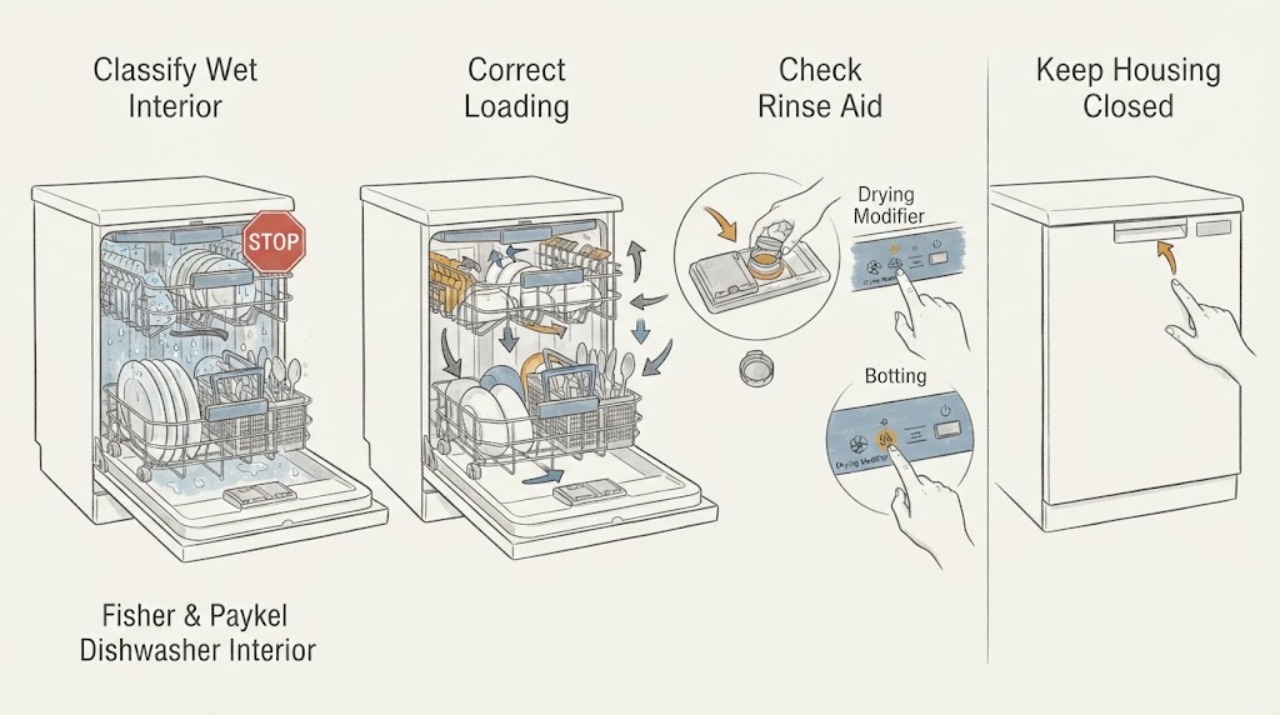
Work through in order
Diagnostic checks
Use only checks that match the exact appliance or system and its official guide.
-
Check 1
Record whether wetness is limited to plastic, affects all dishes, appears as condensation on the tub walls, or is pooled water at the end of the cycle; note when the drawer or door was opened.
Expected result: Only slow-drying items or a delayed-open drawer is wet, or all items are wet immediately after a complete cycle.
Next step: Use the matching loading, rinse-aid and cycle branch; stop for pooled water or a leak rather than treating it as condensation.
Why this matters
Why: Fisher & Paykel lists plastic and delayed unloading as normal drying variables, while immediate wetness across the load needs cycle, rinse-aid or service checks.
-
Check 2
Reload the dishwasher so cups, bowls and containers are not nesting, surfaces are exposed to the documented spray and drying path, and the door or drawer can close without contact.
Expected result: Items are nested, a container holds water, or the rack/load blocks a documented air or door path.
Next step: Correct the load and run the exact model's suitable programme; if the full load remains wet, check rinse aid and drying options.
Why this matters
Why: Fisher & Paykel identifies incorrect loading and nesting as causes of dishes not drying; a blocked path can also prevent the intended drying behavior.
-
Check 3
Check the rinse-aid indicator or dispenser and refill with the manual-specified rinse aid if depleted; use the exact model setting to adjust dosage and wipe any spill.
Expected result: Rinse aid is empty or set low, or it is present at the documented level and the dispenser is closed.
Next step: Correct the rinse-aid condition without pouring product into the tub, then reassess after a complete suitable programme; arrange service for persistent wetness or foam.
Why this matters
Why: Fisher & Paykel says depleted or low rinse aid can cause wet dishes, while excess spilled rinse aid can cause foaming.
-
Check 4
Check the exact model's programme table for Eco/Normal Eco, Extra Dry, Dry+ or Auto Door Open and select only an option documented for that programme.
Expected result: The cycle is Eco or the model offers a documented extra-dry or door-opening option, or no such option exists.
Next step: Use the documented drying-capable programme or modifier; do not copy a button sequence from another Fisher & Paykel model.
Why this matters
Why: Fisher & Paykel says drying modifiers and fan-assisted or automatic door-opening features vary by model and programme.
-
Check 5
Compare drying of plastic, glass and metal items and unload within a few hours after the programme finishes.
Expected result: Plastic remains wet while glass and metal dry, or the entire load is wet immediately and remains so after timely unloading.
Next step: Use the suitable drying option for slow-drying materials; use service for immediate all-load wetness after correct loading and rinse-aid checks.
Why this matters
Why: Fisher & Paykel identifies plastics as slower to dry and delayed unloading as a source of condensation; all-material immediate wetness is not explained by those factors alone.
-
Check 6
Give Fisher & Paykel support or an authorized service partner the model, region, programme, rinse-aid setting, material pattern, timing of wetness and any leak, pooled water or door/drawer issue.
Expected result: Wetness persists after model-matched loading, rinse-aid and programme checks, or a hazard or mechanical problem is present.
Next step: Keep the appliance off for a leak, pooled water, damaged seal or electrical symptom and arrange qualified Fisher & Paykel service; do not open panels or bypass the door/drawer safety system.
Why this matters
Why: The public guidance supports operating and maintenance checks but does not establish a failed heater, fan, pump or control from a wet interior alone.
Use your observations
Decision map
Find the observation that best matches what you see, then follow the next safe action.
-
PATH 01Next step
What you see
Only plastic utensils or containers remain wet, while glass or metal dries and the programme otherwise completes normally.
Do this next
Use the model's documented Extra Dry or Dry+ option if available and allow the full programme to finish; do not infer a failed heater.
Why this path and its safety boundary
Why it matters: Fisher & Paykel lists plastics as items that require a longer drying time.
-
PATH 02Next step
What you see
Dishes are nested, a container holds water, or the load blocks a documented drying path.
Do this next
Separate items, orient containers for drainage and run a documented suitable programme.
Why this path and its safety boundary
Why it matters: Incorrect loading can trap water and restrict the drying effect.
-
PATH 03Next step
What you see
Rinse aid is depleted or set too low, and there is no spill or excess foaming.
Do this next
Refill or adjust it only according to the exact manual, wipe spills and reassess after a complete cycle.
Why this path and its safety boundary
Why it matters: Fisher & Paykel identifies low rinse aid as a cause of wet dishes.
-
PATH 04Next step
What you see
The load is left closed for hours and only a light film or condensation appears afterward.
Do this next
Unload within a few hours and use the model's documented drying modifier if needed.
Why this path and its safety boundary
Why it matters: Residual vapour can resettle as condensation after a delayed unload, which is not by itself evidence of a failed drying system.
-
PATH 05Next step
What you see
All materials remain wet immediately after a suitable complete cycle, or pooled water, a leak, a damaged seal or an electrical symptom is present.
Do this next
Keep the appliance off as appropriate and arrange Fisher & Paykel or authorized service; do not remove panels or bypass safety devices.
Why this path and its safety boundary
Why it matters: The issue is outside the documented owner-level drying adjustments and may require model-specific diagnosis.
Helpful context
Understand the symptom
Separate normal condensation from a drying failure
Note whether only plastic is wet, whether dishes are nested, whether water is on the tub walls, and whether the issue appears immediately at programme end or after the drawer has been closed for hours. Fisher & Paykel explains that residual vapour can settle as condensation when dishes remain in a drawer, so the timing matters before diagnosing a heater or fan.
Reload for air and water access
Separate nested bowls, cups and containers so water and drying air can reach their surfaces. Follow the exact model loading diagram and do not block the door, drawer seal or any documented vent path. Fisher & Paykel lists incorrect loading and nesting as causes of dishes not drying.
Check rinse aid without overfilling
Check the rinse-aid indicator or dispenser and refill with the product specified by the exact manual if it is depleted. If the model exposes a dosage setting, use its documented adjustment; do not pour rinse aid into the tub or exceed the dispenser mark. Fisher & Paykel says low rinse aid can leave dishes wet and spilled rinse aid can create excess foam.
Choose a drying-capable programme
Check whether Eco or Normal Eco is selected and whether the model provides Extra Dry, Dry+ or automatic door opening. Fisher & Paykel states that Extra Dry is available only on some models, and current product pages mark fan-assisted or Auto Door Open drying as selected-model features. Use the exact model manual rather than copying another product's button sequence.
Account for plastic and delayed unloading
Plastic utensils and containers may need longer to dry than glass or metal. Unload within a few hours after the programme finishes rather than leaving warm vapour to condense back onto the load. If every material remains wet immediately at the end of a suitable programme, continue to the service branch instead of increasing an unverified setting.
Stop for leaks, pooled water or persistent failure
Keep the dishwasher off and arrange Fisher & Paykel or authorized service if water is pooled rather than a light film of condensation, a leak appears, the door or drawer seal will not close, the drying fan or door-opening feature behaves abnormally, or drying remains poor after the model-specific checks. Do not remove panels or diagnose a heater, fan, pump or control from wet dishes alone.
When checks do not resolve it
Need a professional?
Use Fisher & Paykel support or an authorized service partner for persistent all-load wetness, pooled water, leaks, damaged seals, abnormal drying features or any electrical symptom.
Safety scope: Limit owner checks to loading, rinse-aid refill or documented dosage, model-specific drying options and timely unloading. Do not open panels, touch energized or heated parts, bypass the door/drawer safety system or replace a heater, fan, pump or control from a wet interior alone.
Common questions
FAQ
Why are my Fisher & Paykel dishwasher plastics still wet?
The Fisher & Paykel guide says plastic utensils and containers can require longer drying. Check loading, rinse aid and whether the model offers Extra Dry or Dry+, then allow the complete programme to finish.
Can low rinse aid cause a wet Fisher & Paykel dishwasher interior?
Yes. Fisher & Paykel lists depleted or low rinse aid as a cause of dishes not drying and recommends refilling or increasing the setting according to the model guide. Wipe spills because excess rinse aid can cause foaming.
Is water on the inside of a Fisher & Paykel DishDrawer always a failure?
No. The guide says residual vapour can resettle as condensation when dishes remain in the drawer for several hours, and water on an inner rim can be normal condensation. Pooled water, a leak or immediate all-load wetness needs service assessment.
When should I call Fisher & Paykel service for poor drying?
Call when all materials remain wet after the exact model's loading, rinse-aid and programme checks, or immediately for pooled water, leaking, a damaged seal, abnormal drying features or electrical symptoms. Do not open panels or bypass the drawer or door safety system.
Read the exact guide
Official sources
- Drop Door DishwashersFisher & Paykel USA · Official product-family information; used only for the explicit selected-model caveat on fan-assisted, Auto Door Open and Dry+ features, not as proof that every model has them.
- Help & Support | Book A Service | Repair | TechnicianFisher & Paykel USA · Official support and authorized-service boundary for unresolved appliance problems.
- DishDrawer Dishwasher User Guide DD24DAX9 NFisher & Paykel Appliances · Exact official DishDrawer user guide used for the model-dependent drying troubleshooting pattern; the article labels the checks as conditional where other Fisher & Paykel families differ.
Community feedback
Share a repair observation
Share a plain-text repair observation. Accepted observations are published automatically; this page may take a moment to update.