
On this page
Start here
Quick answer
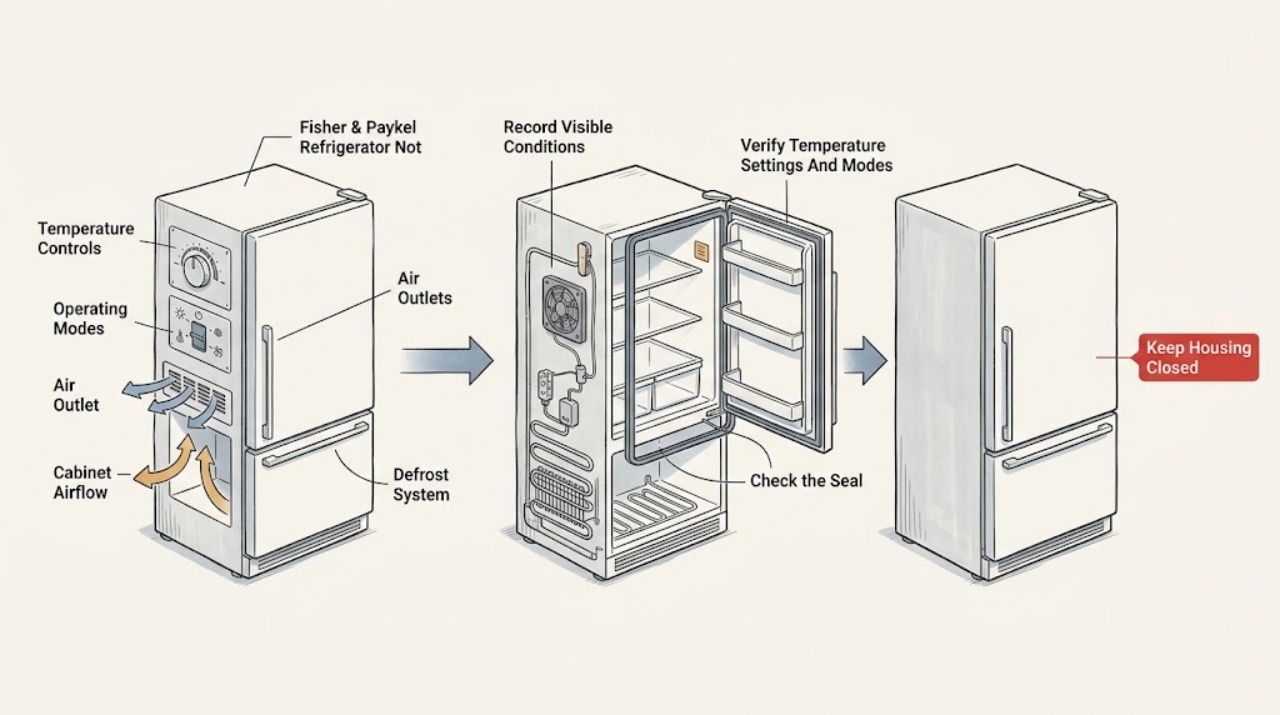
For a Fisher & Paykel refrigerator that is not cooling, first determine whether the appliance has power and whether one compartment or both are warm. Check the exact model's temperature setting and active mode, keep doors closed while the temperature stabilizes, move food away from visible air outlets, and confirm the doors close against clean, flat gaskets. Hot weather, frequent openings, a recent large load, incorrect settings, and a door that is not sealing are listed Fisher & Paykel causes of warm storage compartments; the product family also uses model-dependent airflow, humidity, adaptive cooling, and defrost controls. If the freezer is cold but the refrigerator compartment is warm, focus on the refrigerator setting, loading, and airflow before suspecting a hidden fan, sensor, damper, or defrost issue. If both compartments stay warm, the motor is silent, or it runs continuously after these safe checks, stop food from spoiling and arrange Fisher & Paykel service. Do not remove covers, probe wiring, test live parts, handle refrigerant, or assume an error code without the exact model guide.
Before you begin
Safety first
- The user may verify a safe power connection, record the exact model and compartment pattern, check documented settings and modes, inspect visible door seals and loading, move food away from visible outlets, and observe sounds without opening panels. Electrical diagnosis, panels, fans, sensors, dampers, defrost parts, compressor, sealed-system tubing, refrigerant, integrated-unit removal, and live testing belong to trained service or a qualified electrician.
Work through in order
Diagnostic checks
Use only checks that match the exact appliance or system and its official guide.
-
Check 1
From a safe position, check whether the refrigerator has power: note the interior light, display, audible alarm, and any visible operating indicator. Record whether the freezer is cold, the fresh-food compartment is cold, or both compartments are warm, and write down the exact model and any complete display or indicator pattern. If power is absent, check that the plug or wall isolating switch is on and test the outlet only with a safe, known-good appliance; do not open the refrigerator or electrical enclosure.
Expected result: The display and light are off, the appliance has no power, only one compartment is warm, both compartments are warm, or a model-specific mode or alarm is shown.
Next step: Restore only an obvious safe power connection. For a mode or alarm, use the exact model manual and record the result. Keep doors closed and move perishables to a known-safe cold appliance or cooler while arranging service for persistent warmth.
Stop if: Do not guess a code meaning, repeatedly cycle power, remove panels, reach behind the appliance, or touch damaged cords or wet electrical parts.
Why this matters
Why: No power or a mode that changes normal operation should be resolved from the exact model guide before cooling components are suspected. A cold freezer with a warm refrigerator is an airflow/settings path; both compartments warm or no operating response makes a power, control, or cooling-system issue more likely.
-
Check 2
Use the exact model's user guide or control panel to verify the refrigerator and freezer temperature settings and whether a named mode is active, such as Sabbath, Rapid Cool, Bottle Chill, Fast Freeze, Ice Boost, or a convertible-zone mode where that model provides it. Make only the documented setting change; then minimize door openings and allow the appliance time to stabilize instead of judging the temperature immediately.
Expected result: A compartment setting is warmer than intended, a special mode is active, the display does not respond as described by the manual, or settings are appropriate but the measured compartments remain warm.
Next step: Return only a documented unwanted mode to normal and monitor with the doors closed. If the exact manual's settings are correct but the refrigerator stays warm, proceed to the door, load, and airflow checks and prepare for service if the pattern persists.
Stop if: Do not use a button combination copied from another model, enter a service/test mode, or repeatedly reset the control panel.
Why this matters
Why: An incorrect setting or mode can explain a warm compartment without proving a failed part. A normal setting with continuing poor cooling makes door sealing, airflow, installation conditions, or a hidden cooling/control fault more likely.
-
Check 3
Inspect the closed doors and drawers from the outside. Confirm that food, packaging, shelves, bins, or a tray are not preventing full closure; look at the accessible gasket for dirt, a fold, or a section that is not sitting flat. Close the door gently and verify that it stays sealed without holding it shut. Do not remove the gasket or force a hinge, drawer, or door.
Expected result: An obstruction is present, the gasket is dirty or visibly out of position, the cabinet is visibly not level, or the doors appear to seal flat and tightly.
Next step: Remove only an obvious loading obstruction and clean the accessible gasket as the exact guide permits. If the gasket will not seal, the cabinet is unstable, or cooling remains poor, leave the refrigerator closed and arrange model-specific service or leveling assistance.
Stop if: Do not remove hinges, panels, drawer runners, or the gasket, and do not tip or pull out an integrated or built-in refrigerator.
Why this matters
Why: A door that leaks room air can cause long operation, frost, condensation, and warm storage. A clean, flat gasket and unobstructed closure make a setting, airflow, environmental, or hidden-system fault more likely, but do not rule it out.
-
Check 4
Look inside each affected compartment with the door open briefly. Move food away from visible air outlets and avoid packing items against the rear or ceiling; note whether a large amount of food was just loaded, the room is unusually hot, or doors have been opened repeatedly. Check only the accessible exterior and the installation space for an obvious obstruction to the model's documented clearance; do not remove a rear cover or dismantle cabinetry.
Expected result: An air outlet is blocked, the cabinet is overloaded, a large load was recently added, the room is hot, the installation clearance is obstructed, or the load and surroundings are normal.
Next step: Reposition only visible items and minimize openings while the temperature stabilizes. If an installation obstruction or lack of clearance is suspected, use the exact installation guide and arrange qualified assistance rather than moving or modifying the appliance yourself.
Stop if: Do not scrape frost, vacuum behind powered covers, block or remove air ducts, or alter the installation clearance without the exact guide and qualified help.
Why this matters
Why: Fisher & Paykel identifies outlet placement, large recent loads, hot weather, and frequent openings as conditions that can affect compartment temperature or run time. Normal loading and surroundings make an airflow, defrost, sensor, compressor, or sealed-system problem more likely if both the settings and door seal are normal.
-
Check 5
After the safe setting, door, and loading checks, listen from outside the cabinet without touching panels: note whether there is occasional fan airflow, compressor humming, a defrost crackle, or refrigerant-like gurgling, and whether the unit runs for long periods while compartments remain warm. Do not use sound as a live test and do not remove covers. Record the exact temperature trend, compartment pattern, and any alarm for the service request.
Expected result: The refrigerator cycles and temperatures improve, it runs continuously without cooling, it is silent while both compartments are warm, or abnormal heat, odor, sparks, or repeated breaker operation occurs.
Next step: Keep doors closed and arrange Fisher & Paykel trained or authorized service for persistent poor cooling, a silent warm appliance, continuous operation, or a model-specific alarm. Move perishable food to a known-safe cold location. Stop immediately and isolate power from a safe, dry location for smoke, burning odor, sparks, a damaged cord, or repeated breaker operation.
Stop if: Do not open the rear compartment, test a compressor or fan live, puncture tubing, handle refrigerant, scrape ice with a tool, or bypass a safety control.
Why this matters
Why: Fisher & Paykel identifies several airflow, compressor, defrost, and refrigerant sounds as potentially normal, but persistent warmth with either no cooling response or continuous operation after visible checks makes a hidden fan, sensor, damper, defrost, compressor, control, or sealed-system fault more likely.
Use your observations
Decision map
Find the observation that best matches what you see, then follow the next safe action.
-
PATH 01Safety boundary
What you see
The freezer and refrigerator are both warm, the settings and door closure are correct, and there is no normal cooling response or the appliance is silent.
Do this next
Keep doors closed, protect perishable food in a known-safe cold location, and arrange Fisher & Paykel trained or authorized service. Provide the exact model, temperature trend, power observations, and any sound or indicator pattern.
Why this path and its safety boundary
Why it matters: A power, control, fan, compressor, defrost, or sealed cooling-system fault is more likely than a single blocked shelf outlet; the exact model is needed to interpret any alarm or display pattern.
Safety stop: Do not remove covers, perform live tests, handle refrigerant, or repeatedly reset the appliance.
-
PATH 02Safety boundary
What you see
The freezer remains cold but the fresh-food compartment is warm, especially when a refrigerator setting, door seal, loading, or visible air outlet issue is present.
Do this next
Verify the exact refrigerator setting and mode, check the gasket and closure, move items away from visible outlets, and minimize door openings while temperature stabilizes. Arrange service if the refrigerator remains warm.
Why this path and its safety boundary
Why it matters: A compartment setting, door-air-leak, blocked airflow path, or mode issue is more likely than a complete loss of cooling. If those checks are normal, a hidden fan, damper, sensor, or defrost problem needs model-specific diagnosis.
Safety stop: Do not remove air ducts, fan covers, sensors, or panels, and do not copy a repair or button sequence from another model.
-
PATH 03Safety boundary
What you see
The refrigerator became warm after a large grocery load, frequent door openings, or unusually hot room conditions, while the door seals, power, and settings appear normal.
Do this next
Keep the doors closed as much as practical, avoid adding more warm food, and monitor the temperature trend using the exact model's normal controls. Escalate if compartments stay warm after stabilization or if an alarm appears.
Why this path and its safety boundary
Why it matters: The documented usage and environmental conditions can temporarily increase run time and delay temperature stabilization without proving a failed component.
Safety stop: Do not lower settings repeatedly, disable protective modes, or open the rear compartment to force faster cooling.
-
PATH 04Safety boundary
What you see
The gasket is dirty, folded, or not sitting flat, the door is obstructed, or food is directly in front of a visible air outlet.
Do this next
Correct only the visible obstruction and clean or refit accessible items as the exact manual permits. If the gasket will not seal or cooling does not recover, arrange qualified model-specific service.
Why this path and its safety boundary
Why it matters: Room-air leakage or restricted compartment airflow is more likely and can produce warm storage, long operation, or localized freezing.
Safety stop: Do not remove the gasket, hinges, runners, or air duct, and do not force the door or drawer closed.
-
PATH 05Safety boundary
What you see
Fan airflow, humming, defrost, or gurgling sounds are present, but one or both compartments remain warm after settings, closure, loading, and environmental checks are normal.
Do this next
Stop using the appliance for food storage, keep doors closed, and arrange Fisher & Paykel service with the exact model and temperature pattern. Do not choose a replacement part from sound alone.
Why this path and its safety boundary
Why it matters: The sound may be normal for an ActiveSmart refrigerator, but it does not establish adequate cooling. A hidden airflow, sensor, defrost, control, compressor, or sealed-system fault remains possible.
Safety stop: Do not diagnose the sealed system, handle refrigerant, open covers, or continue repeated cycles to see whether cooling returns.
Helpful context
Understand the symptom
Identify the pattern before changing settings
Fisher & Paykel sells several refrigerator formats, including integrated, built-in, and freestanding designs. A warm fresh-food compartment with a cold freezer is a different decision path from both compartments being warm, and a dark display or light can indicate a power or model-specific operating-mode issue rather than a cooling-system diagnosis. Record the exact model, display or indicator pattern, and the temperature in each compartment before moving food or resetting anything. Do not apply a mode combination or fault meaning from another Fisher & Paykel model.
Settings, doors, and airflow can imitate a failed refrigerator
The troubleshooting tables in the opened Fisher & Paykel guides connect warm compartments or long motor operation with temperature settings, hot weather, frequent door openings, a recent large food load, and doors that do not seal. They also call out air outlets: food placed directly in front of an outlet can freeze in the refrigerator compartment. These are user-observable checks. A clean, flat gasket and unobstructed outlet do not prove that the hidden fan, sensor, damper, defrost system, compressor, or sealed circuit is healthy, but they tell you when professional diagnosis is the appropriate next step.
Use the exact installation and mode information
Clearance, controls, and available functions vary by model and installation format. One current Fisher & Paykel product page lists rear and side air-clearance requirements and functions such as Sabbath mode, rapid cooling, and adaptive defrost for a specific refrigerator; those details are not universal settings for every model. Use Product Help or the manual for the model on the rating label. Do not move an integrated or built-in refrigerator, remove a rear cover, or change an installation clearance as a troubleshooting experiment.
Know when a cooling-system fault is no longer a user check
ActiveSmart systems may vary fan speed and cooling demand, and defrost or refrigerant sounds can be normal. Conversely, both compartments remaining warm, no normal cooling response after safe checks, persistent alarms, repeated power interruption, or an abnormal heat, odor, or electrical symptom can indicate a hidden fan, sensor, damper, defrost, compressor, control, or sealed-system problem. Fisher & Paykel directs owners to trained technicians or authorized service partners for unresolved appliance problems. Do not open the cooling circuit or make live electrical measurements.
Safety boundary
Stop conditions
- Do not guess an error-code or mode meaning; match the complete display or indicator pattern to the exact Fisher & Paykel model guide.
- Do not remove rear covers, fan ducts, sensors, dampers, hinges, gaskets, drawers, electrical covers, or integrated cabinetry to troubleshoot cooling.
- Do not perform live electrical tests, handle refrigerant, puncture tubing, bypass controls, or repeatedly reset the refrigerator.
- Keep doors closed and move perishable food to a known-safe cold location when temperatures remain unsafe or the appliance has stopped cooling.
- Stop for smoke, burning odor, sparks, a damaged cord, water near electrical parts, or repeated breaker operation; isolate power only from a safe, dry location and arrange qualified service.
When checks do not resolve it
Need a professional?
Arrange Fisher & Paykel trained or authorized service when either compartment remains warm after the exact settings, door, loading, airflow, and environmental checks; when both compartments are warm; when the appliance is silent or runs continuously without cooling; or when a model-specific alarm persists. Protect perishable food in a known-safe cold location. Stop immediately for smoke, burning odor, sparks, a damaged cord, water near electrical parts, or repeated breaker operation, and isolate power only from a safe, dry location.
Safety scope: The user may verify a safe power connection, record the exact model and compartment pattern, check documented settings and modes, inspect visible door seals and loading, move food away from visible outlets, and observe sounds without opening panels. Electrical diagnosis, panels, fans, sensors, dampers, defrost parts, compressor, sealed-system tubing, refrigerant, integrated-unit removal, and live testing belong to trained service or a qualified electrician.
Common questions
FAQ
What should I check first when my Fisher & Paykel refrigerator is not cooling?
Record whether the freezer, refrigerator, or both compartments are warm, and check power, the exact model's temperature settings, and any named mode shown by that model. Then check that doors close against clean, flat gaskets and that food is not blocking visible air outlets. Keep the doors closed while the temperature stabilizes and arrange service if the appliance remains warm.
Why is the freezer cold but my Fisher & Paykel refrigerator compartment warm?
A refrigerator setting or mode, door-air leak, loading issue, or blocked visible air outlet is a reasonable first path. Fisher & Paykel guides also identify hidden airflow and control possibilities when the visible checks are normal. Do not remove fan or duct covers; use the exact model guide and arrange service if the fresh-food compartment stays warm.
Can a large load or hot room make a Fisher & Paykel refrigerator run for a long time?
Yes. Fisher & Paykel troubleshooting tables list hot weather, frequent door openings, and a large recent food load as conditions associated with long motor operation or warm storage. Minimize door openings and monitor the temperature trend. Continuous operation with persistent warmth after conditions normalize needs service.
Do normal humming or gurgling sounds mean the refrigerator is cooling correctly?
Not necessarily. Fisher & Paykel identifies fan airflow, compressor humming, refrigerant-like running-water or gurgling sounds, and defrost sounds as possible normal operating sounds. If one or both compartments remain warm despite those sounds and the visible checks are normal, a hidden airflow, sensor, defrost, compressor, or sealed-system problem still needs model-specific diagnosis.
Should I use a Fisher & Paykel error-code reset from another refrigerator model?
No. Controls, modes, indicators, and manuals vary across Fisher & Paykel integrated, built-in, and freestanding formats. Record the complete display or indicator pattern and match it to the exact model manual. Do not enter service mode or repeatedly reset the appliance while food is warming.
When should I call Fisher & Paykel service for a refrigerator that is not cooling?
Call when either compartment remains warm after the exact setting, mode, gasket, loading, airflow, and environment checks; when both compartments are warm; when the appliance is silent or runs continuously without cooling; or when a model-specific alarm persists. Stop for smoke, burning odor, sparks, damaged cords, water near electrical parts, or repeated breaker operation and isolate power safely.
Read the exact guide
Official sources
- Help & Support | Book A Service | Repair | TechnicianFisher & Paykel · Supports using the exact product's troubleshooting and manuals and escalating unresolved refrigerator problems to Fisher & Paykel technicians or authorized service partners.
- TROUBLESHOOTINGFisher & Paykel · Supports the listed RF605 model's setting, mode, gasket, airflow, environmental, sound, and cooling escalation guidance; other models can use different controls or modes.
- 20.1 cu ft Series 7 French Door Refrigerator FreezerFisher & Paykel · Supports that one specific model has ActiveSmart technology, model-specific modes and controls, adaptive defrost, and stated installation air-clearance dimensions; those details must not be generalized to another model.
- TROUBLESHOOTINGFisher & Paykel · Supports the listed integrated models' warm-compartment, door-seal, temperature-setting, air-outlet, mode, sound, and escalation guidance; it is not a universal code or repair manual for every Fisher & Paykel refrigerator.
- CoolingFisher & Paykel · Supports the distinction among integrated, built-in, contemporary, and professional freestanding refrigeration formats and the brand's high-level temperature, humidity, and airflow architecture; it does not provide model-specific repair steps.
Community feedback
Share a repair observation
Share a plain-text repair observation. Accepted observations are published automatically; this page may take a moment to update.