
On this page
Start here
Quick answer
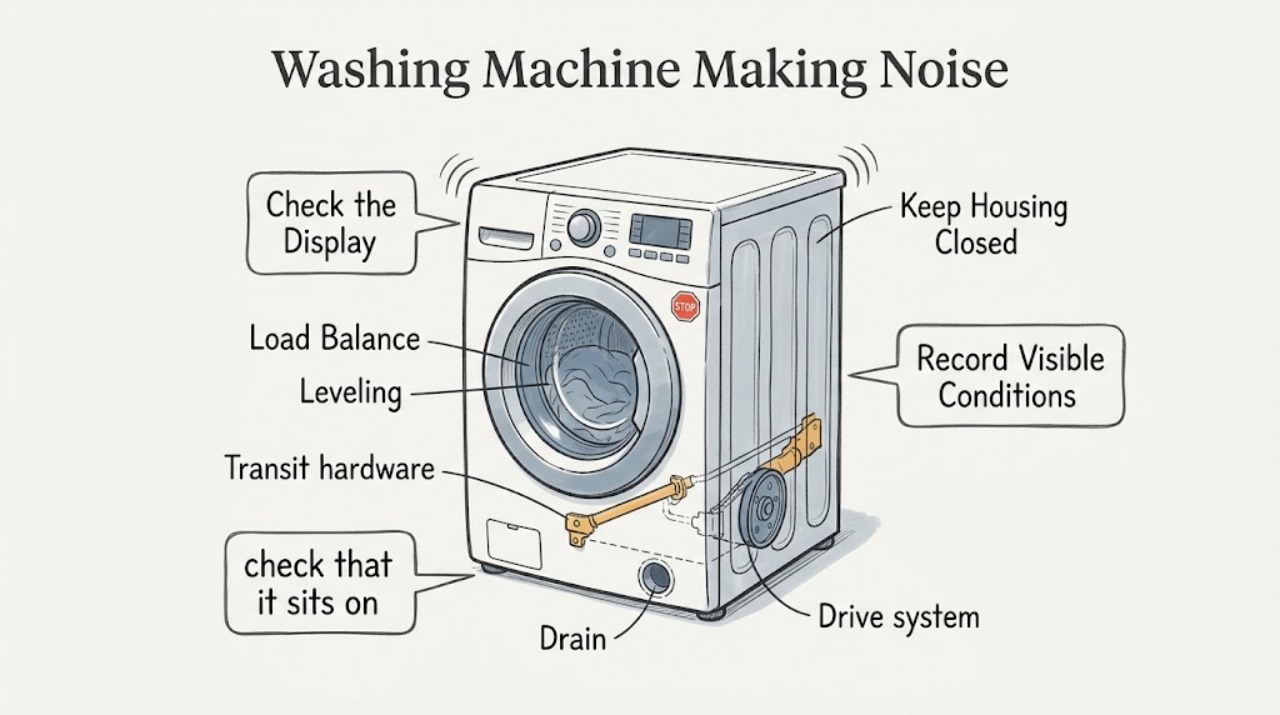
A Fisher & Paykel washing machine can make normal drain, fill, motor, or warning sounds, but banging and new vibration usually deserve a load and installation check first. Pause normally and redistribute the load, reduce an overloaded or bulky load, confirm the machine is level and stable, and verify that front-load transit bolts were removed after installation. Fisher & Paykel says an out-of-balance load can lower spin speed or cause banging, while a top-loader can splash when the water level is too high for the load. If the noise is a sharp scrape, grinding, repeated knocking with an empty balanced drum, accompanied by a leak or fault beeps, or persists after these checks, stop the cycle and arrange qualified Fisher & Paykel service.
Before you begin
Safety first
- Stop for smoke, burning odor, sparking, damaged wiring, a growing leak, repeated breaker trips, or unsafe drum movement. Keep hands away from moving parts and do not remove covers or internal hardware.
Work through in order
Diagnostic checks
Use only checks that match the exact appliance or system and its official guide.
-
Check 1
Record the sound and its timing without leaning over a moving machine: banging or thumping, rattling, squealing, scraping, humming, water splashing, or a series of warning beeps. Note whether it appears only during spin, whether the basket is visibly moving off-center, whether the machine completes the cycle, and whether a fault code or puddle appears.
Expected result: The sound is a short normal-operation sound, a bang during spin, repeated vibration, a harsh mechanical sound, a warning-beep sequence, or noise accompanied by water.
Next step: If the sound is a spin bang or vibration, pause normally and check the load. If it is harsh, accompanied by a leak or fault, or occurs with no load, stop the cycle and continue only with safe external observations.
Why this matters
Why: Fisher & Paykel identifies banging as an out-of-balance symptom and treats continuous or repeated beeps as a fault indication. A noise with water or a harsh mechanical character changes the priority from a loading adjustment to a stop and service decision.
-
Check 2
Use the normal pause control and wait for the drum or bowl to stop. Redistribute clothes evenly, remove a few heavy items, and avoid testing a front-loader with one heavy item or a top-loader with one bulky item alone. Close the door or lid and run one average, balanced load at an appropriate cycle.
Expected result: Clothes were bunched to one side, the load was overloaded or bulky, the noise disappears with an average balanced load, or the same sound returns.
Next step: Keep similar-weight items distributed and use the model's bulky or delicate cycle when applicable. If the same noise returns with a balanced load, continue to the stability and installation checks rather than increasing the spin speed.
Why this matters
Why: An uneven load can make Fisher & Paykel washers bang, reduce spin speed, or repeatedly go out of balance. A quiet balanced test supports a load cause; recurrence with an ordinary load makes leveling, installation, or a mechanical fault more likely.
-
Check 3
With the machine idle, check that it sits on a firm, flat surface and does not rock in any direction. For a front-loader, verify from the installation guide that transit bolts and packing hardware were removed; for a top-loader, confirm all feet support the machine evenly. Do not move a loaded machine or loosen hardware while it is running.
Expected result: The machine rocks, one foot is not supporting it, the floor or stand flexes, transit bolts remain, or the installation is stable and the noise persists.
Next step: Follow the exact installation guide to level the machine or arrange removal of transit hardware if it was left in place. If it is already stable and the noise continues, stop repeated high-speed tests and arrange service if the next checks do not resolve it.
Why this matters
Why: Fisher & Paykel links repeated imbalance and vibration with an unlevel machine, while front-loader guidance specifically identifies transit bolts left in place as a vibration cause. A stable installation makes load and internal mechanical causes more important.
-
Check 4
For a top-loader, review the water level and load shape, especially with pillows, duvets, or other bulky garments. Use Auto or the load-appropriate water level where the model provides it, and choose the model's bulky, delicate, or hand-wash cycle as directed. Observe whether splashing, a small puddle, or banging changes when the load and water level are corrected.
Expected result: The water level was high for the load, a bulky item caused splashing, a lower or automatic level quiets the machine, or noise and water remain with an ordinary load.
Next step: Use the model's recommended water level and cycle for that load. If a puddle grows, the noise persists with a normal load, or the source is not clearly splash-related, stop and request service.
Why this matters
Why: Fisher & Paykel says an excessive water level can cause splashing and that large bulky garments can contribute to splashing; its top-loader guidance separately links banging with imbalance. A quiet result after the correct cycle supports a load or water-level cause, not a failed drive part.
-
Check 5
Check for signs that the sound is a normal operating or warning sound rather than a new mechanical noise. Listen briefly during a drain or controlled spin, note whether the machine lowers spin speed to correct balance, and check for continuous beeps or a displayed fault. Do not continue washing or drying after a fault alert until its user guide has been followed.
Expected result: The sound is limited to drain or fan operation, the spin slows while balance is corrected, a continuous beep or code appears, or a harsh sound continues independent of cycle stage.
Next step: If the sound matches normal operation and there is no damage or fault, monitor the next balanced cycle. If beeps or a code appear, record them; if harsh noise persists, stop the appliance and arrange qualified service.
Why this matters
Why: Fisher & Paykel's warranty distinguishes normal drain, fan, and warning sounds from product defects, while its washer and washer-dryer guides identify balance correction and fault-code beeps as different conditions. A harsh sound that does not follow load or cycle changes is not safely identifiable from the outside.
-
Check 6
After the load, stability, water-level, and normal-sound checks, run only one supervised test with an average balanced load. Record whether the noise is present when empty or during a specific stage, whether the drum spins normally, and whether vibration, leakage, heat, or a fault returns. Keep hands clear of the moving drum and do not remove covers.
Expected result: The machine is quiet and stable, the sound returns with an empty or balanced load, the drum has scraping or grinding behavior, or the machine leaks or reports a fault.
Next step: If the sound returns after these checks, stop further tests and contact Fisher & Paykel service with the model, sound timing, load, installation result, and any code or leak details.
Why this matters
Why: A quiet balanced cycle supports a correctable loading or installation cause. Noise that remains without a load, a harsh change in drum movement, or a leak or fault is consistent with a mechanical, pump, suspension, motor, or control condition that needs professional diagnosis.
Use your observations
Decision map
Find the observation that best matches what you see, then follow the next safe action.
-
PATH 01Next step
What you see
Banging or vibration occurs only with a bunched, single, bulky, or overloaded load
Do this next
Pause normally, redistribute or reduce the load, and use the model-appropriate bulky or delicate cycle.
-
PATH 02Next step
What you see
The washer rocks, is on an unstable surface, or a front-loader still has transit bolts
Do this next
Follow the installation guide to restore a level, stable installation before another spin test.
-
PATH 03Next step
What you see
A top-loader splashes or leaves a small puddle with bulky items or excessive water level
Do this next
Use the load-appropriate water level and cycle. Stop if water continues or the puddle grows.
-
PATH 04Next step
What you see
Only ordinary drain, fan, or balance-correction sounds occur and the machine is stable with no fault
Do this next
Monitor the next balanced cycle; treat a new harsh or escalating sound as a separate service branch.
-
PATH 05Next step
What you see
Noise persists with an empty or balanced machine, or appears with a leak, continuous beeps, scraping, grinding, or a fault code
Do this next
Stop the cycle and arrange qualified Fisher & Paykel service; do not open the cabinet to identify the component.
Helpful context
Understand the symptom
Sound timing is more useful than volume alone
Note whether the sound occurs during filling, washing, draining, acceleration into spin, or the end of a cycle. A brief drain or pump sound can be part of ordinary operation, while a new bang that coincides with the basket accelerating points toward load balance or installation. A scrape, grinding sound, repeated hard knock, or noise with an empty drum deserves a service boundary even if the machine still completes a cycle.
Top-load and front-load checks are not identical
Fisher & Paykel's top-load guidance focuses on distributing clothes in the bowl, water level, bulky items, and leveling. Its front-load guidance adds transit bolts and the difficulty of balancing a single item during spin. Use the model's installation and user guide for any access or adjustment rather than applying a top-loader instruction to a front-loader.
Safety boundary
Stop conditions
- Stop immediately for smoke, a burning smell, sparking, a damaged cord, a growing leak, exposed wiring, repeated breaker trips, or a drum that strikes the cabinet or moves dangerously.
- Do not reach into a moving drum, move a loaded machine, remove covers, or attempt to adjust internal suspension, bearings, motor, pump, or wiring as a user check.
- Do not continue washing after continuous beeps or a fault code until the model's user guide has addressed the warning.
- Stop after the external load, water-level, leveling, and installation checks when the noise persists with a balanced or empty machine.
Only after diagnosis
Potential parts
- leveling foot or installation hardware
Only consider this class if the machine cannot be made stable by the model's leveling procedure and a technician confirms a damaged foot or installation component.
Confirm the exact Fisher & Paykel model and installation configuration before ordering. - suspension or tub support component
Only consider this class if repeated vibration remains with a level installation and balanced load and a technician isolates worn or damaged support hardware.
Confirm the exact model and diagnosed support design; load imbalance alone does not establish a part fault. - drum bearing or drive component
Only consider this class after a qualified diagnosis of scraping, grinding, or persistent rumbling with an empty drum has ruled out loading, leveling, transit hardware, and normal drain sounds.
Confirm the exact model and professional diagnosis before ordering; do not disassemble the cabinet to inspect it.
When checks do not resolve it
Need a professional?
Call a qualified Fisher & Paykel technician when noise persists with an average balanced load or empty drum, the machine cannot be leveled, transit hardware or installation is uncertain, the sound is scraping, grinding, or repeated hard knocking, a leak or fault code appears, or vibration risks moving the appliance.
Safety scope: Stop for smoke, burning odor, sparking, damaged wiring, a growing leak, repeated breaker trips, or unsafe drum movement. Keep hands away from moving parts and do not remove covers or internal hardware.
Have this ready
- Fisher & Paykel model number
- top-load or front-load configuration
- sound type and cycle stage
- whether the sound occurs with an empty drum
- load size and whether it was bulky or uneven
- leveling and floor-stability result
- whether transit bolts were removed on a front-loader
- any fault beeps, display code, puddle, leak, or abnormal drum movement
Common questions
FAQ
Why is my Fisher & Paykel washer banging during spin?
The first check is load balance. Pause normally, redistribute clothes, reduce a bulky or overloaded load, and run one average balanced load. If the machine still bangs, confirm it is level and stable and that front-loader transit bolts were removed.
Can an unlevel Fisher & Paykel washer make noise?
Yes. Fisher & Paykel links repeated imbalance and vibration with a washer that rocks or is not level. Follow the model installation guide to level it on a firm surface before testing again.
Are some Fisher & Paykel washer sounds normal?
Some drain, fan, and warning sounds can be normal according to Fisher & Paykel's USA guidance. A new scraping, grinding, repeated hard knock, or sound with an empty balanced drum is different and should be evaluated by service.
What should I do if my washer noise comes with a leak or fault beeps?
Stop the cycle and address the warning before continuing. Record the model, sound timing, display or beep pattern, and water location. A growing leak, continuous beeps, or repeated noise after safe checks needs qualified Fisher & Paykel service.
Read the exact guide
Official sources
- Front Loading Clothes Washer User Guide WH2424F and WH2424PFisher & Paykel · Official Fisher & Paykel user guide for specified front-loader models; exact installation instructions vary by model.
- Front Loading Washer Dryer User Guide WD8560F1, WD7560P1, and WD8060P1Fisher & Paykel · Official Fisher & Paykel user and installation guide for specified front-loading washer-dryer models; use the exact local model guide for other appliances.
- Fisher & Paykel WashSmart and QuickSmart Washers User GuideFisher & Paykel · Official Fisher & Paykel user guide for specified top-loader washer families; controls and cycles vary by model.
- Fisher & Paykel FabricSmart Clothes Washer User Guide WA1068PFisher & Paykel · Official Fisher & Paykel user guide for the specified FabricSmart washer; use the exact model guide for other machines.
- Warranty | Appliance | Parts | Service WarrantyFisher & Paykel USA · Official Fisher & Paykel USA warranty guidance; it is used here only for the normal-sound distinction, not warranty eligibility.
Community feedback
Share a repair observation
Share a plain-text repair observation. Accepted observations are published automatically; this page may take a moment to update.