
On this page
Start here
Quick answer
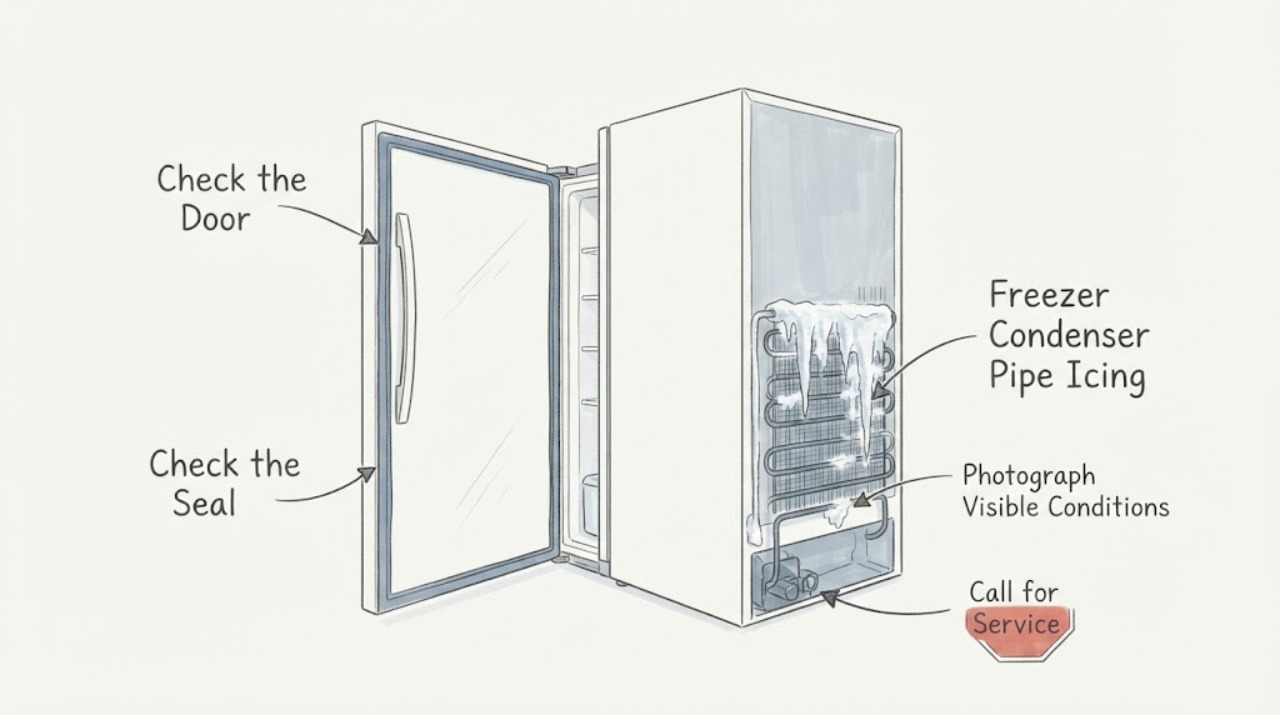
First identify where the ice is. GE explains that a freezer's condenser removes heat and may run inside the cabinet walls, while the evaporator is the part that cools the freezer and may be at the rear or inside the walls. Ice on an interior rear coil or wall is therefore not evidence that an exposed condenser pipe needs refrigerant repair. Unplug the freezer, protect the food, and follow the model manual's defrost procedure; never puncture tubing, scrape with a knife, use a hair dryer or heater, or open the sealed system. Check the door seal, blocked vents, overpacking, and frost recurrence from outside. If the location is unclear, the freezer does not cool, frost returns rapidly, or tubing has been damaged, stop and arrange qualified refrigeration service.
Work through in order
Diagnostic checks
Use only checks that match the exact appliance or system and its official guide.
-
Check 1
Without removing panels, record where the ice is: on the inside rear wall or coil area, on a shelf or interior liner, on an external cabinet surface, or on a truly exposed tube near the compressor or condenser compartment. Photograph the frost pattern and locate the model label for the owner manual.
Expected result: The ice is inside the freezer at the rear, on the cabinet exterior, on an accessible condenser compartment, or on tubing whose function cannot be identified safely.
Next step: If the tube or coil cannot be identified without removing covers, stop at the observation and use the exact manual or qualified service. Do not scrape or bend any tubing.
Why this matters
Why: GE distinguishes the heat-rejecting condenser from the freezer-cooling evaporator and notes that both may be built into cabinet walls depending on freezer design. The phrase 'condenser pipe' alone does not identify the affected component.
-
Check 2
Unplug the freezer or disconnect power using the model's documented method, move food to another cold location, and let removable ice melt with the door or lid open as the manual directs. Protect the floor and use the specified drain or pan if the model has one.
Expected result: The model has a manual-defrost procedure, or the unit is frost-free/automatic-defrost; the ice melts normally, or it remains attached to a tube or panel.
Next step: Follow the exact manual for the freezer type. If ice remains attached to tubing or an enclosed panel, stop rather than force it and arrange service. Do not restore power until the model's procedure says the interior is dry and reassembly is complete.
Why this matters
Why: Whirlpool's defrost guide requires power removal, food protection, drainage, and natural melting. GE explains that many upright freezers use automatic defrost, so a user should not assume every freezer should be manually defrosted in the same way.
-
Check 3
After safe defrosting, inspect the door or lid gasket for gaps, tears, dirt, or packages preventing closure. Keep interior vents clear and reduce overpacking; avoid leaving the door open or placing warm, uncovered food inside.
Expected result: The gasket seals continuously and vents are clear, or there is a gap, damaged gasket, blocked vent, frequent-opening pattern, or overpacked compartment.
Next step: Clean a dirty gasket with the manual-approved method and remove obstructions. If the gasket is torn, the door will not close, or frost returns despite a good seal and clear airflow, arrange service rather than changing refrigerant settings.
Why this matters
Why: Whirlpool identifies warm humid air, poor door sealing, frequent openings, blocked vents, and overpacking as contributors to frost and airflow problems. These observations do not prove a sealed-system fault.
-
Check 4
If the exact manual identifies an accessible condenser area, inspect it only with power disconnected for visible dust and restricted air clearance. Vacuum or clean it only in the manner the manual permits; do not remove sealed panels or treat frost on a cabinet-embedded tube as a cleanable coil.
Expected result: The condenser is accessible and dusty, the condenser is enclosed in the cabinet, or a tube is icy and its identity is uncertain.
Next step: Perform only the manual-approved external cleaning and restore the required clearance. If the condenser is enclosed or the tube is icing, stop and use qualified refrigeration service; do not cut insulation or access the sealed circuit.
Why this matters
Why: Whirlpool notes that some condenser coils can be cleaned while others are enclosed and inaccessible; GE says wrap-around condenser tubing may run inside the outside wall. Ice on an unidentified tube is not a user-serviceable refrigerant diagnosis.
-
Check 5
After the approved defrost and external checks, run the freezer normally and observe temperature, airflow, compressor/fan behavior, and whether the same frost pattern returns. Keep the door closed while it stabilizes and follow the exact manual for temperature expectations.
Expected result: Cooling and airflow recover without rapid refrosting, or the freezer remains warm, frost returns quickly, the compressor runs abnormally, or the same tube ices again.
Next step: If the symptom returns or cooling remains poor, unplug or leave the unit in the safe state specified by the manual and schedule qualified refrigeration service. Provide the frost location, photos, model, temperature behavior, and the checks already performed.
Why this matters
Why: Whirlpool says thick or recurring frost can block airflow and that rapid accumulation may have an underlying defrost or cooling problem requiring professional investigation. A recurrence does not identify a refrigerant fault by itself.
Use your observations
Decision map
Find the observation that best matches what you see, then follow the next safe action.
-
PATH 01Next step
What you see
Ice is on the inside rear wall or a covered coil area rather than on an exposed external condenser.
Do this next
Use the freezer's exact defrost instructions and check door sealing and vents. Do not scrape the coil or open the refrigeration circuit.
Why this path and its safety boundary
Why it matters: That location is consistent with the evaporator/defrost and airflow area described by GE and Whirlpool, so the label 'condenser pipe' is not confirmed.
-
PATH 02Next step
What you see
The freezer is a manual-defrost model and frost is thick enough to obstruct storage or airflow.
Do this next
Unplug, protect food, allow melting, drain and wipe as directed, and avoid knives, ice picks, hair dryers, and heaters. Have service inspect a tube that remains frozen or damaged.
Why this path and its safety boundary
Why it matters: The frost can be removed by the model's power-off defrost procedure, but the process does not repair a refrigeration-circuit defect.
-
PATH 03Next step
What you see
The same ice returns quickly after a complete approved defrost, with a good door seal and clear vents.
Do this next
Stop DIY work and arrange qualified refrigeration service. Do not add refrigerant, solder tubing, bypass a defrost control, or remove internal panels.
Why this path and its safety boundary
Why it matters: Rapid recurrence narrows the issue toward an unresolved defrost, airflow, or cooling-system problem but does not identify which internal part or refrigerant condition is at fault.
-
PATH 04Next step
What you see
The tube is punctured, kinked, oily, hissing, or accessible only after removing a sealed panel.
Do this next
Leave the freezer off, ventilate the area if there is an unusual odor, keep away from the damaged area, and call qualified refrigeration service. Do not test, braze, or recharge the circuit.
Why this path and its safety boundary
Why it matters: The symptom may involve the sealed refrigeration system or physical damage and is outside safe user maintenance.
Helpful context
Understand the symptom
The tube name may be the problem
A freezer owner may call any visible cold or warm tube a condenser pipe, but the two sides of the refrigeration system are different. GE states that the condenser rejects heat and can be routed just inside the outside walls, while the evaporator is the part that cools the freezer and may be at the rear or inside the walls. Ice at the back inside the freezer is more consistent with the evaporator area or an airflow/defrost symptom than with an exposed condenser that a user can repair.
What you can check without opening the sealed system
The safe user checks are location, frost pattern, door sealing, blocked vents, overpacking, and the exact model's defrost instructions. Whirlpool says thick frost can block airflow and that rapid recurrence deserves professional investigation. These checks can narrow the symptom, but they cannot establish a refrigerant leak, restriction, compressor fault, or tubing blockage.
Why scraping or charging the pipe is unsafe
A freezer tube is part of the refrigeration circuit or is embedded in the cabinet. Puncturing, bending, heating, cutting insulation, or adding refrigerant without an approved diagnosis can turn an observation into a leak or injury. Whirlpool's defrost guidance specifically warns against sharp tools and electrical heaters; use a model-specific defrost procedure and qualified service for sealed-system work.
When checks do not resolve it
Need a professional?
Arrange qualified refrigeration service when the ice location is unclear, the freezer does not cool, frost returns rapidly after an approved defrost, the door or gasket cannot seal, a tube is damaged or oily, a sealed panel must be removed, or the diagnosis would require refrigerant recovery, charging, brazing, live electrical testing, or bypassing a defrost control.
Common questions
FAQ
Is ice on a freezer condenser pipe normal?
The phrase is ambiguous. GE says the condenser rejects heat and may be tubing inside the outside wall, while the evaporator cools the freezer and may be at the rear or inside the walls. Identify the location before deciding whether there is a condenser problem.
Can I scrape the ice off with a knife or heat the pipe?
No. Whirlpool warns against an ice pick, knife, hair dryer, or heater during defrosting because these can damage the freezer or create a hazard. Disconnect power and follow the exact manual's defrost process instead.
Could a blocked vent or bad door seal cause the ice?
Yes, those are supported external contributors to frost and airflow problems. Clear obstructions and check the gasket after a safe defrost, but recurring ice still needs service rather than a guessed refrigerant repair.
Should I add refrigerant if the pipe ices?
Do not add refrigerant based on frost alone. The pipe may be an evaporator or an enclosed condenser, and a correct diagnosis requires model-specific and sealed-system service equipment.
Read the exact guide
Official sources
- How to Defrost the FreezerWhirlpool Product Help · Supports power-off defrost, food protection, drainage where provided, natural melting, and warnings against sharp tools, hair dryers, and heaters; exact freezer-model instructions still control.
- Upright & Chest Freezer - Benefit of Wrap Around Condenser and EvaporatorGE Appliances Support · Used to correct the condenser-versus-evaporator terminology and to show that tubing may be enclosed in freezer walls; it does not diagnose the unidentified freezer or authorize tube access.
- 7 Freezer Problems & How to Help Fix ThemWhirlpool · Supports the distinction between condenser and evaporator symptoms, external condenser accessibility limits, frost/airflow checks, rapid-frost service escalation, and no sealed-system DIY diagnosis for this unidentified freezer.
- How to Avoid Frost Build UpWhirlpool Product Help · Supports external checks for humidity, door sealing, frequent openings, warm food, overpacking, and airflow; it does not establish a sealed-system diagnosis.
- Refrigerator and Freezer - Types of Defrost SystemsGE Appliances Support · Supports the distinction between automatic and manual defrost designs and the model-dependent location of the evaporator/defrost heater; it is not used to assign a specific system to the unidentified freezer.
Community feedback
Share a repair observation
Share a plain-text repair observation. Accepted observations are published automatically; this page may take a moment to update.