
On this page
Start here
Quick answer
A dripping or water-running sound from a frost-free freezer can be normal: GE describes melted defrost water falling into the drain pan, and Whirlpool describes dripping or gurgling during defrost as a normal operating sound. The sound alone does not prove a refrigerant leak. Treat it differently if water is actually escaping onto the floor, the door or seal is admitting warm air, the freezer is developing unusual ice, the sound is very loud, or food is no longer staying frozen. Check the source and temperature from outside, keep the door closed, and arrange model-specific service instead of opening the sealed refrigeration system or adding refrigerant.
Work through in order
Diagnostic checks
Use only checks that match the exact appliance or system and its official guide.
-
Check 1
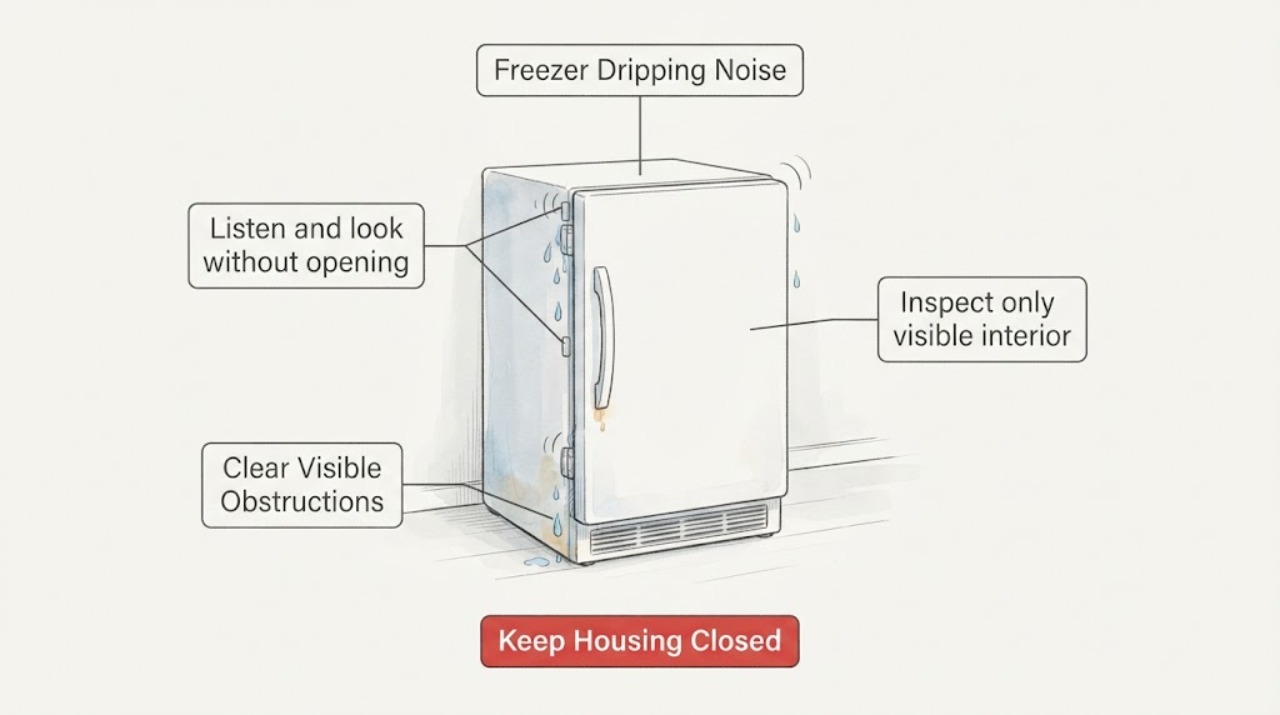
Listen and look without opening panels: note whether the dripping or water-running sound occurs during or after a defrost period, and whether it is heard inside the cabinet or behind the unit. Check the floor and cabinet for actual water at the same time.
Expected result: There is a periodic internal sound with no water escaping, or there is visible water, a persistent stream, or an unusually loud/continuous sound.
Next step: For an internal periodic sound with no leak, continue the external checks and monitor cooling. For visible spillage or a loud continuous sound, keep the freezer closed and arrange model-specific service; do not open the sealed system.
Why this matters
Why: GE and Whirlpool describe water entering a defrost pan during defrost as a normal sound. Visible spillage or a loud persistent noise is a different observation and is not explained by the sound alone.
-
Check 2
Check the door closing and gasket from outside. Look for a package blocking the door, a torn or folded seal, or a sheet of paper that pulls out with almost no resistance at a closed section of the gasket.
Expected result: The door does not close squarely or the seal has a clear gap, or the door closes and the gasket grips consistently.
Next step: Remove only an obvious obstruction and close the door normally. If the seal is damaged, air is escaping, water returns, or the freezer is warming, keep the door closed and request service rather than adjusting a sealed-system part.
Why this matters
Why: Samsung’s freezer-leak guidance says a door that does not close properly can let the appliance warm and cause water to form; it also gives the paper and air-escape checks for the seal. A good seal makes that particular leak path less likely but does not prove the drain or cooling system is sound.
-
Check 3
Inspect only visible interior and floor areas for a new sheet of ice, water pooling at the bottom, frost that is spreading unusually, or food that is softening. Do not remove an interior panel, probe a drain with a sharp object, use a heat source, or puncture ice.
Expected result: There is no water or unusual frost and the freezer remains at its normal set condition, or there is pooling, repeated ice, or a noticeable cooling change.
Next step: For recurrence or temperature change, protect perishable food as appropriate, keep the freezer closed, record the model and symptom timing, and arrange service. Do not attempt a refrigerant recharge or sealed-system repair.
Why this matters
Why: A normal defrost sound should not be treated as evidence of lost refrigerant. Water or frost recurrence and a cooling change indicate that the drain, door, defrost or cooling path needs model-specific diagnosis; they do not identify a particular part or refrigerant charge.
-
Check 4
Record whether the sound is a soft periodic drip, a gurgle/bubble, a hiss/sizzle, or a harsh loud noise, and whether it changes when the compressor, fan, ice maker or defrost cycle operates. Do not repeatedly open the door or run a manual defrost just to reproduce the sound.
Expected result: The sound matches a documented normal pattern and remains quiet, or it is loud, new, continuous, or accompanied by water or poor cooling.
Next step: Keep a short safe recording and the timing notes for the service technician. If loudness, water or cooling loss is present, stop treating it as normal and request service.
Why this matters
Why: Official manufacturer guidance describes refrigerant flow and defrost water as possible normal sounds, while Samsung and Whirlpool direct owners to service when the sound is very loud or cannot be explained. A sound label alone cannot identify a refrigerant leak.
-
Check 5
Check for a stop condition: water reaching an outlet or wiring, smoke or burning smell, a damaged cord, a rapidly rising temperature, or food thawing. Do not touch wet electrical connections or remove covers.
Expected result: Any stop condition is present, or none is present and the freezer is holding its normal temperature without a visible leak.
Next step: For a stop condition, isolate power only if this can be done without touching a wet or damaged connection, keep the door closed, and arrange qualified service. Otherwise, continue monitoring and use the exact model manual if the sound changes.
Why this matters
Why: A stop condition is beyond normal-noise troubleshooting. Without it, a quiet periodic defrost sound may be normal, but no-model research still cannot certify the appliance or rule out a future fault.
Use your observations
Decision map
Find the observation that best matches what you see, then follow the next safe action.
-
PATH 01Next step
What you see
The sound is periodic and internal, occurs around defrost, and there is no puddle, unusual frost or cooling change.
Do this next
Monitor the freezer with the door closed and keep the model information available. Escalate if the sound becomes loud or continuous, water escapes, or cooling changes.
Why this path and its safety boundary
Why it matters: This matches the normal defrost-water descriptions from GE and Whirlpool. It does not indicate a refrigerant leak by itself.
-
PATH 02Next step
What you see
Dripping noise is accompanied by water on the floor, inside the cabinet, or around the base.
Do this next
Keep the freezer closed, check only the door, gasket and visible source, protect nearby electrical connections, and arrange service if the source is not immediately obvious. Do not diagnose refrigerant from the puddle.
Why this path and its safety boundary
Why it matters: Whirlpool treats spillage with a dripping sound as a possible leak, and Samsung lists door sealing, defrost drainage and other external water paths for fridge/freezer leaks.
-
PATH 03Next step
What you see
The sound is very loud or persistent, or the freezer is warming, building unusual ice, or softening food.
Do this next
Record the sound and temperature/food change, minimize door opening, and request qualified service. Do not open the sealed refrigeration system or add refrigerant.
Why this path and its safety boundary
Why it matters: A normal defrost or refrigerant-flow sound is no longer a sufficient explanation. The pattern requires model-specific cooling/defrost diagnosis; it does not identify a refrigerant leak or a particular component.
-
PATH 04Next step
What you see
The sound is difficult to locate and there is no exact brand or model manual available.
Do this next
Find the rating-label model and serial information, then use that manufacturer’s support path. Keep the external observations and do not order parts or attempt refrigerant work by sound alone.
Why this path and its safety boundary
Why it matters: The normal-sound examples are manufacturer-specific and cannot certify an unknown freezer’s operation or service threshold.
Helpful context
Understand the symptom
First separate a sound from a leak
A frost-free freezer periodically melts ice during defrost. GE says the melted water can be heard dripping into the defrost drain pan, and Whirlpool says dripping or gurgling during defrost is generally normal. That describes a sound inside the appliance, not water on the floor. If you can see a puddle, damp cabinet, or repeated overflow, treat the water path as a separate fault and do not label it a refrigerant problem from sound alone.
Why the refrigerant question cannot be answered by sound alone
Samsung’s noise guidance says refrigerant moving through the cooling system can make gurgling or bubbling sounds and that defrost water on the heater can make hissing or sizzling sounds. Whirlpool likewise describes hissing from refrigerant flow as a normal sound. These descriptions are not a leak test: a sealed-system diagnosis needs the exact model and qualified service when cooling performance or the physical appliance condition is abnormal.
Use the model manual for the final threshold
No brand or model was supplied, and the Reddit lead could not be retrieved reliably. Door seals, drain access, temperature displays and service procedures vary by freezer. The safe common checks are to identify where the sound occurs, look for actual water or a blocked door seal from outside, observe frost and cooling changes without dismantling panels, and record the model before requesting service.
Common questions
FAQ
Does a dripping sound prove that the freezer is leaking refrigerant?
No. GE and Whirlpool describe defrost water entering a drain pan as a normal source of dripping or water-running sounds, while Samsung and Whirlpool also describe refrigerant flow as a possible gurgling or hissing sound. Sound alone cannot identify a refrigerant leak.
When is the dripping noise a reason to call for service?
Request service when dripping is accompanied by water spillage, a door or seal that will not close, unusual frost, worsening temperature or softened food, or a loud or continuous noise. These observations need model-specific diagnosis; they do not identify a part by themselves.
Can I add refrigerant or open the freezer to check the cause?
No. The reviewed official guidance supports external observation and service escalation, not a no-model refrigerant charge or sealed-system procedure. Keep the freezer closed and provide the model, symptom timing and cooling observations to a qualified technician.
Read the exact guide
Official sources
- Upright & Chest Freezer - Explanation of a Water Dripping SoundGE Appliances · Official GE support says frost-free upright and chest freezers can drip melted defrost water into a drain pan and that this can be heard as a normal sound. It is a family-level normal-sound explanation, not a diagnosis for an unknown model.
- Understanding the different noises coming from your Samsung refrigeratorSamsung Support · Official Samsung US refrigerator guidance says refrigerant movement can make gurgling/bubbling sounds, defrost water can make hissing/sizzling sounds, and very loud hissing should be serviced. These are Samsung-family examples, not a universal leak test.
- What should I do if I suspect my Samsung fridge/freezer is leaking water?Samsung UK Support · Official Samsung UK fridge/freezer guidance covers door closure and gasket checks, visible drain/pan and connection observations, distinguishing outside spills, and contacting support when the source is unresolved. It does not diagnose refrigerant leakage.
- Refrigerator Noise - Sizzling, Hissing, or Water Dripping - Product Help | WhirlpoolWhirlpool Product Help · Official Whirlpool Product Help states that sizzling or hissing can be water dripping onto the defrost heater during defrost and calls this normal operation. It does not establish a refrigerant leak or a repair for an unknown model.
- Why Is My Refrigerator Making Noise? | WhirlpoolWhirlpool · Official Whirlpool article covers refrigerator and freezer sounds, identifies dripping/gurgling during defrost as generally normal, identifies hissing refrigerant flow as a normal sound in most cases, and directs service when water spills or noise is excessive.
Community feedback
Share a repair observation
Share a plain-text repair observation. Accepted observations are published automatically; this page may take a moment to update.