
On this page
Start here
Quick answer
Ice at the bottom of a frost-free upright freezer is not enough to identify a failed defrost part. First check the door gasket and closure, packages or frost blocking the seal, blocked interior airflow, frequent or prolonged door opening, and any water outside the cabinet. Frost-free upright freezers normally melt frost during an automatic defrost cycle and send the melted water to a drain pan, so recurring ice at the bottom can require model-specific service when the door and external conditions are normal. Do not remove the rear panel, heat the liner with a flame, probe a drain, or replace a defrost component without the exact model manual.
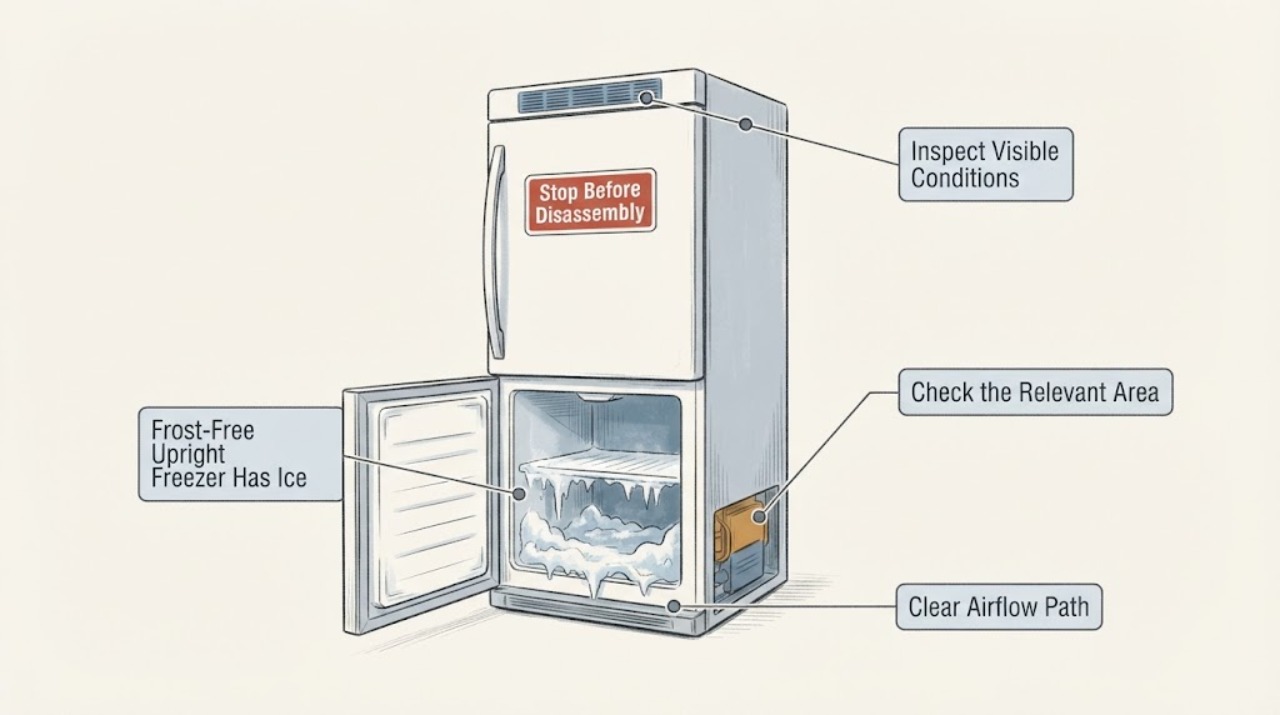
Work through in order
Diagnostic checks
Use only checks that match the exact appliance or system and its official guide.
-
Check 1
Record the freezer model and serial number, then observe the ice while the door is open only long enough to locate it safely. Note whether the ice is a thin frost layer, a hard pool or sheet on the floor, or accompanied by water outside the cabinet. Do not chip the ice with a knife or sharp tool.
Expected result: The ice is limited to a light frost pattern, forms a hard sheet or pool at the bottom, or there is visible water under or around the freezer.
Next step: Take a photo and keep the model information with it. Continue only with the external seal, loading and airflow checks below; if water is near an electrical connection, keep clear and leave the freezer out of service until it is safe.
Why this matters
Why: A thin frost pattern can follow moisture entering during normal use, while recurring bottom ice or external water needs the model’s defrost-water path and installation checked. The appearance alone does not prove a blocked drain, heater failure or sensor fault.
-
Check 2
Inspect the closed door and gasket from the outside and inside edge. Remove packages or ice that prevent full closure, clean food residue from the gasket with the model-approved gentle method, and look for a torn, warped or visibly displaced seal. Do not pull the gasket out of its channel or use heat to reshape it.
Expected result: The door closes evenly with the gasket touching the frame, or there is a gap, obstruction, tear, warp or section that does not seal.
Next step: Correct only an obvious external obstruction or surface residue. If the gasket is damaged, displaced or still leaves a gap, keep the door closed as much as practical and use the exact model manual or service for the seal; do not dismantle the door system.
Why this matters
Why: Frigidaire identifies a warped door or gasket and an incomplete closure as causes of warm air and frost buildup. A sound-looking gasket makes that explanation less likely but does not rule out an internal defrost-water issue.
-
Check 3
Check the interior loading and airflow without removing panels: keep food from covering vents, avoid packing items tightly against the rear or side air paths, and reduce unnecessary or prolonged door openings. Confirm that warm or uncovered food is not being placed into the freezer.
Expected result: A vent is blocked, food is warm or uncovered, the freezer is overpacked, or the loading and door-use pattern is normal.
Next step: Rearrange items to clear the vents, cover or cool food according to the model instructions, and close the door promptly. Monitor whether new ice returns; do not change an unknown temperature setting repeatedly to chase the symptom.
Why this matters
Why: Official frost guidance attributes frost to moisture-laden air, warm or uncovered food, frequent door openings and blocked airflow. These conditions can create frost without proving that an automatic-defrost component has failed.
-
Check 4
Check the freezer’s outside floor and surrounding area for a plumbing leak, spill, condensation or a unit that rocks or is visibly out of position. Do not pull a loaded upright freezer away from the wall or adjust leveling legs unless the model instructions make that an approved user step.
Expected result: There is an external water source or the cabinet is unstable, or the area is dry and the freezer is stable.
Next step: Remove only an obvious external spill and keep the freezer stable. If water recurs, the door does not close, or the source is not clear, request service and provide the photos and model number.
Why this matters
Why: External water can be mistaken for defrost water, while proper leveling helps an upright freezer door close correctly. A dry, stable cabinet with recurring interior bottom ice points back to a model-specific internal path rather than a confirmed external cause.
-
Check 5
After the external checks, compare the symptom with the exact owner manual: frost-free models should describe their defrost behavior and any user-accessible drain or pan. Do not remove a rear evaporator cover, probe a drain, pour hot water into an unseen opening, or replace a heater, sensor, timer or control based on the ice location alone.
Expected result: The exact manual provides a model-specific external defrost or drainage check, or it directs service for recurring ice at the bottom.
Next step: Follow only the exact model manual’s user-level step. If no model-specific step is provided or the ice returns, leave the freezer operating only if the door seals and temperature remain safe, and arrange qualified service rather than guessing the failed defrost component.
Why this matters
Why: GE’s frost-free explanation confirms that automatic defrost creates meltwater that should reach a drain pan, but the source does not establish that every upright has the same accessible path. The model manual controls what, if anything, is safe to access.
Use your observations
Decision map
Find the observation that best matches what you see, then follow the next safe action.
-
PATH 01Next step
What you see
The gasket has a gap, visible damage, or an obstruction, and the ice is concentrated near the door or returns after door-opening or loading problems.
Do this next
Correct only the visible obstruction or surface residue. If the seal remains damaged or the ice continues, use the model manual or qualified service for gasket evaluation; do not remove the sealing system yourself.
Why this path and its safety boundary
Why it matters: Warm humid air entering through an incomplete seal is a supported frost mechanism, but the ice pattern does not prove that the gasket is the only fault.
-
PATH 02Next step
What you see
The gasket closes evenly, vents are clear, the freezer is not being loaded with warm or uncovered food, and the bottom ice returns as a hard sheet or pool.
Do this next
Keep the model and serial information, stop making unapproved internal changes, and arrange model-specific service. Provide photos showing the ice location and any external water.
Why this path and its safety boundary
Why it matters: The common external moisture and airflow explanations are less likely. Frost-free defrost water normally goes toward a drain pan, but the available family-level sources cannot identify a blocked drain or failed defrost component for an unmodelled upright.
-
PATH 03Next step
What you see
Water is present near the electrical cord or outlet, the freezer is leaking onto the floor, or the door cannot close and seal.
Do this next
Keep people away from the wet area, disconnect power only from a safe dry position, protect food if it can be moved safely, and arrange service. Do not pull the freezer through standing water.
Why this path and its safety boundary
Why it matters: This is a water, electrical or temperature-control risk regardless of the eventual frost cause.
-
PATH 04Next step
What you see
The ice is only a small amount of frost near the door after frequent opening or high humidity, and the gasket and airflow checks are normal.
Do this next
Reduce door-open time, keep packages covered, leave vents clear and observe whether the frost stops growing. If it becomes a recurring floor sheet or the freezer temperature changes, use the exact manual and request service.
Why this path and its safety boundary
Why it matters: The official frost guidance treats moisture entering during normal use as a plausible source; a small isolated amount is different from recurring floor ice.
Helpful context
Understand the symptom
Why a frost-free freezer can still have ice at the bottom
A frost-free upright freezer is designed to defrost automatically, but the symptom “ice inside at the bottom” does not identify where the water or frost originated. Warm humid air entering through a poor gasket seal, blocked airflow, warm or uncovered food, or frequent door openings can add moisture that freezes. During a normal defrost cycle, melted water is expected to flow toward a drain pan. The useful first decision is therefore whether the ice follows a door/seal or moisture pattern, or returns despite a sound external setup.
Keep the check at the user-safe boundary
The official sources support inspecting and cleaning the seal, keeping vents clear, confirming the door closes, and observing external water or installation conditions. They do not support opening the liner or naming an internal defrost part for every upright freezer. If the ice returns after the external checks, preserve the model and serial information and arrange service using that model’s manual.
When checks do not resolve it
Need a professional?
Arrange qualified freezer service when the bottom ice returns after a sound gasket, clear airflow and normal loading are confirmed; when water recurs outside the cabinet; when the door will not seal; when the freezer temperature is no longer safe; or when the exact manual does not provide a model-specific user check. Do not disassemble the evaporator area, probe an unseen drain, use a flame or heat gun, or replace a defrost part based only on the ice location.
Common questions
FAQ
Does ice at the bottom prove the defrost drain is clogged?
No. A recurring bottom sheet can be associated with defrost water, but the ice location alone cannot identify a blocked drain or any other internal part on an unmodelled upright freezer. Check the seal, loading, airflow and external water first, then use the exact manual or qualified service.
Can a bad freezer door gasket cause ice inside?
Yes. Frigidaire identifies a warped door or gasket that does not seal as a frost cause. Inspect the seal and clear only visible obstructions or residue; do not remove or reshape the gasket without model instructions.
Should I pour hot water into the bottom of the freezer?
Only if the exact owner manual expressly provides that user-level defrost procedure. Do not pour water into an unseen drain or heat a frost-free freezer around its liner, evaporator cover or wiring. Recurring bottom ice should be handled through model-specific service.
Is water dripping during a frost-free defrost cycle always a failure?
No. GE explains that frost-free upright and chest freezers can drip melted water into a defrost drain pan during a normal defrost cycle. Water that collects as recurring floor ice or leaks outside still needs model-specific evaluation.
Read the exact guide
Official sources
- Upright & Chest Freezer - Explanation of a Water Dripping SoundGE Appliances · Supports that water dripping into a defrost drain pan can be normal during a frost-free defrost cycle. It does not establish that recurring bottom ice is normal or identify an internal fault.
- Refrigerator and Freezer - Types of Defrost SystemsGE Appliances · Supports only the general explanation that frost-free upright freezers defrost automatically and that defrost heat melts frost. It does not diagnose a drain, heater, sensor, timer or control for an unmodelled appliance.
- Refrigerators / Freezer - Frost Build UpFrigidaire Owner Support · Supports external causes and checks for freezer frost: warm humid air, door or gasket seal, blocked airflow, warm/uncovered food, frequent opening, and service when unresolved. It does not identify a defrost part or authorize internal repair on an unmodelled upright freezer.
- Upright Freezer - How to LevelGE Appliances · Supports only the external observation that proper leveling helps an upright freezer door close correctly. It does not support internal frost or defrost diagnosis.
Community feedback
Share a repair observation
Share a plain-text repair observation. Accepted observations are published automatically; this page may take a moment to update.