
On this page
Start here
Quick answer
A new freezer may need a settling period after transport and time to pull down to its operating temperature, but it should be checked with an appliance thermometer rather than by touch alone. Confirm that it has power, cooling is enabled, the control is at the manufacturer’s recommended setting, the door closes and seals, and vents are not blocked. Manufacturer guidance commonly gives up to 24 hours for a newly installed unit to stabilize; if there is still no cooling after that period, or the temperature cannot approach 0°F, stop treating it as normal startup and contact the installer or manufacturer service. Do not open the sealed system or replace a compressor, refrigerant component, thermostat or control based on this symptom alone.
Before you begin
Safety first
- Do not open the sealed system, handle refrigerant, replace a compressor/thermostat/control, bypass protection or keep resetting a tripping breaker. Use the installer, manufacturer service or a qualified electrician for the matching fault.
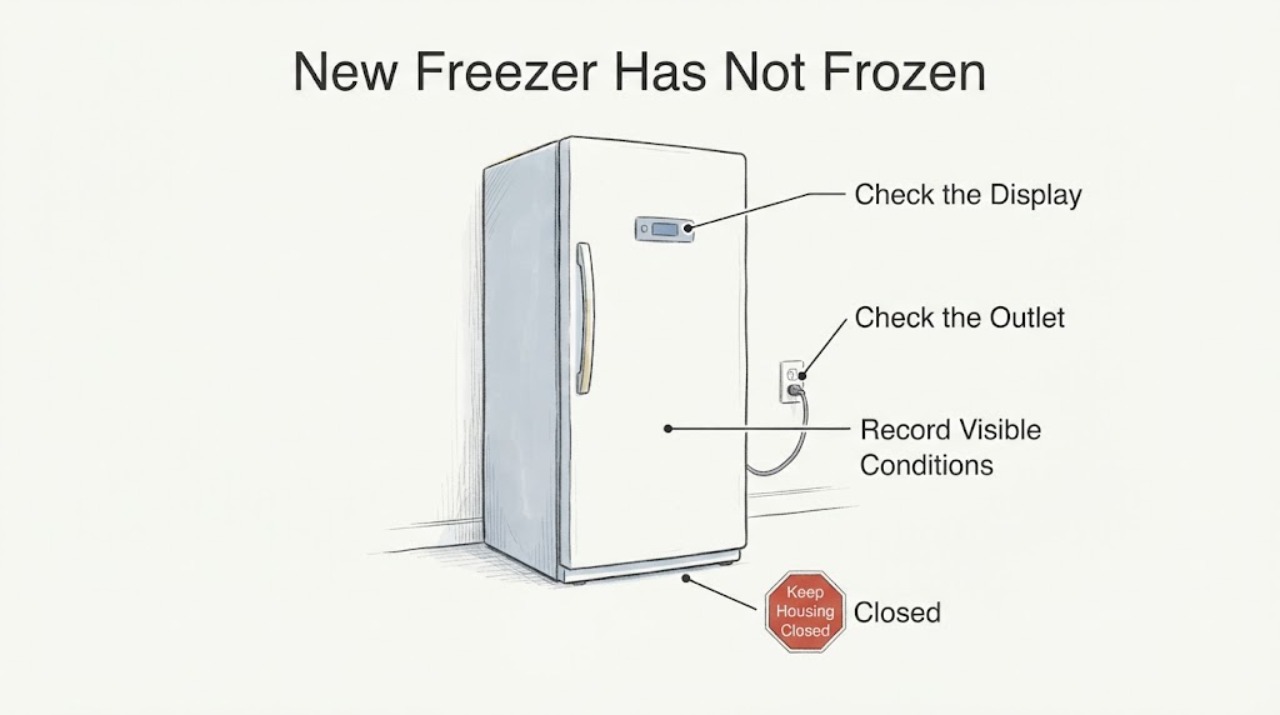
Work through in order
Diagnostic checks
Use only checks that match the exact appliance or system and its official guide.
-
Check 1
Confirm the transport and setup timeline from the delivery record. If the freezer was carried on its side, keep it upright and do not plug it in until it has stood for the same time it was on its side, up to 24 hours; if it stayed upright, follow the model’s installation instructions instead of adding an arbitrary delay.
Expected result: The unit was upright throughout transport, was on its side, or the orientation and waiting time are unknown.
Next step: Follow the exact owner/installation manual or ask the installer to confirm the required setup. Do not repeatedly power-cycle a unit with an uncertain transport history.
Why this matters
Why: Transport orientation can change the required pre-power settling procedure. An unknown history means the generic timing cannot prove that startup was correct.
-
Check 2
From a dry, safe position, verify the plug is seated in the intended dedicated grounded outlet, any visible power or interior light works, and the freezer’s cooling control is enabled. Do not use an extension cord, open the cabinet or reset a breaker that trips again.
Expected result: The unit has no power indication, the outlet/GFCI or breaker is off, cooling is visibly disabled, or the unit has normal power and enabled cooling.
Next step: Correct only an obvious external setup issue allowed by the manual. If the outlet is dead, damaged or repeatedly trips, stop and use an electrician/installer. If power and cooling are normal, continue to temperature and airflow checks.
Why this matters
Why: No power or disabled cooling can explain a warm new freezer; normal external power does not prove that the refrigeration system is working.
-
Check 3
Set the control only to the manufacturer’s recommended starting setting and place an appliance thermometer inside. Keep the door closed as much as practical and allow the manufacturer’s stabilization period, commonly up to 24 hours for a newly installed freezer.
Expected result: The thermometer reaches about 0°F, is trending colder but is not there yet, or remains well above freezing after the stabilization period.
Next step: If it is still cooling and within the documented startup window, wait and recheck. If it remains warm after that window, arrange installer/manufacturer service rather than making repeated setting changes or opening the sealed system.
Why this matters
Why: A measured temperature separates normal pull-down from a unit that is not achieving its operating target. Touching a cold wall or hearing a compressor is not a temperature measurement.
-
Check 4
Inspect only the visible door closure, gasket contact, shipping material, frost pattern and air-vent clearance. Keep packages from blocking vents and do not overfill a new unit while it is pulling down.
Expected result: The door is obstructed or not sealing, vents are blocked, heavy frost is present, or the visible airflow and closure look normal.
Next step: Remove only loose packaging or rearrange items as the manual permits. If the door cannot seal or heavy frost returns, stop loading and contact the installer/service; do not chip ice or remove panels to reach internal parts.
Why this matters
Why: A door leak, obstruction or excess load can destabilize temperature; a normal-looking exterior does not rule out a sealed-system or electrical fault.
-
Check 5
Protect food separately while the freezer is unproven: keep the door closed, monitor the appliance thermometer, and transfer frozen food to a known-working freezer or cooler if the unit stays warm.
Expected result: Food still has ice crystals or is at or below 40°F, or its temperature/time history is unknown and it has been above 40°F too long.
Next step: Follow FDA food-safety guidance for refreezing or discarding. For the appliance, provide the installer/service team the temperature readings, timeline and model/serial information.
Why this matters
Why: FDA food-safety guidance distinguishes food that remains cold or icy from food with an unsafe unknown temperature history; the appliance problem should not be used to guess food safety.
Use your observations
Decision map
Find the observation that best matches what you see, then follow the next safe action.
-
PATH 01Next step
What you see
The freezer was transported on its side and was plugged in before the required upright settling time.
Do this next
Turn it off if safe, set it upright and follow the exact owner/installer instructions before any further startup. Ask the installer or manufacturer whether the premature power-up requires service.
Why this path and its safety boundary
Why it matters: The installation history does not match the manufacturer’s transport guidance, so the lack of immediate freezing cannot be interpreted as a confirmed component failure.
-
PATH 02Next step
What you see
The freezer has been installed correctly, has power and enabled cooling, and has had about 24 hours but the thermometer is still well above 0°F or there is no cooling.
Do this next
Keep the food elsewhere and contact the installer or manufacturer service. Do not open the sealed system, add refrigerant or replace an internal part based on the symptom alone.
Why this path and its safety boundary
Why it matters: This is outside the normal startup window described by the opened manufacturer support guidance; a compressor, sealed-system or control cause remains unverified.
-
PATH 03Next step
What you see
The unit is within its documented startup period and the thermometer is trending colder, with no power, door or airflow problem.
Do this next
Keep the door closed as much as possible, wait the documented period and recheck the thermometer. Do not load a full quantity of perishables before it reaches the manual’s operating target.
Why this path and its safety boundary
Why it matters: The result is consistent with initial pull-down rather than proof of failure, although the final temperature still has to be verified.
-
PATH 04Next step
What you see
A breaker/GFCI trips, the cord or outlet is hot or damaged, or there is smoke or a burning odor.
Do this next
Stop using the freezer, isolate power only from a safe position, and contact an electrician/installer or emergency services as appropriate. Do not keep resetting the protection or open the appliance.
Why this path and its safety boundary
Why it matters: This is an electrical safety condition rather than a cooling adjustment problem.
Helpful context
Understand the symptom
Start with delivery and first-power timing
Ask how the freezer was transported and when it was first powered. GE’s upright and chest freezer instructions say an upright-transported unit has no required waiting time, while a unit carried on its side must be set upright and left standing for the same time, up to 24 hours, before connection. Once installed, a newly installed freezer may still need a stabilization period; Frigidaire’s official troubleshooting guidance gives 24 hours. Use the freezer’s own installation manual if its instructions differ.
Measure temperature instead of guessing from a cold surface
Put an appliance thermometer in the freezer and allow it to stabilize according to the thermometer’s instructions. FDA guidance uses 0°F (-18°C) as the freezer target. Frost on one wall, a cold shelf or a short compressor hum does not prove that the whole compartment is at a safe freezing temperature.
Check only visible setup conditions
With power available and no electrical hazard, verify that the unit is actually powered, cooling is enabled if the model has a cooling on/off control, the control is at the manual’s recommended setting, the door closes, and packaging or food is not blocking vents. A damaged gasket, blocked airflow or room conditions can prevent stable temperature. Do not remove covers or work on the compressor, refrigerant circuit or control wiring.
Protect food while the new appliance is unresolved
Do not load valuable perishables into a freezer that has not demonstrated its temperature. FDA guidance says to keep frozen storage at 0°F or below, keep doors closed during a failure, and discard food when its temperature history is unknown and it has been above 40°F too long. Move food to a known-working freezer or cooler while the new unit is checked.
When checks do not resolve it
Need a professional?
Safety scope: Do not open the sealed system, handle refrigerant, replace a compressor/thermostat/control, bypass protection or keep resetting a tripping breaker. Use the installer, manufacturer service or a qualified electrician for the matching fault.
Have this ready
- Provide the model and serial label, purchase and delivery date, transport orientation, first-power time, outlet/power observations, control setting, thermometer readings over time, door/gasket observations and whether food was moved elsewhere.
Common questions
FAQ
How long should a new freezer take before it freezes food?
The exact manual controls, but the opened Frigidaire freezer guidance says a newly installed unit needs 24 hours to stabilize. GE says a freezer transported on its side must first stand upright for the same time it was on its side, up to 24 hours. Measure the temperature rather than relying only on elapsed time or touch.
What temperature should the freezer reach?
FDA guidance identifies 0°F (-18°C) as the freezer target and recommends an appliance thermometer. A cold-feeling shelf or a little frost is not enough to establish that temperature.
Should I turn the control to the coldest setting or keep testing it?
Use the exact owner manual’s recommended setting and allow the documented stabilization period. Repeated setting changes, cycling power or opening covers cannot identify a sealed-system or control fault and may complicate service or food safety.
Can I put food in while the new freezer is still warm?
Do not rely on an unverified freezer for perishable food. Keep food at a known-safe temperature elsewhere; FDA guidance covers ice crystals, 40°F thresholds and when uncertain food should be discarded.
Read the exact guide
Official sources
- Upright Freezer Quick Start GuideWhirlpool · Opened the official Whirlpool upright-freezer quick-start PDF. It supports the limited, model-family-scoped points that an upright freezer may need 6-8 hours or longer to cool, cooling must be enabled, settings should not be changed repeatedly, and the guide sends detailed instructions to the model owner manual. It is not presented as the assigned freezer’s exact manual.
- Refrigerator - Initial TemperatureGE Appliances · Opened the official GE initial-temperature support page. It says a newly installed refrigerator should stabilize for 24 hours, some cooling should be apparent in the freezer in about an hour, and service is recommended if there is no cooling after 24 hours. Used only as corroborating manufacturer-family startup guidance, not as an exact model procedure.
- Freezer - Not Freezing or Not CoolingFrigidaire · Opened the official Frigidaire support article. It explicitly applies to freezers and refrigerators with freezers and supports external checks for newly installed units, power, temperature, door seal, frost, airflow, load and service escalation. It is used as manufacturer-family guidance, not as a claim about an unassigned brand or model.
- Refrigerator Thermometers - Cold Facts about Food SafetyU.S. Food and Drug Administration · Opened the official FDA consumer guidance. It supports using an appliance thermometer, a 0°F freezer target, keeping doors closed during a failure, and food handling based on temperature/ice-crystal history. It does not diagnose appliance components.
- Upright & Chest Freezer - Moving InstructionsGE Appliances · Opened the official GE transport page. It supports the conditional transport-orientation check: upright transport needs no waiting time, while a freezer transported on its side must stand upright for the same duration, up to 24 hours. It does not establish a fault or authorize internal repair for another brand.
Community feedback
Share a repair observation
Share a plain-text repair observation. Accepted observations are published automatically; this page may take a moment to update.