
On this page
Start here
Quick answer
Do not assume an apartment freezer is malfunctioning just because one area freezes harder than another. Protect food first, then use a freezer-safe thermometer and a short log to separate a location or loading difference from a real temperature trend. Check only the setting, visible vents, overloading, door closure, gasket and visible frost; use the exact owner manual for model-specific targets or reset steps. If the temperature remains inconsistent, food is softening, the door will not seal, or frost returns, report the observations to the landlord or property manager and arrange qualified appliance service instead of opening panels or guessing at a compressor, fan or refrigerant fault.
Before you begin
Safety first
- Do not open cabinet or control panels, take live measurements, bypass a door or temperature interlock, chip ice with sharp tools, use improvised heat, alter wiring, access refrigerant or sealed cooling components, or keep running a unit with a burning smell or damaged cord.
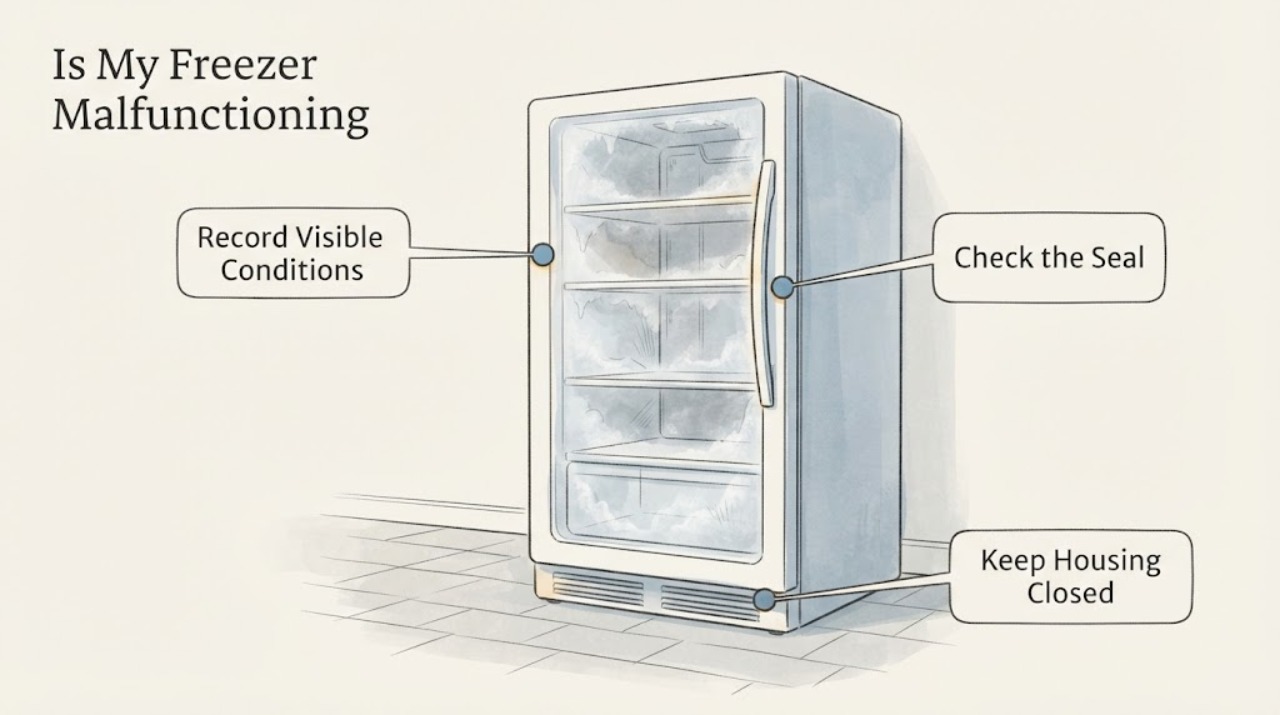
Work through in order
Diagnostic checks
Use only checks that match the exact appliance or system and its official guide.
-
Check 1
Protect food if it is softening or has an uncertain temperature history, then place a freezer-safe appliance thermometer where it can remain undisturbed. Record the reading, location, time, door openings and whether the freezer is standalone or part of a refrigerator.
Expected result: The reading is stable and the variation follows a location or loading pattern, or it continues to rise/oscillate while the door stays closed.
Next step: Follow the exact manual for the model target and allow its stabilization period; if food is warming or the trend persists, protect food and contact the landlord/property manager or qualified appliance service.
Why this matters
Why: A stable location pattern points first to airflow, loading or measurement position; a persistent trend with the door closed is a service-relevant cooling symptom, not proof of one failed component.
-
Check 2
Inspect the accessible interior for food covering vents, overpacking or visible frost. Move only a plainly blocking package and keep space around visible vents; do not remove panels or use a knife, scraper or improvised heat.
Expected result: A vent is blocked by food, or frost/residue covers a vent or wall; alternatively, nothing visible obstructs airflow.
Next step: Correct only the visible loading issue and recheck according to the manual. For thick or recurring frost, an inaccessible vent or no visible cause, document it and arrange service.
Why this matters
Why: Manufacturer guidance associates blocked vents, overpacking and frost with airflow and temperature problems, but a clear view does not rule out a model-specific internal issue.
-
Check 3
Check that no package, shelf or drawer prevents the door from closing, then inspect the visible gasket for dirt, folds, tears or a continuous gap. Clean only the accessible seal using the matching manual guidance and close the door normally.
Expected result: The door closes fully with an intact-looking seal, or it leaves a gap, the gasket is damaged, or frost returns at the edge.
Next step: Remove only the plainly blocking item or clean the accessible gasket. If the gap, damage or recurring frost remains, keep the door closed and use the apartment service route.
Why this matters
Why: A closure or gasket problem can let warm air in and make temperature unstable; an intact visible seal does not diagnose a fan, defrost or sealed-system problem.
-
Check 4
Find the freezer or refrigerator-freezer model label without moving the appliance or removing a panel, and check the exact owner manual for temperature, reset, vent and defrost instructions. Record any recent outage, installation or room-condition change.
Expected result: The model is readable and the manual gives a matching user-level procedure, or the model is missing/unclear or the symptom remains after the documented external checks.
Next step: Follow only the matching manual procedure and its stabilization period. Otherwise send the model, log, photos and food-temperature concern to the landlord/property manager or qualified appliance service.
Why this matters
Why: Controls, vent locations and defrost access differ by model; a generic symptom cannot identify a compressor, fan, thermostat, refrigerant or control fault.
Use your observations
Decision map
Find the observation that best matches what you see, then follow the next safe action.
-
PATH 01Next step
What you see
Food is softening, thawing, leaking or has an uncertain temperature history, or the thermometer shows a continuing warm trend.
Do this next
Move food to a known-safe cold-storage plan, keep the door closed, and contact the landlord/property manager or qualified appliance service; do not keep cycling the control to test it.
Why this path and its safety boundary
Why it matters: Food safety takes priority and the freezer may not be maintaining its required storage condition.
-
PATH 02Next step
What you see
Food covers a vent, the compartment is overpacked, or visible frost is blocking an opening.
Do this next
Move only the plainly blocking food and use the matching manual for any defrost instruction. Do not chip ice, use heat or remove panels; escalate if frost returns or airflow cannot be restored.
Why this path and its safety boundary
Why it matters: The observation can explain uneven airflow, but it does not prove a failed defrost or cooling component.
-
PATH 03Next step
What you see
The door is held open, the gasket has a visible gap or damage, or frost is concentrated around the closure edge.
Do this next
Remove only a plainly blocking item and clean the accessible gasket as directed by the manual. Request service for a damaged gasket, persistent gap or continuing temperature loss.
Why this path and its safety boundary
Why it matters: Warm air entering through a closure problem can produce unstable temperature and frost.
-
PATH 04Next step
What you see
The door closes, vents are clear, no accessible frost explains the pattern, but the thermometer remains inconsistent or the problem returns after the manual stabilization period.
Do this next
Document the log, model label, outage history and visible conditions for the landlord/property manager or qualified service. Do not open panels or work on wiring, refrigerant or sealed cooling components.
Why this path and its safety boundary
Why it matters: The remaining cause depends on the exact freezer design and cannot be diagnosed safely from this no-model symptom alone.
Helpful context
Understand the symptom
Protect food before troubleshooting
If food is softening, thawing, leaking or has an unusual temperature history, move it to a known-safe freezer or cooler plan and avoid tasting questionable food. Keep the freezer door closed as much as possible while you record the problem. The symptom “inconsistent freezing” does not by itself establish a failed part, and repeated door opening makes the temperature harder to interpret.
Measure the pattern instead of judging one package
Place a freezer-safe appliance thermometer where the owner manual permits and note the reading, location, time, recent door openings and whether the freezer is part of a refrigerator. Compare a front/back or upper/lower pattern only after the compartment has had time to settle. Make only a small setting change if the exact manual supports it, then wait for the manual-defined stabilization period; do not keep changing the control every few minutes.
Check loading and visible airflow
Look inside for packages covering a vent, food packed tightly against an air outlet, or a visible sheet of frost. Move only a plainly blocking item so air can circulate; do not remove an interior panel or chip ice with a sharp tool. Vent positions differ by model. If frost is thick, recurring or covering an opening, document it and follow only the matching manual or service route.
Check the door and gasket from the outside
Confirm that a package, shelf or drawer is not holding the door open. Inspect the visible gasket around the closed door for a fold, gap, tear or dirt; clean accessible gasket surfaces with the manual-approved method and close the door without forcing it. A poor seal can create unstable temperature and frost, but a visual check cannot identify a particular defrost, fan or sealed-system fault.
Use the apartment repair route
If the log remains inconsistent after the accessible checks, or if food is warming, the door will not seal, frost rapidly returns, the unit has no power, or a burning smell appears, stop the troubleshooting path. Photograph the display or thermometer, frost/door condition and rating label if safely visible; give the landlord or property manager the time pattern and any recent outage or move. Do not open panels, touch wiring, bypass an interlock, clean inaccessible coils, or work on refrigerant or other sealed cooling components.
When checks do not resolve it
Need a professional?
Use the apartment landlord/property-manager repair route or qualified appliance service when food is warming, the temperature remains inconsistent after the exact manual stabilization period, the door will not seal, frost returns quickly, the unit loses power, or there is an unusual electrical or burning odor.
Safety scope: Do not open cabinet or control panels, take live measurements, bypass a door or temperature interlock, chip ice with sharp tools, use improvised heat, alter wiring, access refrigerant or sealed cooling components, or keep running a unit with a burning smell or damaged cord.
Have this ready
- Provide the full model and serial label if safely visible, freezer type, thermometer readings with locations and times, door/gasket and frost photos, recent outage or installation details, room/apartment conditions, and whether food has softened.
Common questions
FAQ
Does uneven freezing prove the compressor is failing?
No. Uneven freezing can follow blocked vents, overpacking, frost, a door-seal problem, a setting or measurement location. Without the exact model and service tests, it does not identify a compressor, fan, thermostat or refrigerant fault.
Should I keep changing the temperature control?
No. Check the exact manual, make only a supported small adjustment, and allow the manufacturer-defined stabilization period before judging the result. Repeated quick changes and frequent door openings obscure the pattern.
Can I scrape the frost or heat the freezer to test it?
Do not use sharp tools or improvised heat. If the matching manual provides a user-level defrost procedure, follow only that procedure; otherwise document the frost and use the landlord/property-manager or qualified service route.
What should an apartment tenant report?
Report the model label if available, thermometer readings with times and locations, whether the door seals, where frost appears, any recent outage or installation change, and whether food has softened. This gives the property manager or technician usable evidence without requiring cabinet access.
Read the exact guide
Official sources
- Freezer - Not Freezing or Not CoolingFrigidaire · Opened official Frigidaire support article. It applies to freezers and refrigerators with freezers, but the assigned topic has no Frigidaire identity; it is used only for general external-check patterns and service boundaries, not to assert a model-specific setting or component diagnosis.
- 7 Freezer Problems & How to Help Fix ThemWhirlpool · Opened official Whirlpool troubleshooting guide. It supports external observation and manual/service escalation, but it does not establish a diagnosis for an unknown-brand apartment freezer.
- Troubleshooting a Freezer That’s Getting Too ColdWhirlpool · Opened official Whirlpool guidance. It discusses Whirlpool freezers and is used for general symptom distinctions and user-level checks only; it does not prove the unbranded apartment freezer has a Whirlpool design.
- Guide to the Parts of a FreezerWhirlpool · Opened official Whirlpool freezer guide. It supports the general observation that vent locations vary and blocked vents/overpacking can affect temperature; it is not used to assign a component or part to the unbranded topic.
Community feedback
Share a repair observation
Share a plain-text repair observation. Accepted observations are published automatically; this page may take a moment to update.