
On this page
Start here
Quick answer
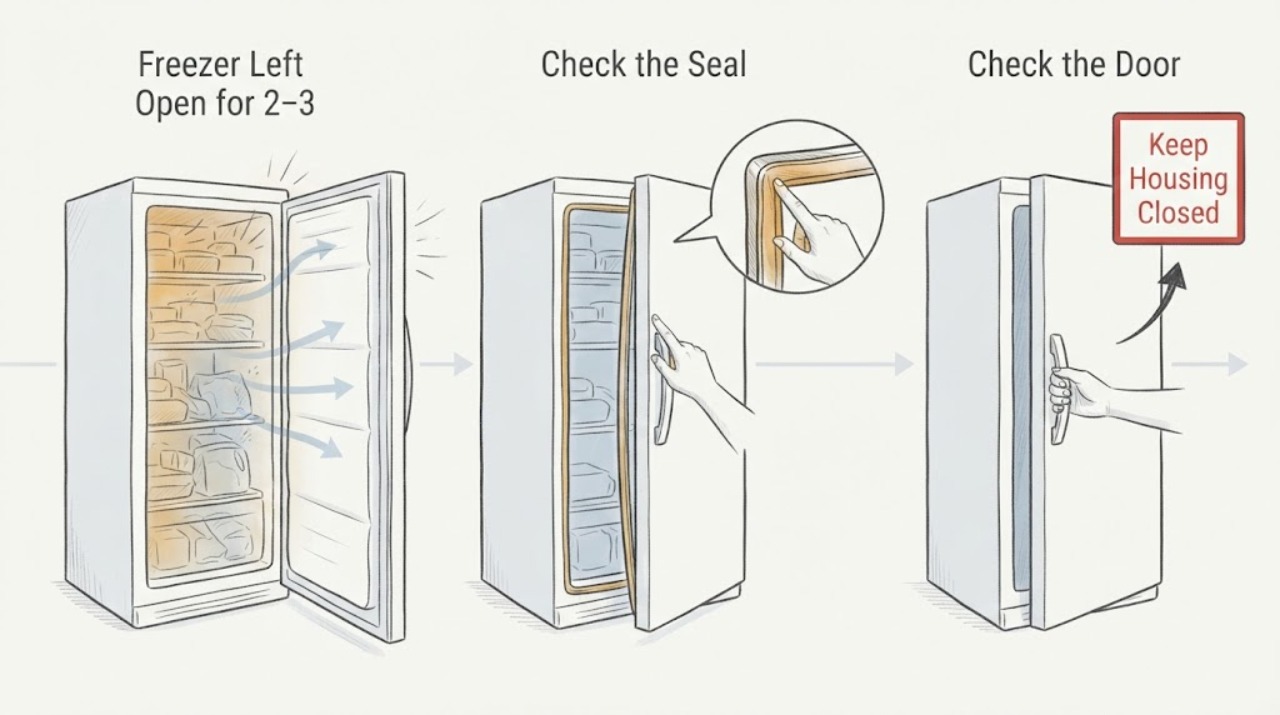
Close and fully seal the freezer, protect food, and check the actual temperature rather than diagnosing the sound by itself. Leaving a door open can let humid air in, increase normal cooling noise and create frost; a fan contacting ice can vibrate or stop when the door opens. Check the gasket, vents and frost without removing panels. If the noise is very loud, the freezer stays warm, the door will not seal, food has thawed beyond the safe limits, or a manual defrost does not restore operation, stop repeated testing and arrange service. Never use a hair dryer or other heat source to melt freezer ice.
Work through in order
Diagnostic checks
Use only checks that match the exact appliance or system and its official guide.
-
Check 1
Close the freezer door completely and check that no package blocks the gasket; use an appliance thermometer if available and avoid opening the door repeatedly while the unit recovers.
Expected result: The gasket seals all the way around and the temperature begins returning toward 0°F/-18°C, or the door does not seal or the temperature keeps rising.
Next step: If the seal is obstructed, rearrange food and close the door. If the seal is damaged or temperature continues rising, move food to a safe freezer and arrange service.
Why this matters
Why: A closed seal gives the freezer a chance to remove the heat and humidity introduced by the open door. A failed seal or continued warming points beyond a simple recovery period.
-
Check 2
Listen from outside the closed freezer, then briefly open the door only to compare the sound; do not put hands or tools near a fan and do not remove a panel.
Expected result: The vibration or grinding changes or stops when the door opens, or it continues unchanged and is very loud.
Next step: For the fan-on-ice pattern, keep the unit closed and use the model manual or qualified service route. Do not force the fan, scrape ice or repeat power cycling.
Why this matters
Why: A sound that changes with the door is consistent with the manufacturer-described fan-on-ice pattern, but it does not prove the fan or defrost system is the failed part. Very loud unchanged noise needs service.
-
Check 3
Inspect only visible surfaces for frost, blocked air vents and items preventing the door from closing; do not remove interior covers or use heat to melt ice.
Expected result: Frost is concentrated around an airflow area or vents are blocked, or there is no visible frost/blockage.
Next step: Clear only movable food from vents and keep the door sealed. If substantial frost or recurring fan noise remains, follow the exact model's manual-defrost/service guidance; never use a hair dryer or other heat source.
Why this matters
Why: An open door can admit humidity and create frost, while blocked vents can restrict cold-air movement. No visible frost means the sound should not be attributed to ice without further evidence.
-
Check 4
Check every perishable frozen item for ice crystals and coldness while the freezer is recovering; do not taste food to decide whether it is safe.
Expected result: Food still has ice crystals and feels as cold as refrigerated, or food has thawed and was above 40°F/4°C for the applicable safety period.
Next step: Keep qualifying food cold and use the official frozen-food chart for item-specific decisions. Discard food outside the safe limits and move remaining food to another working freezer.
Why this matters
Why: FoodSafety.gov allows refreezing or cooking food that still has ice crystals and feels refrigerator-cold; thawed perishable food outside the safe temperature window must be discarded.
Use your observations
Decision map
Find the observation that best matches what you see, then follow the next safe action.
-
PATH 01Next step
What you see
The door now seals, the noise is a temporary hum or increased workload, and the temperature begins recovering after the door stays closed.
Do this next
Keep the door closed, monitor the thermometer and avoid repeated openings. Request service if the temperature does not recover.
Why this path and its safety boundary
Why it matters: This is compatible with the freezer working harder after warm humid air entered; it does not by itself establish a failed component.
-
PATH 02Next step
What you see
The vibration or grinding stops when the freezer door opens and visible frost is present near the airflow path.
Do this next
Do not use a hair dryer, scrape the fan or remove panels. Use the model manual's defrost instructions or arrange qualified service.
Why this path and its safety boundary
Why it matters: The pattern is consistent with a fan contacting ice, which manufacturer guidance treats as a service issue even if a manual defrost temporarily quiets it.
-
PATH 03Next step
What you see
The gasket is obstructed, vents are blocked or food prevents the door from closing fully.
Do this next
Move only the obstruction, close the door fully and monitor recovery; seek service for a damaged gasket or continuing frost.
Why this path and its safety boundary
Why it matters: The open-door condition can continue admitting humidity and reduce airflow, sustaining frost and temperature problems.
-
PATH 04Next step
What you see
The freezer remains warm, the sound is very loud or unchanged, the door will not seal, or food has thawed beyond the food-safety limits.
Do this next
Protect or discard food according to temperature and ice-crystal guidance, stop repeated testing and arrange qualified appliance service.
Why this path and its safety boundary
Why it matters: This is no longer a simple post-open-door recovery pattern and cannot be safely narrowed to a compressor, fan, refrigerant or defrost part from sound alone.
Helpful context
Understand the symptom
Close the door and separate sound from temperature
The first useful observation is whether the freezer is actually returning to a safe temperature after the door is closed. Warm humid room air can make a freezer work harder and can create frost. A vibrating sound alone does not identify a failed compressor, fan motor or refrigerant system.
Look for the ice-and-fan pattern without opening panels
If the noise changes or stops when the freezer door opens, ice around an internal fan is one supported possibility. Samsung advises service for the original cause and forbids using a hair dryer or other heat source. Do not remove an interior panel to reach coils or a fan.
Use temperature and ice crystals for food decisions
FoodSafety.gov recommends a freezer at or below 0°F (-18°C). If food has partially thawed, the safe decision depends on temperature and remaining ice crystals, not on how the freezer sounds or whether the door was open for a particular number of hours.
When checks do not resolve it
Need a professional?
Arrange qualified freezer service when the freezer stays warm after the door is sealed and allowed to recover, a very loud or grinding vibration persists, the fan-on-ice pattern returns after defrost, the gasket will not seal, or the unit leaks or shows other damage. Provide the temperature reading, noise location and whether it changes when the door opens. Do not remove panels, scrape coils, force a fan or use a hair dryer or other heat source.
Common questions
FAQ
Can leaving the freezer open for 2–3 hours make it vibrate?
It can allow warm humid air in, increase cooling workload and create frost. If a fan contacts ice, noise may change when the door opens. That is a supported possibility, not proof of a failed motor or compressor.
Should I use a hair dryer to melt the frost?
No. Samsung's opened guidance specifically warns against a hair dryer or other heat source. Use the exact model's manual-defrost route or service instead.
Is partially thawed food safe after the door was left open?
Check temperature and ice crystals rather than the two-to-three-hour estimate alone. FoodSafety.gov says food can be refrozen or cooked when it still has ice crystals and feels as cold as refrigerated; discard food outside the stated limits.
Read the exact guide
Official sources
- Understand the noises coming from your Samsung refrigeratorSamsung Electronics Canada · Samsung Canada guidance; use as family-level noise and safety guidance only, not as a model-specific diagnosis for an unbranded freezer.
- Food Safety in a Disaster or EmergencyFoodSafety.gov · Government food-safety guidance, not appliance repair guidance; used only for food-temperature and discard decisions.
- Frosting in the Freezer Section - Quad DoorWhirlpool Product Help · Whirlpool refrigerator-family guidance; used for general frost and airflow checks, not for a model-specific part conclusion.
Community feedback
Share a repair observation
Share a plain-text repair observation. Accepted observations are published automatically; this page may take a moment to update.