
On this page
Start here
Quick answer
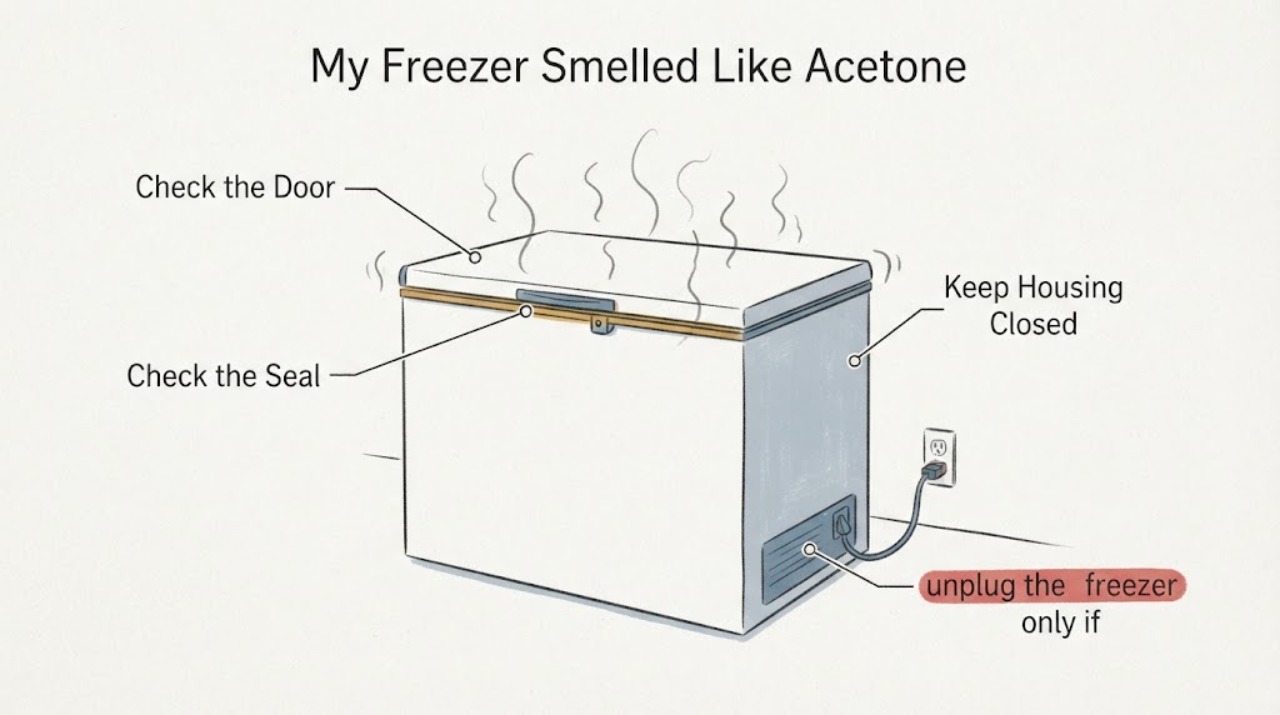
An acetone-like smell does not identify a refrigerant leak, and the freezer should not be opened up or treated with a solvent to find out. First protect the food and people: keep the door closed while you check whether the freezer is still at 0°F or below, discard questionable food rather than tasting it, and leave the area and arrange service if the odor returns strongly, causes irritation, or is accompanied by heat, smoke, electrical damage, loss of cooling, or a visible leak. With the appliance unplugged only when it is safe to do so, inspect food packages and spills, then clean the interior with the exact manual's approved method. Do not puncture refrigerant tubing, use acetone or other chemicals inside the cabinet, or attempt refrigerant work.
Work through in order
Diagnostic checks
Use only checks that match the exact appliance or system and its official guide.
-
Check 1
Keep the freezer door closed while checking the appliance thermometer, if one is available, and note whether the unit is still maintaining 0°F or below. Do not taste food to test it.
Expected result: The freezer is at or below 0°F, food still has ice crystals, the temperature is above 0°F but below 40°F, or the temperature/time is unknown.
Next step: If food temperature or time is uncertain, discard questionable perishables. If the freezer is warming, keep the door closed, transfer food to a known-safe freezer if possible, and arrange appliance service.
Why this matters
Why: FDA uses temperature and time, not odor alone, for food-safety decisions. A freezer that is warming has a cooling or power issue separate from the odor's unconfirmed source.
-
Check 2
Once food safety is protected, check sealed packages, bags, ice trays, shelves, and the floor of the freezer for a spill, torn package, or spoiled item. Remove only questionable food and wipe visible residue with the appliance manual's approved method.
Expected result: A package, spill, or food item is the odor source, or the interior is clean and the odor is strongest outside the food compartment.
Next step: For a food source, discard the affected food and clean the compartment. If the odor persists after cleaning or returns with no food source, stop trying household odor treatments and arrange service.
Why this matters
Why: GE's freezer odor guidance says odors commonly come from unwrapped food or spills and recommends checking that food is covered and sealed. A clean compartment with a recurring exterior odor remains unresolved.
-
Check 3
If cleaning is needed, unplug the freezer only if the plug and surrounding area are dry and safe, and use the documented baking-soda solution. Do not use acetone, bleach, ammonia, petroleum distillates, scented cleaners, or other solvents inside the cabinet.
Expected result: The odor decreases after approved cleaning, or it remains/returns despite a clean interior.
Next step: Leave the freezer clean and ventilated according to its manual. If the smell returns, especially during compressor operation or with cooling loss, keep the appliance out of service and request qualified refrigeration diagnosis.
Why this matters
Why: GE specifies baking soda for the interior and gasket and warns that bleach, ammonia, petroleum distillates, detergent, and some scented products can damage plastic liners or remain as odors. Persistent recurrence is not evidence of a refrigerant type.
-
Check 4
From outside the cabinet only, look for loss of cooling, unusual heat, smoke, damaged wiring or plug, a new electrical smell, or visible oily residue. Do not remove covers, puncture tubing, sniff a suspected line closely, or use a flame or spark to test anything.
Expected result: There is smoke/heat/electrical damage, cooling loss, visible residue, or none of these signs and the odor has stopped.
Next step: For smoke, overheating, damaged wiring, or an active strong odor, leave the area and use emergency or qualified service guidance; disconnect power only if it can be done without contact with a hazard. For cooling loss or visible residue, keep the freezer off and arrange qualified refrigeration service.
Why this matters
Why: The odor remains nonspecific, but accompanying electrical or cooling changes make continued operation unsafe to troubleshoot casually. EPA identifies refrigerant-containing equipment and flammable-refrigerant safety as service matters.
-
Check 5
Record when the odor occurred, whether the compressor or defrost cycle was running, the freezer temperature, any food or spill found, and whether the smell was inside the compartment or outside the cabinet. Give the exact model and this record to service.
Expected result: The odor is a one-time event with a food source, or it recurs without a food source or with a performance change.
Next step: Use the food-cleaning path only when the source is identified and cooling remains normal. For recurrence or any performance/safety change, stop using the freezer and request model-specific diagnosis.
Why this matters
Why: A time-and-location record helps separate an interior odor-cleaning question from a cooling, electrical, or sealed-system service question without guessing a cause.
Use your observations
Decision map
Find the observation that best matches what you see, then follow the next safe action.
-
PATH 01Next step
What you see
The freezer is at 0°F or below, the odor came from a torn or spilled food item, and there is no cooling, electrical, smoke, or heat concern.
Do this next
Discard the questionable food, clean only with the approved method, and monitor for recurrence without using solvents or unapproved cleaners.
Why this path and its safety boundary
Why it matters: The observed evidence supports an interior food/spill odor path, not a refrigerant diagnosis.
-
PATH 02Next step
What you see
The odor returns with no food source, cooling is weakening, or visible residue or other appliance change appears outside the cabinet.
Do this next
Keep the freezer off, avoid opening panels or tubing, and arrange qualified refrigeration service with the model and temperature/odor record.
Why this path and its safety boundary
Why it matters: The cause remains unresolved and could involve an appliance or surrounding source; the report does not establish refrigerant identity or leakage.
-
PATH 03Next step
What you see
There is smoke, an overheated plug or cabinet, damaged wiring, sparking, or an odor that irritates the eyes or throat.
Do this next
Leave the area and seek appropriate emergency help. Do not touch a hot or damaged plug, use a flame, or re-energize the freezer to reproduce the event.
Why this path and its safety boundary
Why it matters: Immediate personal and electrical safety takes priority over food or odor diagnosis.
-
PATH 04Next step
What you see
Food temperature or time outside safe limits cannot be established.
Do this next
Discard questionable perishables and use an appliance thermometer going forward; arrange service if the freezer cannot hold 0°F or below.
Why this path and its safety boundary
Why it matters: Odor, appearance, and a later return to cold do not prove that questionable food is safe.
Helpful context
Understand the symptom
Treat the smell as an observation, not a refrigerant diagnosis
The exact report says a 15-year-old apartment freezer smelled like acetone for a few hours and then seemed normal, but no model, food condition, temperature, visible residue, or cooling change is established. A short-lived odor may come from food, a spill, packaging, or an appliance condition; the word acetone cannot identify a chemical. GE's general freezer odor guidance says its mechanical parts do not produce odor and directs owners to inspect food and spills, while EPA warns that refrigeration equipment and refrigerants have specific servicing and flammable-refrigerant safety requirements.
Food safety comes before odor removal
Do not decide that food is safe or unsafe from smell alone. FDA recommends a freezer temperature of 0°F and an appliance thermometer, and says food with ice crystals or a temperature at or below 40°F may be refrozen or cooked after a temperature event; if the time or temperature is uncertain, discard it. Keep questionable food separate and avoid tasting it to investigate the odor.
When checks do not resolve it
Need a professional?
Arrange qualified service for a recurring unexplained odor, cooling loss, visible residue, smoke, overheating, damaged wiring, or any need to access refrigerant tubing or electrical components. Leave the area and use emergency guidance for active smoke, fire, sparking, or severe irritation.
Common questions
FAQ
Does an acetone smell prove the freezer is leaking refrigerant?
No. The odor description alone cannot identify a refrigerant or any leak. Check food, spills, temperature, and visible exterior safety signs, and leave refrigerant diagnosis to qualified service.
Can I keep the food if the freezer still feels cold?
Use a thermometer and the food's temperature/time history rather than smell or touch. FDA recommends 0°F for a freezer; if food is at or below 40°F or still has ice crystals after a temperature event it may be refrozen or cooked, but when time or temperature is uncertain, discard it.
What can I clean the freezer with?
Follow the exact manual. GE's general guidance uses warm water with baking soda and warns against bleach, ammonia, petroleum distillates, detergent, and scented cleaners that can damage the liner or leave odors. Do not use acetone inside the freezer.
Read the exact guide
Official sources
- Refrigerator & Freezer - OdorsGE Appliances · GE's general refrigerator/freezer odor guidance; used for the labeled manufacturer example and cleaning boundary, not as proof of the unknown freezer's brand or odor source.
- Refrigerator, Freezer and Standalone Ice Maker - Care and Cleaning of Interior and GasketGE Appliances · GE general care guidance; not an exact-model manual and not evidence of the odor source.
- Are You Storing Food Safely?U.S. Food and Drug Administration · FDA consumer food-safety guidance for household freezers.
- Refrigerator Thermometers - Cold Facts about Food SafetyU.S. Food and Drug Administration · FDA consumer guidance for household refrigerator/freezer temperature monitoring.
- Stationary Refrigeration Resources for HomeownersU.S. Environmental Protection Agency · EPA homeowner information; it supports a professional boundary and does not identify the freezer's refrigerant or odor cause.
Community feedback
Share a repair observation
Share a plain-text repair observation. Accepted observations are published automatically; this page may take a moment to update.