
On this page
Start here
Quick answer
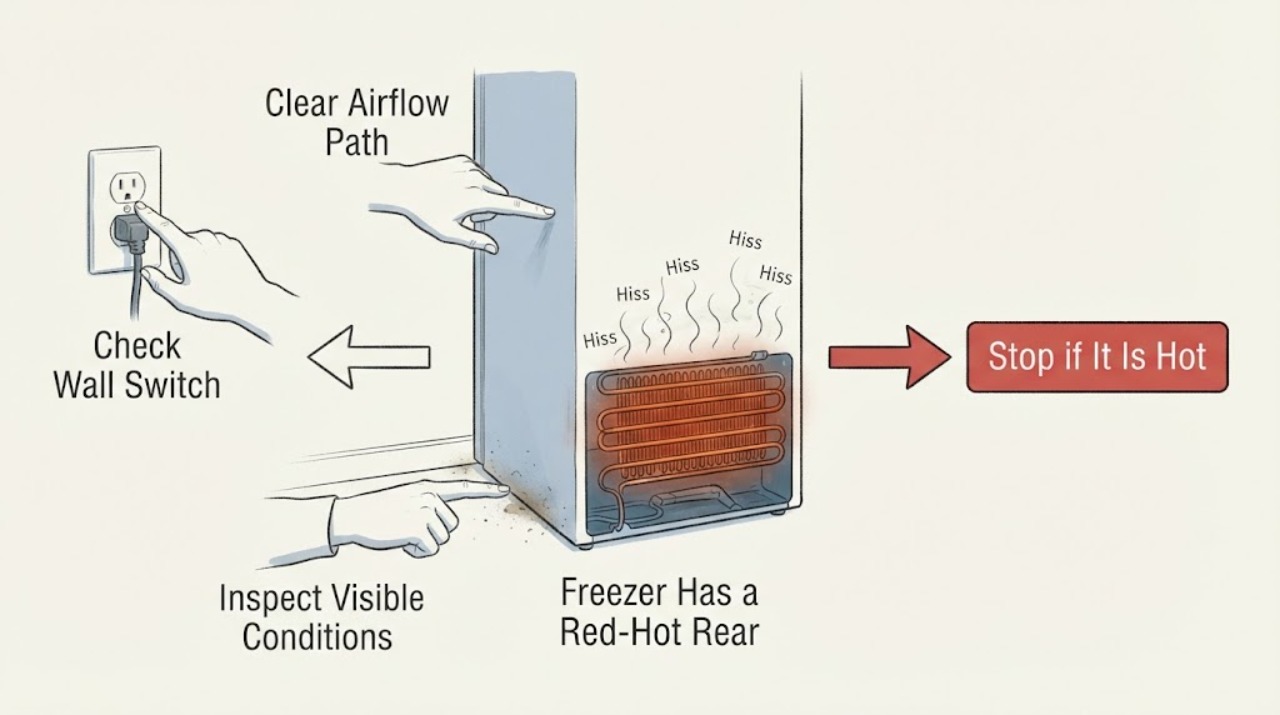
A warm rear cabinet or a gentle hissing sound can be part of refrigeration: manufacturer guidance explains that condenser coils reject heat and that refrigerant or defrost water can make hissing sounds. A coil that is visibly glowing red is different from a surface that merely feels warm, so do not touch it or keep testing the freezer. From a safe, dry position, switch the freezer off and unplug it if you can do so without touching a hot, damaged, smoking, or sparking connection; keep paper, curtains, and other combustibles away. Once it is fully cool, use the exact owner's manual to identify the condenser and any permitted external cleaning or clearance check. If there is smoke, a burning odor, a hot or damaged plug, a tripped breaker, arcing, loss of cooling, or the red glow returns, leave the freezer off and arrange qualified appliance service.
Work through in order
Diagnostic checks
Use only checks that match the exact appliance or system and its official guide.
-
Check 1
Stop using the freezer. From a dry, safe position, switch it off and unplug it only if the plug, cord, outlet, and surrounding area are cool and intact; otherwise isolate the circuit from the panel if that can be done safely. Keep people, paper, curtains, and other combustibles away from the rear of the appliance.
Expected result: There is smoke, a burning or chemical odor, sparking, arcing, a melted or hot plug, visible cord damage, a tripped breaker, or water near the electrical connection.
Next step: Leave the freezer de-energized and arrange qualified appliance service; if there is active smoke or fire, leave the area and use local emergency procedures. Do not touch the coil, move the appliance, bypass a breaker, or reconnect it for another test.
Why this matters
Why: The event cannot be treated as ordinary condenser warmth or a normal refrigeration sound. The visible symptom does not identify which internal part is involved, but it does create a stop-and-service condition.
-
Check 2
After power is isolated and the appliance has cooled, observe the rear area only from a distance. Record whether the sound was a gentle intermittent hiss, a loud continuous hiss, sizzling, snapping, or an electrical buzz, and whether the cabinet was merely warm or a component visibly glowed.
Expected result: The freezer only had a gentle hiss and a warm cabinet, or it had a visible red glow, sizzling, smoke, odor, or an abrupt change in sound.
Next step: Treat a warm surface and gentle hiss as a reason to consult the exact manual, not as permission to touch or repeatedly run the unit. For a visible glow, smoke, odor, loud change, or cooling loss, keep power off and give the observations to a service technician.
Why this matters
Why: Whirlpool documents refrigerant-flow and defrost-related hissing or sizzling as possible normal sounds, but those explanations do not diagnose a visible red glow or an electrical symptom.
-
Check 3
Read the model and serial label without reaching behind a hot or unstable appliance. Once the freezer is cold and unpowered, compare its owner manual with the rear layout and check only accessible airflow openings for obvious dust or blockage; do not remove panels or touch coils.
Expected result: The manual shows an accessible condenser-cleaning procedure, or it says the condenser is sealed, covered, or not owner-accessible; the rear airflow is visibly blocked or heavily dusty, or no blockage is visible.
Next step: Follow only the exact model manual after the appliance is fully cool and disconnected. If the manual does not authorize access, or if the rear part was glowing, leave the cleaning and diagnosis to service instead of trying to expose the system.
Why this matters
Why: Condenser location and owner maintenance vary by design. GE says some condensers are accessible while others are NeverClean or enclosed, so a generic brush or panel-removal instruction could be wrong for this freezer.
-
Check 4
Check the food and cabinet condition without restarting the freezer: note whether food is still hard-frozen, whether the cabinet is unusually hot, and whether frost, water, or a damaged cord or outlet is visible from the front or side.
Expected result: Food is softening, the unit is not cooling, water is present, or the cord/outlet shows damage; or the freezer remains cold with no other abnormal sign.
Next step: Move food to a safe cold appliance, keep the suspect freezer off, and arrange service for the first group of observations. For a cold freezer with only ordinary warmth and a gentle hiss, obtain the exact manual and monitor without touching or repeatedly testing the rear assembly.
Why this matters
Why: Loss of cooling, water, or electrical damage makes the symptom more than a noise question and gives the technician a time-sensitive service history. A cold cabinet does not prove that a red-hot component is safe.
Use your observations
Decision map
Find the observation that best matches what you see, then follow the next safe action.
-
PATH 01Next step
What you see
Smoke, burning odor, sparking, a hot or damaged plug, water near electrics, a repeated breaker trip, or an active red glow is present.
Do this next
Keep the freezer de-energized, keep clear of the rear assembly and combustibles, and arrange qualified appliance service; use local emergency procedures for active smoke or fire.
Why this path and its safety boundary
Why it matters: This is a possible electrical, thermal, or sealed-system hazard rather than a normal-noise question.
-
PATH 02Next step
What you see
The rear cabinet is warm and a gentle hiss occurs, but there is no glow, smoke, odor, electrical damage, cooling loss, or water.
Do this next
Use the exact owner's manual to confirm the rear layout and permitted clearance or cleaning checks. Do not touch the coil or keep cycling the freezer to reproduce the sound; request service if the sound becomes loud or persistent.
Why this path and its safety boundary
Why it matters: Manufacturer guidance describes warm condenser discharge and refrigerant or defrost sounds as possible normal operation on some refrigeration designs, but the evidence does not certify this unknown freezer or explain a red-hot component.
-
PATH 03Next step
What you see
Cooling is poor, food is softening, frost or water appears, or the sound changes from a gentle hiss to loud hissing, sizzling, buzzing, or clicking.
Do this next
Keep the freezer off, protect the food, record the model and observations, and arrange service. Do not open the sealed system, add refrigerant, test capacitors, or run it with a removed cover.
Why this path and its safety boundary
Why it matters: The symptom now includes a performance or safety change that cannot be separated from a component fault through a generic external check.
Helpful context
Understand the symptom
Hissing and warmth are not the same as a visible red glow
Refrigeration systems reject heat through a condenser. GE says condenser designs may place coils at the back, top, or underneath, and that warm or hot air from the exterior can be normal on fan-cooled models. Whirlpool also identifies refrigerant flow and defrost activity as sources of hissing, sizzling, gurgling, and dripping sounds. Those references explain why an ordinary warm surface or quiet hiss is not automatically a failure; they do not make a visibly glowing coil safe to touch or prove that an unbranded freezer is operating normally.
Keep the first response external and unpowered
Do not reach behind the freezer, remove a rear cover, brush a hot coil, spray it, or restart the unit to locate the sound. GE's maintenance guidance says to unplug before cleaning and notes that not every condenser is owner-accessible. With an unknown brand and model, the safe decision is to record the model label from a safe position, protect food in another cold appliance if needed, and let a qualified technician determine whether the glowing part is a condenser, a heater, or an electrical component.
When checks do not resolve it
Need a professional?
Provide the technician with the model and serial label, the time the glow and hiss were noticed, whether the compressor was running, any smoke or odor, breaker or outlet behavior, cooling and food condition, and safe distance photos if available.
Common questions
FAQ
Can a freezer's rear area be hot during normal operation?
Yes, manufacturer guidance says condenser designs reject heat and warm or hot air can leave the rear, side, or bottom on some models. That does not make a visibly glowing coil safe to touch or prove that an unbranded freezer is operating normally.
Is a hissing sound always a refrigerant leak?
No. Whirlpool describes hissing as a possible refrigerant-flow sound and also describes defrost-related sizzling or dripping. A hissing sound with a red glow, smoke, odor, cooling loss, or electrical symptom needs the freezer left off and professionally assessed.
Can I clean the glowing rear coil myself?
Do not clean or touch it while it is hot or energized. GE says to unplug before condenser maintenance and notes that some condensers are not owner-accessible. Use the exact manual only after the appliance is cool and isolated; a visible glow should be handled as a service concern.
Read the exact guide
Official sources
- Refrigerator - Condenser TypesGE Appliances · Used as manufacturer family guidance for explaining why rear heat varies by freezer design; not used to identify an unbranded freezer's exact layout or approve touching a hot component.
- Why is my refrigerator making noise?Whirlpool · Used as brand-family sound guidance only; it does not diagnose or normalize a visible red glow on an unbranded freezer.
- Refrigerator - Warm / Hot AirGE Appliances · Used only to distinguish ordinary exterior warmth from the user's reported visible glow; it does not establish that a red-hot coil is normal on an unknown freezer.
- Refrigerator - Cleaning Condenser CoilsGE Appliances · Used for the safety boundary and model-manual requirement; no GE part or cleaning procedure is transferred to the unknown freezer.
- Refrigerator Normal Sounds and NoisesWhirlpool · Used to explain that hissing, sizzling, gurgling, and airflow sounds can have different sources; the exact model manual remains controlling.
Community feedback
Share a repair observation
Share a plain-text repair observation. Accepted observations are published automatically; this page may take a moment to update.