
On this page
Start here
Quick answer
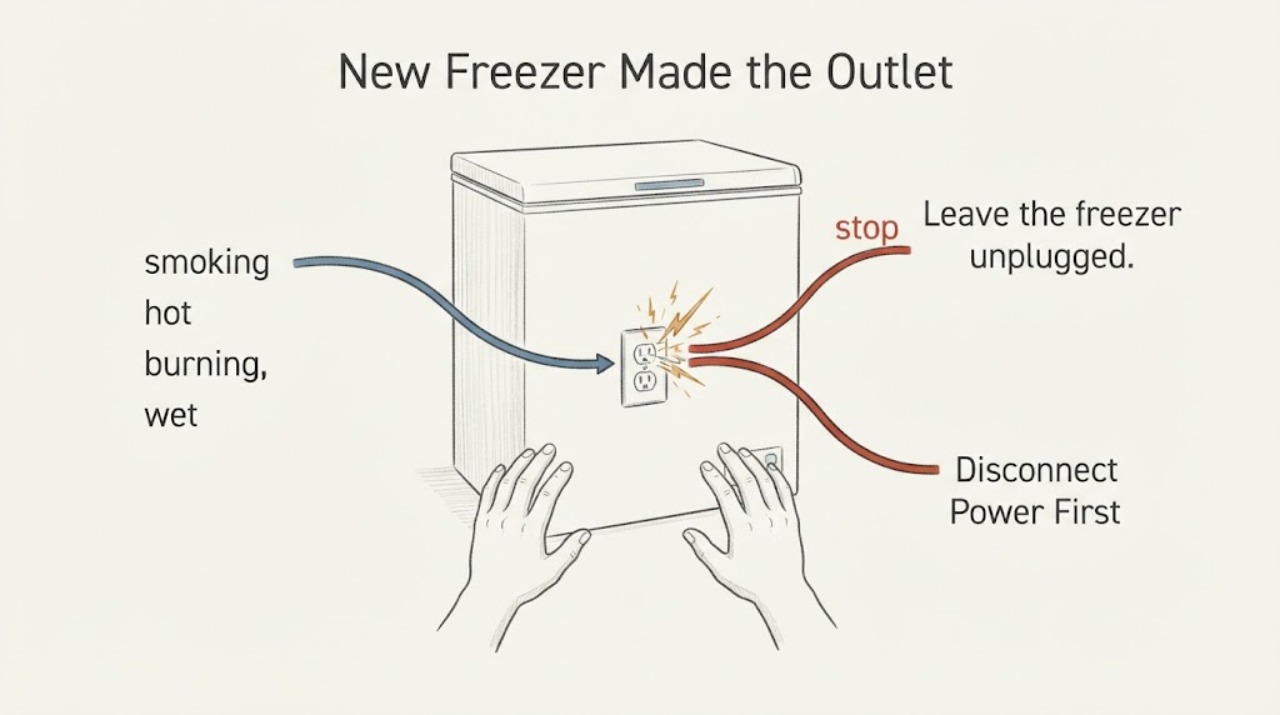
A wall outlet that sparks when a newly installed freezer is plugged in is an electrical fire and shock warning, regardless of whether the freezer was plugged in too soon. Do not plug it in again, move the plug around, replace the receptacle, test grounding, or use an extension cord. From a dry, safe position, turn off the branch-circuit breaker only if you can do so without approaching heat, smoke, water, or exposed parts; otherwise leave the area and call emergency services. Keep the outlet and freezer out of service until a qualified electrician checks the receptacle and circuit and an appliance professional checks the freezer cord and plug. Do not guess that the compressor is the cause.
Work through in order
Diagnostic checks
Use only checks that match the exact appliance or system and its official guide.
-
Check 1
If the outlet is currently sparking, smoking, hot, burning, wet, or visibly damaged, move people away and do not touch the plug, receptacle, freezer, or nearby metal. Call emergency services for flame, active smoke, or immediate fire danger. If there is no immediate danger, isolate the branch circuit from a dry, safe position only if reaching the panel does not bring you near the hazard.
Expected result: There is active smoke/flame/heat/water or exposed electrical material, or the spark stopped and the area is cool and dry.
Next step: For active fire, smoke, water near electrical parts, or inability to isolate safely, leave the area and contact emergency responders. Otherwise keep the branch circuit off and continue only with visual information from a safe distance.
Stop if: Do not approach, unplug, spray water, or handle the panel if doing so would expose you to heat, smoke, water, arcing, or exposed live parts.
Why this matters
Why: An active electrical hazard takes priority over preserving the appliance or completing installation. A stopped spark is still a warning and does not clear the outlet or freezer for reuse.
-
Check 2
Leave the freezer unplugged and mark the sparking receptacle out of service. Do not try the plug a second time, wiggle it to improve contact, reset the breaker repeatedly, or substitute an extension cord, power strip, adapter, or different receptacle as a test.
Expected result: The freezer is fully disconnected and the outlet is unused, or someone proposes another connection to see whether the freezer runs.
Next step: Keep both the freezer and outlet out of service until the receptacle/circuit and freezer cord/plug have been inspected by the appropriate qualified professionals.
Stop if: Never use an extension cord or adapter to bypass a suspected outlet problem, and never force a three-prong freezer plug into a two-slot outlet.
Why this matters
Why: CPSC and NFPA treat outlet sparks and associated heat, odor, discoloration or breaker problems as reasons for qualified electrical assessment. Repeating the connection could recreate an arc and does not distinguish appliance from outlet fault safely.
-
Check 3
From a safe, dry position after power is isolated, record only visible evidence: scorch marks, melted or discolored plastic, a loose-fitting receptacle, a damaged freezer cord or plug, odor, breaker operation, and whether the spark came at insertion, at the plug, or from the wall face. Do not test voltage, polarity, or grounding, and do not remove a cover plate.
Expected result: Damage or odor is visible at the wall outlet, at the freezer plug/cord, at both, or at neither from the safe viewing position.
Next step: Photograph only from a safe distance if useful, keep the circuit off, and give the observations to a qualified electrician and the freezer installer/manufacturer service contact.
Stop if: Stop observing and leave the area if the outlet heats, crackles, smells of burning insulation, or begins sparking again.
Why this matters
Why: Visible evidence helps the electrician and appliance technician decide which side to inspect first, but it cannot establish the fault location or make the circuit safe for a user test.
-
Check 4
Arrange two separate checks: have a qualified electrician inspect the receptacle, branch circuit, connections and protective devices; have an appliance professional or the freezer manufacturer inspect the freezer cord and plug. Give both the installation date and the exact spark circumstances.
Expected result: The electrician finds an outlet/circuit defect, the appliance professional finds cord/plug damage, neither side is visibly defective, or the cause remains undetermined.
Next step: Keep the freezer disconnected until both professionals declare the relevant equipment safe. If the electrical side is repaired, use only the outlet and connection approved for the freezer; do not resume operation based on a breaker reset alone.
Stop if: Do not install a replacement receptacle, alter wiring, test grounding, or open the freezer cabinet yourself.
Why this matters
Why: A spark at the plug-outlet connection can involve either side or both; the symptom does not justify a compressor diagnosis. CPSC states that finding and repairing electrical-system defects is a qualified professional's job, and NFPA routes outlet sparks to a qualified electrician.
-
Check 5
Preserve the new-installation information for service: freezer model and serial label, outlet location, whether the outlet is dedicated, plug type, any delivery or installation work, and photos of visible damage taken without approaching the hazard. Do not infer that a required settling or first-use period explains an electrical spark.
Expected result: The installation documentation and appliance identity are available, or the freezer was connected through an extension, adapter, loose outlet, or other nonstandard arrangement.
Next step: Give the records to the electrician, delivery installer and appliance service contact. Reconnect only after the electrical professional clears the circuit and the appliance professional clears the cord/plug and installation.
Stop if: Do not move the freezer while it is connected or use a temporary connection to preserve food; arrange a safe alternative for food storage if needed.
Why this matters
Why: USFA says major appliances should connect directly to a wall outlet and not an extension cord; installation timing or a nonstandard connection does not make a sparking receptacle safe.
Use your observations
Decision map
Find the observation that best matches what you see, then follow the next safe action.
-
PATH 01Next step
What you see
The outlet or plug is hot, smoking, flaming, wet, visibly damaged, or sparking again.
Do this next
Leave the area if necessary, call emergency responders for fire or active smoke, and isolate the circuit only from a safe dry position. Do not touch the outlet, plug, freezer, or water used to suppress an electrical fire.
Why this path and its safety boundary
Why it matters: This is an active shock/fire hazard, not a freezer installation adjustment.
-
PATH 02Next step
What you see
The spark stopped, but there are scorch marks, a loose outlet, odor, a damaged cord/plug, or a breaker that tripped.
Do this next
Keep the outlet and freezer out of service, call a qualified electrician for the receptacle/circuit, and request appliance service for the freezer cord and plug.
Why this path and its safety boundary
Why it matters: The visible warning remains evidence of an electrical fault or unsafe connection; a reset does not diagnose or clear it.
-
PATH 03Next step
What you see
No damage is visible from a safe distance and someone suggests trying another outlet, an extension cord, or a grounding test.
Do this next
Do not reconnect. Have a qualified electrician clear the original circuit and have the appliance side checked before any approved direct-wall connection is attempted.
Why this path and its safety boundary
Why it matters: Lack of visible damage does not prove that the original outlet, branch circuit, or freezer plug is safe; an improvised test can create another arc or defeat required grounding.
-
PATH 04Next step
What you see
The electrician clears the receptacle/circuit and the appliance professional clears the freezer cord and plug.
Do this next
Follow the freezer manufacturer's installation instructions and use a direct wall connection approved for the appliance. Stop immediately if any spark, heat, odor, breaker trip, or shock recurs.
Why this path and its safety boundary
Why it matters: Only the relevant professionals can establish that the electrical connection and appliance are safe after a spark; freezer settling or compressor assumptions are not substitutes for those checks.
Helpful context
Understand the symptom
The spark is the problem to isolate
The new-installation context does not make a visible outlet spark normal and does not establish that the freezer compressor is defective. CPSC lists arcing or sparking, unusual buzzing, heat, odor and loose plugs as electrical warning signs. The safe decision is to remove both the outlet and appliance from use until the electrical and appliance sides are inspected separately.
Keep the electrical work out of the homeowner checks
Do not open the receptacle, tighten wires, replace the outlet, test polarity or grounding, reset a breaker repeatedly, or use an adapter or extension cord to get the freezer running. USFA's general appliance guidance requires direct wall connection, while CPSC and NFPA route sparking outlets to qualified electrical help.
When checks do not resolve it
Need a professional?
Report the freezer model/serial, installation date, outlet location, exact spark timing, any heat/odor/scorching, breaker behavior, cord/plug condition, and whether an extension or adapter was involved.
Common questions
FAQ
Can I plug the new freezer into another outlet to see whether it works?
No. A spark can involve the outlet, the plug, the cord, or more than one part. Keep the freezer disconnected and have an electrician inspect the electrical side and an appliance professional inspect the freezer cord and plug before any approved reconnection.
Could plugging the freezer in too soon explain the spark?
Do not assume that. Installation timing does not make a visible outlet spark safe or identify the failed component. Treat the spark as an electrical warning and keep the circuit and freezer out of service until qualified checks are complete.
Can I use an extension cord while the outlet is checked?
No. The U.S. Fire Administration says major appliances should plug directly into a wall outlet and never use an extension cord. A temporary cord or adapter would bypass the safety decision rather than fix the spark hazard.
Read the exact guide
Official sources
- Electrical Safety: ChecklistNational Fire Protection Association · NFPA household electrical-safety checklist used for the generic outlet-sparking hazard; it does not provide a freezer repair or circuit-testing procedure.
- CPSC Guide to Home Wiring HazardsU.S. Consumer Product Safety Commission · Government electrical-safety guidance used for a generic sparking receptacle and freezer connection; no appliance model or compressor diagnosis is inferred.
- Appliance and Electrical Fire SafetyU.S. Fire Administration · U.S. government fire-safety guidance used for the freezer's post-clearance connection boundary; it does not diagnose the appliance or outlet fault.
Community feedback
Share a repair observation
Share a plain-text repair observation. Accepted observations are published automatically; this page may take a moment to update.