
On this page
Start here
Quick answer
Do not put a hand, cloth, tool or heat source into the rear vents. If the plug, outlet or floor is wet, do not touch the appliance or electrical connection; keep clear and arrange qualified help. If the electrical area is dry and the plug is safely reachable, disconnect power before wiping only accessible surfaces and leave the rear vent opening alone. Keep the door closed as much as practical, check the freezer temperature with an appliance thermometer, and follow the exact owner manual if water has frozen inside. A rising temperature, persistent water or ice, unusual fan noise, repeated tripping, or any sign that water reached electrical parts is a service boundary. The spill alone does not prove damage to a fan, heater, drain or control board.
Before you begin
Safety first
- Do not probe the vent, remove a rear cover, use improvised heat, chip ice, reset a wet electrical connection, move the freezer, or test internal components. Keep the appliance off when a wet electrical area or abnormal operation makes continued use unsafe.
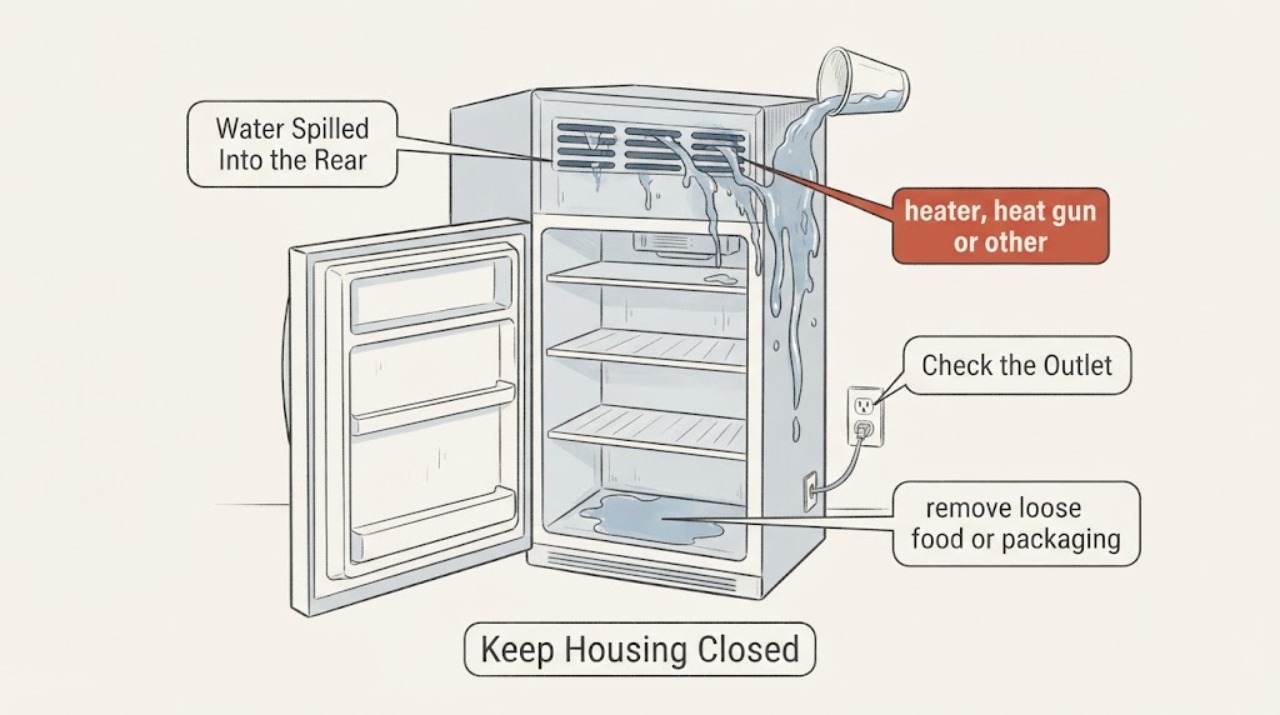
Work through in order
Diagnostic checks
Use only checks that match the exact appliance or system and its official guide.
-
Check 1
Stop reaching into the rear vent and check only from a dry position whether water is on the plug, outlet, power cord, floor near the outlet, or an exposed electrical control. If any electrical area is wet, keep clear and do not unplug, reset a breaker, move the freezer or remove a cover.
Expected result: The plug, outlet, cord and nearby floor are dry, or water is present at or near an electrical connection.
Next step: If dry and safely reachable, disconnect power before cleaning accessible surfaces. If wet, leave the area undisturbed and contact a qualified appliance/electrical professional; do not resume operation until the wet area has been assessed.
Why this matters
Why: A dry, safely reachable connection permits a normal power isolation step; wet electrical areas create a shock and equipment-damage concern that cannot be resolved by a user-level vent inspection.
-
Check 2
With power isolated only when it was safe to do so, remove loose food or packaging that can be reached without touching the rear vent. Blot standing water on the liner, floor or other plainly accessible surfaces with a clean dry cloth; do not insert the cloth, a straw, a brush or any tool into the vent and do not remove a rear panel.
Expected result: Only accessible surfaces are damp and can be dried, or water/ice remains at the vent, behind a cover, or in an area that cannot be reached without dismantling.
Next step: After accessible drying, keep the opening clear and follow the exact owner manual for that model. If water remains inside, the vent is blocked, or access requires a cover or panel, leave power off and arrange service rather than probing or dismantling.
Why this matters
Why: Accessible moisture can be removed without establishing what is behind the opening. Water or ice that remains inside an unknown air path cannot be safely characterized from the task information.
-
Check 3
Do not speed drying or thawing with a hair dryer, heater, heat gun or other electrical appliance, and do not chip ice with a knife, pick or other sharp object. Whirlpool's freezer guidance says to disconnect power for its model-specific defrost procedure, avoid electrical appliances and sharp tools, and consult the owner's manual for the exact model.
Expected result: The water has frozen around the vent, or there is no ice and the accessible area is dry.
Next step: If ice is present, stop at the visible boundary and use only the exact model manual's defrost instructions; otherwise restore power only when the electrical area is dry and safe, then monitor temperature and operation. Do not force stubborn ice.
Why this matters
Why: Frozen water does not identify the part behind the vent, and improvised heat or sharp tools can damage the freezer or create a shock/fire hazard. A dry accessible area does not prove that hidden moisture is absent.
-
Check 4
Once it is safe to operate and the model manual permits it, place or check an appliance thermometer and observe cooling, fan sound, visible frost or water, and any tripped protection without opening the door repeatedly. The FDA target for a freezer is 0°F.
Expected result: The freezer remains at or below 0°F with no new water, abnormal noise or cooling change, or the temperature rises, food begins to thaw, a fan becomes noisy, water returns, or protection trips.
Next step: For a stable result, keep the vent clear and recheck after normal operation. For any abnormal result, keep the door closed, protect the food, isolate power if it is safe, and arrange model-specific appliance service; do not diagnose or replace an internal part from the spill alone.
Why this matters
Why: Stable temperature and no new symptom support monitoring after a superficial spill; they do not prove the hidden vent is dry. Rising temperature, renewed water/ice, noise or electrical interruption indicates that continued use may worsen an unresolved problem.
Use your observations
Decision map
Find the observation that best matches what you see, then follow the next safe action.
-
PATH 01Next step
What you see
Water reached the plug, outlet, cord, floor around the outlet, or an exposed electrical area.
Do this next
Keep people away, do not touch the wet connection or move the freezer, and arrange qualified appliance/electrical assessment before using it again.
Why this path and its safety boundary
Why it matters: The incident has an electrical-safety concern that cannot be cleared by drying the vent or resetting power.
-
PATH 02Next step
What you see
The electrical area is dry, only accessible liner surfaces were wet, no water or ice remains at the visible opening, and the freezer holds its normal temperature without new noise.
Do this next
Keep the rear vent unobstructed, avoid probing it, and monitor the appliance thermometer and operation during the next normal cooling period.
Why this path and its safety boundary
Why it matters: There is no observed sign of an ongoing cooling or electrical problem, although hidden moisture has not been diagnosed.
-
PATH 03Next step
What you see
Water or ice remains inside the vent, the opening is blocked, the freezer temperature rises above the safe target, food thaws, a fan becomes abnormal, or the problem returns after power is restored.
Do this next
Keep the door closed, protect food using FDA temperature and ice-crystal guidance, disconnect power only if the connection is dry and safely reachable, and use the exact model manual or qualified service.
Why this path and its safety boundary
Why it matters: The spill has produced an unresolved internal or cooling symptom, and the unknown model prevents a safe generic internal procedure or component diagnosis.
Helpful context
Understand the symptom
What this symptom does and does not establish
The task identifies only a freezer and a cup of water that went down rear air vents; it does not identify a brand, model, vent layout or whether water reached electrical parts. The opening may lead toward an air channel, evaporator cover, drain area or another model-specific assembly, so the spill is not evidence of a failed fan, heater, drain or control. Treat any water that is still visible, pooling, freezing around the opening or accompanied by new noise or loss of cooling as a reason to stop and obtain model-specific help rather than probing the vent.
Protect food while you decide
Keep the freezer door closed except for a quick safety check. FDA guidance sets the freezer target at 0°F and says food that still has ice crystals or is at 40°F or below can be safely refrozen or cooked; it also says not to rely on appearance or odor when the temperature history is uncertain. Those food-safety limits apply if the spill caused a cooling interruption; they do not show that the appliance itself is undamaged.
When checks do not resolve it
Need a professional?
Call qualified appliance service when water or ice remains inside the rear vent, the exact model manual does not cover the incident, cooling changes, food thaws, abnormal fan/noise or repeated electrical interruption occurs, or any plug, outlet, cord or control area became wet.
Safety scope: Do not probe the vent, remove a rear cover, use improvised heat, chip ice, reset a wet electrical connection, move the freezer, or test internal components. Keep the appliance off when a wet electrical area or abnormal operation makes continued use unsafe.
Have this ready
- Provide the freezer brand and complete model from its rating label, the amount and location of the spill, whether power was disconnected, photos of only safe accessible areas, current thermometer reading, food-thawing status, and any new noise or visible frost.
Common questions
FAQ
Should I pour more water or cleaner into the vent to flush it?
No. The task does not identify the vent's internal path or the freezer model. Do not add liquid, insert an object or remove a cover; dry only plainly accessible surfaces and use the exact owner's manual or service if water remains inside.
Can I use a hair dryer to dry the rear vent?
Do not. Whirlpool expressly warns against using electrical appliances such as hair dryers or heaters to speed freezer defrosting and against sharp tools. Samsung gives the same warning for its refrigerators. Those manufacturer warnings support keeping improvised heat away from a wet freezer, while the exact defrost method remains model-specific.
Is the frozen food still safe after I switch the freezer off?
Use a thermometer if available. FDA says frozen food that still has ice crystals or is at 40°F or below can be safely refrozen or cooked, and says not to rely on appearance or odor when the temperature history is uncertain. Keep the door closed and discard food when the safe temperature history cannot be established.
Read the exact guide
Official sources
- Understanding the different noises coming from your Samsung refrigeratorSamsung Support · Opened official Samsung support text. Used only as a second manufacturer safety boundary: do not use a hair dryer/heat source, unplug before its manual-defrost procedure, and seek service when ice around a fan or abnormal noise persists. It is not used to identify this task's unknown freezer model or internal layout.
- Power Outages: Key Tips for Consumers About Food SafetyU.S. Food and Drug Administration · Opened official FDA power-outage guidance. Used only for keeping the freezer closed, checking temperature after power is restored, and the ice-crystal/40°F rule; a water spill is not assumed to be a power outage.
- Refrigerator Thermometers - Cold Facts about Food SafetyU.S. Food and Drug Administration · Opened official FDA consumer guidance. Used for the 0°F freezer target, keeping doors closed, and the ice-crystal/40°F food-safety rule when a cooling interruption occurs; it does not diagnose appliance damage.
- How to Defrost the Freezer - Product HelpWhirlpool Product Help · Opened official Whirlpool guidance for a freezer defrost procedure. Used only for the safety limits on disconnecting power, avoiding forced ice removal, avoiding electrical heat sources and consulting the exact owner's manual; it is not treated as a model-specific layout for this unidentified freezer.
Community feedback
Share a repair observation
Share a plain-text repair observation. Accepted observations are published automatically; this page may take a moment to update.