
On this page
Start here
Quick answer
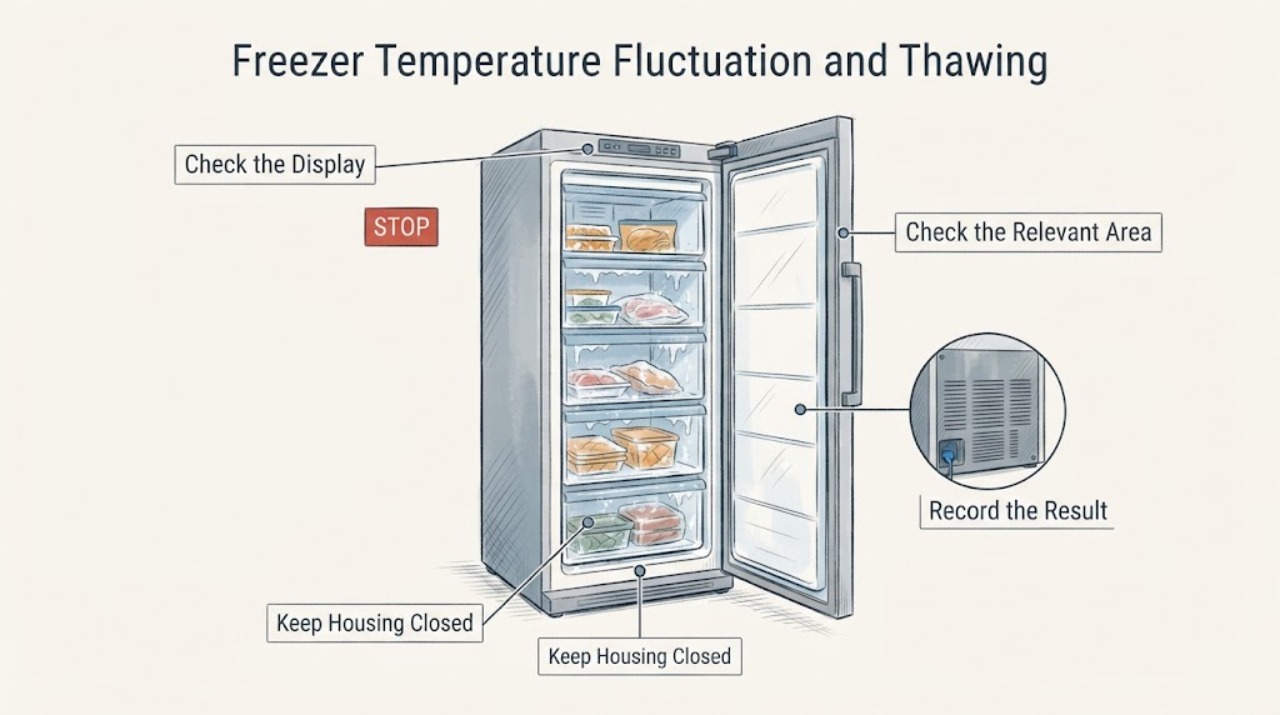
Keep the freezer door or lid closed and protect the food before chasing the appliance fault. Use an appliance thermometer or the exact model’s temperature display to establish whether the compartment is actually warming; an air reading taken immediately after opening can be misleading. Check that power and cooling are on, the control has not been changed or switched off, the door/lid closes fully, packages are not blocking it, vents are clear, and the freezer has the installation clearance required by its manual. After one control adjustment, allow the manufacturer’s stabilization period instead of repeatedly changing the setting. If food has thawed, do not taste it: FoodSafety.gov says food can generally be refrozen when it still has ice crystals or is 40°F (4°C) or below, while food held above 40°F for the listed time should be discarded. Persistent warming, no cooling, heavy frost, abnormal noise or a compressor that never starts needs qualified service; do not open the sealed system or guess at a thermostat, fan or compressor.
Work through in order
Diagnostic checks
Use only checks that match the exact appliance or system and its official guide.
-
Check 1
Keep the freezer door or lid closed as much as possible and move food only if needed to protect it. Check an appliance thermometer or the exact model display without prolonged opening. If there has been a power outage, note when it began and whether the freezer was full or half full.
Expected result: Food still has ice crystals or measures at or below 40°F (4°C), or food is fully thawed/warmer and the freezer has been without reliable cooling.
Next step: Follow the FoodSafety.gov chart for each food item and discard items that exceed its time/temperature limits. Keep the door closed while the appliance diagnosis continues; do not use food appearance or taste as the safety test.
Why this matters
Why: FoodSafety.gov says a full freezer can hold temperature for approximately 48 hours and a half-full freezer about 24 hours when kept closed; food with ice crystals or at/below 40°F can generally be refrozen, while unsafe thawed food should not be tasted.
-
Check 2
Verify that the freezer has power and cooling enabled: check the plug and accessible breaker/fuse, confirm the control is not in an off or convertible-refrigerator mode, and confirm any power indicator or compressor indicator behaves as the exact manual describes. Do not remove electrical covers.
Expected result: Power/cooling was off or interrupted, or the freezer has power and the control was already enabled.
Next step: If power was restored, close the freezer and allow the model’s full cooling/stabilization period before judging it. If it has power but never cools or the indicator behavior is abnormal, arrange service rather than repeatedly resetting it.
Why this matters
Why: Whirlpool says some freezers must be manually turned back on after a power outage or surge and that control styles differ by model. Power restoration does not prove the freezer has recovered its target temperature.
-
Check 3
Check the temperature setting once, using the appliance manual. For Whirlpool chest-freezer guidance, the mid setting is a normal starting point and one-step changes should be followed by at least 24 hours before rechecking; do not keep moving the control during that interval.
Expected result: The setting was changed, the freezer is newly started or heavily loaded, or the setting was already stable and the temperature still fluctuates.
Next step: Make no further adjustment during the stabilization period. If the measured temperature remains unsafe afterward, continue to the seal/airflow check and service boundary rather than selecting the coldest setting blindly.
Why this matters
Why: A new setting, a large load of unfrozen food or repeated door openings can temporarily raise temperature. Whirlpool warns that the freezer needs hours to cool and that adjustments need time to stabilize; these facts do not explain a persistent warm freezer after stabilization.
-
Check 4
With the freezer closed as soon as possible, inspect the door or lid gasket, hinge/closure area, shelves or baskets, and package placement. Remove only accessible packaging or food that prevents a complete seal, and keep internal air vents clear. For a chest or convertible model, check that it is level and has the clearance required by its manual.
Expected result: The gasket is compressed/torn, the door or lid is held open by a package or basket, frost prevents sealing, vents are blocked, or the closure and airflow path are clear.
Next step: Correct only a visible package/position problem under the manual. Do not chip frost with a sharp tool or use a heat source. If the gasket is damaged, frost returns quickly or the freezer remains warm with a good seal, request service.
Why this matters
Why: Whirlpool identifies a poor seal, misplaced baskets/shelves, packages blocking closure, excessive frost, blocked airflow and inadequate clearance as causes of warm operation or longer compressor run time. A clear seal does not rule out a cooling-system fault.
-
Check 5
If the temperature remains unstable after the measured control, sealing and loading checks, record the actual readings over the stabilization period, whether the compressor cycles, any alarm, unusual noise, heavy frost pattern or warm exterior, and the appliance model. Do not remove panels, pierce tubing, test live circuits or replace a thermostat, fan, relay or compressor from the symptom alone.
Expected result: The freezer returns to a stable safe temperature, or it remains warm/fluctuating or shows abnormal operation.
Next step: For persistent fluctuation, keep the door closed, protect or discard food according to FoodSafety.gov, and arrange qualified appliance service. Resume normal loading only after the technician confirms safe cooling.
Why this matters
Why: A stable reading after the documented adjustment supports a setup or transient cause. Persistent warming with adequate power, a closed seal and correct loading exceeds safe external diagnosis; the pattern does not identify a single internal part.
Use your observations
Decision map
Find the observation that best matches what you see, then follow the next safe action.
-
PATH 01Next step
What you see
The freezer was off after an outage or control change, and the measured temperature returns to the safe target after the manual’s stabilization period with the door kept closed.
Do this next
Leave the control at the documented setting and monitor with the same thermometer method. Discard any food that exceeds FoodSafety.gov time/temperature limits.
Why this path and its safety boundary
Why it matters: A power/control interruption or transient recovery explains the initial fluctuation more closely than a confirmed cooling-component failure.
-
PATH 02Next step
What you see
Packages, shelves or baskets prevent the door/lid from sealing, the gasket is damaged, vents are blocked, or heavy frost keeps the closure from seating.
Do this next
Remove only the visible obstruction and follow the model manual for gasket/frost service. Do not use sharp tools or heat to force a defrost; arrange service for a damaged seal or returning frost.
Why this path and its safety boundary
Why it matters: Warm air can enter or cold airflow can be restricted, so the observed temperature change has an external installation/loading lead.
-
PATH 03Next step
What you see
The thermometer remains above the safe target after power, setting, seal and loading checks, or the compressor never starts, runs abnormally, or unusual noise/frost accompanies the warming.
Do this next
Keep the door closed, protect/discard food using FoodSafety.gov guidance and arrange qualified service. Do not open the sealed system or order a guessed part.
Why this path and its safety boundary
Why it matters: The problem exceeds safe external classification; the symptom does not distinguish a control, sensor, fan, compressor, defrost or sealed-system cause.
-
PATH 04Next step
What you see
Food is partially thawed but still contains ice crystals or measures at/below 40°F (4°C), while the appliance issue is being addressed.
Do this next
Refreeze or cook according to the official food-safety chart and keep the freezer closed while service is arranged. Never taste food to assess safety.
Why this path and its safety boundary
Why it matters: FoodSafety.gov allows refreezing in that condition, although quality may suffer; food safety and appliance repair remain separate decisions.
Helpful context
Understand the symptom
Separate food safety from appliance diagnosis
A thawing complaint has two decisions. First protect the food while the door stays closed. Then determine whether the freezer truly warmed, rather than reacting to one soft package or a display that shows only a setpoint. FoodSafety.gov provides the food-safety disposition; it does not diagnose the freezer. The appliance checks below classify power, settings, sealing, loading and environment before service is considered.
Temperature readings need a stable method
Opening a freezer repeatedly admits warm air. GE Appliances notes that an air reading changes whenever the door opens and recommends placing a suitable thermometer between frozen packages in the middle of the freezer after the food has been cold for a sufficient period. The exact display and control behavior depend on the appliance manual, so do not transfer a control sequence from another model.
When checks do not resolve it
Need a professional?
Stop relying on the freezer for food storage and arrange service for persistent temperature fluctuation after external checks, repeated thawing, a damaged seal, heavy returning frost, no cooling, abnormal compressor/noise behavior or any condition requiring panel or sealed-system access.
Common questions
FAQ
What freezer temperature should I use when food is thawing?
FoodSafety.gov and manufacturer guidance commonly use 0°F (-18°C) as the freezer target, but the exact control method is model-specific. Verify the actual temperature with an appliance thermometer using a stable placement and allow the manual’s stabilization time after one adjustment.
Can I refreeze food that partially thawed?
FoodSafety.gov says food may generally be refrozen if it still contains ice crystals or is 40°F (4°C) or below, although quality may decline. If it was above 40°F for the chart’s stated time, discard it; never taste food to decide.
Why does the freezer temperature change whenever I open the door?
Opening the door admits warm air, and GE Appliances notes that an air reading changes when the door opens. Keep the door closed, measure between established frozen packages and judge the trend over the required stabilization period rather than reacting to an immediate air reading.
Should I keep turning the control colder until the food refreezes?
No. Whirlpool recommends one-step adjustment followed by a stabilization period, and some models can be accidentally turned off or have different controls. Use the exact owner manual and arrange service if the measured temperature remains unsafe after stabilization.
Read the exact guide
Official sources
- Freezer - Measuring TemperatureGE Appliances · Opened GE Appliances guidance and used only for the general measurement method: air readings change with door opening, and a thermometer belongs between established frozen packages. The exact model manual controls the assigned freezer.
- How to Use the Controls (Chest and Upright Freezer)Whirlpool Product Help · Opened Whirlpool Product Help. Used for model-manual gating, 0°F target guidance, stabilization after adjustment, compressor cycling and the distinction between chest/upright control styles. It does not authorize transferring a button sequence to another model.
- Setting the Controls for a FreezerWhirlpool Product Help · Opened Whirlpool Product Help. Used for checking whether a freezer was turned off after an outage, one-step control changes, waiting between adjustments and initial cooling/load guidance. It is not a model-specific diagnosis for an unidentified freezer.
- Food Safety During Power OutageFoodSafety.gov · Opened FoodSafety.gov chart. Used for keeping freezer doors closed, approximate full/half-full hold times, ice-crystal/40°F refreezing rule, discard conditions and the instruction never to taste food to test safety.
- Not Cooling - Convertible Chest FreezerWhirlpool Product Help · Opened Whirlpool Product Help. Used conditionally for chest/convertible freezer checks: level, basket/lid closure, package obstruction, installation temperature/clearance and service boundary. These checks are not asserted as model-specific for an unidentified freezer.
Community feedback
Share a repair observation
Share a plain-text repair observation. Accepted observations are published automatically; this page may take a moment to update.