
On this page
Start here
Quick answer
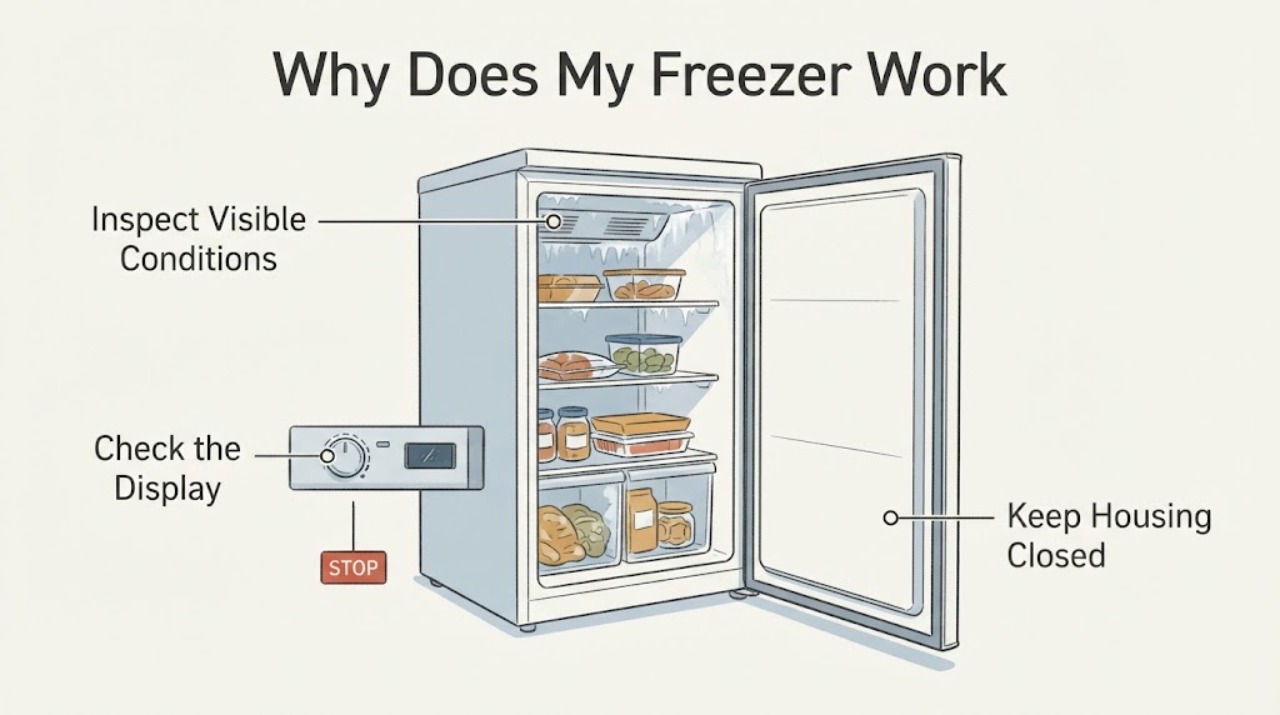
First separate a normal cooling or defrost pause from a real temperature rise. Put an appliance thermometer between frozen packages, keep the door closed, and record whether the freezer remains at 0°F (-18°C) or below while the compressor cycles off and back on. A brief pause in sound can be normal on some models, including during automatic defrost; the sound alone does not show that freezing has stopped. If the measured temperature rises above the safe target, food softens or melts, or the unit does not recover, check the setpoint, door closure, visible gasket, blocked vents, frost pattern and accessible airflow without opening sealed panels. Keep the door closed and protect the food while arranging service if the temperature remains high. Do not assume a compressor, refrigerant system, fan or thermostat is defective from the symptom alone.
Work through in order
Diagnostic checks
Use only checks that match the exact appliance or system and its official guide.
-
Check 1
Place an appliance thermometer between frozen packages, close the door, and record the freezer temperature at several intervals while the appliance goes through its usual quiet and running periods.
Expected result: The temperature remains at or below 0°F (-18°C), or it rises above that target while food softens, melts or loses ice crystals.
Next step: If the temperature is high, keep the door closed, limit opening, protect or transfer food as needed, and continue with the external checks below. Arrange qualified service if it does not recover to the model's documented target.
Why this matters
Why: A stable target temperature supports normal cycling even if the compressor sound changes. A sustained rise shows that the freezer is not maintaining the condition needed for long-term frozen storage; it does not identify a specific failed part.
-
Check 2
Listen and observe without opening panels: note whether the compressor resumes after the quiet spell, whether the pause coincides with sizzling, popping or hissing, and whether the temperature remains stable.
Expected result: The compressor resumes and the temperature stays on target, or the unit remains quiet while the temperature climbs and food softens.
Next step: For a stable-temperature cycle, follow the model manual and monitor. For a warm freezer or a cycle that never recovers, stop guessing from sound and arrange appliance service; do not open the sealed system or test live components.
Why this matters
Why: GE identifies compressor sounds and some automatic-defrost sounds as normal operating behavior for its upright and chest freezers, but a quiet period combined with a rising temperature is a performance problem rather than a sound diagnosis.
-
Check 3
Check the temperature control, operating mode and power indicator from the user-accessible controls, then compare the setting with the freezer's owner manual.
Expected result: The control is in an off/demo mode, has been moved warmer, or is set as the manual specifies; the freezer has power and the control responds normally.
Next step: Restore only the documented user setting if it was changed, then allow the manual's stabilization period before judging the result. If the setting is correct and the temperature still rises, request service rather than repeatedly changing the control.
Why this matters
Why: An off mode or changed setting can explain a freezer that cools briefly and then stops. A correct setting and normal power do not rule out an airflow, defrost or refrigeration fault.
-
Check 4
Inspect the door or lid closure and gasket from the outside, remove any package blocking closure, and look for a visible gap, torn seal or heavy frost around the opening.
Expected result: The door closes evenly with a continuous seal, or a package, gap, damaged gasket or heavy frost prevents a tight closure.
Next step: Remove only the obstruction and clean the accessible gasket according to the manual. If the seal is damaged, frost returns quickly or the door will not close, keep the door shut as much as possible and arrange service; do not pry ice with a sharp tool or remove interior panels.
Why this matters
Why: Warm air entering through a poor seal or blocked closure can raise temperature and create frost that restricts cooling airflow. Heavy frost can also point to a model-specific defrost or sealing problem; it does not prove which internal part failed.
-
Check 5
Check the accessible interior vents, exterior clearance and condenser area for blocked airflow or heavy dust, and clean only surfaces the owner manual identifies as user-maintainable with power disconnected if required by that manual.
Expected result: Food blocks an interior vent, the unit is pressed against a wall, the accessible condenser area is dusty, or airflow and clearance are normal.
Next step: Move food away from vents and restore the manual's clearance; clean accessible coils only as directed. If the freezer still warms after these external checks, stop at this boundary and have a qualified technician diagnose it without the owner opening sealed or electrical parts.
Why this matters
Why: Whirlpool identifies blocked vents, dirty coils and inadequate clearance as conditions that can weaken cooling. Normal-looking airflow does not clear a sealed-system, fan or defrost fault.
-
Check 6
Protect the food while the temperature is uncertain: keep the door closed, note whether packages still contain ice crystals, and use the thermometer reading rather than smell or appearance alone.
Expected result: The freezer is at or below 0°F, or food has softened, thawed, or been above a safe cold temperature for an unknown period.
Next step: Keep solidly frozen food closed and cold. If food is partly frozen or still has ice crystals, follow FDA's refreeze/use guidance; discard perishable food whose safety window cannot be established, and do not use the freezer as normal until it maintains temperature.
Why this matters
Why: FDA states that food stored at 0°F remains safe and that food safety after a failure depends on measured temperature and ice crystals; appearance or odor alone cannot establish safety.
Use your observations
Decision map
Find the observation that best matches what you see, then follow the next safe action.
-
PATH 01Next step
What you see
The thermometer stays at or below 0°F while the compressor pauses and resumes, and the food remains solid.
Do this next
Monitor the temperature and follow the owner manual; service is warranted if the target later rises or food begins to soften.
Why this path and its safety boundary
Why it matters: The observed short spell is consistent with temperature control or an automatic-defrost cycle rather than proof that the freezer has stopped freezing.
-
PATH 02Next step
What you see
The thermometer rises above 0°F, packages soften, or the freezer does not return to its target after the quiet period.
Do this next
Keep the door closed, protect the food, complete only the external setting, closure and airflow checks, and arrange qualified appliance service if temperature recovery fails.
Why this path and its safety boundary
Why it matters: The freezer is failing to maintain freezing conditions, even though the exact cause is unresolved.
-
PATH 03Next step
What you see
There is a visible door gap, damaged gasket, blocked vent, heavy frost or inadequate clearance.
Do this next
Remove the safe obstruction and follow the manual for accessible cleaning. Do not remove panels or use sharp tools on ice; request service if the condition returns or the door cannot seal.
Why this path and its safety boundary
Why it matters: A sealing or airflow condition may be allowing warm air in or preventing cold air circulation; heavy frost may require model-specific service.
-
PATH 04Next step
What you see
The freezer is warm and silent, has no power indicator, shows an off/demo mode, or remains above target after the user setting is corrected.
Do this next
Verify the accessible plug and documented control state without opening the unit, then arrange qualified service. Keep food closed and move it to a known-safe freezer if necessary.
Why this path and its safety boundary
Why it matters: The symptom could involve power, controls or internal refrigeration, and the model-unknown evidence is insufficient to name a component.
Helpful context
Understand the symptom
Do not diagnose from a quiet spell alone
A freezer does not have to make the same sound continuously. Compressor cycling and, on automatic-defrost models, a temporary defrost period can make the appliance seem quiet. The useful distinction is the food temperature: if the compartment remains at its target and food stays solid, a sound change may be normal; if the measured temperature rises and stays high, the freezer is not maintaining freezing conditions.
Use a thermometer before assuming a part has failed
The display or a hand on the package is not enough to identify a short cooling cycle. Use an appliance thermometer between frozen packages and record readings with the door closed. The model manual controls the correct setpoint and any defrost behavior; model-unknown symptoms do not justify naming a sealed-system, fan or control-board failure.
Common questions
FAQ
Is it normal for a freezer to stop making noise for a while?
Sometimes. Official freezer guidance describes compressor and automatic-defrost sounds that can start and stop during normal operation. Check the temperature instead of judging by sound: if the compartment stays at its target and food stays solid, a quiet spell may be normal; if temperature rises and food softens, it needs diagnosis.
What temperature should a freezer hold?
FDA identifies 0°F (-18°C) as the freezer target for safe frozen storage and recommends an appliance thermometer with periodic checks. Use the model manual for its displayed setting and stabilization time, because a control number is not the same as a measured compartment temperature.
Could a door seal or frost problem make freezing stop after a short time?
Yes, a poor seal, blocked closure, heavy frost or blocked airflow can reduce cooling performance. Check those conditions externally and follow the manual for cleaning. A recurring frost pattern or a freezer that remains warm still needs qualified service; it does not prove a particular defrost part failed.
Can I decide the food is safe because it still looks frozen?
Do not rely on appearance or odor alone. Use the thermometer and check for ice crystals; follow FDA food-safety guidance for partly thawed food, and discard food when its time and temperature history cannot be established.
Read the exact guide
Official sources
- Are You Storing Food Safely?U.S. Food and Drug Administration · Opened FDA consumer guidance used for the model-agnostic temperature and food-safety boundary. It does not diagnose the freezer's cooling components.
- Setting the Controls for a FreezerWhirlpool Product Help · Opened manufacturer support page used only for the principle that user controls and stabilization time are model-specific; it is not evidence that the assigned freezer is Whirlpool.
- What to do if your freezer is not freezingWhirlpool · Opened Whirlpool guidance used as a manufacturer example for model-agnostic external checks, with explicit instruction to consult the correct owner manual and use professional service for other repairs. It does not establish that any unbranded freezer has a Whirlpool design or a specific failed part.
- Upright & Chest Freezer - Normal SoundsGE Appliances · Opened manufacturer guidance used only to distinguish a sound-only pause from a measured temperature failure. It is not a model mapping for the unbranded freezer in this topic; model-specific cycle behavior remains subject to its owner manual.
Community feedback
Share a repair observation
Share a plain-text repair observation. Accepted observations are published automatically; this page may take a moment to update.