
On this page
Start here
Quick answer
First identify whether this is a standalone chest or upright freezer or the freezer compartment of a refrigerator, then check the actual temperature, power, control setting, door or lid seal, air clearance, and visible airflow. A control left off, showroom or demo mode, a recently added large load, an open or obstructed door or lid, a warm installation location, or blocked vents can make a freezer warm without proving a failed compressor. Whirlpool says some chest freezers use a mid setting intended to maintain about 0°F under normal conditions, while model-specific controls vary. If the freezer is powered and running but remains warm after the exact control and external checks, if the compressor is silent or repeatedly clicks, if heavy frost blocks airflow, or if food is warming, protect the food and arrange qualified appliance service; do not open the sealed system or add refrigerant.
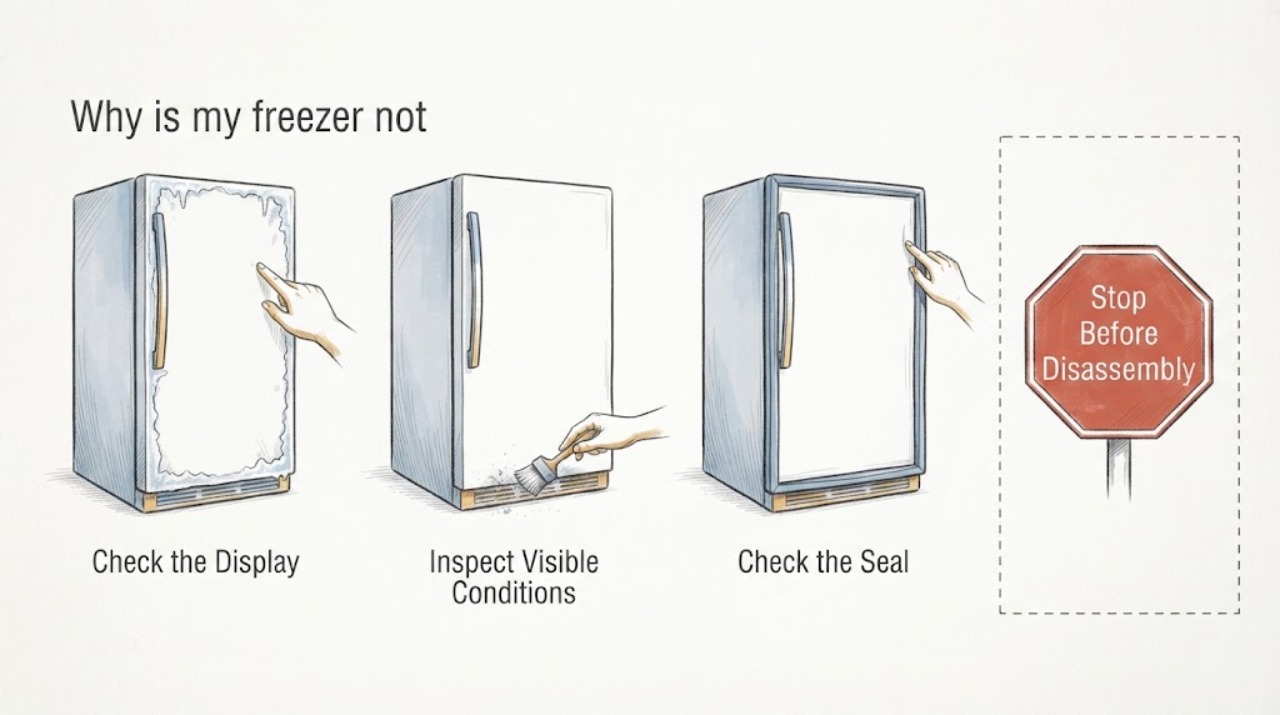
Work through in order
Diagnostic checks
Use only checks that match the exact appliance or system and its official guide.
-
Check 1
Identify whether the appliance is a standalone chest freezer, standalone upright freezer, or a freezer compartment in a refrigerator. Measure its internal temperature with an appliance thermometer or use the model's documented temperature display, and note whether the unit is running, silent, or repeatedly clicking.
Expected result: The temperature is falling and the unit runs normally, or the temperature is rising while the unit is silent, repeatedly clicking, or operating without producing cold.
Next step: Keep the door or lid closed and follow the format-specific checks below. Protect food and arrange service if the temperature continues rising or the unit will not run normally.
Why this matters
Why: A falling temperature supports a recovery or setting/load issue. A powered unit that remains warm with abnormal or absent operation needs service diagnosis; the observation does not identify a compressor, relay, defrost, or sealed-system part.
-
Check 2
Check that the freezer is turned on and that the control is set to the documented freezing range. If the display is lit but cooling is absent, look for a model-specific Demo, Showroom, or cooling-off indication; do not use a button sequence from another freezer.
Expected result: The control was off, the setting was warmer than intended, or a demo/showroom mode was indicated; alternatively, the documented cooling mode is active and the setting is appropriate.
Next step: Restore cooling only with the exact owner's instructions, then allow the model's documented recovery time before judging the result. If the control is correct and the freezer remains warm, stop changing settings and arrange service.
Why this matters
Why: Whirlpool says a freezer can be turned off after an outage or cleaning and that demo or showroom modes on some refrigerator models can leave lights on while disabling cooling. A correct setting with no cooling makes a service issue more likely.
-
Check 3
Inspect the door gasket or chest lid from the outside. Remove packages, baskets, ice, or shipping material that prevents full closure, and check whether the cabinet is visibly level enough for the door or lid to seal. Do not force a warped lid or tear a gasket.
Expected result: The door or lid does not close evenly, a package holds it open, frost or debris prevents sealing, or the seal closes uniformly with no visible gap.
Next step: Correct only a plainly visible loading, debris, or leveling issue permitted by the manual and monitor the measured temperature. If the seal remains damaged or the freezer stays warm, request service.
Why this matters
Why: Whirlpool says a poor seal admits warm air and moisture, can create frost, and makes the compressor run longer. A good visible seal does not rule out an internal cooling fault.
-
Check 4
Check the installation environment and visible airflow: keep the freezer away from an oven, radiator, or other heat source, preserve the clearance specified in the exact manual, and avoid packing food against vents or cabinet walls in a refrigerator-freezer.
Expected result: The freezer is in an unusually hot or cold location, clearance is blocked, vents are covered, or the installation and visible airflow look normal.
Next step: Restore only the manual-specified clearance and airflow, then allow the appliance to stabilize while keeping the door closed. Arrange service if temperature does not recover or heavy frost continues to block airflow.
Why this matters
Why: Whirlpool says extreme ambient conditions, blocked vents, crowded loading, and insufficient clearance can extend operation or prevent the intended temperature. Normal external airflow does not prove the sealed system is healthy.
-
Check 5
Consider recent heat load and usage: note whether a large amount of unfrozen food was added, the lid or door was open for a long time, or a power outage occurred. For a freezer compartment, leave its return and supply vents clear; for a standalone chest freezer, use the loading guidance in its manual.
Expected result: The problem began after a large warm load, extended opening, or outage and the unit is running; or those events did not occur and the temperature keeps rising.
Next step: Keep the freezer closed and allow the exact model's recovery period. If the temperature remains unsafe or the unit cannot recover, move food and arrange qualified service instead of repeatedly cycling power.
Why this matters
Why: Whirlpool says a large warm load or extended opening can raise freezer temperature for several hours, while an outage can leave the freezer warm after power returns. Persistent warming without those conditions needs service assessment.
Use your observations
Decision map
Find the observation that best matches what you see, then follow the next safe action.
-
PATH 01Next step
What you see
The freezer was turned off, in a cooling-off/demo mode, incorrectly set, or recently loaded with warm food, and its temperature begins to fall after the documented correction.
Do this next
Keep the door or lid closed for the model's recovery period and recheck the temperature. Do not add a large new load until the freezer has stabilized.
Why this path and its safety boundary
Why it matters: A control or temporary heat-load condition is more likely than an established component failure.
-
PATH 02Next step
What you see
The door or lid has a visible gap, a package or frost prevents closure, or the freezer is not level enough to seal.
Do this next
Remove only the visible obstruction and follow the exact manual for leveling or gasket service. Arrange repair if the seal remains damaged or the temperature does not recover.
Why this path and its safety boundary
Why it matters: Warm, moist room air can enter continuously, causing frost and longer operation without proving a compressor or refrigerant fault.
-
PATH 03Next step
What you see
The freezer is a refrigerator compartment with blocked vents, crowded contents, unusually warm room conditions, or dirty accessible condenser guidance for that model.
Do this next
Clear only the user-accessible vents and follow the exact manual for any condenser cleaning. Do not remove panels or assume a fan, defrost part, or sealed system has failed.
Why this path and its safety boundary
Why it matters: Air distribution, heat load, or environment may be limiting cooling; Whirlpool notes that condenser cleaning requirements vary by model and some are technician-only.
-
PATH 04Next step
What you see
The freezer remains warm after the control, seal, clearance, load and airflow checks, or it is silent, repeatedly clicking, heavily frosting, leaking, or warming stored food.
Do this next
Protect the food, leave the freezer in the safest state described by its manual, and arrange qualified appliance service. Do not open the sealed system, test live circuits, or add refrigerant.
Why this path and its safety boundary
Why it matters: A service-level electrical, defrost, relay, compressor, fan, or sealed-system problem remains possible, but no specific part is established by the symptom.
Helpful context
Understand the symptom
Start by identifying the freezer format
A standalone chest or upright freezer has its own thermostat, door or lid seal, and cabinet clearance. A freezer compartment inside a refrigerator may share cooling, vents, fans, and controls with the fresh-food section. Whirlpool's support pages treat these as different product families, so the exact owner's manual matters before changing settings, cleaning a condenser, or opening any service access.
Warm does not identify a failed compressor
A freezer can be warm because cooling is turned off, the controls are wrong, a display or showroom mode is active, the door or lid is not sealing, warm food was recently loaded, or air cannot circulate. GE also lists defrost-control, relay, wiring, and compressor faults for a powered upright or chest freezer, but those are service possibilities rather than conclusions a homeowner can make from a warm cabinet.
Protect food while you determine the next step
Use an appliance thermometer or the freezer's documented temperature display and note whether the temperature is falling, stable, or rising. Keep the door or lid closed while checking, move vulnerable food to a known-cold freezer if the compartment is warming, and arrange service when the documented external checks do not restore cooling. Do not remove sealed-system panels or attempt refrigerant work.
When checks do not resolve it
Need a professional?
Protect food and arrange qualified freezer service when the temperature continues rising, the appliance will not run normally, heavy frost blocks airflow, the seal is damaged, or external checks do not restore cooling. Do not remove sealed-system panels, handle refrigerant, test energized wiring, or replace a compressor, relay, fan, or defrost part from the warm-freezer symptom alone.
Have this ready
- Provide the appliance type and full model number, measured temperature and timing, whether lights or controls work, compressor or fan observations, seal and frost findings, room conditions, recent outage or warm load, and the external checks already completed.
Common questions
FAQ
What should I check first when a freezer is not cooling?
Identify whether it is a standalone freezer or a refrigerator freezer compartment, then check the actual temperature, power and control setting, door or lid seal, and whether the unit is running. Keep the door or lid closed while the temperature recovers and protect food if it continues to rise.
Can a freezer be powered on but still not cool?
Yes. GE lists control, defrost-control, relay, wiring and compressor possibilities for an upright or chest freezer with working lights. Those possibilities require model-specific service diagnosis; a lit control panel does not identify the failed part.
Can a bad door seal make a freezer warm?
Yes. Whirlpool says a lid or door that cannot seal lets moisture and warm air in, can cause frost, and makes the compressor run longer. Check for packages, debris, frost, level and visible gasket damage before requesting service.
Should I turn the freezer colder and wait?
Use the exact manual for the control sequence. Whirlpool says some chest-freezer mid settings target about 0°F under normal conditions and advises waiting between adjustments; repeatedly changing controls or using another model's sequence can obscure the diagnosis. If the temperature does not recover, arrange service.
Read the exact guide
Official sources
- Setting the Controls for a FreezerWhirlpool Product Help · Opened Whirlpool chest-freezer control guidance. The near-0°F and recovery timing are presented as chest-freezer examples only; exact control behavior and target for an unspecified freezer must come from its manual.
- Upright & Chest Freezer - Not WorkingGE Appliances · Opened GE's general upright/chest freezer support page. It is used to establish that a powered but warm freezer may require service and that control, defrost, relay, wiring or compressor causes cannot be selected from the symptom alone; it does not identify the unbranded freezer or a specific failed part.
- Not Cooling - Freezer Section - RefrigeratorWhirlpool Product Help · Opened Whirlpool refrigerator freezer-section guidance used conditionally for a freezer compartment. It is not used to claim that the unbranded topic is a French-door refrigerator; the article explicitly branches by format.
- Not Cooling - Convertible Chest FreezerWhirlpool Product Help · Opened Whirlpool convertible chest-freezer guidance used conditionally for standalone chest/freezer-format checks. The task has no model, so exact clearances and control sequences remain manual-dependent.
- Not Freezing - Door is Sealing - Chest FreezerWhirlpool Product Help · Opened Whirlpool chest-freezer support guidance used conditionally for standalone-freezer recovery and load checks; it is not treated as a universal instruction for upright or refrigerator-freezer designs.
Community feedback
Share a repair observation
Share a plain-text repair observation. Accepted observations are published automatically; this page may take a moment to update.