
On this page
Start here
Quick answer
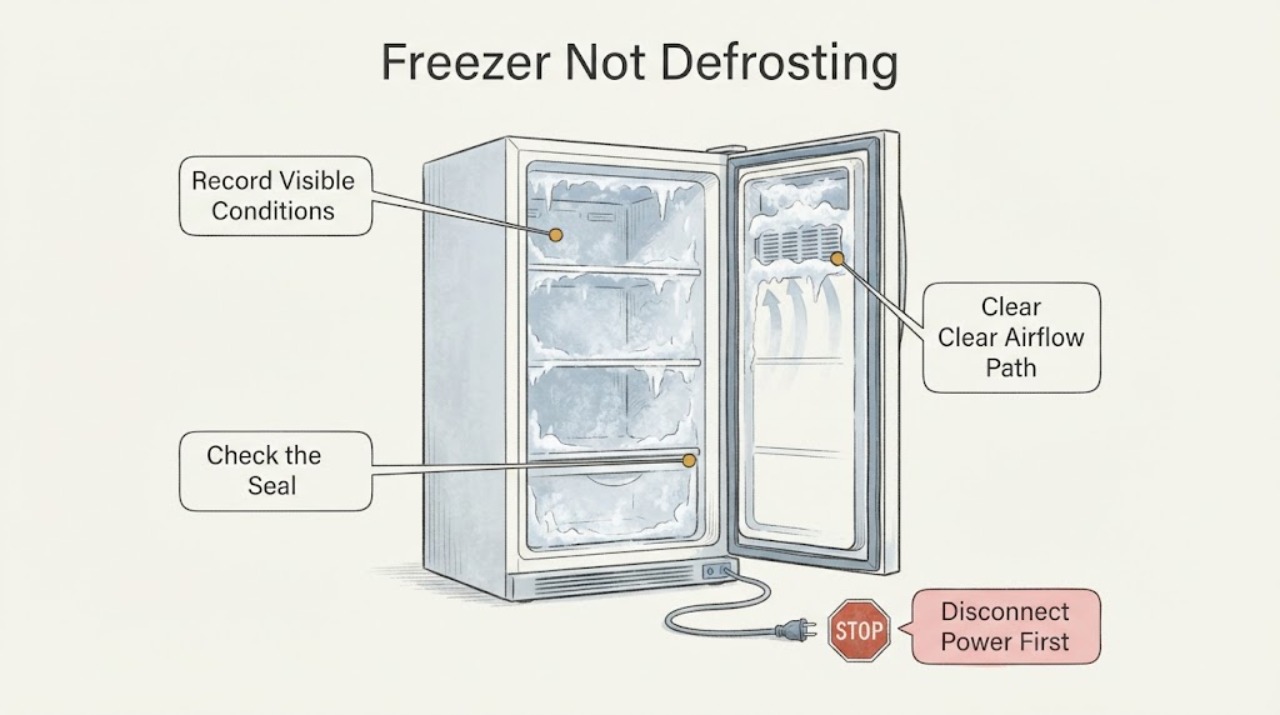
A small amount of frost can be removed during a frost-free freezer's programmed defrost cycle, but the timing and owner procedure are model-specific. Thick or recurring frost, an ice sheet, blocked vents, or frost around a door edge warrants an external check of the door closure, gasket, airflow and setting against the exact manual. If the manual permits a complete defrost, unplug the freezer, move the food, let ice melt naturally with the door open and towels in place, and dry it before restarting as directed; never use a hair dryer, heat gun, flame, knife or other sharp tool. If frost or a floor ice sheet returns after a complete defrost, stop guessing at a heater or drain part and arrange manufacturer or qualified service.
Work through in order
Diagnostic checks
Use only checks that match the exact appliance or system and its official guide.
-
Check 1
With the freezer closed and safe to inspect, record where the frost or ice is located and whether it is a light film, a thick back-wall layer, a floor ice sheet, or frost concentrated near the door opening. Check whether any interior vents are covered by food or ice.
Expected result: Only a light film is present and vents are open, or thick/recurring frost, a floor sheet, a back-wall blockage or a vent obstruction is present.
Next step: Use the matching frost-pattern branch below. Do not scrape, chip or heat the ice while making this observation.
Why this matters
Why: A light film can be handled by a model's normal cycle. Thick or localized frost shows moisture or airflow is not being cleared and does not by itself identify a failed heater or sensor.
-
Check 2
Check the door path from the outside: remove packages that prevent closure, confirm drawers and baskets are seated, and inspect the gasket for dirt, twisting, tears or a section that will not contact the cabinet. Clean an intact gasket only with warm water and mild detergent, then dry it.
Expected result: The door closes and the gasket contacts evenly, or a package/rail blocks closure, the gasket is dirty or distorted, or the gasket is torn or remains loose.
Next step: Correct only the accessible obstruction or clean the gasket. If the gasket is damaged or the door still does not seal, keep the freezer closed as much as practical and arrange model-specific service.
Why this matters
Why: A door that cannot seal admits warm humid air and can create recurring frost. A torn or persistently loose gasket is not repaired by changing a temperature setting.
-
Check 3
Check the exact owner manual for the freezer's recommended setting and airflow layout. Keep food from covering vents, allow warm uncovered food to cool as the manual directs, and avoid repeated door openings while observing whether the frost pattern stabilizes.
Expected result: Airflow was blocked or the setting/usage differed from the manual, or vents are open and the setting is correct but frost remains or returns.
Next step: After correcting the accessible condition, monitor the freezer through its normal cycle. If thick frost remains, the freezer cannot maintain temperature, or frost recurs, use the safe-defrost and service boundary rather than changing internal settings.
Why this matters
Why: Blocked airflow, excess moisture and temperature or usage conditions can maintain frost, but correcting them does not prove that the automatic-defrost system is healthy.
-
Check 4
If the exact manual permits owner defrosting, unplug the freezer, move the food to safe storage, leave the door open, place towels to catch meltwater, allow the ice to melt naturally, and dry the interior before reconnecting it according to that manual.
Expected result: The ice clears without tools or heat and the freezer resumes normal operation, or ice cannot be cleared safely, the compartment was damaged, or heavy frost returns after a complete defrost.
Next step: Do not use a hair dryer, heat gun, flame, knife, pick or sharp scraper. If defrosting is not covered by the exact manual, or frost returns, leave panels and heaters untouched and request manufacturer or qualified service.
Why this matters
Why: A successful natural defrost removes the immediate ice obstruction but does not establish the cause. Recurrence or a floor ice sheet after defrost can require diagnosis of the drain or automatic-defrost path.
-
Check 5
After the freezer is fully defrosted and restarted as directed, document whether frost returns, whether a sheet forms on the floor, whether the door seal remains tight and whether the unit reaches the manual's normal operating condition. Do not remove an interior panel or test a heater, sensor or drain electrically.
Expected result: Frost stays clear and airflow/temperature recover, or frost rapidly returns, the floor ices again, the freezer cannot recover, or the door still leaks air.
Next step: For recurrence or poor cooling, keep the freezer closed, protect food as needed and provide service with the model, frost location, door-seal result and defrost history. Do not continue repeated defrost cycles or bypass an interlock.
Why this matters
Why: Stable operation supports an environmental, loading or sealing cause; rapid recurrence, a floor sheet or failure to recover exceeds a safe external diagnosis and does not identify one replacement part.
Use your observations
Decision map
Find the observation that best matches what you see, then follow the next safe action.
-
PATH 01Next step
What you see
Only a light frost film is present, the vents are open and the door closes evenly.
Do this next
Keep the door closed, avoid blocking airflow and monitor the next normal cycle. Do not manually chip the film or change an internal control.
Why this path and its safety boundary
Why it matters: This may be normal moisture awaiting the freezer's programmed automatic-defrost cycle; the exact cycle is model-specific.
-
PATH 02Next step
What you see
Frost is concentrated at the door edge or the gasket does not contact evenly.
Do this next
Remove only the accessible obstruction and clean an intact gasket as directed. If the gasket is torn or the seal remains poor, request model-specific service.
Why this path and its safety boundary
Why it matters: Warm humid air can be entering through an obstruction, dirty/distorted gasket or damaged seal.
-
PATH 03Next step
What you see
Thick frost covers the back wall or vents, but the door seal is intact and packages were blocking airflow.
Do this next
Clear only the loading obstruction. If the exact manual permits it, perform a natural unplugged defrost; if frost returns, stop and arrange service.
Why this path and its safety boundary
Why it matters: Restricted airflow or excess moisture can preserve the frost pattern; the observation does not prove a heater failure.
-
PATH 04Next step
What you see
A floor ice sheet or heavy frost returns after a complete, natural defrost, or the freezer cannot recover normal cooling.
Do this next
Keep the freezer out of repeated test cycles and arrange manufacturer or qualified appliance service. Do not remove panels, test energized parts, apply heat or order a guessed component.
Why this path and its safety boundary
Why it matters: The drain or automatic-defrost path may need professional diagnosis, but the symptom cannot distinguish a drain, heater, sensor, control or sealing fault.
Helpful context
Understand the symptom
First decide whether the frost is light or persistent
The task does not identify a brand or model, so an exact automatic-defrost interval or temperature setting cannot be assumed. A light film that disappears during the appliance's normal cycle is different from thick frost on the back wall, a sheet of ice on the floor, frost around the door, or frost that returns quickly. The pattern and whether the vents remain open determine the next safe check; they do not prove that a particular heater, sensor or control has failed.
Defrost without adding heat or damaging the liner
If the exact manual allows owner defrosting, follow that manual's food-storage and restart instructions. The general safe boundary is to unplug first, remove the food, leave the door open, protect the floor with towels, allow ice to melt naturally and dry the compartment completely. Do not chip ice with a knife or pick, use a hair dryer or heat gun, apply a flame, remove a panel, or test a heater from the symptom alone. A floor ice sheet or rapid recurrence after a complete defrost is a service description, not a reason to guess a part.
When checks do not resolve it
Need a professional?
Stop external troubleshooting and arrange service for recurring heavy frost, a recurring floor ice sheet, a damaged door seal, loss of cooling after defrosting, or any diagnosis that would require removing a panel or working near energized parts.
Common questions
FAQ
Is a small amount of freezer frost always a failure?
No. A light film may be removed during a frost-free model's normal automatic-defrost cycle. The timing is model-specific; thick, localized or recurring frost needs the door, airflow and safe-defrost checks described here.
Can I use a hair dryer or knife to clear the freezer?
No. Official guidance warns against a hair dryer, and sharp tools can damage the liner, wiring or sealed system. If the exact manual permits owner defrosting, unplug the appliance and allow ice to melt naturally with towels in place.
Why does frost keep returning after I defrost the freezer?
Check for a door or gasket leak, blocked airflow and excess moisture first. If a complete safe defrost is followed by a returning floor ice sheet or heavy frost, the drain or automatic-defrost path needs professional diagnosis; the symptom does not identify a single part.
Should I replace the defrost heater because the freezer will not defrost?
Do not order or test a heater from this symptom alone. Frost can also result from a door seal, airflow, drain, setting or other model-specific condition. Provide the exact model and the frost pattern to manufacturer or qualified service.
Read the exact guide
Official sources
- LG Refrigerator - Frost BuildupLG Electronics USA · Opened LG USA support article. The automatic-defrost timing and procedures are LG-specific examples; the article uses it for frost-pattern reasoning and the explicitly stated safe/service boundaries, not as a universal manual for unidentified freezers.
- How to Avoid Frost Build Up - FreezerMaytag · Opened Maytag product-help article. Used for the manufacturer explanation of moisture, airflow and sealing factors; it does not establish a component diagnosis or exact setting for the unidentified task appliance.
- Refrigerator's Freezer Frost Build UpFrigidaire · Opened Frigidaire owner-support article. Used for the manufacturer-documented external causes and prevention checks; no Frigidaire-specific setting is generalized to an unidentified freezer.
- Frost forms in the freezer or refrigeratorSamsung Support · Opened Samsung USA troubleshooting page. Its no-hair-dryer warning, natural/manual defrost boundary and recurrence-service instruction are cited as Samsung guidance and safety boundaries, not as model-independent cycle timings.
Community feedback
Share a repair observation
Share a plain-text repair observation. Accepted observations are published automatically; this page may take a moment to update.