
On this page
Start here
Quick answer
On the Frigidaire FGAC5044W1, 70°F/21°C is within the documented 41–89°F operating range, and 15 inches from the wall exceeds the manual's 12-inch minimum on the measured side. Those facts make low room temperature and that one clearance less likely, but they do not rule out a blocked or dirty filter, another obstructed air path, an unsuitable mode or setpoint, or an internal refrigeration or defrost problem. Frigidaire says light frost can be normal while the coil sensor stops the compressor so it can melt; heavy, fast, or recurring frost after the accessible filter, airflow, clearance, and mode checks is a service condition. Let the frost thaw naturally, clean only the accessible filter, and do not scrape coils, add refrigerant, open the cabinet, or use a heater.
Before you begin
Safety first
- The owner-level boundary is the dry external filter, external airflow, documented mode, and normal observation checks. Do not remove the cabinet, scrape coils, use forced heat, probe live wiring, test a capacitor or compressor, add refrigerant, or bypass a sensor or protection device.
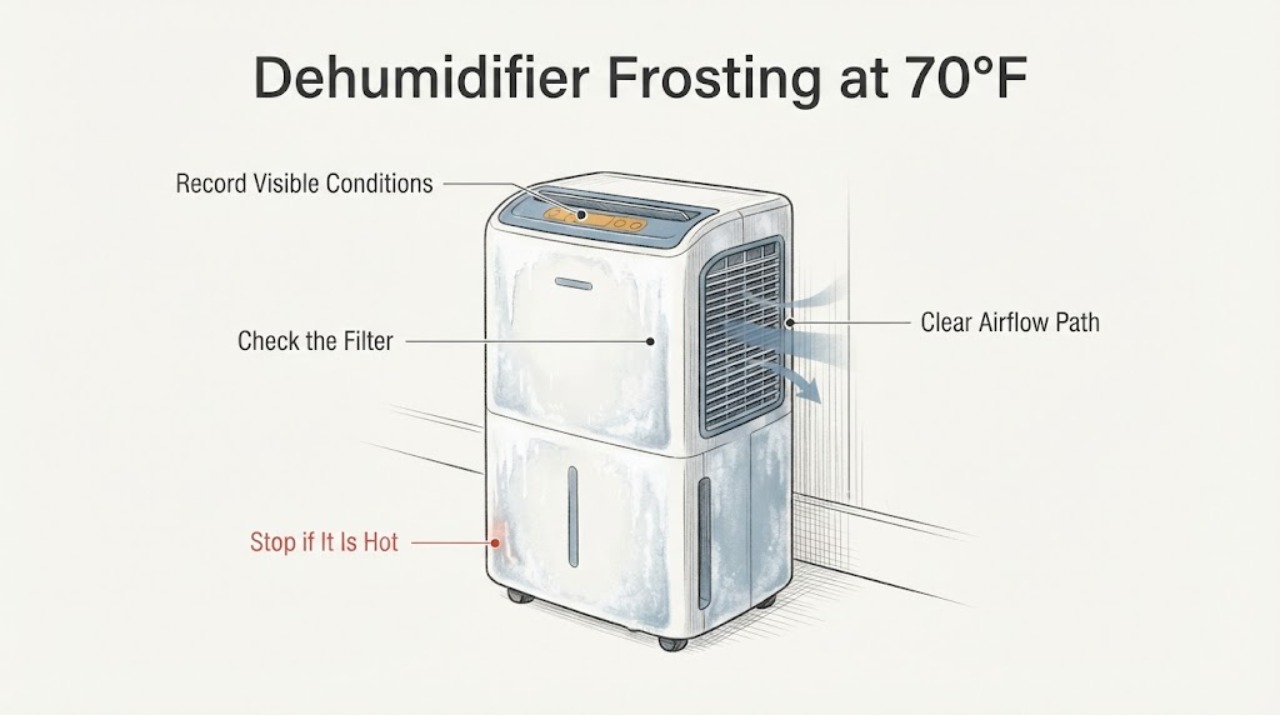
Work through in order
Diagnostic checks
Use only checks that match the exact appliance or system and its official guide.
-
Check 1
Confirm the exact model is FGAC5044W1 and record whether the frost is a thin patch that later clears, a thick layer covering much of the visible coil, or frost that returns almost immediately. Record the room temperature as about 70°F/21°C, the 15-inch wall measurement, humidity, selected mode, setpoint, and how long the unit ran before icing.
Expected result: The model and conditions match, or the display/model is uncertain; the frost is light and temporary, or heavy, fast, and recurring.
Next step: Continue only with the external checks below when the appliance is dry and there is no hazard. If the model cannot be confirmed, use the matching manual rather than applying this model's thresholds.
Stop if: Do not scrape the coil, remove a cover, or keep restarting a unit that ices rapidly, overheats, smells burned, or trips protection.
Why this matters
Why: The exact identity keeps the 41–89°F range, clearance, controls, and filter instructions tied to this model. Frigidaire treats light frost as potentially normal but identifies heavy frost, restricted airflow, or a frost pattern that does not clear as needing additional checks or service.
-
Check 2
Turn the dehumidifier off, disconnect it from the grounded outlet only when the plug and surrounding area are dry and safe, and allow the frost to melt naturally. After thawing, remove and inspect the accessible filter at the back, clean and dry it exactly as the manual directs, and reinstall it fully.
Expected result: The filter is visibly blocked or dirty and the frost clears after a natural thaw, or the filter is clean and frost returns without a clear airflow cause.
Next step: Make one normal test only after the filter is dry and the unit has thawed. If thick or rapid frost returns, stop using the unit and arrange Frigidaire service.
Stop if: Do not use a heat gun, flame, hair dryer, knife, or other tool to accelerate defrosting; do not touch a powered fan or exposed wiring.
Why this matters
Why: Frigidaire identifies a dirty filter or restricted airflow as a contributor to heavy frost. A clean, dry, correctly installed filter that does not change recurring frost makes a simple maintenance explanation less likely; it does not identify a particular internal part.
-
Check 3
Check the complete external air path after the unit is dry: the rear filter intake, the upper discharge, and the space around every side. The manual requires at least 12 inches around the dehumidifier; the reported 15 inches from one wall exceeds that minimum on that side, but confirm that furniture, curtains, dust, or a nearby surface do not block another side or the top.
Expected result: All sides and the top discharge are clear with at least the documented clearance, or another obstruction remains.
Next step: Remove only loose external obstructions and repeat one normal run after a complete natural thaw. If airflow is clear but heavy frost recurs at 70°F, proceed to service rather than moving into internal diagnosis.
Stop if: Do not dismantle grilles or panels, reach into the air path, or run the unit with a missing filter or unsafe wet area.
Why this matters
Why: The reported 15-inch wall gap reduces concern about that measured clearance, while a blocked intake or discharge can still restrict airflow and promote frost. Clear external obstructions only; this check cannot prove that the fan, coil, or sealed system is healthy.
-
Check 4
Read the normal display controls and check the selected humidity mode and target. If Continuous mode is shown as CO, change to a normal 35–85% target range using only the documented controls; do not enter service settings. Let the unit complete one ordinary cycle after the frost has naturally thawed.
Expected result: CO/Continuous mode was selected, the target was outside the documented normal range, or a normal mode and target were already selected.
Next step: Observe whether the frost stays light and clears or returns heavily. If heavy frost returns with a normal mode, clean filter, clear airflow, 70°F room, and adequate clearance, stop use and request service.
Stop if: Do not repeatedly change setpoints, defeat frost protection, or continue operation while ice blocks airflow or the unit is overheating.
Why this matters
Why: Frigidaire's frost guidance specifically advises changing CO to a 35–85 range when heavy ice is present. Correcting a documented mode or target can remove a control-condition explanation, but it does not prove that recurring frost is normal.
-
Check 5
During the one controlled test, note whether the fan and compressor cycle normally, whether the frost clears during the unit's protection/defrost behavior, and whether a red-light error code such as E4, EC, AS, or ES appears. Stop the test if the unit becomes abnormally hot, smells burned, smokes, leaks near electrical parts, or trips protection.
Expected result: The light frost clears and does not return, the heavy frost returns quickly, an error code appears, or a hazard is present.
Next step: Keep the unit off for persistent heavy frost, recurring errors, or any hazard. Provide Frigidaire service with the exact model, room temperature, clearance measurements, mode, filter result, frost timing, and display photo.
Stop if: Do not open the cabinet, probe live wiring, test a capacitor or compressor, add refrigerant, or repeatedly reset a fault.
Why this matters
Why: A frost pattern that clears supports the documented automatic protection explanation. Rapid recurrence, a persistent code, or a hazard leaves an internal airflow, sensor, control, compressor, or sealed-system diagnosis for qualified service; the symptom alone cannot select a replacement part.
Use your observations
Decision map
Find the observation that best matches what you see, then follow the next safe action.
-
PATH 01Next step
What you see
Only a light patch of frost appears during operation, the room is about 70°F/21°C, the external filter and airflow are clear, and the frost later clears without a recurring error.
Do this next
Monitor the unit and keep the filter, intake, discharge, and documented clearance clear. Arrange service if the frost becomes thick, covers the coil, returns rapidly, or the dehumidifier stops behaving normally.
Why this path and its safety boundary
Why it matters: This pattern is consistent with Frigidaire's explanation that light frost near the evaporator can be normal and should be melted by the coil-sensor protection cycle.
-
PATH 02Next step
What you see
The filter or another external air path was blocked, or CO/Continuous mode was selected, and the frost clears after natural thaw, cleaning, clearances, and a documented mode correction.
Do this next
Use the corrected external setup and monitor one normal cycle. Do not keep operating if heavy frost returns or airflow becomes blocked again.
Why this path and its safety boundary
Why it matters: The observed pattern makes an external airflow or operating-mode condition more likely than it was at the start, but it does not prove that the condition was the only cause.
-
PATH 03Next step
What you see
At 70°F/21°C, with the filter clean, all air paths clear, the measured wall gap at least 15 inches, and a normal mode selected, thick frost returns quickly or does not clear.
Do this next
Turn the unit off after a safe natural thaw and arrange authorized Frigidaire or qualified appliance service. Include the model and the complete check sequence.
Why this path and its safety boundary
Why it matters: Low ambient temperature and the measured wall clearance are less supported explanations. Frigidaire's guidance leaves restricted airflow elsewhere or an imbalanced/internal refrigeration or defrost condition as service-level possibilities; it does not support selecting a part from this observation.
-
PATH 04Next step
What you see
A red-light error code appears, the unit repeatedly stops, or frost is accompanied by overheating, smoke, a burning odor, water near electrical parts, a damaged cord, or repeated breaker/GFCI operation.
Do this next
From a safe, dry position disconnect power if it can be done without touching a hazard, keep clear, and contact Frigidaire service or a qualified electrician as appropriate. Preserve the exact code and conditions.
Why this path and its safety boundary
Why it matters: This is no longer an ordinary frost or filter check. The exact code and hazard pattern need model-specific service, and electrical or water hazards require immediate stop-use handling.
Helpful context
Understand the symptom
Why 70°F and 15 inches change the first check
The exact FGAC5044W1 manual says the dehumidifier is designed to operate from 41°F to 89°F and calls for at least 12 inches of clearance around it. A reported room temperature of 70°F/21°C and 15 inches from the wall therefore make the low-temperature and that measured-wall-clearance explanations less supported than they would be in a cold or cramped room. Check all sides and the top discharge, however: one wall measurement does not prove that the intake and discharge are clear, and it does not diagnose the sealed system.
Light frost versus a service pattern
Frigidaire explains that a light frost can be normal because the evaporator approaches freezing; a coil sensor should stop the compressor and allow the frost to melt. Heavy ice, frost that forms rapidly, or frost that returns after the filter and airflow are corrected is not a reason to keep restarting the appliance. Let it thaw naturally and arrange service if the pattern persists. The manual does not authorize a homeowner to open the cabinet or service refrigerant or internal controls.
When checks do not resolve it
Need a professional?
Arrange Frigidaire or qualified appliance service when thick or rapid frost returns after the filter, complete external airflow, clearance, and documented mode checks at about 70°F/21°C; when a red-light error code persists; or when the unit repeatedly stops. Stop immediately for smoke, a burning smell, abnormal heat, water near electrical parts, a damaged cord, or repeated protection trips. The exact product support page identifies FGAC5044W1 as a discontinued model, so give the provider the complete model and serial information and do not assume that a generic part will fit.
Safety scope: The owner-level boundary is the dry external filter, external airflow, documented mode, and normal observation checks. Do not remove the cabinet, scrape coils, use forced heat, probe live wiring, test a capacitor or compressor, add refrigerant, or bypass a sensor or protection device.
Common questions
FAQ
Is frost normal on a Frigidaire FGAC5044W1 dehumidifier?
A light frost can be normal because the evaporator approaches freezing, and Frigidaire says the coil sensor should stop the compressor so it can melt. Thick, fast, or recurring frost is not something to scrape or keep restarting; check the accessible filter, airflow, clearance, and mode, then arrange service if it persists.
Does 70°F/21°C rule out a temperature-related frost problem?
It makes low ambient temperature less likely because the exact manual gives a 41–89°F operating range, but it does not rule out blocked airflow, another obstruction, mode or setpoint conditions, or an internal fault. Use the full external-check sequence rather than treating 70°F as a diagnosis.
Is 15 inches from the wall enough clearance?
The manual calls for at least 12 inches around the dehumidifier, so 15 inches exceeds the minimum on the measured side. Check the rear intake, top discharge, and all other sides too; one wall measurement does not prove that airflow is unobstructed.
Can I fix heavy frost by scraping the coil or adding refrigerant?
No. Let the unit thaw naturally, clean only the accessible filter, and keep the external airflow clear. The manual says there are no user-serviceable parts and directs owners to authorized service; do not open the cabinet, use forced heat, or handle refrigerant.
Read the exact guide
Official sources
- Product Support: Frigidaire Gallery High Humidity 50 Pint Capacity Dehumidifier with Wi-Fi White-FGAC5044W1Frigidaire Canada · Opened official Frigidaire product-support page for the exact FGAC5044W1 model; it identifies the product and provides model-specific component and service context, including the top air discharge and rear filter access.
- User manual_Midea_FB_R410a_Electric_WIFI_16120300A25883_211209Frigidaire · Opened the official PDF from the FGAC5044W1 product-support page; the manual covers safe operation, 41–89°F operating conditions, 12-inch clearance, controls, filter reset, error indicators, and the no-user-serviceable-parts boundary.
- Dehumidifier - Frost BuildupFrigidaire · Opened official Frigidaire support article for dehumidifier frost buildup; it distinguishes light frost from heavy frost and discusses low ambient temperature, clearance, filter airflow, Continuous mode, and service escalation.
Community feedback
Share a repair observation
Share a plain-text repair observation. Accepted observations are published automatically; this page may take a moment to update.