
On this page
Start here
Quick answer
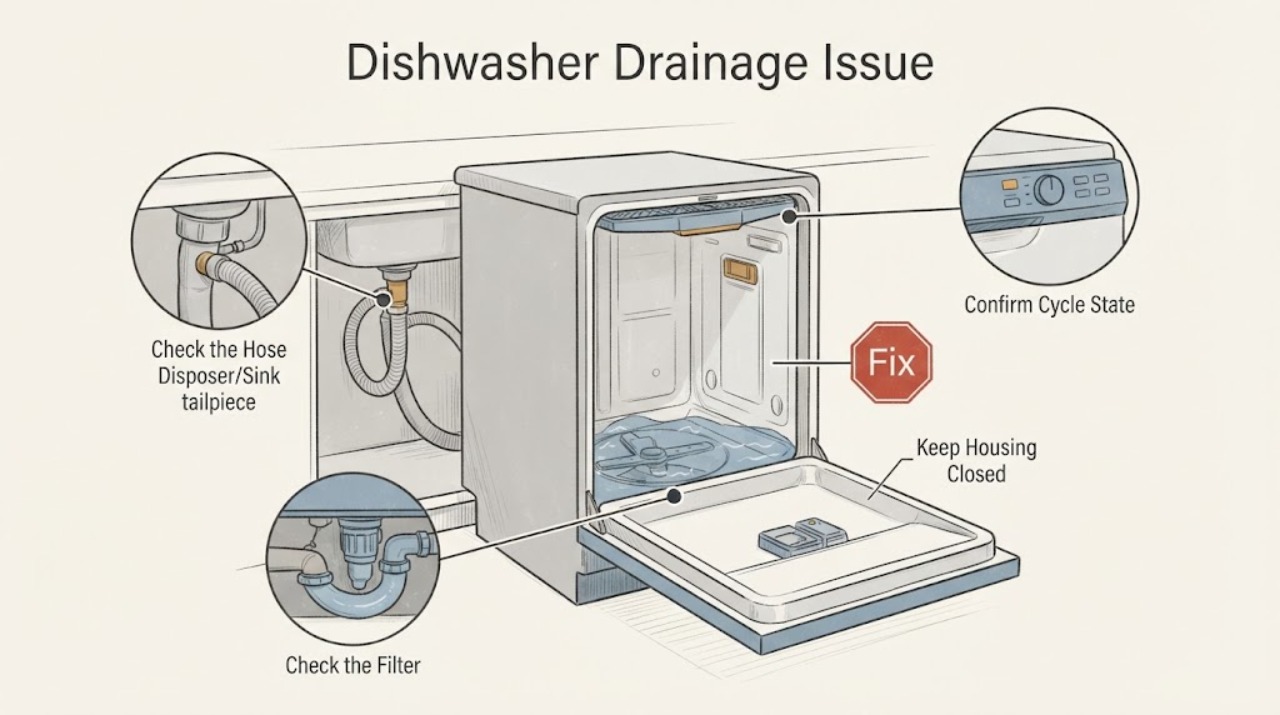
First confirm that the cycle finished rather than remaining paused. Then inspect the visible drain hose for kinks and the correct high-loop routing, check the disposer knockout plug if the dishwasher was connected to a garbage disposal, and clean the accessible glass trap and filters with power controlled. If the dishwasher stopped mid-cycle, use the model-documented Cancel procedure; Frigidaire's general page describes holding Cancel for 5–10 seconds and starting a new cycle, but control behavior is model-specific. If water remains, an i20 code returns, the drain pump only hums, there is a leak or the problem continues after these external checks, leave the dishwasher off and arrange Frigidaire-authorized service rather than opening the pump or cabinet.
Work through in order
Diagnostic checks
Use only checks that match the exact appliance or system and its official guide.
-
Check 1
Check whether the cycle actually completed, is paused, stopped mid-cycle, or shows a named drainage code; record whether water is above the filter area and whether the dishwasher is leaking.
Expected result: The cycle is paused or incomplete, water remains after completion, i20 is displayed, or there is a leak or water near electrical parts.
Next step: If there is a leak or unsafe water exposure, stop using the dishwasher and isolate water/power from a safe location. Otherwise continue with the visible hose and filter checks.
Why this matters
Why: A paused/incomplete cycle needs its documented cancel path, while standing water or i20 supports the drainage branch. A leak or electrical hazard changes the decision to stop and contain the appliance.
-
Check 2
With the dishwasher idle, inspect the visible drain hose for kinks, pinching or movement and verify the correct high-loop routing; if connected to a garbage disposal, confirm the disposer inlet knockout plug was removed during installation.
Expected result: The hose is kinked or too low, the disposer plug remains, the connection is damaged/leaking, or the visible installation appears clear.
Next step: Correct only a clearly accessible routing or installation issue according to the model instructions and check for leaks. If the hose or connection requires disassembly or is damaged, leave the dishwasher off and call service/plumbing help.
Why this matters
Why: Frigidaire identifies restricted hose routing, incorrect height and a retained disposer plug as causes of incomplete drainage. A clear external path does not prove a drain pump or control fault.
-
Check 3
After controlling power and allowing hot water to cool, clean the accessible glass trap/coarse and fine filters as Frigidaire describes; if a countertop drain air gap is installed, inspect and clean that external component without opening the dishwasher cabinet.
Expected result: Food debris or residue is present in the filter, trap or air gap, or the accessible drain path is clear but water remains.
Next step: Rinse and reinstall the filters correctly, then use the exact model's documented drain test. If water remains or the path requires pump/cabinet access, stop and arrange service.
Why this matters
Why: Frigidaire associates debris in these accessible areas with drainage restriction. A clear filter/trap does not identify a hidden pump or internal hose problem.
-
Check 4
If the dishwasher stopped mid-cycle and there is no leak or electrical hazard, use the model manual's Cancel procedure; Frigidaire's general drainage page describes holding Cancel for 5–10 seconds, then starting a new cycle to drain.
Expected result: The cycle cancels and the dishwasher drains, or water remains, the code returns or the dishwasher will not start the drain routine.
Next step: Use the reset once as documented. If drainage fails again, stop repeating resets and move to service; do not force a cycle or run the pump with a leak.
Why this matters
Why: A documented cancel can clear an incomplete cycle but cannot prove the drain path or pump is repaired. i20-specific reset options are also model-dependent.
-
Check 5
Stop user troubleshooting if water remains after the hose, disposer, filter and documented cancel checks, i20 returns, the drain pump only hums or runs continuously, or there is a leak, burning odor or electrical concern.
Expected result: The drainage failure repeats or is accompanied by a leak, unusual electrical symptom, pump behavior or damage.
Next step: Leave the dishwasher off, close the water supply if there is active leakage and it is safe, and arrange Frigidaire-authorized or qualified service. Do not open the cabinet, remove the pump or perform live tests.
Why this matters
Why: Frigidaire routes unresolved drainage trouble to support; the available general sources do not identify a failed pump, impeller, control board or hidden blockage.
Use your observations
Decision map
Find the observation that best matches what you see, then follow the next safe action.
-
PATH 01Next step
What you see
The drain hose is kinked, routed below the required high-loop height, recently moved, or the disposer knockout plug remains.
Do this next
Correct the accessible installation issue per the exact manual, check for leaks and run the model-documented drain test. Use service/plumbing help if the connection is damaged or inaccessible.
Why this path and its safety boundary
Why it matters: The visible installation matches Frigidaire's documented drainage causes and does not require assuming a failed internal pump.
-
PATH 02Next step
What you see
Food debris is present in the glass trap, coarse/fine filter or external drain air gap.
Do this next
Clean and reinstall the accessible filter/trap components, then reassess one cycle. If standing water remains, request service rather than dismantling the pump.
Why this path and its safety boundary
Why it matters: Frigidaire supports these accessible areas as possible drainage restrictions.
-
PATH 03Next step
What you see
The display specifically shows i20 and the dishwasher is not draining completely.
Do this next
Perform only those accessible checks and use the i20 reset allowed by the model. If i20 returns, leave the dishwasher off and arrange service.
Why this path and its safety boundary
Why it matters: Frigidaire defines i20 as a drainage problem and lists hose obstruction/height, disposer plug and filter checks.
-
PATH 04Next step
What you see
The drain path and accessible filters are clear but water remains, the pump behaves abnormally, or a leak/electrical hazard is present.
Do this next
Isolate water/power safely and arrange Frigidaire-authorized or qualified service. Do not open the cabinet, bypass safety controls or perform live electrical tests.
Why this path and its safety boundary
Why it matters: The official guidance has reached its service boundary; the symptom does not prove a particular internal part.
Helpful context
Understand the symptom
Start with the drainage symptom
Water left after a completed cycle, a cycle still paused, a hose that has been moved, and a dishwasher that stopped mid-cycle are different observations. Frigidaire's official drainage guidance starts with cycle state and visible drain-path checks; it does not establish a failed pump from standing water alone.
Keep the drain path model-appropriate
Frigidaire's hose guide calls for a high drain-hose routing of at least 32 inches and says a disposer knockout plug must be removed when a disposer is used. Use the exact model installation instructions for the actual connection; do not cut, extend, reroute or dismantle the drain system based on a generic pump diagnosis.
Clean only the accessible filter path
Frigidaire's glass-trap guide supports cleaning the accessible air gap and coarse/fine filters under running water. A clean filter does not prove the internal pump, impeller or control is sound, so persistent drainage failure belongs with service.
When checks do not resolve it
Need a professional?
Arrange service if drainage remains poor after the hose, disposer, filter and model-documented cancel checks., Leave the dishwasher off for active leaks, water near electrical parts, burning odor or abnormal pump operation., Do not dismantle the pump or cabinet, bypass controls or perform live electrical tests without model-specific qualified service procedures.
Have this ready
- complete model and serial information
- whether the cycle completed, stopped or displayed i20
- water level and location, including any leak
- drain hose/high-loop/disposer and filter observations
- whether the documented Cancel procedure changed the symptom
Common questions
FAQ
Why is water left in my Frigidaire dishwasher?
Check whether the cycle completed, then inspect the drain hose for kinks and correct high-loop routing, the disposer knockout plug if applicable, and the accessible glass trap/filter. Persistent water after those checks needs service rather than a guessed pump replacement.
What does i20 mean on a Frigidaire dishwasher?
Frigidaire defines i20 as the dishwasher not draining properly. Its official checks include the disposer plug, drain hose obstruction/height and glass trap/filter; the exact model controls the reset procedure.
Can I remove the dishwasher pump to clear a blockage?
Not as a general user step. Frigidaire's opened guidance supports the accessible hose, air gap, glass trap and filters. If those are clear and water remains, leave the dishwasher off and arrange qualified service.
Read the exact guide
Official sources
- Dishwasher - Drain Hose GuideFrigidaire · Official Frigidaire drain-hose guidance opened directly. Supports the 32-inch routing, disposer plug and service/manual boundary; it is not a pump-repair procedure.
- Dishwasher Error Code i20 - Unit did not drain properlyFrigidaire · Official Frigidaire i20 support page opened directly. Used only when i20 is actually displayed; it supports hose, height, disposer plug, filter and reset observations.
- Dishwashers - Not DrainingFrigidaire · Official Frigidaire support page opened directly. Supports cycle, hose, filter, disposer, cancel and service checks; exact model remains controlling.
- What can I do if my dishwasher is not draining?Frigidaire · Official Frigidaire support page opened directly. Supports cycle-completion, hose, filter and model-manual checks with service escalation.
- Dishwasher Glass Trap and Filter GuideFrigidaire · Official Frigidaire filter guide opened directly. Supports external air-gap inspection and accessible coarse/fine filter cleaning; exact model controls filter layout.
Community feedback
Share a repair observation
Share a plain-text repair observation. Accepted observations are published automatically; this page may take a moment to update.