
On this page
Start here
Quick answer
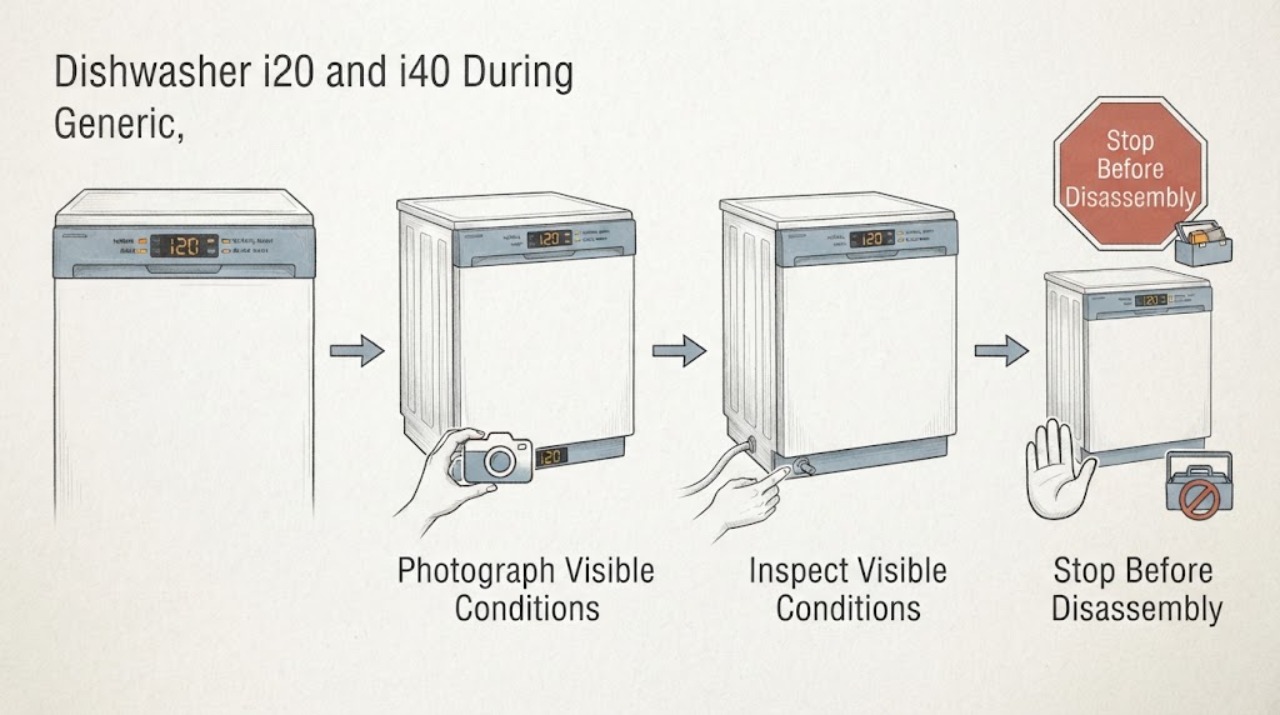
Treat I20 and I40 as separate drain-related observations, not as one combined fault. Frigidaire's dishwasher error guide defines i20 as a cycle that did not drain completely and i40 as a clogged filter or sump; the i20 checks emphasize the disposer knockout plug, drain-hose obstruction or pinch, hose height, and the glass trap/filter, while i40 points first to food soil in the glass trap and sump. Record which code appears, whether it follows Normal or Quick wash, and whether water remains before cancelling or resetting. Confirm the full rating-label model FGID2477RF3A and use its own manual because the opened Frigidaire product-support page is for the FGID2477RF platform rather than proving every suffix behaves identically. With power isolated as appropriate, inspect only the accessible filter, sump opening, visible drain route, disposer connection, water level, and leaks. If i20 returns with a clear external drain path, i40 returns after the permitted filter cleaning, water remains under the unit, or a pump or wiring diagnosis would be needed, stop running cycles and arrange qualified service; do not tilt the dishwasher, enter service mode, remove the pump, or test live wiring.
Work through in order
Diagnostic checks
Use only checks that match the exact appliance or system and its official guide.
-
Check 1
Before cancelling or resetting, photograph the complete display and record the exact rating-label identity, including the FGID2477RF3A suffix. Note whether the code is i20 or i40, whether it blinks or remains displayed, whether it occurred during Normal or Quick wash, and whether the cycle was still washing, draining, or already stopped.
Expected result: Only i20 appears, only i40 appears, the two codes occur at different stages, both are seen at different times, or the display/model cannot be confirmed.
Next step: Use the complete FGID2477RF3A manual when the identity is confirmed. If the suffix or display is unclear, preserve the photos and obtain model-specific support instead of using a cross-model code table; do not run a cycle merely to produce another code.
Why this matters
Why: Frigidaire maps i20 to incomplete draining and i40 to a clogged filter or sump. Similar-looking messages from another model or an unconfirmed sequence cannot establish the same meaning, and the two codes should not be fused into one failure.
-
Check 2
With the dishwasher idle and power isolated as the model guide requires, look at the water level in the tub and clean only the accessible glass trap/filter area using the FGID2477RF3A owner instructions. Do not reach into a hidden pump, remove a pump cover, or use tools to probe the sump.
Expected result: The filter or sump opening has visible food soil, the filter is clear, standing water remains, or water is present under the dishwasher.
Next step: If the manual permits it, clean and reseat the accessible filter once. If standing water persists, water is under the unit, the sump or filter is damaged, or the code returns after the safe check, leave the dishwasher off and arrange service.
Why this matters
Why: Frigidaire identifies i40 with food soil in the filter or sump and includes the filter among the i20 drain checks. A clear filter does not rule out a restricted hose or an internal drain problem; water under the unit is a leak and electrical-safety boundary.
-
Check 3
From outside the appliance, inspect the visible drain hose to the sink or disposer for a kink, pinch, disconnection, leak, or low route. If it drains into a disposer, confirm that the intended inlet is used and that the disposer knockout plug was removed during installation; do not pull the dishwasher out or disconnect a hose.
Expected result: A kink, obstruction, incorrect hose height, leak, disconnected connection, or retained disposer knockout plug is visible, or the external drain route looks normal.
Next step: Correct only an obvious, dry, user-accessible installation condition supported by the exact guide. For a leak, inaccessible connection, or normal-looking route with recurring i20/i40, stop and arrange qualified service rather than forcing a drain test.
Why this matters
Why: Frigidaire lists these visible drain-path conditions for i20. An apparently normal route narrows the external checks but does not identify a pump, motor, wiring, or control fault, and i40 may still reflect soil in the sump.
-
Check 4
Check the door edge and gasket for a visible obstruction and note whether the dishwasher starts, fills, washes, and reaches the drain stage. If the exact manual permits a reset, use the documented cancel or power-off procedure only once after recording the code; do not enter a service mode, hold the latch, or repeatedly restart the unit.
Expected result: The door will not latch, the unit never reaches drain, it drains and stops with i20, it stops with i40 after washing, or the reset clears the display only temporarily.
Next step: Remove only a visible loading obstruction and observe the code timing once. If the latch is unreliable, the unit repeatedly stops, or either code returns after the permitted procedure, leave it off and provide the record to qualified service.
Why this matters
Why: A door or cycle-state issue can prevent a valid drain event, while i20 and i40 point to different drain/filter observations. A temporary clear does not show that the underlying restriction or sump soil is gone.
-
Check 5
After the accessible checks, and only if there is no leak, wet electrical area, burning odor, damaged cord, or breaker problem, compare one Normal wash and one Quick wash only if the exact manual allows normal operation. Record whether each code appears and whether water remains; do not tilt the machine, remove panels, or run a diagnostic cycle.
Expected result: i20 appears only after one cycle, i40 appears after both cycles, the codes alternate by cycle, both cycles finish with no standing water, or a safety hazard appears.
Next step: If either code recurs or water remains, stop testing and arrange service with the cycle, timing, water level, photos, and checks. For a leak, burning odor, wet electrical area, or tripped breaker, isolate water and power only from a safe dry position and do not retest.
Why this matters
Why: Different timing can separate an incomplete drain path from filter or sump soil, but alternating codes do not prove two failed parts. A hazard overrides further comparison, and a clear cycle does not justify opening the pump area.
Use your observations
Decision map
Find the observation that best matches what you see, then follow the next safe action.
-
PATH 01Next step
What you see
i20 appears after the dishwasher reaches drain, the tub retains water, and the visible filter, hose route, and disposer connection have not been cleared.
Do this next
Check only the accessible hose, hose height, disposer knockout plug, and glass trap/filter. If those are clear or i20 returns, leave the appliance off and arrange qualified service.
Why this path and its safety boundary
Why it matters: This matches Frigidaire's incomplete-drain description. The next safe decision is still the documented external drain path, not a pump diagnosis.
-
PATH 02Next step
What you see
i40 appears after wash, especially when food soil is visible in the glass trap or sump opening.
Do this next
With power isolated and the exact guide in hand, clean and reseat only the accessible filter once. If i40 returns, stop repeated cycles and arrange service.
Why this path and its safety boundary
Why it matters: Frigidaire defines i40 as a clogged filter or sump caused by food soil. It is a bounded cleaning check, not proof that a drain pump or motor must be replaced.
-
PATH 03Next step
What you see
Normal wash and Quick wash produce different codes or different stopping stages.
Do this next
Keep separate photos and cycle records for each code and give them to service if either recurs. Do not use one code's reset or component conclusion for the other.
Why this path and its safety boundary
Why it matters: The timing is an independent observation: one path may be exposing incomplete draining while another exposes filter or sump restriction. It does not justify combining i20 and i40 into one component diagnosis.
-
PATH 04Next step
What you see
The filter and visible drain path are clear but i20 returns, i40 returns after cleaning, or water remains under or inside the unit.
Do this next
Stop using the dishwasher and arrange qualified service. Do not tilt it, remove the pump or toe-kick, enter service mode, or test live wiring.
Why this path and its safety boundary
Why it matters: The documented user-level checks have not resolved the condition. A hidden pump, motor, sump, connection, or control issue remains possible, and water under the unit changes the priority to safety.
-
PATH 05Next step
What you see
The full model suffix cannot be confirmed, the message is not exactly i20 or i40, or the display is only an unfamiliar light/status pattern.
Do this next
Photograph the label and display, obtain the exact manual or Frigidaire support, and do not apply a cross-model code table or part recommendation.
Why this path and its safety boundary
Why it matters: The opened FGID2477RF support page is a platform-level resource and Frigidaire says owner manuals contain model-specific information. A nearby code or status message is not a safe substitute for the FGID2477RF3A guide.
-
PATH 06Next step
What you see
A leak, wet electrical area, burning odor, damaged cord, or breaker trip occurs at any point.
Do this next
Stop the dishwasher. From a safe, dry position, close the water shutoff and isolate power if doing so does not expose anyone to the hazard, then arrange qualified service; do not reset or retest.
Why this path and its safety boundary
Why it matters: This is a water or electrical stop-use condition rather than an ordinary i20/i40 cleaning branch.
Helpful context
Understand the symptom
Read I20 and I40 as different signals
Frigidaire's general dishwasher guide labels i20 as a unit that did not drain completely and i40 as a clogged filter or sump. The i20 page lists the disposer knockout plug, drain hose obstruction or restriction, minimum hose height, and glass trap/filter; the i40 page points to food soil built up in the sump and asks the owner to clean the glass trap and filter. That overlap does not make the codes interchangeable: capture the exact code and the moment it appears, especially whether Normal and Quick wash produce different results.
Keep the FGID2477RF3A identity and manual boundary
The opened Frigidaire Gallery product-support page identifies the discontinued FGID2477RF platform and provides English, French, and Spanish owner and installation guides. It does not by itself prove that every suffix has identical controls or code behavior. Read the model from the dishwasher's rating label, retain the complete FGID2477RF3A identity, and use the matching manual before applying a reset or interpreting an unfamiliar display.
Water and installation checks come before pump conclusions
Frigidaire's documented user-level checks are external: look for a blocked or pinched drain hose, confirm the disposer knockout plug is removed, check the hose route and height, and clear the owner-removable glass trap/filter as the matching manual permits. Frigidaire's installation guidance also expects an accessible shutoff valve and properly connected water, drain, and power supplies. A clear filter does not prove that a hidden pump, motor, valve, or control is good, so those parts remain a professional differential rather than a shopping list.
Only after diagnosis
Potential parts
- glass-trap or filter assembly
Consider this class only if the exact manual confirms the accessible filter is damaged or cannot be cleaned and reseated; i40 alone does not prove a replacement is needed.
Confirm the full FGID2477RF3A identity and manufacturer fit information before ordering any part. - drain system or wash motor
Consider this class only after qualified service confirms a persistent i20 or i40 with the documented external path clear; the code does not select a pump or motor by itself.
Do not infer compatibility or order an internal part from i20/i40 without model-specific service diagnosis.
When checks do not resolve it
Need a professional?
Arrange qualified Frigidaire dishwasher service when i20 returns after the accessible drain-path checks, i40 returns after the permitted glass-trap/filter cleaning, the two codes recur at different stages, water remains, the full FGID2477RF3A identity or exact display cannot be matched, or a hidden pump, motor, sump, wiring, or control diagnosis would be required. Stop immediately for a leak, water near electrical parts, burning odor, damaged cord, or tripped breaker. Do not tilt the dishwasher, remove the pump or panels, enter service mode, bypass the latch, or test live wiring.
Common questions
FAQ
Are i20 and i40 the same Frigidaire dishwasher error?
No. Frigidaire defines i20 as a dishwasher that did not drain completely and i40 as a clogged filter or sump. They overlap around the drain path but should be recorded and checked separately.
What should I check first for i20 on FGID2477RF3A?
Confirm the exact model and inspect only the accessible drain path: disposer knockout plug, visible hose obstruction or pinch, hose height, and the glass trap/filter. If i20 returns with that path clear, arrange service instead of assuming the pump is bad.
Can cleaning the filter fix i40?
It may, because Frigidaire associates i40 with food soil in the glass trap or sump and directs owners to clean the glass trap and filter. Clean and reseat only the accessible filter as the exact manual permits; recurrence requires service.
Should I tilt the dishwasher or remove the drain pump?
No. A clear filter or hose does not safely identify a hidden pump, motor, sump, or control problem. Leave the appliance off for recurrence, leaks, or water near electrical parts and arrange qualified service.
Read the exact guide
Official sources
- Where can I find my model and serial number?Frigidaire Owner Center · Frigidaire dishwasher model-label location and identity confirmation
- Product Support: Frigidaire Gallery 24'' Built-In Dishwasher Stainless Steel-FGID2477RFFrigidaire Canada · Frigidaire Gallery FGID2477RF dishwasher platform identity and owner/installation guide availability relevant to the FGID2477RF3A suffix
- Dishwasher Error Codes and Alarms GuideFrigidaire Owner Center · Frigidaire dishwasher i20 incomplete-drain and i40 clogged-filter/sump meanings and permitted first checks
- Dishwasher Error Code i20 - Unit did not drain properlyFrigidaire Owner Center · Frigidaire dishwasher i20 drain-path checks
- Delivery and Installation Guide - DishwasherFrigidaire Owner Center · Frigidaire dishwasher visible installation supply, drain, power, and shutoff boundaries
- Dishwasher Error Code i40 - Clogged filter or sumpFrigidaire Owner Center · Frigidaire dishwasher i40 filter and sump guidance
- Dishwashers - How do I start my dishwasher?Frigidaire Owner Center · Frigidaire dishwasher cycle selection, Start/Cancel, door latch, and hot-water start guidance
Community feedback
Share a repair observation
Share a plain-text repair observation. Accepted observations are published automatically; this page may take a moment to update.