
On this page
Start here
Quick answer
First note when the Frigidaire dishwasher vibrates: during fill, when the wash pump starts, as the spray arms alternate, while draining, or throughout the cycle. Frigidaire describes water filling, water circulation, motor operation, wash-pump and drain-pump humming, spray-arm whooshing, and some fan operation as normal stage-related sounds; a tall dish, pan, or utensil striking a spray arm can cause knocking or banging. Excessive cabinet movement, a unit that shifts in its opening, vibration that began after installation or loading, or a harsh sound that persists with an empty machine points away from normal operation. With power off and the tub cool, inspect only the visible loading and installation conditions. Do not energize the dishwasher with panels removed or reach through the bottom; persistent pump/motor vibration, loose mounting, damaged parts, leaks, or electrical symptoms require qualified service.
Before you begin
Safety first
- The user may stop the cycle, isolate power safely, observe external stability, remove an obvious loading obstruction with power off, and record cycle-stage behavior. Installation adjustment, cabinet removal, pump/motor/control access, bottom-panel work, interlock bypass, and live electrical tests are for qualified professionals.
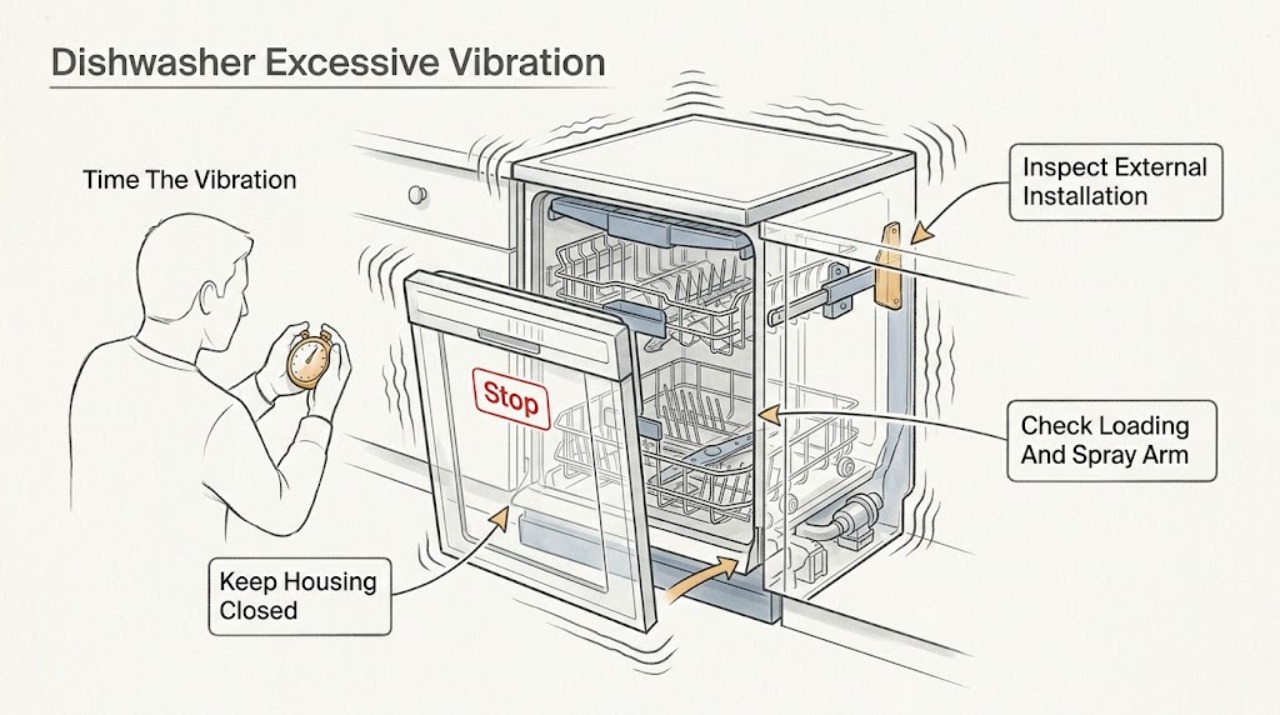
Work through in order
Diagnostic checks
Use only checks that match the exact appliance or system and its official guide.
-
Check 1
Stop the cycle, allow the dishwasher to cool, and record when the vibration occurs: during water entry, when washing starts, when spray arms alternate, while draining, during drying, or continuously. Note whether the cabinet moves, the door rattles, the floor/counter vibrates, or the symptom is only an audible hum or whoosh.
Expected result: The sound matches a fill, wash-pump, drain-pump, spray-arm, detergent, or fan stage; a physical shake occurs; or vibration is present in every stage.
Next step: Use the normal-sound branch when the noise is brief and stage-specific with no shaking. Use loading and installation checks for physical movement, and the pump/motor service branch for harsh vibration that follows a specific pump stage.
Stop if: Do not keep running a machine that walks, leaks, smells burnt, trips power, or produces metal-on-metal impact or an escalating harsh vibration.
Why this matters
Why: Frigidaire lists several stage-specific sounds as normal, but physical cabinet movement or persistent vibration is a different symptom. Timing narrows the subsystem without identifying a failed part.
-
Check 2
With the dishwasher unplugged or safely isolated and the door closed, inspect from outside the cabinet opening without pulling the unit out. Look for a visibly shifted or rocking cabinet, contact with adjacent cabinetry, a door that sits out of square, or a unit that changed after installation or floor/counter work. Confirm only that the accessible floor and surrounding structure appear stable; do not adjust feet or mounting screws unless the exact installation guide explicitly makes that an owner task.
Expected result: The dishwasher rocks or shifts, contacts the opening, sits visibly out of alignment, or appears stable and supported.
Next step: If newly installed or visibly shifted, leave it off and have the installer or qualified technician correct alignment, leveling, and mounting. If stable, continue to the unloaded rack and spray-arm clearance check.
Stop if: Do not pull out a built-in dishwasher, loosen mounting hardware, place shims under the unit, or reach under the base to test support.
Why this matters
Why: A change after installation or a cabinet that moves makes installation, leveling, support, or mounting more likely than a spray-arm sound. A stable exterior does not rule out an internal pump or motor fault.
-
Check 3
With power off and the tub cool, remove only an obvious tall item, pan, utensil, or loose object that can be reached normally. Slowly rotate each accessible spray arm by hand only if the exact owner manual permits it and no sharp or hot item is present; check for visible contact with dishes, racks, or the tub. Do not remove the spray-arm assembly or reach into the sump.
Expected result: A tall item or utensil touches a spray arm, a rack is not seated, a loose item is present, or all accessible clearances look normal but vibration remains.
Next step: Reposition or remove the obvious interfering item and run one supervised cycle only if the unit is stable and dry. If vibration persists with an unloaded or correctly loaded rack, move to service rather than disassembling the spray system.
Stop if: Do not force a rack, bend a spray arm, remove filters or pump covers for this check, or operate with a loose object that can contact moving parts.
Why this matters
Why: Frigidaire specifically identifies dish, pot, pan, or utensil interference as a cause of knocking or banging. Clear loading can remove an impact sound, but it does not explain persistent cabinet shaking or a pump-stage vibration.
-
Check 4
Only if the dishwasher is stable, dry, and free of electrical or water hazards, run one short owner-approved cycle with no dishes and listen from outside the closed door. Do not add a hand or tool to the tub while it runs. Note whether the vibration occurs when the wash pump starts, during drain-out, or independently of water/pump stages.
Expected result: The vibration disappears empty, appears only with a particular load, matches normal stage sounds, or remains at the same pump stage with no dishes.
Next step: Stop after the single comparison. If the empty machine still vibrates harshly or moves, record the stage and arrange service; do not infer a replacement pump from sound alone.
Stop if: Do not run an empty comparison if there is a leak, standing water, electrical damage, repeated breaker trip, unstable installation, exposed part, or abnormal burning odor.
Why this matters
Why: A load-dependent change supports rack, dish, utensil, or spray-arm interference. A brief stage sound without cabinet movement may be normal; repeated physical shaking at wash or drain points makes pump/motor, impeller, support, or obstruction service more likely.
-
Check 5
Record the model, installation age, cycle and stage, empty-versus-loaded result, whether the cabinet moves, any spray-arm contact, drain or wash performance, leak, fault code, odor, and power symptoms. Use the exact owner manual and Frigidaire support route for the model; do not remove the bottom panel or perform a live test to obtain more detail.
Expected result: The symptom is resolved after loading correction, remains with an empty stable machine, starts after installation changes, or is accompanied by a leak, poor wash/drain, error, heat, odor, or electrical symptom.
Next step: Keep the dishwasher off for persistent or unsafe symptoms and arrange Frigidaire or qualified appliance service. Provide the model, timing, recording, installation history, and checks already completed.
Stop if: Do not open the base, access the wash/drain pump, bypass a safety interlock, run with panels removed, or repeatedly cycle a vibrating machine.
Why this matters
Why: A resolved load issue is consistent with spray-arm or rack interference. Persistent empty-machine vibration or a safety/performance symptom needs professional diagnosis of the pump, motor, mounting, obstruction, controls, or wiring.
Use your observations
Decision map
Find the observation that best matches what you see, then follow the next safe action.
-
PATH 01Safety boundary
What you see
The sound is a brief fill, wash-pump, drain-pump, spray-arm, detergent, or fan-stage sound and the cabinet does not move, leak, or show a fault.
Do this next
Continue using the exact model manual and monitor whether the sound changes into physical shaking, impact, leak, odor, or poor performance.
Why this path and its safety boundary
Why it matters: The pattern is consistent with Frigidaire's documented normal operating sounds rather than excessive vibration.
Safety stop: Stop if the sound becomes harsh, continuous, metal-on-metal, or accompanied by movement, leak, heat, odor, or an error.
-
PATH 02Safety boundary
What you see
Vibration or knocking occurs only with a particular load and a tall dish, pan, utensil, rack, or loose item visibly contacts the spray arm or tub.
Do this next
Reposition or remove the interfering item and run one supervised cycle if the unit is stable and dry. Escalate if contact or vibration returns with correct loading.
Why this path and its safety boundary
Why it matters: Frigidaire identifies loading interference as a cause of knocking/banging when the spray arm circulates; this does not indicate a failed motor by itself.
Safety stop: Do not bend the spray arm, force racks, remove the sump, or reach into moving components.
-
PATH 03Safety boundary
What you see
The cabinet rocks, shifts in its opening, contacts surrounding cabinetry, or the vibration began after installation, movement, or floor/counter work.
Do this next
Leave the appliance off and have the installer or qualified technician correct the installation using the exact model instructions. Do not pull out or shim the dishwasher yourself.
Why this path and its safety boundary
Why it matters: Installation alignment, leveling, support, or mounting is more likely than a pump-stage sound, but the external observation cannot identify which adjustment is required.
Safety stop: Do not loosen mounts, adjust feet, lift the unit, or work under the base.
-
PATH 04Safety boundary
What you see
A stable, correctly loaded dishwasher vibrates with no dishes or at a repeatable wash-pump or drain-pump stage, and the symptom is harsh, physical, or worsening.
Do this next
Stop the cycle, keep the dishwasher off, and arrange qualified service with the exact stage, recording, model, and performance symptoms.
Why this path and its safety boundary
Why it matters: A wash/drain pump, motor, impeller, obstruction, support, control, or internal mounting issue is possible. Frigidaire's sound labels do not identify a replacement part.
Safety stop: Do not access the pump, remove the bottom panel, perform live tests, or repeatedly run the machine to reproduce the vibration.
-
PATH 05Safety boundary
What you see
Vibration is accompanied by a leak, standing water, poor wash or drain performance, fault code, burning odor, hot connection, smoke, or a breaker trip.
Do this next
Isolate power from a safe dry location, close a visible water shutoff if appropriate, and obtain qualified appliance or electrical service.
Why this path and its safety boundary
Why it matters: The symptom may involve an internal pump, valve, control, wiring, installation, or water fault and is no longer a normal-sound question.
Safety stop: Do not touch wet electrical parts, reset repeatedly, bypass the door interlock, or open the cabinet.
Helpful context
Understand the symptom
Separate normal stage sounds from physical shaking
A Frigidaire dishwasher can make changing sounds as water enters, the wash pump circulates water, spray arms alternate, the drain pump removes water, detergent is released, or an optional drying fan operates. Those sounds do not automatically mean the cabinet should shake or walk. Record the cycle stage, whether vibration is felt through the door or floor, whether the sound changes with the racks unloaded, and whether the unit is newly installed. A short spray-arm knock caused by a tall item is a different problem from a cabinet that moves or a harsh vibration that continues with no dishes.
Installation and loading are the safe first checks
A dishwasher that rocks in its opening, contacts surrounding cabinetry, or changed after installation needs an installation review, not a guessed pump part. From a dry, unpowered position, observe whether the cabinet is visibly out of alignment, the door closes squarely, and the racks and spray arms have clearance. Remove only an obvious tall dish, pan, utensil, or loose item that can be reached without tools. Do not pull out a built-in dishwasher, loosen mounting hardware, or access the base to check leveling or a motor.
Persistent vibration can be a pump or motor service issue
Frigidaire's noise guide identifies wash-pump and drain-pump hum by when they operate, but a sound description alone cannot prove a failed motor, impeller, bearing, or control. If vibration remains with correct loading and a stable installation, or is accompanied by poor washing, incomplete draining, leaks, burning odor, a breaker trip, or a fault indication, stop the cycle and arrange service. Keep the safety boundary at dry external observation; bottom covers, pumps, wiring, and live tests are not user checks.
Safety boundary
Stop conditions
- Stop immediately for water near electrical parts, smoke, burning odor, a hot or damaged plug/cord, a breaker trip, or a leak that reaches the floor or cabinet wiring; isolate power only from a safe dry location.
- Do not run the dishwasher with panels removed, an unstable cabinet, exposed wiring, a bypassed door interlock, or a loose object contacting moving parts.
- Do not pull out a built-in dishwasher, loosen mounting hardware, adjust leveling feet, work under the base, or dismantle a pump or motor.
- Do not force racks or spray arms, chip or remove obstructions with tools, or repeatedly cycle a machine with harsh vibration.
- If the vibration persists with correct loading and a stable installation, keep the dishwasher off and arrange qualified service.
When checks do not resolve it
Need a professional?
Arrange Frigidaire or qualified dishwasher service when the unit rocks or shifts, vibration began after installation or movement, a correctly loaded empty dishwasher still shakes, a harsh vibration repeats at the wash or drain pump stage, or vibration is accompanied by poor washing/draining, a leak, standing water, fault indication, burning odor, heat, smoke, or a breaker trip. Provide the full model, installation history, cycle stage, empty-versus-loaded result, video or sound description, and any safety or performance symptom.
Safety scope: The user may stop the cycle, isolate power safely, observe external stability, remove an obvious loading obstruction with power off, and record cycle-stage behavior. Installation adjustment, cabinet removal, pump/motor/control access, bottom-panel work, interlock bypass, and live electrical tests are for qualified professionals.
Common questions
FAQ
Is some vibration normal on a Frigidaire dishwasher?
Frigidaire says water filling, water circulation, motor operation, spray-arm movement, and fan operation on equipped models can produce normal sounds. A brief stage sound is different from a cabinet that moves, walks, or shakes continuously.
Why does my Frigidaire dishwasher knock when it washes?
Frigidaire says a dish, pot, pan, or utensil can interfere with spray-arm circulation and cause knocking or banging. With power off and the tub cool, remove or reposition only the obvious interfering item; persistent vibration with correct loading needs service.
Could an installation problem make a Frigidaire dishwasher vibrate?
A dishwasher that rocks, shifts in its opening, contacts cabinetry, or changed after installation needs an installation review. Do not pull out the built-in unit or adjust mounts and feet without the exact installation procedure; have the installer or a qualified technician correct it.
How can I tell if the wash or drain pump is causing vibration?
Record whether the harsh physical vibration repeats when washing starts or while draining, then stop after one safe observation. Frigidaire identifies wash-pump and drain-pump humming by stage, but the sound does not prove a pump or motor part; persistent empty-machine vibration requires professional diagnosis.
When should I stop using a vibrating Frigidaire dishwasher?
Stop for cabinet movement, a leak, standing water, poor draining, a fault, burning odor, smoke, a hot connection, or a breaker trip. Isolate power safely and arrange qualified service; do not run with panels removed or access the pump from underneath.
Read the exact guide
Official sources
- Delivery and Installation Guide - DishwasherFrigidaire · Installation support page; exact mounting and leveling instructions remain model-specific.
- Dishwashers - What are normal dishwasher operations sounds?Frigidaire · Dishwashers represented by the support article; drying-fan behavior applies only to equipped models.
- Dishwashers | FrigidaireFrigidaire · Dishwasher support landing page; the exact model determines available instructions.
- Dishwasher - Noise GuideFrigidaire · Dishwashers represented by the support article; exact sounds and components vary by model.
- Where can I find my model and serial number?Frigidaire · All-appliance support page; dishwasher label location can vary by model.
Community feedback
Share a repair observation
Share a plain-text repair observation. Accepted observations are published automatically; this page may take a moment to update.