
On this page
Start here
Quick answer
A Frigidaire dishwasher that appears not to spray can have blocked spray arms or filters, a rack or utensil preventing arm rotation, a fill or drain condition, or a circulation problem. Start with the model's loading and cleaning guidance: confirm the unit fills, rotate the accessible spray arms by hand with power off, and clean only the filter, glass trap, and spray-arm openings the owner manual identifies. If there is no wash-pump sound or the problem remains after these external checks, stop and use Frigidaire service rather than opening the tub or replacing a pump by guesswork.
Before you begin
Safety first
- Isolate power before touching spray arms, filters, or the tub; keep the door closed during any supervised cycle. Do not open the cabinet or test live wiring.
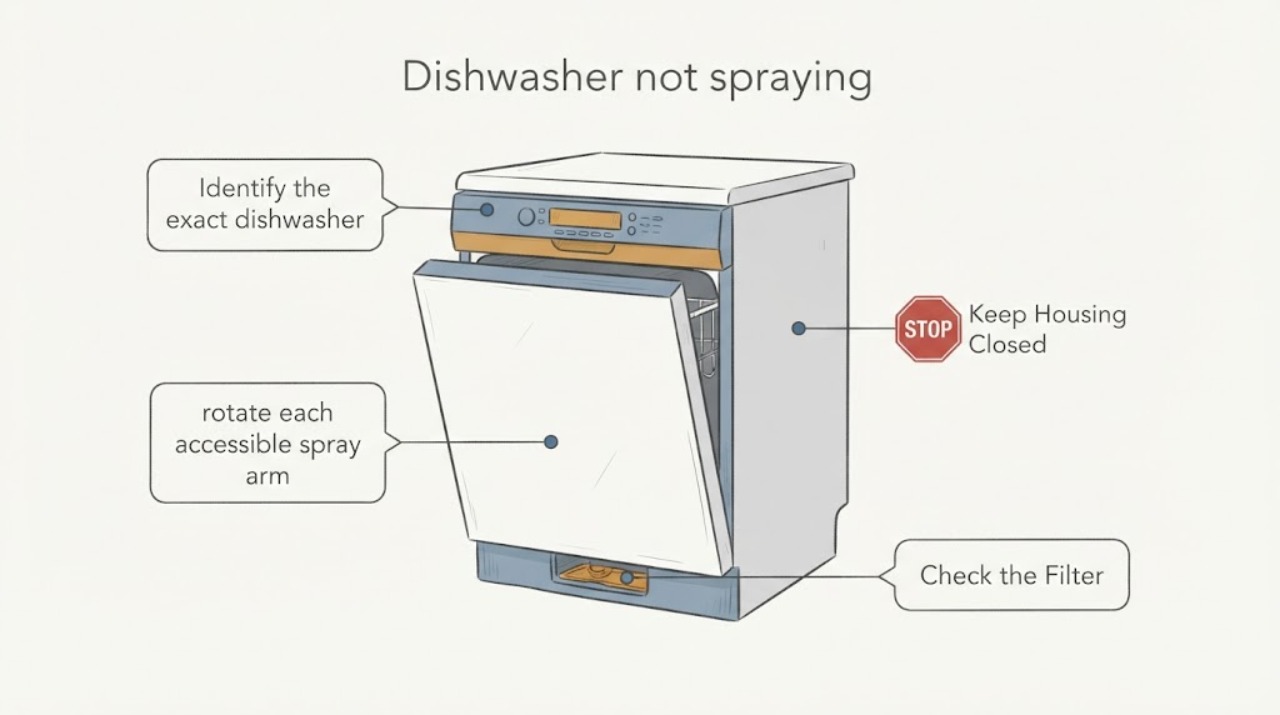
Work through in order
Diagnostic checks
Use only checks that match the exact appliance or system and its official guide.
-
Check 1
Identify the exact Frigidaire dishwasher model and confirm that the symptom is a wash phase with no visible or audible spray, rather than a unit that never fills, is paused, or is only reporting poor cleaning.
Expected result: There is water in the tub after fill and the cycle reaches washing, or the tub remains dry or the cycle never starts.
Next step: Continue with the external spray and loading checks for the exact model.
Stop if: Use Frigidaire's filling/start guidance and owner manual before treating the problem as a spray failure.
Why this matters
Why: A dry tub points toward a fill/start issue, while water is present but no wash action points toward a circulation or spray-path investigation; the model manual controls the access and parts layout.
-
Check 2
With the dishwasher stopped and power isolated, rotate each accessible spray arm by hand and inspect the racks, pan handles, and tall utensils for contact or blockage.
Expected result: An arm catches, cannot rotate freely, or a loaded item protrudes into its path.
Next step: Reposition the item or rack according to the model's loading guidance, then run one supervised cycle.
Stop if: Continue to the filter and spray-arm cleaning check.
Why this matters
Why: Frigidaire says rack loading can prevent spray-arm rotation; this is an external obstruction, not proof of a pump fault.
-
Check 3
Remove and clean the filter, glass trap, and accessible spray arms only as shown in the exact owner manual; check the spray-arm openings for food debris without enlarging or damaging them.
Expected result: Food soil or debris is present in the filter, glass trap, or spray-arm openings, or all are clear.
Next step: Rinse and reinstall each component securely as the manual shows, then run one cycle with the correct loading.
Stop if: Do not disassemble the pump or sump to search for a cause; continue with the sound and fill observations.
Why this matters
Why: Frigidaire identifies those areas as places where dish debris can cause blockages and poor cleaning, but a clear path does not prove a circulation-pump failure.
-
Check 4
During a supervised wash cycle, listen from outside the closed door for a wash-pump hum and changing spray-arm whoosh; also note whether the machine fills and drains normally.
Expected result: The wash-pump hum or spray-arm whoosh is present, absent, unusually loud, or replaced by a steady drain-pump sound.
Next step: If wash sounds are present but results remain poor, recheck loading, detergent, filter, and spray-arm cleanliness; if the wash phase is absent, stop and arrange service.
Stop if: Do not open the cabinet or run live electrical tests; use the service branch.
Why this matters
Why: Frigidaire associates wash-pump humming and alternating spray-arm sounds with washing, while a steady drain-pump sound is a different phase; sound cannot identify a specific failed component.
-
Check 5
Check the visible water-supply line and valve position and confirm that the door is fully closed; do not remove panels or manipulate internal valves.
Expected result: The supply is off or restricted, the line is kinked, the door is not closing, or all external conditions are normal.
Next step: Correct only the visible supply or door condition and run one supervised cycle.
Stop if: If the unit still does not spray, stop repeated cycles and arrange qualified service with the model number and observations.
Why this matters
Why: Frigidaire lists an open, unrestricted water supply and a properly closed door as prerequisites for filling and starting; normal external conditions do not rule in a particular pump or control part.
Use your observations
Decision map
Find the observation that best matches what you see, then follow the next safe action.
-
PATH 01Next step
What you see
The dishwasher is dry after the fill phase or never starts the selected cycle
Do this next
Check only the visible water supply, door closure, and model-specific start guidance; use service if the unit still does not fill or start.
Why this path and its safety boundary
Why it matters: The reported symptom may be a fill or start condition rather than a spray-arm problem.
-
PATH 02Next step
What you see
Water is present, a rack or utensil stops an arm, or debris blocks a spray arm/filter
Do this next
Reposition the load or clean and reinstall the accessible components as the exact manual shows, then run one supervised cycle.
Why this path and its safety boundary
Why it matters: An external loading or cleanable spray-path restriction is supported by Frigidaire's guidance.
-
PATH 03Next step
What you see
The arms rotate freely, the filter and trap are clear, and the wash-pump sound is absent or replaced by an abnormal sound
Do this next
Stop and arrange qualified Frigidaire service; do not open the cabinet, test live wiring, or replace a pump based on sound alone.
Why this path and its safety boundary
Why it matters: The public user checks do not establish which internal component is responsible.
-
PATH 04Next step
What you see
Spray sounds are present but dishes remain dirty
Do this next
Review the model's loading and detergent guidance and clean the accessible filter, glass trap, and spray arms before seeking service.
Why this path and its safety boundary
Why it matters: The symptom may be loading, cycle, detergent, filter, or spray-arm cleanliness rather than no circulation.
When checks do not resolve it
Need a professional?
Use qualified service for persistent no-spray behavior, leaks, electrical symptoms, or any internal pump/valve diagnosis.
Safety scope: Isolate power before touching spray arms, filters, or the tub; keep the door closed during any supervised cycle. Do not open the cabinet or test live wiring.
Common questions
FAQ
Does no visible spray prove the Frigidaire circulation pump has failed?
No. Frigidaire's own checks first cover filling, loading interference, filters, the glass trap, and spray arms. Its noise guide describes wash-pump and spray-arm sounds but does not make sound alone a component diagnosis.
Can I remove and clean the spray arms on any Frigidaire dishwasher the same way?
Do not assume that. Frigidaire says features and appearance vary by model, so use the exact owner manual for removal, access, and reinstallation. The article limits the check to accessible openings and loading interference.
What if the dishwasher fills but the wash sound never starts?
That observation is not enough to identify a pump, motor, or control failure. Stop repeated cycles, keep the unit closed and powered off before inspection, and arrange qualified service rather than opening the cabinet or doing live tests.
Read the exact guide
Official sources
- Dishwasher - Noise GuideFrigidaire · External interpretation of common wash, spray-arm, and drain sounds
- Dishwasher - Loading GuideFrigidaire · Dishwasher rack loading and spray-arm rotation; features vary by model
- Dishwasher - Not CleaningFrigidaire · General dishwasher cleaning-performance checks; exact filter and spray-arm access is model-dependent
- Dishwasher - Not FillingFrigidaire · External water-supply and fill checks
- What should I do if my dishwasher is not starting?Frigidaire · External start, door, water-supply, and breaker checks
- Dishwasher - Dispenser and Detergents GuideFrigidaire · Detergent and dispenser checks when spray is present but cleaning is poor
Community feedback
Share a repair observation
Share a plain-text repair observation. Accepted observations are published automatically; this page may take a moment to update.