
On this page
Start here
Quick answer
For a normal food or stale-water odor, first remove soiled dishes, check that the dishwasher drains, clean the filter and glass trap, and use one Frigidaire-supported cleaning method at a time. Frigidaire recommends either an empty PowerPlus or Heavy cycle with Sanitize, or one cup of white vinegar in the tub with an empty cycle and no detergent; its filter guide supports rinsing the filters and removing food residue. A drain hose or disposer connection that prevents complete draining can leave food soils in the sump and cause odor. Do not mix vinegar with detergent, bleach or other cleaners, do not reach into standing water or broken glass, and do not keep operating the dishwasher if the odor is acrid or electrical, accompanied by smoke, heat damage or a tripped breaker. If the smell returns after the safe cleaning and drain checks, use the exact model manual and arrange service.
Before you begin
Safety first
- Do not mix vinegar, detergent, bleach or other cleaners; do not reach into energized, hot, broken-glass or standing-water conditions; do not disconnect hoses, remove panels or bypass electrical protection. Stop use for smoke, heat damage, sparking, acrid electrical odor or a tripped breaker.
Work through in order
Diagnostic checks
Use only checks that match the exact appliance or system and its official guide.
-
Check 1
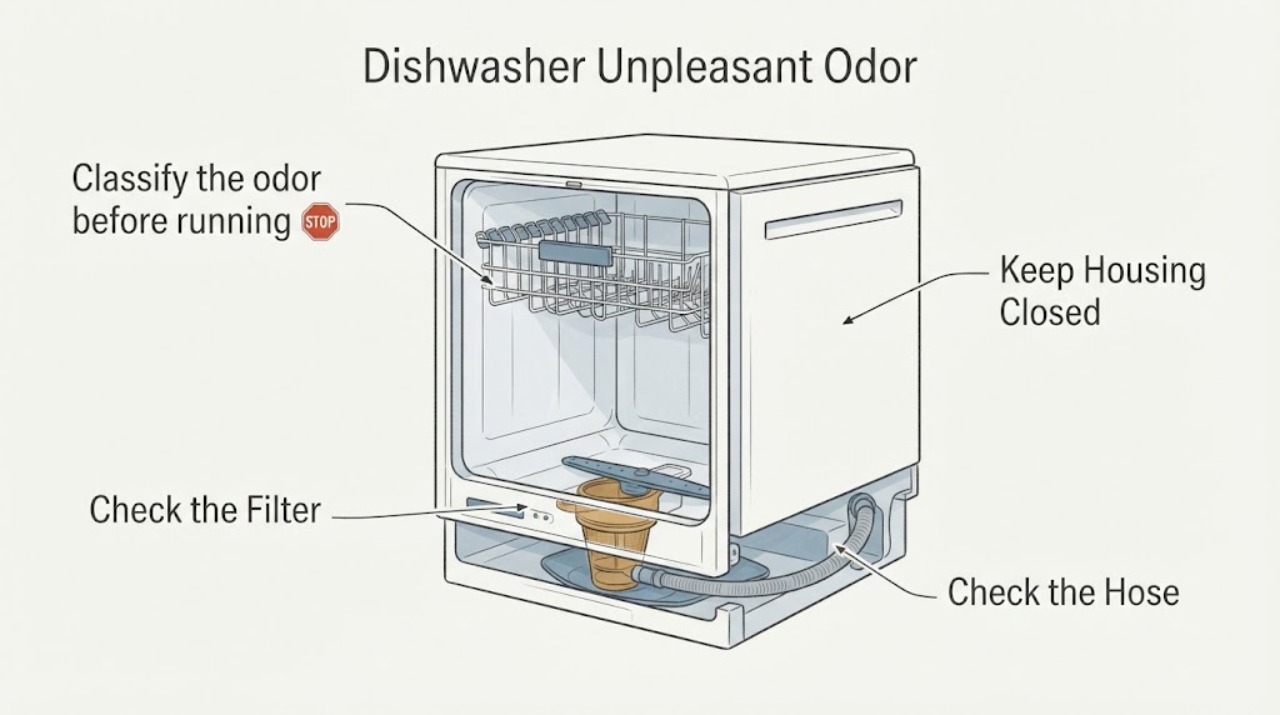
Classify the odor before running any cleaning cycle and stop immediately for smoke, heat damage, sparking, an acrid electrical smell, a tripped breaker or another immediate hazard.
Expected result: The odor is stale food, drain-related or a new-appliance smell, or it is sharp/electrical and accompanied by a safety symptom.
Next step: For a hazard, stop using the dishwasher and arrange qualified appliance or electrical service. Do not run a cleaning cycle, mix chemicals or open panels to locate the smell.
Why this matters
Why: Frigidaire's odor guidance supports normal cleaning and drainage checks for ordinary dishwasher odor; an electrical or heat-related smell is outside that cleaning path.
-
Check 2
With the dishwasher off and cool, use the exact model manual to access and clean the filter and glass trap; rinse the filter and remove visible food residue without reaching into sharp debris.
Expected result: Food residue, broken glass or other debris is present, or the filter and trap are clear but the odor remains.
Next step: Reinstall the parts according to the model manual and continue to the drain check. If debris is trapped, damaged or inaccessible, stop and arrange service rather than disassembling the sump.
Why this matters
Why: Frigidaire recommends cleaning the filter and glass trap every two to three months and says the cylinder filter collects large items such as broken glass, bones and pits. A clear filter does not prove the drain system or interior is free of the odor source.
-
Check 3
Check whether water covers the filter screen after a cycle and whether the visible drain area or disposer connection is obstructed; do not disconnect the drain hose.
Expected result: There is only a small normal amount of water, water covers the filter screen, or the drain/disposer connection has a visible installation issue.
Next step: Use only the model manual for accessible drain checks. For recurring standing water, an inaccessible hose or a new disposer installation, stop and arrange qualified service or installer support.
Why this matters
Why: Frigidaire says some water at the bottom can be normal, while water over the filter screen or incomplete drain installation can leave food soils and cause odor.
-
Check 4
After the filter and visible drain checks, choose exactly one Frigidaire-supported odor method: an empty PowerPlus or Heavy cycle with Sanitize, or one cup of white vinegar in an empty cycle with no detergent.
Expected result: The ordinary food or drain odor improves after one supported method, or it remains or changes to a sharp/electrical smell.
Next step: Do not combine vinegar with detergent, bleach or another cleaner and do not repeat chemical treatments indefinitely. For persistent or electrical odor, stop using the unit and arrange service.
Why this matters
Why: Improvement supports a maintenance or residue explanation but does not prove that the dishwasher has no drain or mechanical issue. A persistent or electrical odor needs a different service boundary.
-
Check 5
Record the full model number, odor description, cycle stage, filter/trap condition, standing-water observation, drain/disposer history and the cleaning method used.
Expected result: The odor returns after the safe maintenance path, the unit still holds water, the smell is electrical/burning or the source cannot be located safely.
Next step: Keep the dishwasher out of service for a hazard and arrange qualified Frigidaire service or installer support. Do not remove panels, bypass electrical protection or select a replacement part from odor alone.
Why this matters
Why: Frigidaire directs unresolved odor concerns to the Owner's Manual and service; the no-model symptom does not identify a pump, heater, wiring, seal or drain component.
Use your observations
Decision map
Find the observation that best matches what you see, then follow the next safe action.
-
PATH 01Next step
What you see
The odor is sharp/electrical or accompanied by smoke, heat damage, sparking, a tripped breaker or another immediate hazard.
Do this next
Stop using the dishwasher, keep clear of the hazard and arrange qualified appliance/electrical service. Do not run vinegar, Sanitize or another cycle to test it.
Why this path and its safety boundary
Why it matters: This is outside Frigidaire's ordinary food-residue and drain-odor cleaning path.
-
PATH 02Next step
What you see
The odor is food or stale-water related, filter/glass-trap residue is present, and no standing-water or electrical hazard is found.
Do this next
Clean the filter and glass trap, check visible drainage, then use one Frigidaire-supported empty-cycle method without mixing chemicals.
Why this path and its safety boundary
Why it matters: Food soils or ordinary interior residue are plausible contributors, but a clean filter alone does not rule out incomplete draining.
-
PATH 03Next step
What you see
Water covers the filter screen, the drain is slow, or a disposer/drain-hose installation issue is visible or recently changed.
Do this next
Use the exact model manual for accessible checks and arrange installer or qualified service for an inaccessible, recurring or built-in drain issue. Do not disconnect hoses or add drain chemicals.
Why this path and its safety boundary
Why it matters: Frigidaire links incomplete draining and food soils left in the sump with odor; the no-model task does not establish a pump or hose failure.
-
PATH 04Next step
What you see
The odor remains after the filter, visible drain and one supported cleaning method, or it returns quickly.
Do this next
Stop repeating chemical treatments and schedule qualified service with the model and observation record. Keep the unit off for an electrical or heat-related odor.
Why this path and its safety boundary
Why it matters: The maintenance path has not established the source; a model-specific drainage, heating, seal or electrical inspection may be needed.
Helpful context
Understand the symptom
Frigidaire treats several dishwasher odors as maintenance or drainage concerns: new-appliance smell can fade, soiled dishes can create odor, and standing water or food residue can keep an odor inside the tub. The safe cleaning path is different from an acrid or electrical smell. Use one supported cleaning method, never combine chemicals, and stop for smoke, heat damage or electrical symptoms.
Identify the odor before choosing a cleaning step
Note whether the smell is stale food, sewage-like drain odor, detergent or vinegar residue, or a sharp electrical/burning smell. If the dishwasher is new, Frigidaire says a new smell can fade with use. If soiled dishes sit inside, use a rinse-only cycle when you are not ready to run a full wash, and check that the unit is draining. Do not use a normal cleaning cycle to investigate smoke or an electrical smell.
Clean the filter and glass trap safely
After the dishwasher is off and cool, use the model manual to access the filter and glass trap. Frigidaire recommends cleaning the filter and glass trap every two to three months; its guide says to empty and rinse the filters under running water and remove food residue with a sponge or bottle brush. Use gloves and caution if broken glass, bones or sharp debris may be present, and do not reach into an energized or water-filled unit.
Check whether incomplete draining is feeding the odor
A small amount of water at the bottom after a cycle can be normal, but water covering the filter screen or recurring standing water can leave odor-producing soils. Check only the visible drain area and the disposer connection. Frigidaire says the drain hose must be installed to encourage complete draining and that a new disposer may still have its knockout plug in place. Do not disconnect a hose, pull out a built-in dishwasher or pour chemicals into the drain as a user odor treatment.
Run one supported cleaning method
After the filter and visible drain checks, choose one method from Frigidaire's odor page: an empty PowerPlus or Heavy cycle with the Sanitize option, or one cup of white vinegar directly in the tub with an empty cycle and no detergent. Do not add detergent to the vinegar method and do not combine vinegar with bleach, dishwasher cleaner or another chemical. If the smell persists, stop repeating treatments and arrange model-appropriate service.
When checks do not resolve it
Need a professional?
Arrange qualified service when the odor returns after filter, visible drain and one supported cleaning method, when standing water persists, or immediately for an acrid/electrical odor, smoke, heat damage, sparking or repeated breaker trip.
Safety scope: Do not mix vinegar, detergent, bleach or other cleaners; do not reach into energized, hot, broken-glass or standing-water conditions; do not disconnect hoses, remove panels or bypass electrical protection. Stop use for smoke, heat damage, sparking, acrid electrical odor or a tripped breaker.
Have this ready
- Full model number, odor character and timing, filter/trap findings, standing-water observation, drain/disposer installation history, visible damage and the single cleaning method used.
Common questions
FAQ
Can I run vinegar and detergent together to remove Frigidaire dishwasher odor?
No. Frigidaire's odor page says to put one cup of white vinegar in the tub for an empty cycle and explicitly says not to add detergent. Use one supported method at a time and do not combine cleaners.
Can standing water cause a Frigidaire dishwasher odor?
It can. Frigidaire says some water at the bottom after a cycle can be normal, but water covering the filter screen or incomplete drainage can leave food soils and contribute to odor. Check the visible drain path and use the model manual for further steps.
Is an acrid or burning smell just another dishwasher odor to clean?
No. The ordinary odor guidance covers food, residue and drainage conditions. Stop using the appliance for smoke, heat damage, sparking, an acrid electrical smell or a repeated breaker trip and arrange qualified service rather than running another cleaning cycle.
Read the exact guide
Official sources
- Dishwasher - Why does my dishwasher have an odor and how do I fix it?Frigidaire Owner Support · Opened the official Frigidaire support article for dishwasher odor. It supports new smell as a temporary condition, odor from leaving soiled dishes, rinse-only use when not ready for a full cycle, checking drainage and service routing. It does not diagnose an electrical or internal component fault.
- Dishwasher Glass Trap and Filter GuideFrigidaire Owner Support · Opened the official Frigidaire filter guide. It supports cleaning the drain air gap where fitted, rinsing coarse and cylinder filters, and removing visible residue with a sponge or bottle brush. It is used only for model-manual-bounded accessible cleaning, not sump disassembly.
- Dishwasher - OdorsFrigidaire Owner Support · Opened the official Frigidaire dishwasher odor article. It supports cleaning every three months, either an empty PowerPlus/Heavy plus Sanitize cycle or one cup of white vinegar in an empty cycle with no detergent, filter/glass-trap cleaning every two to three months and the relationship between poor draining and odor.
- Why is water in the dishwasher after it runs?Frigidaire Owner Support · Opened the official Frigidaire dishwasher water article. It distinguishes some normal residual water from water covering the filter screen and supports checking visible drainage/debris and a new disposer knockout plug. It does not identify a drain-pump fault.
- Dishwasher - Drain Hose GuideFrigidaire Owner Support · Opened the official Frigidaire drain-hose guide. It states that correct drain-hose installation reduces odor from food soils left in the sump, gives model-independent routing context and notes the disposer knockout-plug check. The article does not direct a no-model user to disconnect or re-plumb a built-in appliance.
Community feedback
Share a repair observation
Share a plain-text repair observation. Accepted observations are published automatically; this page may take a moment to update.