
On this page
Start here
Quick answer
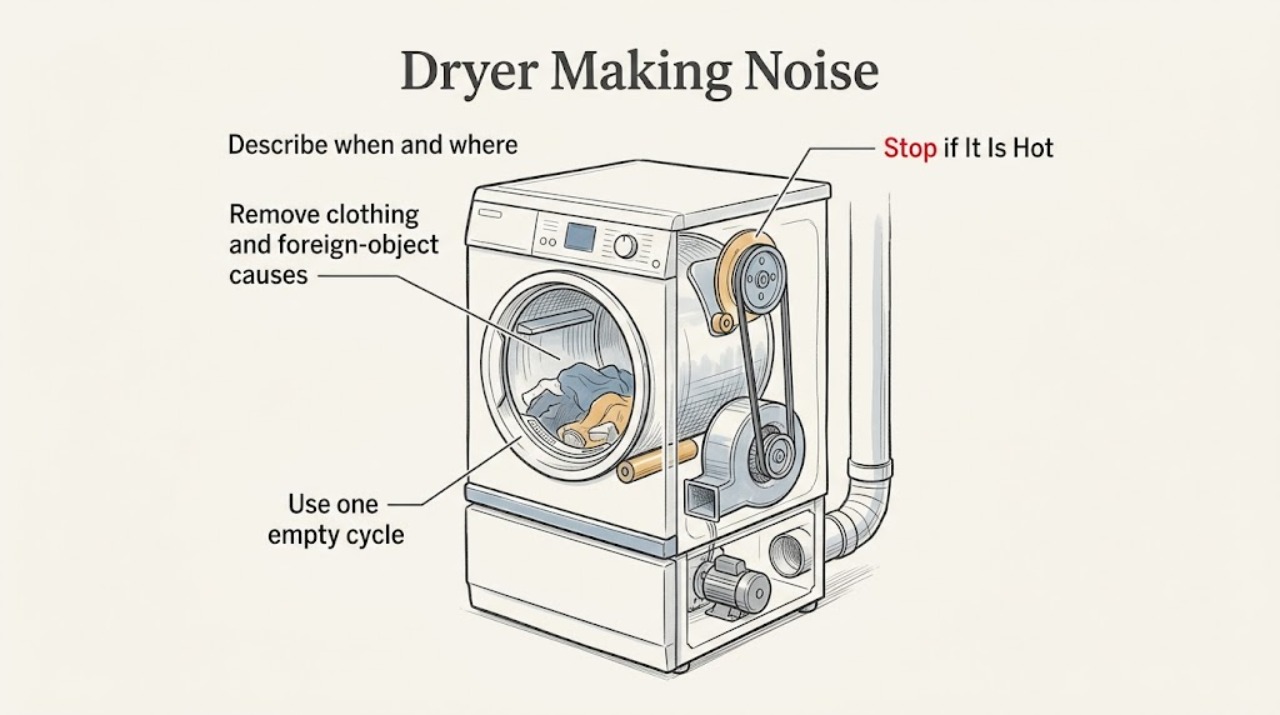
Identify the sound before opening or moving the dryer. Stop it and check the pockets, fasteners, and drum for a loose object; Frigidaire also recommends an empty cycle to separate a clothing noise from a unit noise. Chimes, airflow, and model-specific water or gas-valve sounds can be normal, while a persistent rattle, clank, squeak, scrape, grinding sound, or vibration from the empty drum needs service. Keep the lint screen in place and do not operate a gas dryer without an outdoor exhaust duct. Stop immediately for smoke, burning smell, gas odor, arcing, a hot cable, a loose or walking appliance, or a noise accompanied by overheating or a stopped motor. Do not remove cabinet panels or reach into the drum, blower, belt, or motor while power is connected.
Work through in order
Diagnostic checks
Use only checks that match the exact appliance or system and its official guide.
-
Describe when and where the noise occurs
From a safe position, note whether the sound occurs at start-up, only while tumbling, during heating, at the end of a cycle, or when the dryer is idle. Record whether it is a chime, rattle, clank, thump, squeak, scrape, grind, hum, or vibration, and whether the drum is turning. Stop for smoke, burning smell, gas odor, shock, arcing, or abnormal heat.
Expected result: The sound is a documented chime or airflow sound, it occurs only with heat or steam, it follows drum rotation, or an immediate safety hazard is present.
Next step: For a hazard, stop using the dryer and arrange appropriate emergency or qualified service. Otherwise continue with the load and empty-drum comparison while keeping the dryer closed and stationary between checks.
Why this matters
Why: The timing narrows the decision without requiring cabinet access. A normal model sound can be monitored, but a rotation-linked or worsening noise points to the load, drum support, drive, blower, or motor. A safety symptom overrides all sound checks.
-
Remove clothing and foreign-object causes
Stop the dryer and wait for the drum to stop. Check accessible pockets, buckles, zippers, buttons, and the visible drum for coins or other loose objects. Turn garments inside out or fasten loose metal items before a retest. Do not reach behind the drum seal or use a tool to probe the blower housing.
Expected result: A coin or other object is found, fasteners were loose on the load, or the visible drum is clear but the sound persists.
Next step: Remove only the loose object and run one small or empty test if the dryer has no safety symptom. If the sound continues with the empty drum, stop testing and arrange service.
Why this matters
Why: Frigidaire identifies foreign objects and metal fasteners as common causes of rattling or clanking. If the drum is clear and the noise remains, it is coming from the appliance or an inaccessible area rather than the clothing.
-
Use one empty cycle to isolate a unit noise
After the visible load checks, run one brief empty cycle only if the dryer is cool, dry, stable, and free of smoke, gas odor, burning smell, damaged wiring, or excessive heat. Stand nearby and listen without opening the cabinet. Stop the cycle if the sound is loud, scraping, grinding, metallic, or accompanied by vibration or heat.
Expected result: The noise disappears when empty, remains with the empty drum, or the dryer vibrates, walks, or becomes hot.
Next step: If the empty cycle is quiet, reload loosely and secure fasteners. If the noise remains or the dryer moves or overheats, stop using it and arrange qualified service; do not remove panels to inspect the drive system.
Why this matters
Why: A noise that disappears empty is more consistent with the load or a loose object. A noise that remains empty is from the dryer and should not be chased with repeated cycles. Walking or abnormal heat adds a stability, drive, airflow, or safety concern.
-
Check stability and installation conditions
With the dryer off, check from the outside that it sits firmly on a solid, level surface and that no pedestal or stacking hardware is visibly loose. If it was recently installed, compare the installation to the model's instructions and ensure any shipping materials were removed. Do not lift the dryer alone or reach under it while it is connected.
Expected result: The appliance rocks or walks, a pedestal or bracket is loose, the floor is unstable, installation is recent, or the dryer is stable but the noise persists.
Next step: Correct only an accessible installation or load condition allowed by the manual. If the unit remains unstable, the hardware needs adjustment, or the sound persists on a stable empty dryer, stop and request qualified service or the installer.
Why this matters
Why: Frigidaire's noise guide links vibration or walking to leveling and installation conditions, and links clanking or squeaking on a pedestal to a loose unit. Stability problems can amplify a normal sound or create a mechanical hazard.
-
Check lint and exhaust without opening the cabinet
When the dryer is cool, remove, clean, dry, and reinstall the lint screen. Inspect the visible exhaust outlet and accessible duct for crushing or blockage. Keep the screen in place during every cycle. If the dryer is gas-fired, do not run it without an outdoor exhaust duct or when there is a gas odor.
Expected result: The lint screen is coated or damaged, the visible exhaust is restricted, the dryer is gas-fired without a safe outdoor duct, or lint and exhaust are clear but the noise or heat persists.
Next step: Restore a clean, dry screen and clear only an accessible obstruction. Have an inaccessible or recurring exhaust restriction cleaned by a qualified provider. Stop the dryer for gas, heat, smoke, or persistent internal noise and arrange service.
Why this matters
Why: Frigidaire states that lint buildup can restrict airflow and hinder performance. Restricted airflow can make a dryer run hot and can change fan or blower noise; a clear screen does not prove that the full duct or internal blower is clear.
-
Escalate a persistent mechanical or overheating noise
If the noise remains with an empty, stable drum, occurs on every rotation, becomes louder, or is accompanied by a stopped motor, burning smell, overheating, or a recurring breaker trip, leave the dryer off. Do not remove the top or front panel, touch the belt, rollers, pulley, blower, motor, heater, or gas burner, and do not bypass a thermal limiter.
Expected result: The noise is persistent or worsening, the dryer stops, the motor may have overheated, or a fire, gas, electrical, or lint hazard is present.
Next step: Isolate power or gas only from a safe position, keep clear, and arrange qualified Frigidaire service. Give the technician the sound description, when it occurs, whether the drum was empty, and any heat or safety symptoms.
Why this matters
Why: A unit noise that survives the safe load, empty-cycle, stability, and lint checks points to an internal mechanical, electrical, airflow, or thermal-protection condition. Frigidaire identifies an overheated motor or activated thermal limiter as service conditions.
Use your observations
Decision map
Find the observation that best matches what you see, then follow the next safe action.
-
PATH 01Next step
What you see
The noise disappears after pockets and clothing fasteners are secured.
Do this next
Use the dryer with fasteners secured and loads arranged normally. If the noise returns with an empty drum, stop and arrange service.
-
PATH 02Next step
What you see
The sound is a documented chime, airflow, or model-specific valve or burner sound and there is no heat, gas, or electrical hazard.
Do this next
Compare it with the model's Complete Owner's Guide and monitor it. If it becomes louder, changes character, or is accompanied by poor operation, request service.
-
PATH 03Safety boundary
What you see
The dryer rocks or walks, or a pedestal, bracket, or installation condition is visibly loose.
Do this next
Stop operation and have the appliance leveled or installation corrected according to the manual. Do not lift or work underneath a connected dryer.
Why this path and its safety boundary
Safety stop: True
-
PATH 04Safety boundary
What you see
The lint screen or visible exhaust path is restricted, the dryer is abnormally hot, or a gas dryer lacks a safe outdoor exhaust duct.
Do this next
Stop using the dryer until the accessible lint and exhaust issue is corrected; arrange qualified exhaust or appliance service for any inaccessible restriction. Never run a gas dryer without outdoor exhaust.
Why this path and its safety boundary
Safety stop: True
-
PATH 05Safety boundary
What you see
A rattle, scrape, grind, squeak, or repetitive vibration remains in an empty, stable dryer, or the dryer stops or overheats.
Do this next
Stop using the dryer and arrange qualified Frigidaire service for the internal drive, blower, motor, heater, or thermal-protection diagnosis. Do not remove panels or replace a part based on sound alone.
Why this path and its safety boundary
Safety stop: True
-
PATH 06Safety boundary
What you see
There is smoke, burning or gas odor, shock, visible arcing, a hot or damaged cable, water near electrical parts, or a breaker that trips again.
Do this next
Stop immediately, isolate power or gas only if safe, leave the area for a gas odor, and contact the appropriate emergency or qualified service provider. Do not restart the dryer.
Why this path and its safety boundary
Safety stop: True
Helpful context
Understand the symptom
First separate the load from the dryer
Rattling or clanking can come from coins, fasteners, buckles, or another object in the load. Stop the dryer, check pockets and the visible drum, and note whether the sound changes with one garment or with an empty drum. Do not put your hand near a moving drum or blower.
Some sounds are expected, but their pattern matters
A cycle chime, airflow, a steam-model water valve, or a gas-model valve or burner may be normal for the model. A brief thump after the dryer has been idle can also occur as drum support rollers settle. A new, worsening, metallic, scraping, grinding, or repetitive sound that remains with an empty drum is not something to diagnose by replacing a part at random.
Treat heat, gas, and lint symptoms as stop conditions
Keep the lint screen clean and installed, and keep the exhaust path clear. Never operate a gas dryer without an exhaust duct venting outdoors. Stop for smoke, burning or gas odor, a hot or damaged cable, visible arcing, repeated breaker trips, or an appliance that walks or becomes abnormally hot.
When checks do not resolve it
Need a professional?
A technician is required for persistent or worsening mechanical noise, a noise that remains with an empty load, unstable installation that cannot be safely corrected, motor or thermal-limiter symptoms, inaccessible exhaust restriction, and any gas, electrical, heat, or fire hazard.
Common questions
FAQ
How can I tell if the noise is from the clothes or the Frigidaire dryer?
Stop and check pockets and metal fasteners, then run one safe empty test. If the sound disappears empty, the load was the likely source; if it remains, stop and arrange service.
Which Frigidaire dryer sounds can be normal?
Depending on the model, a chime, airflow, steam water-valve click, suspension-roller sound, gas-valve sound, or burner sound can be normal. Compare the sound with the model's Complete Owner's Guide and watch for changes.
Should I keep running a Frigidaire dryer that is scraping or grinding?
No. Stop when a scraping, grinding, metallic, or worsening sound remains with an empty drum, especially with vibration or heat. Do not open the cabinet; arrange qualified service.
Can restricted lint or exhaust airflow cause a noisy dryer?
Restricted airflow can alter blower noise and cause a dryer to run hot. Clean and reinstall the lint screen, inspect only the accessible outlet, and have an inaccessible or recurring restriction professionally checked. Never run a gas dryer without outdoor exhaust.
Read the exact guide
Official sources
- My dryer is running, but does not seem to be heating. What should I do?Frigidaire · Separating gas and electric dryer checks and stopping for unsafe ventilation or heating conditions
- Dryers - How often do I need to clean my dryer or the lint screen/filter to optimize my drying performance?Frigidaire · Cleaning the lint screen and recognizing restricted airflow as a possible contributor to heat or blower noise
- Is it normal for my dryer to make sounds or noises?Frigidaire · Separating clothing or foreign-object rattles from unit noise and identifying normal model-specific dryer sounds
- Laundry Dryer NoisesFrigidaire · Chimes, rattling, clanking, squeaking, pedestal looseness, vibration, walking, leveling, and escalation to service
- What should I do if my dryer stops operating?Frigidaire · Recognizing a stopped dryer after overload or overheating and escalating thermal-protection symptoms
Community feedback
Share a repair observation
Share a plain-text repair observation. Accepted observations are published automatically; this page may take a moment to update.