
On this page
Start here
Quick answer
A no-fill tray does not by itself prove a bad fill valve or ice-maker assembly. First identify the refrigerator family and exact model: Frigidaire says not all top-freezer refrigerators include an ice maker, and the ON control differs by model. With the refrigerator installed safely, confirm the ice maker is ON, the household water supply is connected and open, the filter is correctly installed and not overdue or frozen, and the freezer is cold enough according to the model instructions. A newly installed refrigerator can have two or three empty cycles while air is purged and may need up to 24 hours to begin normal production. Do not force a harvest cycle, bypass a signal arm, apply power to a valve, or order an inlet valve or ice-maker assembly without the exact model. If water delivery and model controls are correct but the tray still does not fill, arrange Frigidaire service.
Before you begin
Safety first
- Do not apply power to a fill valve, force a harvest cycle, bypass a signal arm or sensor, remove internal covers, use a sharp tool around ice, or order an internal part without exact model confirmation. Turn the ice maker OFF if no water supply is connected.
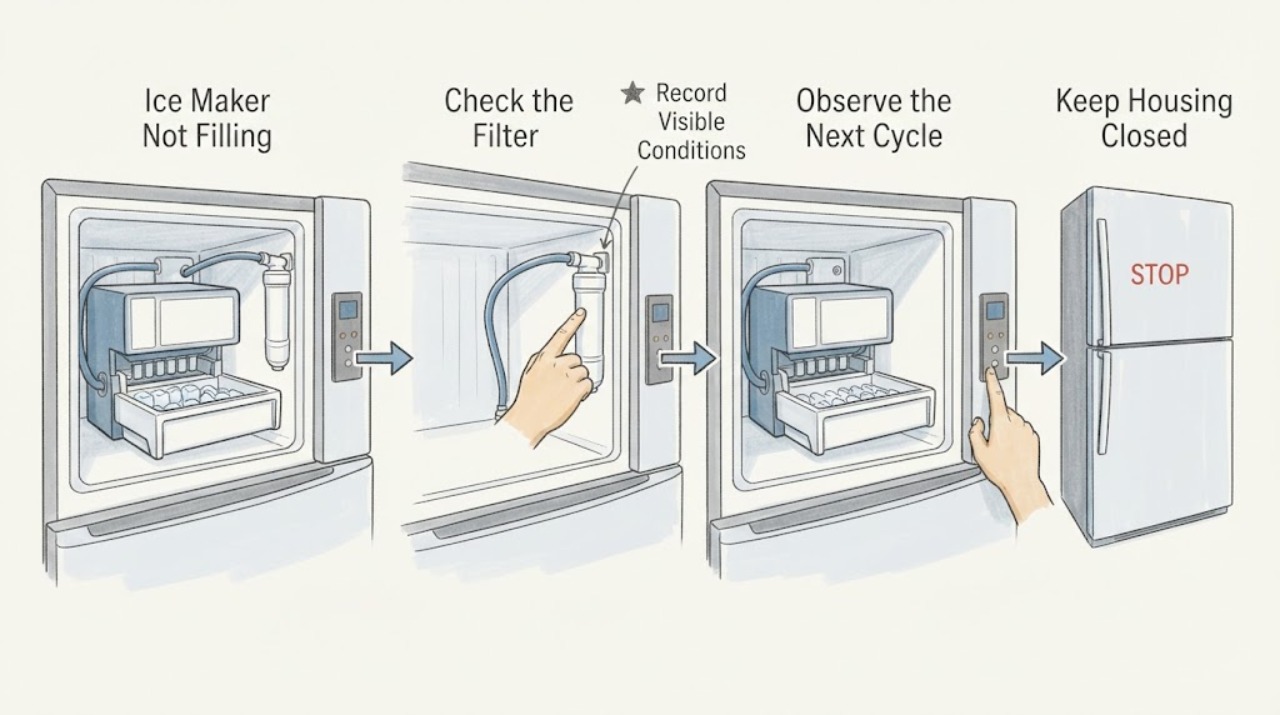
Work through in order
Diagnostic checks
Use only checks that match the exact appliance or system and its official guide.
-
Check 1
If the refrigerator has a leaking water line, water near electrical connections, a damaged filter housing, sparking, or an unusual valve noise while no water supply is connected, stop the ice-making request. Close the household water shutoff only if there is a water leak and it is safe to do so; keep hands away from wiring and do not energize a valve manually.
Expected result: There is no leak or electrical hazard, or water/electrical damage or an unconnected supply is present.
Next step: For a hazard, keep the ice maker out of service and arrange qualified appliance/plumbing help. If the supply is not connected, Frigidaire directs users to turn the ice maker OFF until it is connected.
Why this matters
Why: A dry external setup permits ordinary user checks; a leak, electrical hazard, or unconnected line requires isolation and service rather than repeated ice cycles.
-
Check 2
Record the exact model and identify whether the refrigerator is French-door, side-by-side, or top-freezer. Confirm from the matching manual that an ice maker is fitted and locate its model-specific ON control; use the top-freezer signal-arm instruction only when the appliance is confirmed as that family.
Expected result: The ice-maker control is clearly ON, the top-freezer signal arm is down/ON on a confirmed top-freezer model, or the model/family and control are still uncertain.
Next step: Follow only the exact manual for the identified model. If the model or ice-maker presence cannot be confirmed, stop at the external water check and give the uncertainty to service.
Why this matters
Why: Frigidaire states that not all top-freezer refrigerators include an ice maker and that controls vary by model; an uncertain control state cannot support an internal fault diagnosis.
-
Check 3
Check the accessible water path without opening the cabinet: confirm the household supply is on, the line is not kinked behind a pushed-back refrigerator, and the water dispenser has normal flow if the model has one. Check that the filter is installed securely and is not frozen, cracked, clogged, or overdue; use only the model's filter instructions.
Expected result: Water is slow/absent, the line is kinked, the filter is loose/damaged/overdue, or water flow and the filter appear normal.
Next step: Correct only the accessible supply/filter condition covered by the manual, prime/purge after a filter or installation change, and allow the system to stabilize. If flow is normal and the tray remains dry, continue to temperature/startup checks rather than opening the water circuit.
Why this matters
Why: Frigidaire links low ice production to supply-line restriction, slow dispenser flow, and filter condition; normal external flow makes those explanations less likely but does not identify the fill valve or ice-maker assembly.
-
Check 4
Check whether the refrigerator was recently installed, had a filter or water-line change, or experienced a power interruption. For a new or recently reconnected system, follow Frigidaire's priming instructions and allow the model's startup period; confirm the freezer setting is not warmer than the manual allows. Do not force a harvest cycle or set an unverified temperature value.
Expected result: The appliance is new/reconnected and has had only a few empty cycles, or it has been operating normally for the model's expected period with a stable freezer temperature.
Next step: For a new/reconnected unit, complete priming and wait the model-appropriate stabilization period. If the unit is established, cold, and still produces no fill, arrange service after the final external checks.
Why this matters
Why: Frigidaire says trapped air can cause two or three empty cycles and that ice production can take up to 24 hours after installation; a warm freezer can also slow production.
-
Check 5
Prepare the exact model and serial, refrigerator family, ice-maker ON state, water-flow and filter observations, installation/filter-change date, freezer setting as shown by the manual, time since startup, and whether the tray is completely dry or has partial fill for Frigidaire service.
Expected result: The model control is ON, water supply/filter and temperature conditions are acceptable, startup/priming time has passed, and the tray still does not fill; or the source cannot be safely checked.
Next step: Keep the ice maker out of service as appropriate and arrange Frigidaire-qualified service. Do not apply power to a valve, bypass a signal arm or sensor, force a diagnostic harvest, remove internal covers, or order a part from the symptom alone.
Why this matters
Why: The remaining possibilities include an internal fill, sensing, timing, or ice-maker condition, but the no-model evidence cannot identify a failed part or safe internal procedure.
Use your observations
Decision map
Find the observation that best matches what you see, then follow the next safe action.
-
PATH 01Next step
What you see
The refrigerator was just installed or reconnected, the ice maker is ON, and only two or three cycles have been empty.
Do this next
Prime/purge the water system according to Frigidaire's instructions and allow the model-specific stabilization period. Escalate if the tray remains dry after that period.
Why this path and its safety boundary
Why it matters: Frigidaire says trapped air in new plumbing can cause two or three empty cycles and that startup production can take up to 24 hours.
-
PATH 02Next step
What you see
The water dispenser is slow or absent, the supply line is kinked, or the filter is loose, frozen, cracked, clogged, or overdue.
Do this next
Correct the accessible supply or filter condition using the exact manual, prime/purge after relevant changes, and allow production to resume. Do not replace an internal valve from this observation alone.
Why this path and its safety boundary
Why it matters: The observed condition is consistent with Frigidaire's documented water/filter causes of reduced or absent ice production.
-
PATH 03Next step
What you see
The exact ice-maker control is ON, water flow and filter installation are normal, the freezer is at its manual-specified condition, and startup time has passed, but the tray remains dry.
Do this next
Stop further user-level testing and arrange Frigidaire service with the exact model and observations. Do not force a harvest cycle, bypass a sensor or arm, or probe the valve.
Why this path and its safety boundary
Why it matters: The accessible supply and startup explanations are not established; an internal ice-maker or fill condition remains possible but is not diagnosed.
-
PATH 04Next step
What you see
The water supply is disconnected, a line or filter is leaking, water is near electrical parts, or the freezer/ice maker cannot be safely identified.
Do this next
Turn the ice maker OFF when no water supply is connected, close the water shutoff for an active leak only if safe, keep the appliance out of service as needed, and obtain qualified appliance/plumbing help.
Why this path and its safety boundary
Why it matters: Water, electrical, or identity risk takes priority over production testing; an unspecified family cannot justify a universal control or part procedure.
Helpful context
Understand the symptom
Confirm the refrigerator family before changing a control
Frigidaire's ice-maker support covers French-door, side-by-side, and top-freezer refrigerators, but it specifically notes that not all top-freezer models have an ice maker. Find the model on the appliance label and use its manual before moving a signal arm or selecting an ice-maker control. A tray that is empty on a newly installed appliance can reflect trapped air or normal startup time rather than a failed component.
Start with water delivery and temperature, not an internal part
Frigidaire identifies a kinked supply line, a clogged or overdue filter, slow or absent dispenser water, and a freezer set too warm as possible reasons for low or absent ice production. These are model-safe external observations. They do not prove that an inlet valve, ice-maker motor, thermostat, sensor, or control board has failed, so those parts remain a service diagnosis.
When checks do not resolve it
Need a professional?
Arrange Frigidaire service when the correct model control is ON, accessible water/filter and temperature conditions are acceptable, priming and startup time have passed, and the tray still does not fill; also call for any leak, electrical hazard, damaged filter housing, or unresolved family/model uncertainty.
Safety scope: Do not apply power to a fill valve, force a harvest cycle, bypass a signal arm or sensor, remove internal covers, use a sharp tool around ice, or order an internal part without exact model confirmation. Turn the ice maker OFF if no water supply is connected.
Have this ready
- Full model and serial, refrigerator family, ice-maker control state, water-dispenser flow, supply-line and filter observations, installation/filter-change date, freezer condition, elapsed startup time, and whether the tray is empty or partially filled.
Common questions
FAQ
How long should I wait after installing a Frigidaire refrigerator before judging the ice maker?
Frigidaire says trapped air can cause two or three empty cycles and that, after installation and cooling for several hours, the ice maker can produce ice within 24 hours. Use the exact model manual for any different timing and escalate if the tray remains dry after the model-appropriate period.
Can a water filter stop the Frigidaire ice tray from filling?
It can reduce ice production when clogged, overdue, frozen, cracked, or installed incorrectly, especially if dispenser flow is slow or absent. Check only the accessible filter installation and use the matching manual; do not infer a bad inlet valve from filter symptoms.
Do all Frigidaire top-freezer refrigerators have an ice maker or signal arm?
No. Frigidaire states that not all top-freezer refrigerators have an ice maker. Confirm the exact model and use the signal-arm instructions only for a matching top-freezer design; French-door and side-by-side controls may differ.
Read the exact guide
Official sources
- What should I do if the dispenser on my refrigerator is not dispensing ice?Frigidaire Owner Support · Opened Frigidaire official dispenser page. It is used only for accessible bin/control context and not as proof of a fill-valve or ice-maker assembly fault.
- Refrigerators - How do I use my ice maker in my Top-Freezer refrigerator?Frigidaire Owner Support · Opened Frigidaire official top-freezer-specific page. Signal-arm guidance is limited to confirmed top-freezer designs and is not generalized to French-door or side-by-side models.
- What should I do if my ice maker is not making enough ice in my refrigerator?Frigidaire Owner Support · Opened Frigidaire official support page covering French-door, side-by-side, and top-freezer refrigerator families. It supports external water/filter/temperature checks and service escalation, not an internal part diagnosis for an unspecified model.
- Refrigerators - What does it mean to ‘Prime the Water Supply System’ and why is it important for my refrigerator?Frigidaire Owner Support · Opened Frigidaire official priming guide. It supports trapped-air and initial-flow context; it does not authorize internal water-line or valve work.
- Refrigerators - No WaterFrigidaire Owner Support · Opened Frigidaire official no-water support page. It supports external supply, lock, filter, and service checks that can affect ice production; it does not diagnose an internal fill component.
- My refrigerator was just installed and the ice maker is not working, how do I fix it?Frigidaire Owner Support · Opened Frigidaire official installation support page. It supports ON status, priming, empty initial cycles, up-to-24-hour startup context, and turning the ice maker OFF when no water supply is connected.
Community feedback
Share a repair observation
Share a plain-text repair observation. Accepted observations are published automatically; this page may take a moment to update.