
On this page
Start here
Quick answer
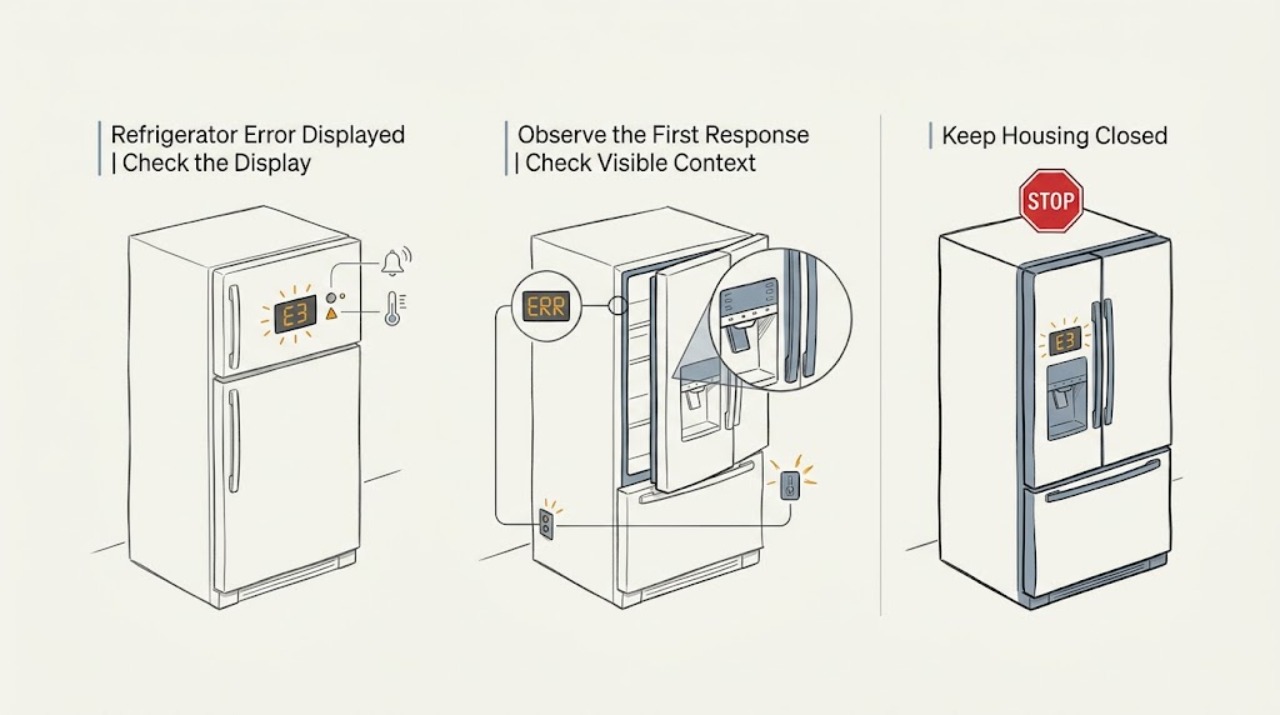
Do not apply a generic Frigidaire code list to every refrigerator. Before pressing CLEAR ALERTS, unplugging the unit, or resetting a breaker, photograph and transcribe the exact characters, capitalization, spaces, blinking or solid state, lamp order, tone pattern, affected compartment, and the complete model number. Frigidaire's general guide gives conditional examples: PF can indicate a power failure or surge; H or HI a high-temperature alarm; Door Ajar an open door; SB or Sb Sabbath Mode; 77 77 Demo Mode; and DI SP or DISP an ice-chute jam. Its French-door alarm guide also lists SY CF, SY CE, SY EF, OP, and SH as examples that may require authorized service. These are not a cross-model diagnosis: confirm the exact display and sequence in the Owner's Manual for this refrigerator. Check only accessible conditions such as a door left open, a visibly poor gasket seal, an obvious ice chute blockage, a recent outage, or a changed setting. If the code returns after the model-approved acknowledgement, the display is unknown, a service-family code appears, cooling is failing, water is near electrical parts, the cord or outlet is hot or damaged, or the breaker trips, leave the refrigerator in a safe state and arrange qualified service. Do not open panels, probe wiring, or perform live electrical tests.
Before you begin
Safety first
- The user may record the display and model, inspect accessible door/gasket and chute conditions, and follow a model-specific acknowledgement explicitly allowed by the Owner's Manual. Qualified personnel must handle panels, wiring, sensors, fans, heaters, valves, controls, compressors, refrigerant, live testing, and any electrical or water-damaged appliance.
Work through in order
Diagnostic checks
Use only checks that match the exact appliance or system and its official guide.
-
Check 1
Before acknowledging or resetting anything, photograph the display and write the exact characters, capitalization, spaces, decimal points, flashing or solid state, lamp order, and tone sequence. Record whether the display is on the refrigerator, freezer, dispenser, or an interior control area.
Expected result: A complete code and sequence are visible; only a partial code is visible; or there is only a lamp/chime pattern with no text.
Next step: Keep the record and continue to identify the model. If the pattern remains uncertain, use the unknown-code branch and contact Frigidaire or qualified service rather than trying a reset to make it reappear.
Stop if: Do not clear the display, disconnect power, or press random key combinations before recording it.
Why this matters
Why: A complete visual and timing record can be matched to the exact manual. A partial code or lamp-only pattern cannot safely be converted into a different code by guesswork.
-
Check 2
Locate the complete model number from the accessible rating label or Owner's Manual and record the refrigerator platform: French door, side-by-side, top freezer, or another documented configuration. Match the exact model manual to the recorded code and key layout.
Expected result: The model and platform are confirmed; the model is incomplete; or a code was found only in a manual for another platform.
Next step: Use only the confirmed model manual. If the model cannot be confirmed, preserve the code and request support with the serial/model information; do not copy a reset sequence from a similar-looking refrigerator.
Stop if: Do not splice code meanings or key sequences across French-door, side-by-side, top-freezer, or other model families.
Why this matters
Why: Frigidaire's alarm guidance covers multiple refrigerator types but explicitly says meanings vary by model. A code from another platform is research context, not proof of the meaning on this unit.
-
Check 3
Without removing panels, note whether the refrigerator is cooling, whether the refrigerator or freezer is warm, whether a door was left open, whether the gasket visibly contacts the cabinet, whether an accessible ice chute is blocked, and whether water is approaching controls or wiring.
Expected result: There was a long-open door or poor visible seal; the temperature is high; an ice chute has an obvious accessible jam; the unit is cooling normally; or water/electrical damage is present.
Next step: Close doors, keep food safety in mind, and clear only an accessible loose ice obstruction after following the exact manual. Leave the unit off and call service for water near electrics, damage, persistent warmth, or an unresolved code.
Stop if: Do not remove evaporator covers, dispenser housings, wiring, fan guards, or electrical panels to find the cause.
Why this matters
Why: Door, temperature, and ice-jam context can support the corresponding official alarm branch, but it cannot establish an internal sensor, fan, valve, heater, or control failure. Water near electrics or physical damage is a stop-use condition.
-
Check 4
Compare the exact recorded text to the exact model manual and treat the public Frigidaire examples only as conditional orientation: PF after an outage or surge, H/HI with high temperature, Door Ajar after an open door, SB/Sb or 77 77 for model-specific modes, DI SP/DISP for an ice-chute blockage, and service-family examples such as SY CF, SY CE, SY EF, OP, or SH.
Expected result: The characters, platform, and surrounding symptom match the exact manual; the characters match only a general support example; or the code is in a service-oriented family.
Next step: Follow only the exact model's documented user acknowledgement or accessible check. For a service-family code, persistent code, or mismatch, retain the display record and arrange service.
Stop if: Do not declare a part failed or buy a part from a code that is not confirmed for the exact model.
Why this matters
Why: An exact manual match supports the corresponding user-level branch. A general-example match without model confirmation remains uncertain. A service-oriented code or a repeated code raises the need for qualified diagnosis.
-
Check 5
Ask whether there was a power outage, surge, recent breaker event, or repeated loss of display, and record whether the refrigerator recovered its normal display and cooling. Make only an external observation of the plug and outlet when they are cool and dry; do not probe them or cycle the breaker repeatedly.
Expected result: PF appears after a known outage; the display is normal again; the refrigerator remains warm; the outlet or cord is hot/damaged; or the breaker trips again.
Next step: Use the exact manual's acknowledgement only after the code is recorded. For a hot/damaged cord or outlet, smoke, arcing, repeated trip, or persistent loss of power, leave the refrigerator in a safe state and arrange qualified appliance/electrical service.
Stop if: Do not perform live voltage tests, open the plug or outlet, remove refrigerator electrical covers, or repeatedly reset the breaker.
Why this matters
Why: PF is documented by Frigidaire as a power failure or surge indication and may accompany a high-temperature alarm. A hot/damaged power path or repeated trip is an electrical safety problem, not a reset problem.
-
Check 6
After recording the evidence, use only the exact model manual's documented acknowledgement or clear-alert control, if it explicitly permits a user action. Do not infer that unplugging for a fixed interval or pressing a key combination applies to this refrigerator.
Expected result: The alarm clears and cooling is normal; it clears but returns; it will not clear; or the display becomes blank after a power action.
Next step: Preserve the original photo and arrange service for recurrence, no-clear behavior, loss of cooling, or any electrical symptom. Do not keep clearing a recurring code.
Stop if: Do not use a hard reset to erase evidence, bypass an alarm, or make a refrigerator with unsafe temperature or electrical symptoms continue operating.
Why this matters
Why: A cleared alarm can acknowledge a transient condition, but it does not prove the underlying cause is fixed. A returning or uncleared code, lost display, or worsening temperature needs diagnosis.
-
Check 7
Prepare a service record with the exact model and serial, refrigerator platform, code/photo, lamp and tone sequence, first time seen, outage or door history, temperature symptoms, ice/water observations, actions already taken, and whether the code returned.
Expected result: The code is known and transient; the code is unknown or recurring; cooling is abnormal; or a hazard is present.
Next step: Contact Frigidaire support or a qualified refrigerator technician. Keep the unit unplugged when the manual or safety symptoms require it, and protect food according to food-safety guidance if cooling has failed.
Stop if: Do not remove control boards, sensors, fans, heaters, valves, harnesses, or panels, and do not perform live tests.
Why this matters
Why: The record lets a technician bind the symptom to the correct model control and service documentation without the user opening the appliance. Unknown or recurring codes cannot be safely resolved by a generic parts list.
Use your observations
Decision map
Find the observation that best matches what you see, then follow the next safe action.
-
PATH 01Safety boundary
What you see
The exact display is PF and a recent outage, surge, or breaker event is documented.
Do this next
Record the code, verify that power and cooling have returned without unsafe external conditions, and use only the exact model manual's Alarm Reset or acknowledgement. Arrange service if PF returns, cooling does not recover, or the power path is abnormal.
Why this path and its safety boundary
Why it matters: Frigidaire documents PF as a power failure or surge indication; a prolonged outage can also leave a high-temperature condition.
Safety stop: Do not repeatedly reset the breaker or test the refrigerator live.
-
PATH 02Safety boundary
What you see
The exact display is H or HI and the refrigerator or freezer is warm, a door was open, or the seal is visibly not contacting.
Do this next
Close and inspect the doors and visible gasket, preserve the temperature/code record, and follow the exact manual's clear-alert instruction. Call service if the temperature stays high or H/HI returns.
Why this path and its safety boundary
Why it matters: Frigidaire associates H/HI with a high-temperature alarm and identifies an open door, changed settings, or a poor gasket as possible accessible context; the code does not by itself identify the cooling part at fault.
Safety stop: Do not remove the gasket, evaporator cover, fan, sensor, or control panel to chase the alarm.
-
PATH 03Safety boundary
What you see
The display or alarm indicates Door Ajar and a door is not fully closed or the visible gasket is obstructed.
Do this next
Remove only an accessible obstruction, close the door, and use the model-specific acknowledgement. If the alarm remains or returns, arrange service and provide the model and code record.
Why this path and its safety boundary
Why it matters: Frigidaire's guide describes a door-ajar alarm after a period with the door open. An alarm that remains with properly closed doors may involve an alignment, switch, wiring, or control issue that is not a user repair.
Safety stop: Do not dismantle the door, switch, hinge, gasket, or control to defeat the alarm.
-
PATH 04Safety boundary
What you see
The exact display is SB/Sb or 77 77 and the refrigerator otherwise behaves like a model-specific Sabbath or Demo mode.
Do this next
Use the exact model manual to identify and exit the mode. If the mode cannot be confirmed or the unit remains warm after the correct mode change, call service.
Why this path and its safety boundary
Why it matters: Frigidaire lists SB/Sb and 77 77 as mode examples, but the key sequence and availability are model-dependent. A mode indication is not evidence of a failed sensor or compressor.
Safety stop: Do not copy a button sequence from another Frigidaire refrigerator.
-
PATH 05Safety boundary
What you see
The exact display is DI SP or DISP and the ice chute visibly contains a loose blockage or compacted ice.
Do this next
Follow the exact manual, remove the ice bin only if the manual permits it, thaw and empty the accessible ice, clean and wipe it dry, and replace it correctly. Call service if the code returns or the jam is not safely accessible.
Why this path and its safety boundary
Why it matters: Frigidaire describes DI SP/DISP as an ice jam condition in its general guide. This branch concerns an accessible chute blockage, not a hidden auger, motor, valve, heater, or control diagnosis.
Safety stop: Do not use knives, picks, heat guns, boiling water, or disassemble the dispenser.
-
PATH 06Safety boundary
What you see
The display matches SY CF, SY CE, SY EF, OP, SH, or another service-oriented code in the exact manual, or the refrigerator has abnormal cooling, fan, water, or control behavior.
Do this next
Keep the exact code and model record, avoid panel removal, and arrange Frigidaire or qualified refrigerator service.
Why this path and its safety boundary
Why it matters: Frigidaire's French-door alarm guidance identifies these as examples that may require authorized service. Their presence does not justify naming a motor, sensor, board, or wiring part without model-specific diagnosis.
Safety stop: Do not bypass a sensor, fan, door switch, valve, or control, and do not perform live electrical testing.
-
PATH 07Safety boundary
What you see
The code is partial or unknown, only lamps or tones are present, the display returns after acknowledgement, or the model cannot be confirmed.
Do this next
Photograph the pattern again if it appears without changing the controls, locate the exact manual, and contact Frigidaire or qualified service with the model/serial and timeline. Do not reproduce the fault to obtain a clearer code.
Why this path and its safety boundary
Why it matters: Without exact identity and sequence, a generic list cannot distinguish a mode, door/temperature alarm, ice issue, power event, or internal control fault.
Safety stop: Do not splice codes, guess a part, repeatedly unplug, or open the refrigerator.
-
PATH 08Safety boundary
What you see
The error display is accompanied by water near electrical parts, smoke, burning odor, arcing, a hot or damaged cord/outlet, repeated breaker trips, or a damaged cabinet.
Do this next
Keep people away from the hazard, disconnect power only from a safe dry location if accessible, and arrange qualified appliance or electrical service. Do not restore power to see whether the code clears.
Why this path and its safety boundary
Why it matters: This is a safety isolation issue rather than a code interpretation exercise. The user cannot verify internal insulation, wiring, control, or compressor electrical safety from the display.
Safety stop: Do not touch wet electrical components, remove panels, probe live circuits, or reset a tripping breaker repeatedly.
Helpful context
Understand the symptom
An error display is a model-identification problem first
A short code, a blinking lamp, or a repeating chime is not enough to identify a failed part. Frigidaire publishes separate guidance for different refrigerator platforms and warns that alarm meanings vary by model. Preserve the display before clearing it, record the refrigerator type and model number, and use the exact Owner's Manual for that appliance. A code that looks similar after a missed segment or a different lamp order can lead to a wrong branch.
Use official examples as conditional clues, not a universal code chart
PF, H/HI, Door Ajar, SB/Sb, 77 77, and DI SP/DISP are examples documented in Frigidaire support material. Some French-door guidance also lists SY CF, SY CE, SY EF, OP, and SH, with several requiring authorized service. The same characters can be absent, differently formatted, or assigned differently on another platform. Do not combine a code from a French-door page with a reset sequence from a side-by-side or top-freezer manual.
Safe checks stay outside the cabinet
The user-level checks are limited to recording the display, looking at door closure and gasket contact, noting temperature and cooling symptoms, checking an accessible ice chute for an obvious blockage, and documenting a recent outage or changed setting. Keep hands away from wet electrical areas and do not remove covers, test wiring, bypass an interlock, or keep resetting a breaker. A refrigerator that is warm, leaking toward electrical parts, smoking, arcing, or repeatedly tripping power needs service rather than a code experiment.
Safety boundary
Stop conditions
- Stop user troubleshooting for smoke, burning odor, arcing, a hot or damaged cord/outlet, repeated breaker trips, water near electrical parts, or a damaged cabinet; isolate power only from a safe dry location and arrange qualified service.
- Do not open control, evaporator, dispenser, compressor, or wiring panels; do not bypass a door, fan, sensor, valve, or interlock; and do not perform live electrical tests.
- Do not repeatedly clear, unplug, or reset the refrigerator before recording the exact code, lamp sequence, model, and timeline.
- Do not copy a code meaning or key sequence from another Frigidaire platform or model family, and do not buy a part from an unconfirmed code.
- Do not use knives, picks, heat guns, boiling water, or improvised tools inside an ice chute or around electrical components.
When checks do not resolve it
Need a professional?
Safety scope: The user may record the display and model, inspect accessible door/gasket and chute conditions, and follow a model-specific acknowledgement explicitly allowed by the Owner's Manual. Qualified personnel must handle panels, wiring, sensors, fans, heaters, valves, controls, compressors, refrigerant, live testing, and any electrical or water-damaged appliance.
Common questions
FAQ
Should I reset my Frigidaire refrigerator as soon as an error appears?
No. Photograph and transcribe the exact code, lamp sequence, timing, and model first. Then use only the exact Owner's Manual's acknowledgement or reset instruction; a cleared alarm does not prove the underlying condition is fixed.
What does PF mean on a Frigidaire refrigerator?
Frigidaire documents PF as a power failure or surge indication. Record it, note any outage or breaker event, and check only for safe external power conditions. If PF returns, cooling does not recover, or the cord/outlet is hot or damaged, arrange qualified service.
What does H or HI mean on a Frigidaire refrigerator?
Frigidaire identifies H/HI as a high-temperature alarm. An open door, changed setting, or poor gasket can be accessible context, but a persistent alarm can require service. Check doors and visible gasket contact, follow the exact manual, and do not remove panels.
Are Frigidaire refrigerator error codes the same across models?
No. Frigidaire explicitly warns that alarm meanings and reset procedures vary by model. A code listed for a French-door refrigerator should not be combined with a sequence from a side-by-side, top-freezer, or another model.
When should an error display become a service call?
Call when the code is unknown or recurring, a service-family code appears, cooling remains abnormal, a door alarm stays with the door closed, or there is water near electrics, smoke, odor, arcing, a hot/damaged cord or outlet, a repeated breaker trip, or cabinet damage. Do not open the refrigerator or test live wiring.
Read the exact guide
Official sources
- Refrigerator Error Codes and Alarms GuideFrigidaire · Applies as a general Frigidaire refrigerator support guide across documented refrigerator platforms; exact meanings and key sequences remain model-dependent.
- Refrigerator Error Code PF or Power Failure LightFrigidaire · Applies to Frigidaire refrigerators displaying PF or a power-failure light; use the exact model manual if the display or reset behavior differs.
- What do the alarms or error messages mean on my French-Door refrigerator?Frigidaire · Use only when the exact appliance is a covered Frigidaire platform and then confirm the model manual; the page itself warns that alarms vary by model.
- Refrigerator Error Code H or HI - High TemperatureFrigidaire · Applies to Frigidaire refrigerators displaying H or HI; temperature thresholds and acknowledgement behavior still depend on the model.
- Refrigerators | FrigidaireFrigidaire · Applies to Frigidaire refrigerator owner support and links to platform-specific articles; it is not a substitute for the exact Owner's Manual.
Community feedback
Share a repair observation
Share a plain-text repair observation. Accepted observations are published automatically; this page may take a moment to update.