
On this page
Start here
Quick answer
First locate what is freezing: food or water in the fresh-food compartment, a crisper drawer, items directly in front of a vent, or the freezer itself. For a Frigidaire refrigerator, check the temperature setting and any extra-cold or temporary mode against the exact manual, then move food away from vents and direct cold-air paths. Frigidaire lists 37°F for the refrigerator and 0°F for the freezer as factory suggested settings for many electronically controlled models, while a Custom-Flex temperature drawer has its own guidance. If freezing is limited to a crisper, Frigidaire says cold air moving through the damper and low humidity can contribute; using the refrigerator more often or slightly increasing the drawer humidity may help. Check that doors close and the gasket seals, because frost and warm-air leakage can disturb temperatures. Make one documented adjustment and allow the appliance time to stabilize. If the whole fresh-food section freezes, the setting is normal, vents are clear, the door seals, or frost repeatedly returns, stop changing controls and arrange qualified service for the damper, sensor, control, or defrost system; do not remove panels, chip ice, or perform live electrical tests.
Before you begin
Safety first
- Do not remove panels, chip ice, apply direct heat, bypass a door switch, force a damper, or probe live sensors, wiring, controls, fans, or defrost parts.
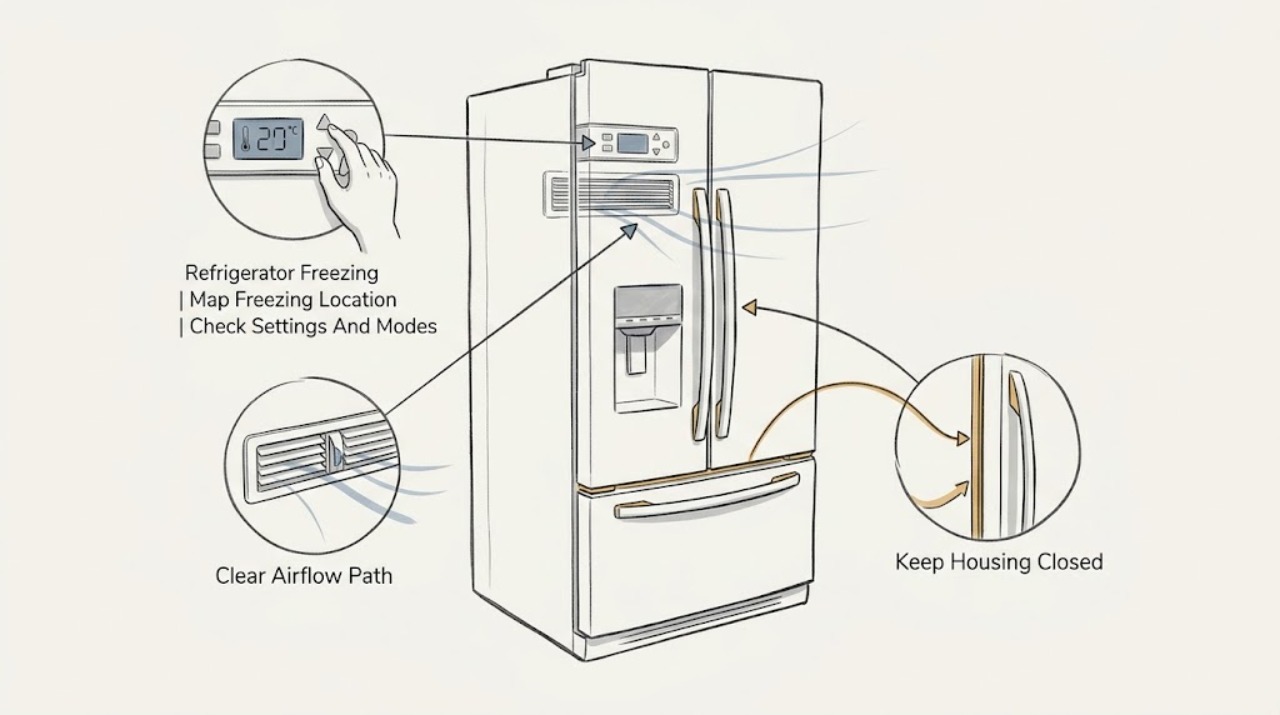
Work through in order
Diagnostic checks
Use only checks that match the exact appliance or system and its official guide.
-
Check 1
Map the frozen items by compartment and position: crisper drawer, shelf near a rear or side vent, door bin, ice chute area, entire fresh-food compartment, or freezer. Record whether the problem affects one item or many and whether frost is visible.
Expected result: Only a crisper or vent-adjacent item freezes, several fresh-food shelves freeze, the freezer is unusually cold, or frost coats a wall or package.
Next step: Continue with the matching location branch and keep the temperature setting unchanged until it is recorded. Do not diagnose a sensor from location alone.
Stop if: Stop if thawing water is near outlets or wiring, or if the cabinet has smoke, burning odor, exposed wiring, or repeated electrical trips.
Why this matters
Why: A localized pattern points first to direct cold air, damper or humidity conditions, or item placement. Broad fresh-food freezing points toward settings, airflow control, door sealing, or sensing. Frost adds a warm-air or defrost-related branch rather than identifying one part.
-
Check 2
Read the refrigerator and freezer controls and identify any extra-cold, vacation, fast-freeze, temperature-drawer, or recently changed mode shown by the exact model. Compare the current setting with the model manual before making one small adjustment.
Expected result: The fresh-food setting is colder than the model recommendation, the freezer is set unusually cold, a temporary mode is active, the appliance was installed or reset recently, or the settings are normal.
Next step: Return only to the exact manual's recommended setting, disable a temporary mode only as documented, and allow the manual's stabilization period before judging the result. If freezing continues at a normal setting, continue with airflow and seal checks.
Stop if: Do not repeatedly change controls, enter an undocumented service mode, or disconnect the appliance merely to clear a temperature symptom.
Why this matters
Why: An unintended setting or mode can explain freezing without an internal failure. Frigidaire's published 37°F refrigerator and 0°F freezer values are suggested settings for the referenced electronically controlled models, not a universal setting for every configuration. A recent installation or reset needs stabilization time.
-
Check 3
With doors open only briefly, move food and containers away from visible vents and direct cold-air paths without blocking shelves or returns. For a crisper-only pattern, inspect the accessible humidity control and use the exact model's documented position.
Expected result: A package is touching or directly in front of a vent, a return path is blocked, the crisper humidity is set low, or no accessible obstruction is found.
Next step: Rearrange only accessible items, make one documented humidity adjustment if applicable, and observe the same locations after stabilization. Do not remove vent covers or reach behind panels.
Stop if: Do not force a damper, block an air return, insert tools into a vent, or chip frost from an air path.
Why this matters
Why: Frigidaire says food contacting vents can disrupt airflow and freeze, and that low humidity can contribute to crisper freezing. Clearing the path may resolve a localized pattern; a clear path with whole-compartment freezing points elsewhere.
-
Check 4
Check that each affected door closes fully and inspect the visible gasket for a gap, warp, crack, dirt, or food obstruction. Note whether frost is concentrated near the door edge, on the rear wall, around an ice chute flap, or across an air path; do not remove a panel.
Expected result: A door does not seal, the gasket has a visible defect, frost is concentrated around an entry gap or chute, or the doors and visible gasket look normal.
Next step: Remove only an obvious food obstruction and clean the accessible gasket as the manual permits. Arrange service for a damaged or misaligned seal, recurring frost, or a pattern behind an inaccessible cover.
Stop if: Do not force the door, replace a gasket without confirming the model, chip ice, apply direct heat, or open the evaporator or fan compartment.
Why this matters
Why: A poor seal lets warm moist air enter and can create frost that disturbs airflow and temperature. Frigidaire also identifies an ice-chute flap that does not close as a frost source on applicable models. A normal visible seal does not rule out an internal damper, sensor, or defrost issue.
-
Check 5
After the setting, airflow, and visible seal observations, compare a crisper-only symptom with temperatures or freezing in the rest of the fresh-food compartment. If the exact model has a humidity control, adjust only that control as documented and do not change the main temperature simultaneously.
Expected result: Only the crisper remains affected, the issue resolves with normal use or a small humidity change, or the whole fresh-food compartment continues to freeze.
Next step: Monitor a localized symptom after the documented adjustment. For broad or recurring freezing, stop adjusting user controls and arrange model-specific service.
Stop if: Do not remove a damper cover, test a sensor live, bypass a control, or continue if frost or thawing water reaches electrical parts.
Why this matters
Why: A crisper-only result is consistent with the damper and humidity branch described by Frigidaire. Whole-compartment freezing at a normal setting is less likely to be solved by drawer humidity and raises concern for an airflow-control, sensor, control, or other internal fault.
-
Check 6
If food continues to freeze after one documented setting correction, clear vents, a sound door seal, and the model-appropriate humidity check, record the model, compartment location, setting, mode, frost pattern, and time to recur for service.
Expected result: Freezing stops after an external correction, returns at the normal setting, affects the whole fresh-food compartment, or recurs with heavy frost or abnormal cooling behavior.
Next step: Protect food and arrange qualified Frigidaire or appliance service for a persistent symptom. Keep the refrigerator out of service for smoke, burning odor, electrical damage, or water near electrical parts.
Stop if: Do not open panels, make live measurements, force a defrost cycle, bypass a door switch, or use direct heat to clear ice.
Why this matters
Why: Recovery after moving an item or correcting a setting supports an external cause. Persistent broad freezing or recurring frost makes a damper, sensor, control, or defrost fault more likely, but the symptom does not identify a replacement part.
Use your observations
Decision map
Find the observation that best matches what you see, then follow the next safe action.
-
PATH 01Safety boundary
What you see
Freezing is limited to a crisper drawer or a small area, especially after infrequent use, while the rest of the fresh-food section is normal.
Do this next
Use the refrigerator more normally and make only the slight humidity adjustment allowed by the exact model; monitor before changing the main temperature.
Why this path and its safety boundary
Why it matters: Freezer air through the damper and low humidity are more likely than a whole-refrigerator control failure.
Safety stop: Stop and seek service if the whole compartment begins freezing or the damper requires panel access.
-
PATH 02Safety boundary
What you see
Only packages touching or directly in front of a visible vent freeze, and the rest of the compartment is not unusually cold.
Do this next
Move packages away from the vent and clear only accessible obstructions, then observe the same shelf after stabilization.
Why this path and its safety boundary
Why it matters: Direct cold airflow or blocked air paths are more likely than a failed sensor.
Safety stop: Do not remove the vent cover or insert tools into the air path.
-
PATH 03Safety boundary
What you see
The refrigerator or freezer setting is colder than the model recommendation, a temporary cold mode is active, or the appliance was recently installed or reset.
Do this next
Return to the exact model's documented setting, disable the mode as instructed, and allow the required stabilization period before judging the change.
Why this path and its safety boundary
Why it matters: A user setting or an uncompleted stabilization period is more likely than an internal fault at the first check.
Safety stop: Do not repeatedly adjust settings or enter an undocumented service mode.
-
PATH 04Safety boundary
What you see
The gasket or door does not seal, frost gathers around a door or ice-chute gap, or frost blocks an air path.
Do this next
Correct only an accessible obstruction and arrange service for a damaged seal, recurring frost, or any frost behind a cover; do not chip or heat the ice.
Why this path and its safety boundary
Why it matters: Warm-air entry and frost are more likely to be disturbing airflow than a simple temperature-setting problem.
Safety stop: Stop if thawing water reaches electrical components.
-
PATH 05Safety boundary
What you see
The whole fresh-food compartment freezes even though settings are normal, vents are clear, the door seals, and one stabilization period has passed.
Do this next
Protect food and arrange qualified model-specific service. Provide the model, settings, affected locations, frost pattern, and recurrence time.
Why this path and its safety boundary
Why it matters: An internal damper, temperature sensor, control, or defrost/airflow fault becomes more likely; the observation cannot select one part safely.
Safety stop: Do not remove panels, live-test wiring or sensors, force a damper, or apply direct heat.
Helpful context
Understand the symptom
Where the freezing occurs changes the diagnosis
“The refrigerator is freezing” can mean a crisper drawer freezes while the rest of the fresh-food compartment is normal, bottles freeze only beside a vent, or the entire compartment is below its intended temperature. It can also describe a freezer that is simply set too cold. Record the location, food position, setting, mode, door behavior, and frost pattern before moving shelves or changing several controls at once.
Crisper-only freezing can be an airflow or humidity pattern
Frigidaire explains that freezer air can move into the fresh-food compartment through a damper and create freezing temperatures in crisper drawers, especially when the unit has not been used for an extended time. It also notes that low humidity can contribute and suggests slightly increasing the humidity setting when the model provides that control. This branch applies to the drawer symptom; it does not prove that the damper is defective when the whole refrigerator is freezing.
Frost and door sealing can make a cold-air problem look random
Frigidaire says frost forms when warm and cold air combine below freezing and identifies a warped gasket or door, very low settings, blocked airflow, and products placed directly in a cold-air path as possible contributors. A gasket check and a visible vent check are safe external observations. Repeated frost behind a panel, a fan that cannot be reached safely, or a compartment that remains abnormally cold needs model-specific service rather than scraping or heating the cabinet.
Do not dismantle a freezing refrigerator
Move food only with the appliance operating normally and follow the model manual for any temperature or humidity adjustment. Do not chip ice, use a heat gun or hair dryer, remove an evaporator or fan cover, force a damper, bridge a door switch, or probe a sensor or control while energized. If water from thawing reaches electrical parts, the cabinet has a burning odor, or the refrigerator repeatedly trips protection, leave it out of service and arrange qualified help.
Only after diagnosis
Potential parts
- air damper assembly
Consider this only after a persistent fresh-food freezing pattern remains with the documented settings, clear vents, and intact door seal, and a qualified diagnosis points to restricted or uncontrolled damper airflow.
Confirm the complete refrigerator model and the manufacturer's parts information; damper designs vary by architecture. - temperature sensor or control component
Consider this only when a qualified technician identifies a sensing or control fault after the external setting, airflow, seal, and frost checks do not resolve broad freezing.
The symptom does not identify a sensor or control part, and no replacement should be ordered without exact model diagnosis.
When checks do not resolve it
Need a professional?
Arrange qualified Frigidaire or appliance service when freezing affects the whole fresh-food section at a normal setting, returns after accessible airflow and seal checks, or requires internal damper, sensor, control, fan, or defrost work. Stop using the appliance for smoke, burning odor, damaged wiring, repeated electrical trips, or thawing water near electrical parts.
Safety scope: Do not remove panels, chip ice, apply direct heat, bypass a door switch, force a damper, or probe live sensors, wiring, controls, fans, or defrost parts.
Have this ready
- Exact model, compartment and shelf locations affected, current settings and modes, installation or reset date, door and gasket observations, vent and item-placement changes, humidity setting if applicable, frost pattern, and time until freezing recurs.
Common questions
FAQ
Why are only my Frigidaire crisper drawers freezing?
Frigidaire says freezer air can move through the damper into the fresh-food compartment, and that infrequent use or low humidity can contribute to crisper freezing. Try only the model-documented humidity adjustment and monitor whether the rest of the compartment remains normal.
What should I check when food freezes near a refrigerator vent?
Move food away from the visible vent and clear accessible airflow paths. Frigidaire warns that food touching vents can disrupt airflow and freeze. Do not remove the vent cover or assume a sensor has failed from one frozen package.
What temperature should a Frigidaire refrigerator use?
Frigidaire publishes 37°F for the refrigerator and 0°F for the freezer as factory suggested settings for the referenced electronically controlled models, while other configurations such as a Custom-Flex temperature drawer have separate guidance. Use the exact model manual and allow stabilization after a change.
Read the exact guide
Official sources
- Refrigerator Too ColdFrigidaire · Frigidaire refrigerators
- Refrigerators - How can I avoid “freezing” in my crisper drawers?Frigidaire · Refrigerators, French Door Refrigerators, Side by Side Refrigerators, and Top Freezer Refrigerators
- Refrigerators - What is the recommended temperature settings for my refrigerator?Frigidaire · Refrigerators, French Door Refrigerators, Side by Side Refrigerators, and Top Freezer Refrigerators
- Refrigerators / Freezer - Frost Build UpFrigidaire · Frigidaire refrigerators
- Service & RepairFrigidaire · Frigidaire appliance service requests and qualified diagnosis
Community feedback
Share a repair observation
Share a plain-text repair observation. Accepted observations are published automatically; this page may take a moment to update.