
On this page
Start here
Quick answer
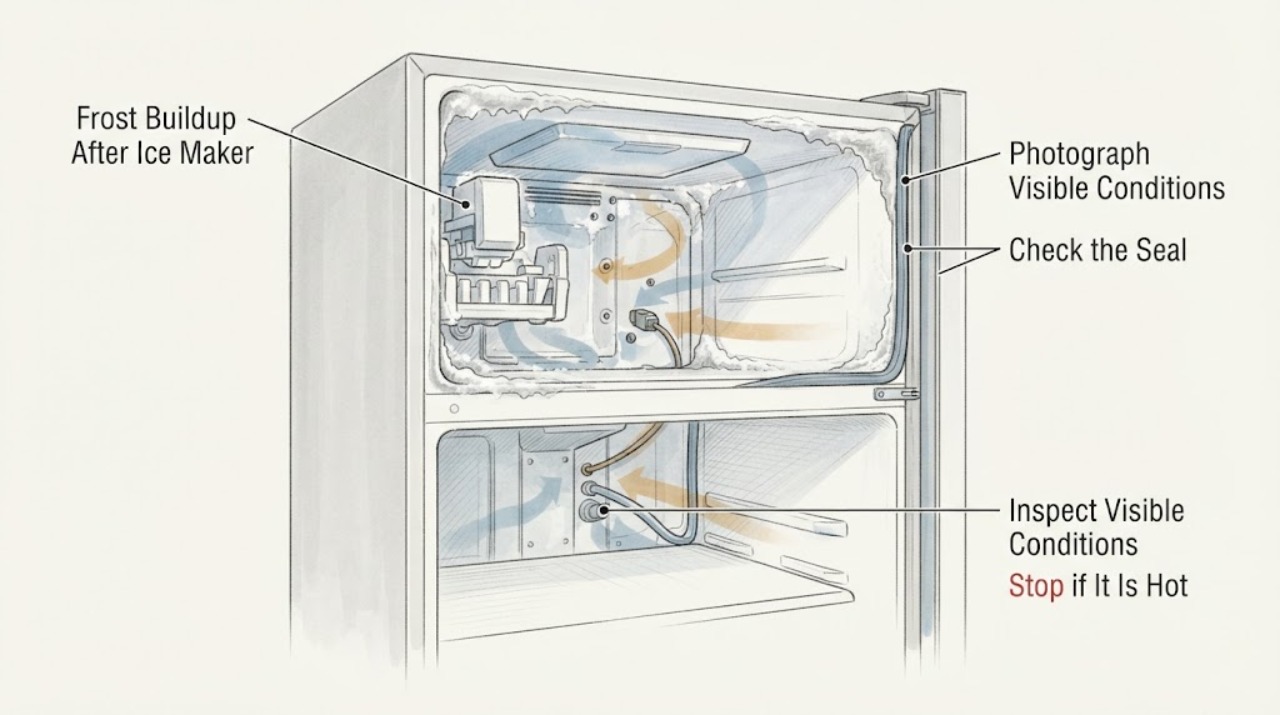
On a Frigidaire FGUB2642LF8 with the ice maker and water dispenser removed, treat the removal as an unverified modification, not as proof of the frost cause. First photograph and map the frost, protect food, and check that every door and visible gasket seals and that no package blocks a vent. Then, with the appliance idle, inspect only from the outside for an open or wet water-line end, a missing cover, a loose trim piece, or a cavity opening created by the removal; do not reconnect tubing, reinstall parts by appearance, or open panels. Frigidaire says frost is commonly caused by warm air entering through a poor door or chute seal, very low settings, or blocked airflow, and its water-leak guidance says loose connections and extended door opening can also produce water or evaporator ice. If frost is broad or recurring, cooling is abnormal, water reaches the floor, a liner or wire is damaged, or inspection would require access behind a cover, stop and arrange qualified Frigidaire service. Never chip ice, use a heat gun or direct heat, pour chemicals into a drain, or perform a powered or pressurized water test.
Work through in order
Diagnostic checks
Use only checks that match the exact appliance or system and its official guide.
-
Check 1
Keep the FGUB2642LF8 doors closed as much as practical, protect temperature-sensitive food, and briefly photograph the frost before moving anything. Map whether it is along a door edge, around a former dispenser or ice-maker opening, beside a vent, on the rear panel, on the freezer floor, or across several areas.
Expected result: The frost is a thin localized patch at an opening or edge, or it is a thick or broad sheet with water, blocked airflow, or a warmer compartment.
Next step: Continue only with external gasket, opening, vent, and setting checks when there is no immediate hazard. Protect or discard food when temperatures are unsafe and arrange service for broad, recurring, or panel-level frost.
Why this matters
Why: A localized patch makes an air-entry or modification-opening check more relevant. Broad or recurring frost with cooling loss makes internal airflow, defrost, drain, or service work more likely; the photograph preserves evidence before it changes.
-
Check 2
From the front, confirm that both French doors and the freezer drawer close fully without a bin, package, ice residue, or removed-component trim holding them open. Inspect the visible gaskets for dirt, folds, gaps, tears, or a section pulled away; clean only an accessible surface with the gentle method in the exact manual.
Expected result: A door edge remains open, the gasket does not contact continuously, frost itself prevents closure, or the doors and visible gaskets seal evenly.
Next step: Remove only a harmless obstruction and close the door. Arrange model-specific service for a torn gasket, loose door, misalignment, or frost that prevents closure; do not pull the gasket, adjust hinges, or reshape it with heat.
Why this matters
Why: A door or gasket gap admits warm humid air and can reproduce frost after the dispenser or ice maker has been removed. An even seal shifts attention to the modification opening, airflow, setting, drain, or internal service causes.
-
Check 3
With the refrigerator idle, inspect the former ice-maker and dispenser areas only from the outside or the normal accessible cabinet side. Look for an open hole, missing cover, loose trim, sharp edge, exposed connector, disconnected tube end, moisture, or a water trail; do not insert a tool, reconnect tubing, pressurize the line, or remove a panel.
Expected result: The removed-component area is dry, closed, and mechanically protected, or an opening, wet tube or fitting, missing cover, damaged liner, exposed wire, or water trail is visible.
Next step: Keep the water supply off if any accessible connection is wet or open, protect the floor, and arrange qualified service to identify the correct cap, seal, water-path repair, or approved configuration. Do not reinstall parts by appearance or tape over a water connection.
Why this matters
Why: A missing or poorly sealed opening can admit warm air and create localized frost, while a wet or open water path can leak independently of the frost. The observation cannot establish which original dispenser, valve, liner, or seal part is needed.
-
Check 4
Move only packages that touch the visible supply or return vents and read the displayed temperature setting against the exact FGUB2642LF8 manual. Note whether frost began after the removal, a long-open door, a power interruption, a move, or a setting change; do not make repeated large setting changes.
Expected result: A vent is blocked, the setting is colder than the manual recommends, a one-time door or power event preceded light frost, or the vents and setting are correct while frost persists.
Next step: Correct only the accessible loading or model-authorized setting issue and allow the refrigerator to stabilize. Arrange service when frost returns, food temperatures remain abnormal, or the removed-component opening needs a cover or internal access.
Why this matters
Why: Frigidaire identifies blocked airflow, very low settings, and warm-air events as frost contributors. A correct setting and clear accessible airflow with recurring frost make a modification seal, defrost, fan, drain, or control issue more concerning.
-
Check 5
After the safe visible checks, monitor the same frost location and floor during normal operation without forcing a defrost. Record whether frost stops spreading, returns in the same opening or rear-panel area, melts into the cabinet or floor, or coincides with reduced airflow, a temperature alarm, or a stopped or abnormal fan.
Expected result: Frost stops after a confirmed door or loading correction, or it returns quickly, spreads broadly, produces water, blocks airflow, or coincides with poor cooling or an alarm.
Next step: Keep the unit closed and food protected, then arrange qualified Frigidaire service with the frost photographs, model/serial, removed-part history, temperature record, and visible opening or water observations. Do not remove covers, chip ice, use direct heat, or repeatedly force a defrost.
Why this matters
Why: A stable localized pattern after a one-time warm-air event may be monitored. Rapid recurrence, meltwater, broad coverage, or cooling loss means the underlying seal, drain, defrost, fan, control, or modified water path remains unresolved.
Use your observations
Decision map
Find the observation that best matches what you see, then follow the next safe action.
-
PATH 01Next step
What you see
Frost is light and localized, the doors and visible gaskets seal, the removed-component area is dry and protected, temperatures are stable, and it followed a one-time long-open-door or warm-load event.
Do this next
Keep doors closed, correct only harmless loading or setting issues, and monitor the photographed area without scraping or heating the frost.
Why this path and its safety boundary
Why it matters: A temporary warm-air event or localized opening effect is more plausible than an established internal defrost failure.
-
PATH 02Next step
What you see
Frost centers on a former ice-maker or dispenser location and an opening, missing cover, damaged liner, disconnected tube end, or loose trim is visible.
Do this next
Keep the water supply off if the path is wet or open, protect the floor, retain all removed parts, and have qualified Frigidaire service identify the model-specific sealing and water-path repair.
Why this path and its safety boundary
Why it matters: The modification may have changed the air seal or left a water-path hazard, but the correct replacement or approved configuration cannot be selected by appearance alone.
-
PATH 03Next step
What you see
The doors seal and accessible vents and settings are correct, but frost is broad or quickly recurring, the rear panel or fan area is iced, cooling is poor, or water returns at the bottom.
Do this next
Protect food and arrange appliance service with photographs, temperature history, frost timing, and the complete model/serial. Do not open the rear panel or force a defrost.
Why this path and its safety boundary
Why it matters: An internal defrost, airflow, drain, control, or fan problem is more likely than a simple loading issue; the removal history may be relevant but does not prove the failed system.
-
PATH 04Next step
What you see
A gasket or door cannot seal, frost prevents closure, water reaches the floor, or a visible water connection is wet.
Do this next
Stop using the affected function, keep the area dry, turn off the water supply if it can be reached safely, and arrange prompt qualified service without disconnecting or pressurizing the line.
Why this path and its safety boundary
Why it matters: Warm-air entry or water exposure can worsen the frost and create a separate floor or electrical hazard.
-
PATH 05Next step
What you see
There is exposed wiring, a cracked or swollen liner, water near electrical parts, smoke, burning odor, sparking, an inaccessible moving fan, or any need to remove a panel or reach behind the modification.
Do this next
Stop using the refrigerator, disconnect power only if it can be done without touching water or damaged parts, protect food, and obtain prompt qualified appliance or electrical help.
Why this path and its safety boundary
Why it matters: This is a safety and professional-access boundary, not a frost-cleaning task.
Helpful context
Understand the symptom
FGUB2642LF8 is a specific French-door refrigerator identity, but the ice maker and water dispenser have reportedly been removed. That history changes the first decision: determine whether the frost is entering through a door or opening, whether any water path is exposed or wet, and whether the removal left a missing cover or altered seal. The history alone cannot show that the defrost system, fan, drain, or water component is defective. Use the complete model and serial label when requesting the exact manual or service.
Frigidaire's opened refrigerator guidance supports external door, gasket, chute, vent, temperature, and visible water checks. It does not authorize reconstructing a removed dispenser or ice maker from a photograph, nor does it make a frost pattern proof of a particular part. Keep any removed parts and fasteners together for the technician.
Frost that returns quickly, covers a rear panel, or accompanies poor cooling needs service. A wet floor, water near electrical parts, exposed wiring, cracked liner, or a door that cannot close is a stop condition. Do not accelerate defrosting with a heat gun, sharp tool, boiling water, or chemicals.
When checks do not resolve it
Need a professional?
Use qualified refrigerator service for recurring or broad frost, poor cooling, water leakage, or any modification-area repair. Use prompt electrical or emergency help for smoke, sparking, burning odor, damaged wiring, or water at electrical parts.
Common questions
FAQ
Does removing the ice maker prove that it caused the frost?
No. Removal is an important timeline and may leave an air opening or water-path issue, but frost can also come from a door gasket, blocked vent, very low setting, defrost drain, fan, or control problem. Map the frost and inspect only accessible surfaces before service.
Can I cover the removed dispenser opening or reconnect the tube myself?
Do not guess a cover, seal, fitting, or reconnection. Keep any wet or open water path off and have qualified service verify the FGUB2642LF8 configuration. Tape, improvised plugs, or a pressurized test can create leaks or airflow problems.
Can I use a hair dryer or heat gun to clear the frost?
No. Do not chip, puncture, scrape, or heat the frost directly. Water, liner damage, hidden wiring, and refrigerant or defrost components can turn a frost problem into a safety or equipment failure. Arrange service when the frost is broad or recurring.
Read the exact guide
Official sources
- Refrigerator Water LeaksFrigidaire · Official Frigidaire refrigerator leak guidance; used for visible connection, door-open, chute, and floor-water boundaries, not for reconstructing a removed dispenser or ice maker.
- Refrigerators / Freezer - Frost Build UpFrigidaire · Official Frigidaire refrigerator article; it applies at refrigerator level and is used for door, chute, temperature, and airflow causes, not as an exact removed-component parts diagram.
- Refrigerators - Not CoolingFrigidaire · Official Frigidaire refrigerator not-cooling guidance; settings and checks are general, so exact FGUB2642LF8 manual instructions control any model-specific procedure.
Community feedback
Share a repair observation
Share a plain-text repair observation. Accepted observations are published automatically; this page may take a moment to update.