
On this page
Start here
Quick answer
First photograph and locate the frost before removing anything. Frigidaire explains that frost forms when warm and cold air combine below 32°F, and identifies an imperfect door or gasket seal, an ice-chute flap that does not close, an excessively low freezer setting, and blocked airflow as causes. A small patch after a door was left open or a moist load is a condensation clue, not proof that the appliance is healthy; what matters is whether it clears and stays away after the door closes normally. Check the exact model's temperature setting, door closure, clean gasket, ice chute if fitted, and visible vents. Never chip frost with a knife or other sharp object, and do not use a hair dryer, heat gun, open flame, or other direct heat. If frost rapidly returns, covers a rear panel or vent, occurs on one localized area, prevents the door from closing, or comes with warming food, fan/defrost symptoms, water, burning odor, or a fault display, stop at external checks and arrange model-specific service.
Before you begin
Safety first
- This article covers external observation, normal controls, visible loading/vent checks, gasket cleaning, and only an exact-model manual-authorized natural defrost. Qualified appliance service must handle evaporator covers, defrost heaters/sensors, fans, controls, wiring, drains, compressors, refrigerant circuits, and live testing.
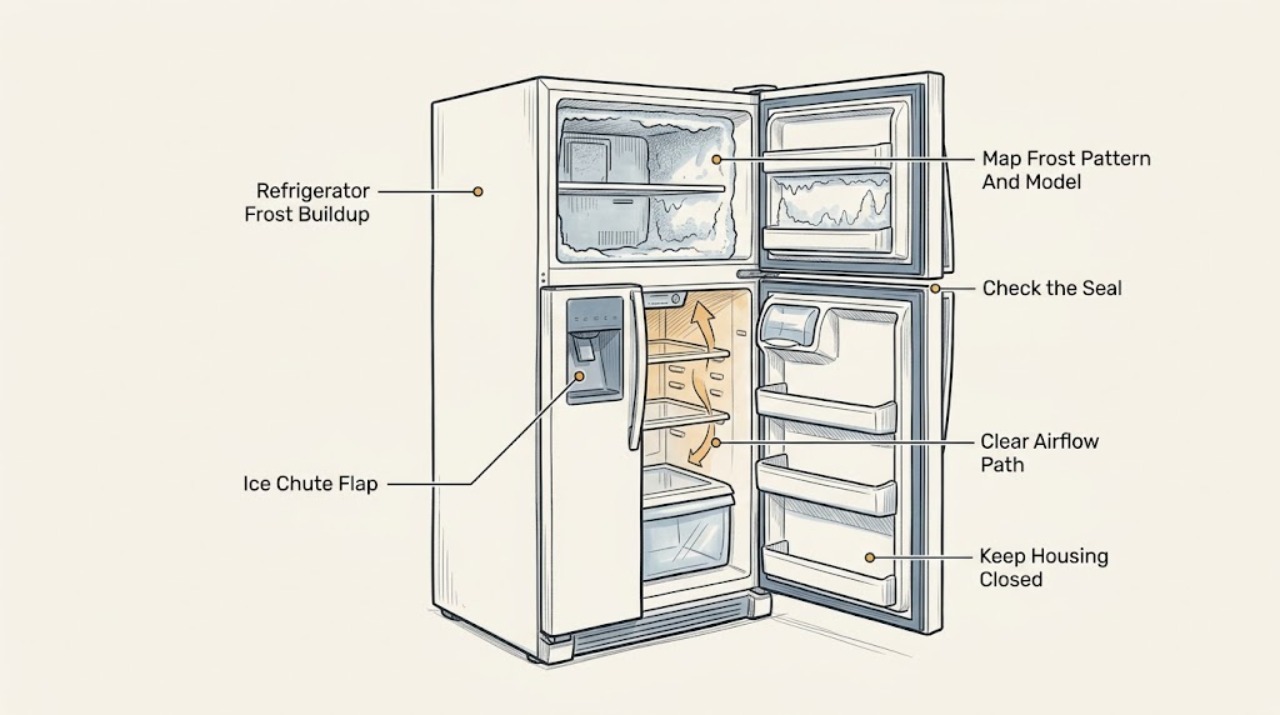
Work through in order
Diagnostic checks
Use only checks that match the exact appliance or system and its official guide.
-
Check 1
Without touching or scraping the frost, note whether it is in the fresh-food compartment or freezer, on a door edge or gasket, on food near a vent, across a rear wall, or concentrated in one small area. Photograph it and record whether it appeared after a long door opening, a power event, loading warm or uncovered food, or a recent setting change. Read the full model number from the product label so the matching Frigidaire manual can identify the layout and owner-accessible controls.
Expected result: The frost is a small transient patch, follows a door perimeter, sits in front of a vent, covers much of a rear panel, returns in the same local spot, or the compartment and model are unknown.
Next step: Use the matching branch after completing the visible door, airflow, and setting checks. If the model or compartment is unknown, identify it before changing a control or attempting any defrost procedure.
Stop if: Do not remove panels, force shelves or covers, chip the frost, or use a tool to expose a hidden component.
Why this matters
Why: A transient patch points toward moisture entering during a specific event; a perimeter pattern makes an air leak more likely; frost directly at a vent makes loading or airflow relevant; broad rear-panel or repeated localized frost cannot be assigned to a particular defrost part without the model and service diagnosis.
-
Check 2
Close the refrigerator and freezer doors normally and look for a container, shelf, drawer, ice bin, or package holding a door open. Inspect the visible gasket for dirt, gaps, distortion, or a section that is folded out of the sealing surface. With the refrigerator safely closed, clean only the gasket using warm soapy water and a soft cloth, then dry it and close the door again. If the model has a dispenser ice chute, look from the outside to see whether the flap is visibly held open by ice; do not reach into the chute.
Expected result: The door cannot close freely, the gasket is dirty or visibly misshapen, frost follows the gasket perimeter, the chute flap is not closed, or the door and visible seal look normal.
Next step: Remove only the item blocking closure, clean and dry the gasket, or follow the exact model's owner instructions for a visible ice-chute obstruction. Recheck the frost pattern after normal use; if the gasket remains distorted, the door will not align, or the chute will not close, arrange service.
Stop if: Do not heat, stretch, glue, cut, or pry the gasket; do not insert a tool into the ice chute or defeat a door switch.
Why this matters
Why: Frigidaire says a door or gasket that does not make a proper seal and an ice-chute flap that remains open can admit warm moisture and create frost. Cleaning can address a surface sealing problem, but a warped gasket, door, or concealed chute mechanism is not proven fixed by wiping it.
-
Check 3
Using the model manual to locate the vents, move only accessible food containers that are touching or directly blocking an interior air outlet or return. Leave a clear path around vents and do not press packages against the rear wall. Check whether the frost is immediately in the cold-air stream or on food placed against that outlet. Do not remove a vent cover or reach behind it.
Expected result: Food is against a vent or rear wall, the frost is localized in the cold-air stream, the cabinet is overpacked, or vents are visibly clear and frost is elsewhere.
Next step: Rearrange food to restore the model's visible airflow path and observe whether new frost stops. If a vent remains blocked by frost, or the frost returns despite clear loading, stop at external checks and use the service branch.
Stop if: Do not pry frost from a vent, remove an air duct, touch a fan, or run a motor with a door switch held closed.
Why this matters
Why: Frigidaire states that blocked airflow pathways and products placed directly in a cold-air line can make frost accumulate; its too-cold guidance also says food touching vents disrupts airflow and can freeze. A clear vent with broad or recurring frost makes simple loading less likely, not impossible to prove a hidden airflow or defrost fault.
-
Check 4
Read the displayed or dial setting without guessing a service value. Compare it with the exact owner's manual; as a general Frigidaire electronic-control reference, the opened guidance lists 37°F for fresh food and 0°F for the freezer, while other families can differ. Record whether the unit was newly installed, recently unplugged, affected by an outage, or had a door left open. Keep doors closed as much as practical and allow the manual's stabilization period after a setting or power change.
Expected result: The freezer is set below the model recommendation, a door was open or warm uncovered food was recently added, the unit has not stabilized after installation or power loss, the setting is normal, or the cabinet is not holding temperature.
Next step: Restore only the model-authorized setting, minimize door openings, and observe after stabilization. Protect perishable and frozen food; if temperatures remain abnormal, frost grows quickly, or food warms, arrange refrigerator service.
Stop if: Do not repeatedly change settings to force a cycle, adjust a hidden control, add refrigerant, or access cooling components.
Why this matters
Why: Frigidaire identifies an extremely low freezer setting and warm air entering through an open door as frost contributors, and says a newly installed refrigerator can take about 24 hours to stabilize. A normal setting with a cabinet that is too warm or unstable suggests a cooling or control issue rather than a frost-only housekeeping issue.
-
Check 5
If the owner's manual provides an owner-accessible defrost or shutdown procedure for this exact model, follow only that procedure. Otherwise, leave the frost intact and contact service. When a manual does authorize a complete shutdown, move food safely, disconnect power only from a dry accessible position, leave doors open as directed, protect the floor from meltwater, and wait for natural melting; do not chip, scrape, or heat the frost. Restore power only as the manual specifies and watch for the same pattern returning.
Expected result: The exact manual contains a defrost procedure, no such owner procedure is found, frost melts naturally but rapidly returns, or the frost cannot be removed without force or heat.
Next step: Use the model manual's procedure only when it explicitly applies; otherwise document the pattern and arrange service. If the frost returns, give the technician the before-and-after photos and timing instead of repeating improvised defrosts.
Stop if: Never use a knife, ice pick, screwdriver, scraper, hair dryer, heat gun, open flame, boiling water, or other direct heat, and never remove an interior panel to defrost it.
Why this matters
Why: A manual-authorized shutdown may remove accumulated ice but does not identify why it formed. Rapid recurrence, a broad rear-panel sheet, or frost that requires force points beyond a safe owner remedy and can involve a concealed airflow or defrost system.
-
Check 6
If the door, gasket, visible chute, loading, airflow, and model-authorized setting checks are normal but frost keeps returning, prepare a service record. Include the model and serial, compartment and exact frost location, photographs before any natural melt, time to return, temperature readings or display, door/gasket result, vent/load result, recent outage or installation, and any fan noise, water, alarm, or cooling change.
Expected result: Frost rapidly returns, is concentrated on one rear or evaporator-side area, covers a vent or panel, prevents a door from closing, or is accompanied by warming food, unusual fan behavior, water, an alarm, smoke, odor, heat, or repeated breaker trips.
Next step: Stop at the external checks and arrange Frigidaire or qualified appliance service. Isolate the appliance from power only if there is a safe dry means to do so; keep food at a safe temperature and follow local food-safety guidance if the cabinet warmed.
Stop if: Do not remove an evaporator cover, test a heater, sensor, fan, valve, control, or wiring live, bypass a door or temperature switch, or order a part from the frost pattern alone.
Why this matters
Why: This pattern is not safely narrowed to a gasket or setting. It may require model-specific diagnosis of the defrost, airflow, drain, temperature-control, or sealed refrigeration system, and the frost itself can reduce airflow or prevent proper door closure.
Use your observations
Decision map
Find the observation that best matches what you see, then follow the next safe action.
-
PATH 01Safety boundary
What you see
The frost is a small patch that appeared after a long door opening, warm uncovered food, or another obvious moisture event, and the door now closes and the cabinet temperature is stable.
Do this next
Restore normal loading and door use, clear visible airflow paths, and observe whether the patch stops growing. Escalate if it returns in the same place or the cabinet warms.
Why this path and its safety boundary
Why it matters: Warm moisture entering a below-freezing area can form ice crystals. This is a plausible condensation explanation, but it is not a universal declaration that any recurring frost is normal.
Safety stop: Do not chip the patch or use direct heat to make the observation faster.
-
PATH 02Safety boundary
What you see
Frost follows the door edge or gasket, the door is held open by a package, the gasket is dirty or visibly distorted, or an ice-chute flap is visibly open.
Do this next
Remove the obstruction, clean and dry the visible gasket, or follow the model's visible chute guidance. Arrange service if the door, gasket, alignment, or chute still cannot seal.
Why this path and its safety boundary
Why it matters: The strongest supported explanation is warm air entering through a seal or chute opening. Frigidaire specifically identifies the gasket/door seal and ice-chute flap as frost sources.
Safety stop: Do not modify the gasket, insert tools into the chute, or defeat a door interlock.
-
PATH 03Safety boundary
What you see
Frost or frozen food is directly in an interior cold-air stream, a package touches a vent or rear wall, or the cabinet is packed so tightly that visible vents are obstructed.
Do this next
Rearrange only accessible items to clear the model's vents and monitor the pattern. If the vent is blocked by ice or frost returns with clear loading, use the service branch.
Why this path and its safety boundary
Why it matters: Restricted or poorly distributed airflow is more likely. Frigidaire warns that food contacting vents disrupts airflow and that placement directly in a cold-air line can accumulate frost.
Safety stop: Do not remove duct covers, touch a fan, or pry ice out of an air passage.
-
PATH 04Safety boundary
What you see
The freezer setting is below the model guidance, the unit has not stabilized after installation/power loss/setting change, or food is warming while frost grows.
Do this next
Use the matching manual's setting and stabilization guidance, minimize door openings, and protect food. Arrange service if temperature does not stabilize or frost continues to build.
Why this path and its safety boundary
Why it matters: An overly cold setting or recent warm-air event can contribute to frost, but frost combined with unstable cabinet temperature is also a reason not to assume a housekeeping cause.
Safety stop: Do not keep changing the setting, access the thermostat, or attempt to repair the cooling system.
-
PATH 05Safety boundary
What you see
Frost rapidly returns after a model-authorized natural defrost, is localized on a rear panel, blocks airflow, prevents the door from closing, or is accompanied by warming, water near electrical parts, burning odor, abnormal heat, smoke, or repeated trips.
Do this next
Stop using the appliance when a hazard or warming condition is present and arrange qualified service. Provide model, photos, timing, settings, temperature symptoms, and hazard details; do not open the cabinet.
Why this path and its safety boundary
Why it matters: A hidden defrost, airflow, temperature-control, drain, or sealed-system issue is possible, and a hazard makes continued testing inappropriate. The observable pattern does not select a safe replacement part.
Safety stop: No improvised defrosting, panel removal, live testing, bypassing, refrigerant work, or repeated power cycling.
Helpful context
Understand the symptom
A frost pattern is more useful than a guess at a part
Frost is condensed moisture that freezes on a cold surface. A short-lived patch after warm air entered the cabinet can have a different explanation from frost that returns in the same corner, grows across a rear panel, or appears around a door perimeter. Frigidaire does not publish one universal amount of frost that is normal for every refrigerator family. Record the compartment, location, thickness, spread, and how quickly it returns, then use the checks below. Do not remove interior covers to look for a heater, fan, sensor, drain, or evaporator.
Safe boundary for frost removal
Keep this diagnosis to a dry, unplugged-safe external inspection, normal control settings, visible vents, door alignment, gasket cleaning, and the exact owner's manual. Do not use a knife, screwdriver, ice pick, scraper, or other sharp tool to chip frost. Do not use a hair dryer, heat gun, space heater, open flame, boiling water, or a directed heat source: heat can damage liners, seals, wiring, or nearby components and can create an electrical hazard. Do not remove an evaporator cover, force a damper or ice chute, bypass a door switch, probe wiring, or perform a live test. If water is near electrical parts, the cord or outlet is hot or damaged, there is smoke or a burning smell, or a breaker repeatedly trips, stop using the refrigerator and arrange qualified service.
When checks do not resolve it
Need a professional?
Safety scope: This article covers external observation, normal controls, visible loading/vent checks, gasket cleaning, and only an exact-model manual-authorized natural defrost. Qualified appliance service must handle evaporator covers, defrost heaters/sensors, fans, controls, wiring, drains, compressors, refrigerant circuits, and live testing.
Common questions
FAQ
Is a small amount of frost in a Frigidaire refrigerator always a failure?
No universal amount is established for every Frigidaire model. Frost after a specific warm-air or moisture event can be condensation, but frost that returns quickly, spreads, blocks airflow, or accompanies warming needs further diagnosis. Start with door closure, gasket, visible vents, and the model setting rather than assuming it is normal.
Can I use a knife or hair dryer to remove refrigerator frost?
No. Do not chip frost with a knife, ice pick, screwdriver, or scraper, and do not use a hair dryer, heat gun, flame, boiling water, or directed heat. Use a complete natural melt only when the exact owner's manual explicitly authorizes an owner-accessible shutdown procedure; otherwise arrange service.
What temperature should I set a Frigidaire refrigerator to?
For many Frigidaire electronic-control refrigerators, the opened general guidance lists 37°F for fresh food and 0°F for the freezer. A multi-door temperature drawer and dial-control models can differ, so use the matching owner's manual and allow the stated stabilization period after installation or a power event.
When does frost buildup require service?
Arrange service when the door or gasket cannot seal, a visible chute will not close, frost returns after the manual-authorized natural melt, frost is localized on a rear panel or blocks a vent, or frost is paired with warming food, abnormal fan behavior, water, alarms, smoke, burning odor, abnormal heat, or repeated breaker trips. Do not remove panels or test internal parts yourself.
Read the exact guide
Official sources
- Refrigerator Too ColdFrigidaire · Frigidaire refrigerator/freezer settings and visible vent blockage
- Refrigerator Door IssuesFrigidaire · Frigidaire refrigerator door closure and visible gasket checks
- Refrigerators / Freezer - Frost Build UpFrigidaire · Frigidaire refrigerator frost formation, listed causes, visible checks, and escalation
- Refrigerators - What is the recommended temperature settings for my refrigerator?Frigidaire · Frigidaire refrigerator family temperature-setting and stabilization guidance
- Refrigerator Clean and Care GuideFrigidaire · Frigidaire refrigerator gasket and interior cleaning
Community feedback
Share a repair observation
Share a plain-text repair observation. Accepted observations are published automatically; this page may take a moment to update.