
On this page
Start here
Quick answer
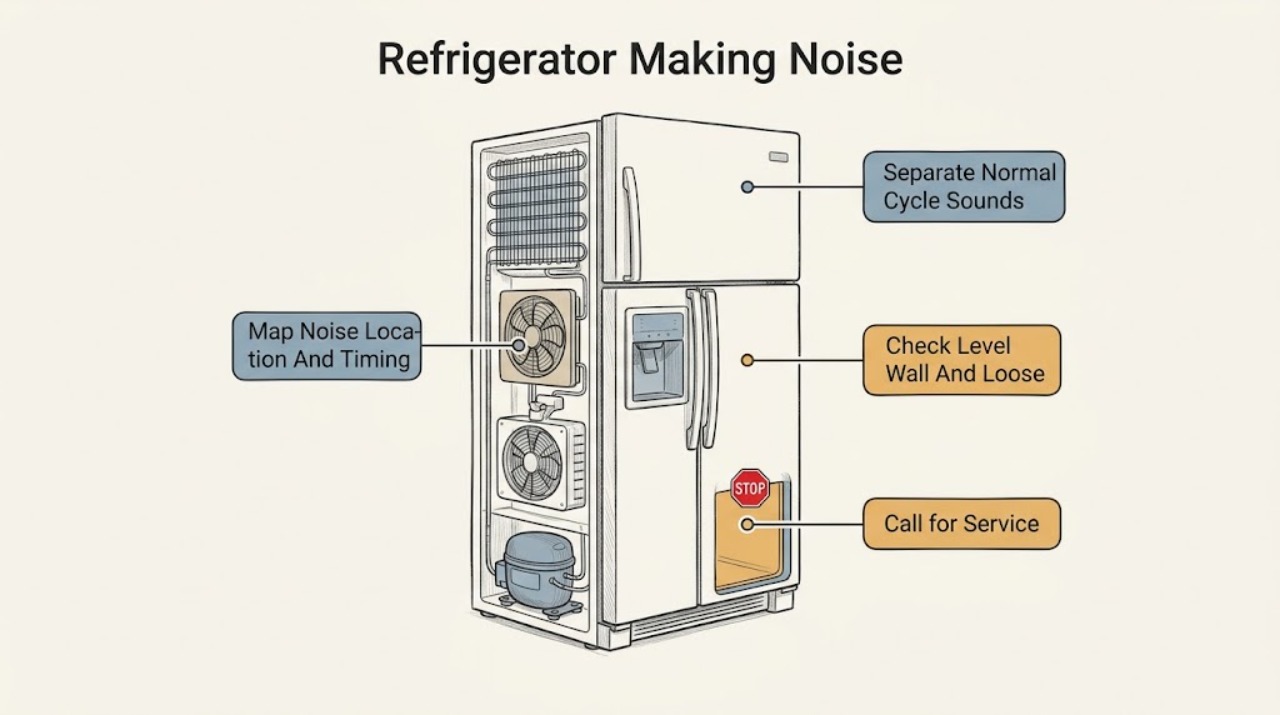
Describe the noise by location and timing before assuming a failed part. Frigidaire manuals identify refrigerant gurgling, fan airflow, defrost hissing or sizzling, ice dropping, water-valve buzzing, dispenser clicks, and compressor hum or pulsation as possible operating sounds; a brief pop or crack when the compressor starts can also come from metal expansion or refrigerant circulation. A rattle that changes when the cabinet is leveled, moved clear of a wall, or loose items are removed is more likely resonance. Check that doors close and seal, vents are not blocked, and frost or an ice-chute flap is not interfering. If the noise is continuous grinding or scraping, comes with poor cooling, a leak, burnt smell, sparks, abnormal heat, or repeated breaker trips, stop using the refrigerator and arrange model-specific service. Do not remove fan, compressor, control, or sealed-system covers.
Before you begin
Safety first
- Owner checks are limited to external sound classification, cabinet contact, door/gasket and visible vent checks, and model-approved ice-bin handling with the ice maker off and power disconnected. Fan, compressor, valve, drive, control, wiring, defrost, and sealed-system work requires qualified service.
Work through in order
Diagnostic checks
Use only checks that match the exact appliance or system and its official guide.
-
Check 1
Without touching the appliance interior, note whether the sound is from the rear/bottom, inside the freezer, near a door or dispenser, or from the cabinet. Record whether it occurs at compressor start, during defrost, while making or dispensing ice, when a door moves, or continuously between cycles.
Expected result: The sound is brief and cycle-linked; happens only during ice dispensing; changes with door movement or cabinet vibration; or is continuous, harsh, and localized.
Next step: Use the matching branch below and confirm the complete model before applying a control sequence or removing a bin.
Stop if: Stop listening and isolate the refrigerator from a safe location if there is smoke, a burnt smell, sparking, a hot cord or cabinet, an active leak near electrics, or a breaker trip.
Why this matters
Why: Cycle-linked sounds fit normal compressor, fan, defrost, ice-maker, valve, or dispenser operation more closely. Dispensing-only sounds narrow toward the chute/bin/auger. Door or cabinet changes point toward contact, gasket, leveling, or loose items. Continuous grinding or scraping is an abnormal-mechanical branch.
-
Check 2
For a brief sound, compare its timing with normal operation: refrigerant or fan airflow, compressor hum or pulsation, defrost hissing/popping, ice-maker fill/harvest/ice-drop, water-valve buzz, or dispenser clicks. Observe only from outside the closed mechanism; do not hold a door switch or reach toward a fan, auger, or chute.
Expected result: The sound is brief and repeats only at one normal cycle stage; it is a new sound between cycles; or it has changed to grinding, scraping, repeated hard impact, or electrical crackling.
Next step: If the sound is brief and there is no symptom such as poor cooling or a leak, monitor it. Otherwise continue to the cabinet, door, and ice-bin checks without opening the appliance.
Stop if: Do not diagnose a motor, fan, compressor, valve, or control by touching it while energized.
Why this matters
Why: A repeatable, brief cycle sound is consistent with the operating mechanisms documented by Frigidaire. A changed or continuous harsh sound is less likely to be normal and needs external checks followed by service if it remains.
-
Check 3
Check from outside whether the refrigerator rocks, touches a wall or cabinet, has objects on top, or has bottles, shelves, or containers that can resonate inside. If a safe small repositioning is possible without pulling on water tubing, clear the contact and use the model's leveling adjustment only as directed.
Expected result: The rattle changes or stops after leveling/clearance; a loose object was the source; or the rattle remains localized after the cabinet is stable and clear.
Next step: Leave the cabinet stable and clear if the noise normalizes. If it persists, arrange service rather than removing rear covers or mounting hardware.
Stop if: Do not move the refrigerator far enough to kink or strain the water line, and do not reach behind an energized appliance.
Why this matters
Why: Uneven floors, wall contact, top objects, and loose contents can amplify normal vibration. A persistent localized rattle after those conditions are corrected makes a fan, compressor mount, ice-maker drive, or another internal mechanical issue more likely.
-
Check 4
Check that every door and drawer closes fully, nothing is blocking it, the gasket is clean and contacting the cabinet, freezer vents are not blocked by food, and visible frost is not interfering with a vent or ice-chute flap. Do not remove interior panels or scrape hidden frost.
Expected result: A door or drawer is obstructed, the gasket does not seal, vents are blocked, frost is present, the ice-chute flap is held open, or the door/airflow path is clear.
Next step: Remove only the external obstruction and clean the gasket with the model-approved method. If heavy frost, a damaged gasket, or a flap that will not close remains, stop and arrange service.
Stop if: Do not chip frost with a sharp tool, use a heat gun, defeat a door switch, or remove a fan cover.
Why this matters
Why: Door leakage, blocked vents, frost, and a chute flap that cannot close can change airflow and make fans or the compressor run harder; they can also create new rubbing or air noise. A clear, sealed cabinet makes an internal fan or control issue more likely if the sound continues.
-
Check 5
If the noise occurs only when ice is dispensed or after long periods without use, turn the ice maker off and disconnect power before removing the storage bin as the exact manual shows. Look for fused cubes, loose chips, moisture, a damaged bin, or an auger/bin that does not seat correctly; clean and dry only the owner-removable parts.
Expected result: Cubes are clumped or frozen around the auger, the bin is wet or damaged, the auger/bin is not seated, or the bin and visible chute are clear and correctly fitted.
Next step: Refit the fully dry bin and perform one brief supervised test only if there is no hazard. If the noise returns, stop dispensing and arrange service.
Stop if: Never use a knife, ice pick, screwdriver, or force to break ice; never reach into a powered auger or chute.
Why this matters
Why: Clumped ice or a mis-seated bin can load the dispenser and explain a dispensing-only rattle. A clear, correctly seated bin with persistent noise makes the drive, chute actuator, or another internal mechanism more likely.
-
Check 6
After correcting only the external resonance, door/airflow, or owner-removable ice-bin condition, run one brief supervised cycle with all covers and bins correctly fitted. Note whether the sound is now brief and cycle-linked and whether cooling, door sealing, ice production, and dispensing remain normal.
Expected result: The noise stops or becomes a documented brief cycle sound; the refrigerator cools but the harsh sound returns; cooling or ice production is abnormal; or an electrical, leak, or heat warning appears.
Next step: Leave a repeat-fault refrigerator off when safe to do so and arrange Frigidaire or qualified appliance service with the full model, location/timing, and related symptoms.
Stop if: Do not continue cycling power or operating after smoke, sparking, burnt odor, water near electrical parts, abnormal heat, exposed wiring, or repeated breaker trips.
Why this matters
Why: Improvement after an external correction supports resonance, door/airflow, or bin loading. Persistent harsh noise or a combined cooling/ice symptom points to an internal fan, motor, valve, control, compressor, defrost, or sealed-system issue.
Use your observations
Decision map
Find the observation that best matches what you see, then follow the next safe action.
-
PATH 01Safety boundary
What you see
The sound is brief and tied to compressor start, refrigerant flow, fan airflow, defrost, ice-maker fill/harvest/drop, water-valve action, or dispenser operation, with normal cooling and no hazard.
Do this next
Monitor the timing and character. Reassess if it becomes continuous, harsh, louder, or associated with poor cooling, frost, a leak, or an electrical symptom.
Why this path and its safety boundary
Why it matters: This pattern matches normal operating mechanisms described in Frigidaire manuals more closely than a failed component.
Safety stop: Stop using the refrigerator for smoke, sparking, burnt smell, abnormal heat, active leak near electrical parts, or a repeated breaker trip.
-
PATH 02Safety boundary
What you see
The rattle changes when the refrigerator is leveled, moved clear of a wall/cabinet, or loose objects are removed from the top or interior.
Do this next
Keep the cabinet stable and clear, without stressing water tubing. Use service if the sound returns while the cabinet remains stable.
Why this path and its safety boundary
Why it matters: External resonance or contact is more likely than a failed ice-maker or compressor part.
Safety stop: Do not pull the refrigerator out by its water line or remove rear covers to chase a vibration.
-
PATH 03Safety boundary
What you see
A door or drawer does not seal, a gasket is dirty/damaged, vents are blocked, frost is present, or an ice-chute flap cannot close, and fan or compressor behavior changed.
Do this next
Clear only external obstructions and clean the gasket as directed. Escalate heavy frost, a damaged seal, or persistent fan noise after the cabinet is clear.
Why this path and its safety boundary
Why it matters: Air leakage or restricted airflow can create frost and make the cooling system work harder, producing more noticeable airflow or vibration.
Safety stop: Do not scrape frost, defeat door switches, or disassemble the evaporator/fan area.
-
PATH 04Safety boundary
What you see
The sound occurs only when dispensing and the bin contains clumped ice, moisture, loose chips, or an auger/bin that does not seat correctly.
Do this next
Turn the ice maker off, disconnect power, and follow the exact manual to clean, dry, and refit the owner-removable bin. Stop dispensing if the sound returns.
Why this path and its safety boundary
Why it matters: A loaded or mis-seated storage-bin and auger path is more likely than a refrigerator-wide fan or compressor fault.
Safety stop: Do not use sharp tools or force a jammed auger/chute.
-
PATH 05Safety boundary
What you see
Grinding, scraping, repeated hard impacts, or electrical crackling persists after external checks, or the sound is accompanied by poor cooling, recurring frost, a leak, burnt smell, sparks, abnormal heat, exposed wiring, or breaker trips.
Do this next
Stop using the refrigerator and arrange qualified Frigidaire appliance service with the model and sound recording/description. Protect perishable food separately if cooling is affected.
Why this path and its safety boundary
Why it matters: An internal fan, motor, valve, drive, control, defrost, compressor, wiring, or sealed-system fault is more likely and cannot be identified safely from sound alone.
Safety stop: Do not operate through an electrical or water hazard, bypass protection, perform live tests, or open the sealed system.
Helpful context
Understand the symptom
A refrigerator can make several normal sounds
The useful clue is when and where the sound occurs. Refrigerant can gurgle, fans can move air, the defrost system can hiss or pop, the compressor can hum or pulsate, and the automatic ice maker can buzz, run, loosen ice, let water flow, or drop cubes. A brief sound tied to one of those cycles is different from a new sound that continues between cycles or is accompanied by a cooling or electrical symptom.
Start with resonance and the door seal
A level refrigerator that touches a wall or has loose items on top or inside can turn a modest operating sound into a loud rattle. A door that does not close, a dirty or damaged gasket, blocked vents, frost, or an ice-chute flap held open can also change airflow and fan behavior. These are external checks; they do not justify removing the rear cover or fan shroud.
Ice-making and dispensing are separate events
A short water-valve buzz or cubes dropping into the bin belongs to ice production. A click or rattle only when dispensing points instead to the chute, clumped cubes, storage bin, or auger. If the model allows the bin to be removed, turn the ice maker off and follow that model's cleaning and refitting instructions; keep hands and tools away from a powered mechanism.
When a noise becomes a service symptom
A continuous grind, scrape, repeated hard impact, or electrical sound is not identified by the brand name alone. The combination with poor cooling, recurring frost, a water leak, burnt odor, sparking, abnormal heat, or a tripping breaker raises the urgency. Stop using the appliance and give the technician the model, sound timing, location, and any temperature or ice symptoms.
Safety boundary
Stop conditions
- Stop operation and isolate power from a safe location for smoke, sparking, burnt smell, abnormal heat, exposed wiring, water near electrical parts, damaged cord, or repeated breaker trips.
- Turn the ice maker off and disconnect power before removing or cleaning an owner-removable ice bin; keep hands and tools away from powered fans, augers, chutes, and dispenser mechanisms.
- Do not chip frost with sharp tools, use heat to defrost, defeat door or safety switches, move the cabinet by its water tubing, or remove rear/interior covers.
- Do not perform live electrical tests, open the compressor or sealed refrigerant system, replace an internal motor/valve/control from sound alone, or bypass protective devices.
When checks do not resolve it
Need a professional?
Arrange Frigidaire or qualified appliance service when grinding, scraping, repeated hard impacts, or abnormal electrical noise persists after safe external checks; when the refrigerator also has poor cooling, recurring frost, a leak, or ice/dispenser failure; or immediately for smoke, sparks, burnt smell, abnormal heat, exposed wiring, water near electrical parts, or repeated breaker trips.
Safety scope: Owner checks are limited to external sound classification, cabinet contact, door/gasket and visible vent checks, and model-approved ice-bin handling with the ice maker off and power disconnected. Fan, compressor, valve, drive, control, wiring, defrost, and sealed-system work requires qualified service.
Common questions
FAQ
What refrigerator noises are normal on a Frigidaire?
Frigidaire manuals describe fan airflow, compressor hum or pulsation, refrigerant gurgling, defrost hissing or popping, ice-maker motor and ice-drop sounds, water-valve buzzing, and dispenser clicks as possible operating sounds. A brief sound tied to a cycle is less concerning than a continuous grind, scrape, or electrical sound.
Why does my Frigidaire refrigerator rattle?
Check whether the cabinet rocks, touches a wall, has objects on top, or contains loose items that resonate. Frigidaire recommends those checks for vibration or rattling. If the sound remains localized after the cabinet is stable and clear, use service rather than removing a fan or compressor cover.
Is a pop or crack when the compressor starts dangerous?
Frigidaire says popping or cracking when a freezer compressor comes on can result from metal expansion and contraction or refrigerant circulation, and it may lessen as the freezer runs. Treat a new continuous crackle, grinding sound, burnt odor, heat, or poor cooling as a service symptom instead.
Why is the noise only heard when dispensing ice?
A dispensing-only rattle can come from fused cubes, loose chips, moisture, a damaged storage bin, or an auger/bin that is not seated. Turn the ice maker off, disconnect power, and follow the exact manual to clean, dry, and refit the bin. Never use a sharp tool or force the auger.
Can a door seal or frost cause refrigerator noise?
Yes. Frigidaire identifies a door or gasket that does not seal, blocked vents, frost, and an ice-chute flap that cannot close as conditions that affect airflow and refrigerator operation. Clear external obstructions and check the gasket, but do not scrape frost or remove fan panels.
When should I stop using a noisy Frigidaire refrigerator?
Stop for grinding or scraping that persists, repeated hard impacts, smoke, sparks, a burnt smell, abnormal heat, a water leak near electrical parts, exposed wiring, repeated breaker trips, or noise combined with poor cooling. Arrange qualified service and provide the model, noise timing/location, and related symptoms.
Read the exact guide
Official sources
- Is it normal to hear a popping or cracking sound when the freezer motor (compressor) comes on?Frigidaire · Opened Frigidaire owner-support article applying to freezers; used for the compressor-start sound explanation, not as a diagnosis of every refrigerator noise.
- Is it normal for my freezer to make vibrating or rattling sounds?Frigidaire · Opened Frigidaire owner-support article applying to freezers and refrigerators; it does not identify internal component failure.
- Refrigerators / Freezer - Frost Build UpFrigidaire · Opened Frigidaire owner-support article for refrigerators; used for external door/airflow/frost checks rather than internal fan repair.
- Frigidaire Refrigerator User Manual (A29030501)Frigidaire · Opened Frigidaire manual for a specific refrigerator family; its controls and layout are not assumed for every Frigidaire refrigerator.
- Refrigerator Door IssuesFrigidaire · Opened Frigidaire owner-support article applying to refrigerators; used only for safe external door and gasket inspection.
- Frigidaire Refrigerator User Manual (A19894606)Frigidaire · Opened Frigidaire manual for a specific refrigerator family; used for documented mechanisms and safety instructions, not universal button sequences or part fit.
Community feedback
Share a repair observation
Share a plain-text repair observation. Accepted observations are published automatically; this page may take a moment to update.