
On this page
Start here
Quick answer
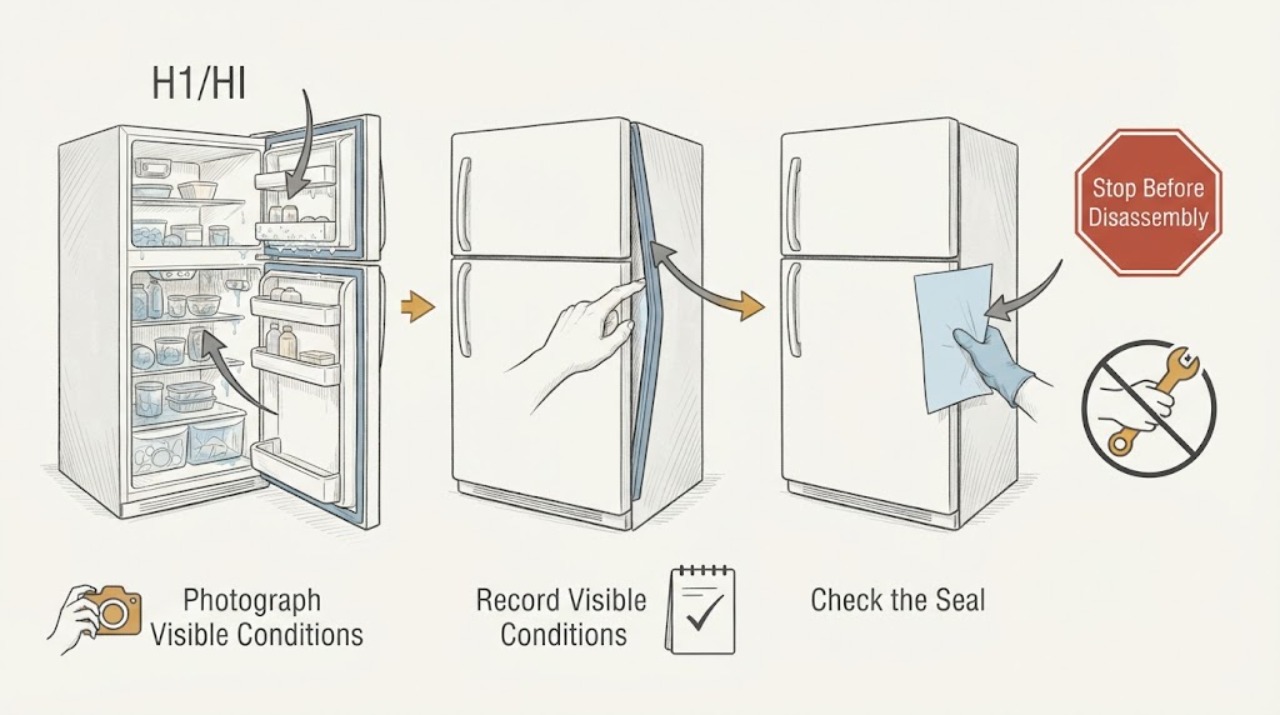
For the Frigidaire FFSS2614QS6A, do not treat H1 as a promise of a fixed recovery time. The display may be a visual reading of HI, which Frigidaire describes as a high-temperature alarm, but the exact characters and which compartment is alarming should be recorded first. Frigidaire's published recovery reference is about 24 hours for temperature stabilization after installation or a power outage, not a guarantee that a refrigerator with an active cooling fault will recover. Keep the doors closed, use an appliance thermometer, and judge progress by the measured refrigerator and freezer temperatures. If the refrigerator has not returned to a safe temperature or is still not cooling after 24 hours of normal operation, arrange service. Move or protect perishable food promptly when it has been above 40°F for too long.
Work through in order
Diagnostic checks
Use only checks that match the exact appliance or system and its official guide.
-
Check 1
Before acknowledging the alarm, photograph the panel and transcribe every character exactly, including whether it looks like H1 or HI, which compartment display shows it, whether it flashes, and whether an audible alarm is present.
Expected result: The display clearly shows H or HI, appears to show H1, or is too ambiguous to read; the refrigerator side, freezer side, or both are affected.
Next step: Keep the photo with the model and temperature log. Use the exact FFSS2614QS6A manual or service path if the characters do not clearly match H or HI.
Why this matters
Why: Frigidaire's official H or HI article defines a high-temperature alarm, but a visually ambiguous final character and an unknown affected compartment should not be converted into a different code or part diagnosis.
-
Check 2
Place an appliance thermometer in the fresh-food compartment and another in the freezer if available, then record the starting temperatures and the time without repeatedly opening the doors.
Expected result: The refrigerator is at or below 40°F, the freezer is at or below 0°F, both are above target but falling, or one compartment is warm while the other is near target.
Next step: Keep doors closed and continue the log. If temperatures are flat or worsening, or the 24-hour checkpoint passes without cooling, schedule refrigerator service instead of guessing a component.
Why this matters
Why: Measured temperature is the useful recovery signal. Frigidaire's suggested electronic settings are 37°F for fresh food and 0°F for the freezer; a display alarm can remain a high-temperature record even while the temperature is falling.
-
Check 3
Make only external checks: confirm the doors close fully, the visible gasket contacts the cabinet, food is not blocking interior air vents, and the refrigerator is not installed in an environment below 55°F.
Expected result: A door was left open, the gasket has a visible gap or obstruction, vents are blocked by food, the room is below the recommended minimum, or none of these conditions is present.
Next step: Correct only an accessible door, gasket-surface, loading, or environmental condition, then continue temperature monitoring. If the temperature remains high, arrange service.
Why this matters
Why: Frigidaire lists extended door opening, poor sealing, restricted airflow, and unsuitable ambient temperature as accessible context for unstable or warm temperatures. These observations do not prove an internal cooling part has failed.
-
Check 4
Check the external power state only when the plug and outlet are cool and dry: note whether interior lights and the control display are on, and whether a recent outage or breaker event occurred; do not probe the outlet or repeatedly cycle the breaker.
Expected result: The display and lights are normal after an outage, power is intermittent, the outlet or cord is hot or damaged, or power appears normal but cooling is not returning.
Next step: For an abnormal power path, stop use and obtain qualified electrical or appliance service. Otherwise preserve the outage timeline and continue the measured-temperature decision path.
Why this matters
Why: A power event can precede a high-temperature alarm, but normal lights do not prove that the cooling system is working. Heat, arcing, damage, or repeated trips are electrical safety symptoms.
-
Check 5
Use 24 hours of normal operation as a stabilization checkpoint only when the appliance has power, the doors are closing, and the measured temperatures are trending downward; do not keep clearing an alarm or changing settings to force a result.
Expected result: Both compartments reach their safe ranges, temperatures are still falling but above target, one compartment remains warm, or there is no meaningful cooling after 24 hours.
Next step: If temperatures are safe and stable, retain the log and watch for a returning alarm. If a compartment remains unsafe, the alarm returns, or cooling is absent, arrange service and provide the complete evidence record.
Why this matters
Why: Frigidaire's 24-hour guidance is a recovery reference after installation or outage, while its not-cooling guidance says to schedule service when the unit has run 24 hours and still does not cool. It cannot distinguish a specific cooling component without professional diagnosis.
Use your observations
Decision map
Find the observation that best matches what you see, then follow the next safe action.
-
PATH 01Next step
What you see
The display is H or HI, both compartments are cooling, and measured temperatures steadily approach the recommended ranges after a documented outage or long door opening.
Do this next
Keep doors closed, continue the temperature log, and use only the exact model manual's alarm acknowledgement once the temperatures are safe.
Why this path and its safety boundary
Why it matters: A high-temperature alarm can be the record of the earlier warm condition; the 24-hour period is a stabilization checkpoint rather than proof of a repair.
-
PATH 02Next step
What you see
The display looks like H1 but cannot be confirmed as H or HI, or the alarm is on only one compartment.
Do this next
Preserve the panel photo, complete model, affected compartment, and measured temperatures, then use the exact manual or arrange qualified service.
Why this path and its safety boundary
Why it matters: The visual code and platform context are incomplete; the alarm cannot safely identify a damper, fan, sensor, compressor, or other part.
-
PATH 03Next step
What you see
After 24 hours of normal operation the refrigerator remains above 40°F, the freezer is not near its target, temperatures are flat or rising, or the alarm returns.
Do this next
Protect perishable food, stop repeated resets or setting changes, and schedule qualified refrigerator service without removing panels or testing live circuits.
Why this path and its safety boundary
Why it matters: This exceeds the manufacturer recovery checkpoint and is no longer a wait-for-stabilization question; an unresolved cooling condition needs diagnosis.
-
PATH 04Next step
What you see
Perishable food has been above 40°F for more than two hours, or its time and temperature history cannot be established.
Do this next
Follow FoodSafety.gov guidance for the affected food, move safe food to a working refrigerator or cooler, and keep the appliance temperature log for service.
Why this path and its safety boundary
Why it matters: Food safety takes priority over waiting for the refrigerator to recover; appearance, odor, or a cleared alarm cannot prove safety.
-
PATH 05Next step
What you see
The cord or outlet is hot or damaged, there is smoke or arcing, or the breaker trips again.
Do this next
Stop using the refrigerator and obtain qualified electrical or appliance service; do not open covers or perform live measurements.
Why this path and its safety boundary
Why it matters: The immediate issue is an electrical hazard, not a high-temperature reset.
Helpful context
Understand the symptom
What H1 or HI tells you
Frigidaire's official alarm article is titled H or HI - High Temperature and applies to all refrigerators. If the display looks like H1, photograph it before pressing buttons because the final character can be read differently on a segmented display. The alarm says the measured or sensed temperature is high; it does not identify a compressor, fan, damper, sensor, or other part.
How long to wait
Use 24 hours as Frigidaire's stabilization checkpoint after installation or a power outage. It is not a guarantee that an actively failing refrigerator will cool in 24 hours. During that period, keep the doors closed, avoid repeated setting changes, and log actual temperatures in both compartments. A temperature that is steadily falling is different from a temperature that is flat or rising.
Protect food while it recovers
Use an appliance thermometer rather than relying on the display or touching food. FoodSafety.gov recommends a refrigerator at 40°F or below and a freezer at 0°F or below. If perishable food has been above 40°F for more than two hours, follow the food-safety disposal guidance; do not taste food to decide whether it is safe.
When checks do not resolve it
Need a professional?
Arrange qualified refrigerator service if the unit has run for 24 hours without cooling, a compartment remains above a safe temperature, H or HI returns after recovery, the exact display cannot be identified, or the appliance has smoke, arcing, a hot or damaged cord/outlet, or repeated breaker trips. Protect perishable food immediately when measured temperature and time exceed food-safety limits.
Have this ready
- Complete model and serial label, panel photo, exact display and affected compartment, outage or door-open timeline, starting and follow-up temperatures in both compartments, door/gasket and airflow observations, and any food-safety or electrical symptoms.
Common questions
FAQ
Is H1 the same as HI on a Frigidaire FFSS2614QS6A?
Frigidaire's official article defines H or HI as a high-temperature alarm. If the segmented display looks like H1, preserve a photo and confirm the exact model manual rather than assuming the final character.
Does 24 hours guarantee that the refrigerator will be cold again?
No. Frigidaire uses about 24 hours as a temperature-stabilization reference after installation or a power outage, and its not-cooling guidance says to schedule service if the unit has run 24 hours and still does not cool.
What temperature should I use to decide whether food is safe?
Use an appliance thermometer. FoodSafety.gov recommends a refrigerator at 40°F or below and a freezer at 0°F or below; follow its guidance for perishable food that has been warmer than 40°F for too long.
Read the exact guide
Official sources
- Where can I find my model and serial number?Frigidaire · The opened page says a side-by-side refrigerator model number is visible along the upper right side of the fresh-food compartment when the door is opened.
- Freezer - Not Freezing or Not CoolingFrigidaire · The opened page applies to freezers and refrigerators with freezers; it states a 24-hour stabilization reference after installation or outage, suggested settings, external door/seal/airflow checks, and service when cooling does not return.
- Refrigerators - What is the recommended temperature settings for my refrigerator?Frigidaire · The opened page applies to refrigerators, French Door, Side by Side, and Top Freezer refrigerators and states about 24 hours for temperature stabilization.
- Refrigerator Error Code H or HI - High TemperatureFrigidaire · The opened page applies to all refrigerators and states that H or HI is a high-temperature alarm, with possible door, setting, or gasket context and model-dependent acknowledgement.
- 4 Steps to Food SafetyFoodSafety.gov · The opened government guidance states that refrigerators should be 40°F or below and freezers 0°F or below, and gives the two-hour perishable-food boundary.
Community feedback
Share a repair observation
Share a plain-text repair observation. Accepted observations are published automatically; this page may take a moment to update.