
On this page
Start here
Quick answer
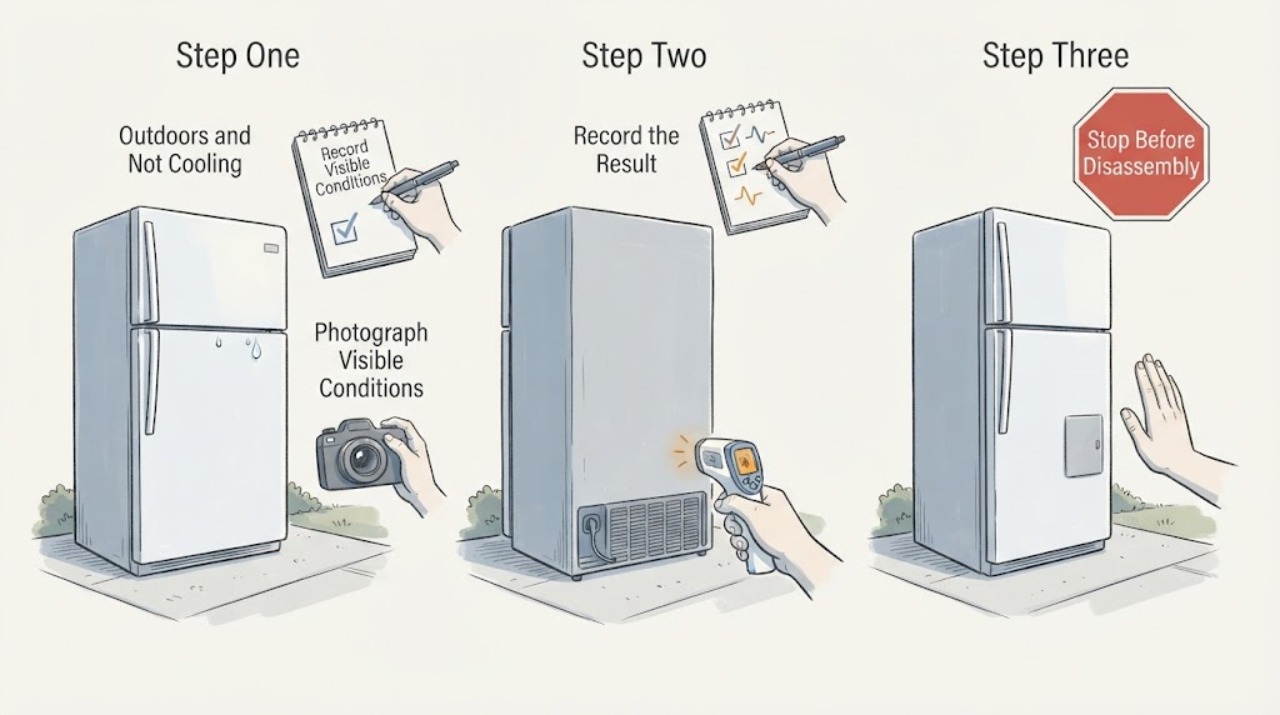
Do not recharge or open the sealed system of a Frigidaire FFRU17B2QWD outdoors without a qualified refrigeration technician. First confirm the complete nameplate model: the Tennessee Department of Health list names FFRU17B2QWD, while the Frigidaire owner-support and specification documents opened here identify the closely related base model FFRU17B2QW, not the full D suffix. That Frigidaire family material says the refrigerator is intended for surrounding air up to 110°F and identifies R-134 on the QW support record, but those values must not be assumed for the D suffix until its own label/manual confirms them. From a safe position, record the room temperature, refrigerator temperature, power, door seal, clearance, and whether the compressor or fan runs. Keep food at or below 40°F or move it to a known-safe appliance. An outdoor location and a suspected R-134 leak are not proof of a leak or a reason to add gas: refrigerant recovery, leak detection, evacuation, charging, and any tubing work belong to qualified service, and EPA prohibits intentional venting.
Work through in order
Diagnostic checks
Use only checks that match the exact appliance or system and its official guide.
-
Check 1
Protect food first and measure the refrigerator with an appliance thermometer from a dry, safe position. Record the cabinet temperature, the time of measurement, whether the door stayed closed, and whether food has been above 40°F. Do not taste questionable food or use appearance and odor as the safety test.
Expected result: The refrigerator is at or below 40°F, above 40°F for a known short interval, above 40°F for four hours or more, or the exposure time is unknown.
Next step: Move perishable food to a known-safe refrigerator or cooler and follow FDA food-safety guidance when the temperature is unsafe or uncertain. Continue appliance checks only with the refrigerator empty or food protected.
Stop if: Do not keep food in the unit while waiting for a refrigerant diagnosis, and do not taste food to decide whether it is safe.
Why this matters
Why: A measured temperature separates a cooling complaint from a food-safety emergency. FDA says the refrigerator should be at or below 40°F and that perishable food held above 40°F for four hours or more should be discarded; unsafe food can look and smell normal.
-
Check 2
Read and photograph the complete rating-plate identity, including FFRU17B2QWD, any suffix or revision, serial number, refrigerant marking, voltage, and market. Compare it with the Frigidaire manual or service record for that exact identity; do not rely on a seller description or the family name alone.
Expected result: The label clearly says FFRU17B2QWD and provides a matching manual, the label only shows a base or similar FFRU17B2QW identity, or the label is unreadable or missing.
Next step: Send the complete label and market to Frigidaire or a qualified refrigeration technician. Until the D-suffix documentation is matched, do not assume the QW refrigerant or temperature limits apply.
Why this matters
Why: The government list confirms that FFRU17B2QWD exists as a refrigerator model, but Frigidaire's opened support documents identify the base QW record. A suffix or market mismatch prevents safe transfer of the R-134 charge, outdoor limit, wiring, or service procedure.
-
Check 3
From outside the cabinet, record the outdoor conditions: air temperature at the refrigerator, direct sun or rain exposure, dust around the visible rear vent, clearance from walls, and whether the unit is on a firm level surface. Do not pull the refrigerator out, remove a panel, or clean an internal coil while powered.
Expected result: The ambient temperature exceeds the matched manual's limit, the unit is in direct sun or rain, the rear clearance or visible airflow is restricted, or the installation conditions are within the documented range.
Next step: Only correct a plainly visible, safe placement issue without moving a heavy appliance or exposing wiring, then monitor temperature. If conditions are within the matched documentation and cooling remains poor, arrange service rather than adding refrigerant.
Stop if: Do not operate in rain or standing water, move the appliance by its cord or tubing, or work near a running fan or energized wiring.
Why this matters
Why: Frigidaire says garage suitability varies by model; its opened QW specification sheet limits surrounding air to 110°F, calls for air clearance, and says 32°F and below will not affect operation for that base model. An outdoor condition can reduce cooling performance without proving low refrigerant.
-
Check 4
With doors closed and no panels removed, note whether the interior light and control respond, whether the compressor or fan can be heard from outside, whether the sound cycles, and whether the cabinet is becoming unusually hot. Do not diagnose the sealed system by sound or touch a hot compressor, fan, or electrical connection.
Expected result: The unit is dark, the compressor or fan is silent, the compressor runs continuously without temperature recovery, or operation sounds normal but the measured temperature remains high.
Next step: Use only a dry, accessible outlet or breaker check if the connection is safe; otherwise arrange qualified service. Provide the measured temperature, outdoor conditions, and operating pattern instead of opening the cabinet or testing live components.
Stop if: Stop for smoke, burning smell, sparks, a hot or damaged cord or outlet, repeated breaker trips, or water near electrical parts.
Why this matters
Why: No response points first to power; a continuously running unit in an outdoor heat load may be working harder, while persistent warmth with normal documented conditions can involve airflow, control, compressor, defrost, or sealed-system faults. These observations do not identify a refrigerant leak.
-
Check 5
Look only through normal openings for a door or gasket gap, blocked internal airflow, heavy frost, or visible dust at an accessible external vent. Record whether the freezer or single refrigerator compartment is warm and whether the condition changes after a documented safe placement correction. Do not chip frost, puncture tubing, open the evaporator cover, or apply heat.
Expected result: The door seal has a visible gap, airflow is blocked, frost covers an accessible area, the exterior is clean and unobstructed, or the compartment remains warm after the visible issue is corrected.
Next step: Correct only the visible obstruction documented for the matched model and allow recovery. Arrange service if the temperature stays high, frost returns, or any check would require a panel or sealed-system access.
Stop if: Do not use a knife, hair dryer, open flame, chemical spray, or live electrical measurement on the refrigerator.
Why this matters
Why: A door leak, blocked airflow, frost, or outdoor dust can make cooling inefficient. A clear exterior with persistent high temperature leaves an internal fan, defrost, compressor, control, or sealed-system diagnosis for a technician.
-
Check 6
Treat the suspected R-134a leak as an unconfirmed service hypothesis. Record when cooling declined, any oil or tubing damage visible without opening the cabinet, prior repairs, and whether the unit was moved or exposed to weather. Do not attach gauges, add gas, vent refrigerant, pierce a process tube, braze, evacuate, or use a leak-dye or torch procedure.
Expected result: A qualified prior report identifies a leak and refrigerant type, only the owner suspects low charge from poor cooling, or the refrigerant identity is unknown or conflicts with the nameplate.
Next step: Request a written diagnosis that records the matched refrigerant, leak location, repair method, evacuation/charging result, and expected temperature outcome. Ask for a repair-versus-replace estimate based on the exact used appliance and verified fault.
Stop if: Do not buy a can of R-134a, top off an unknown system, or authorize a recharge without leak diagnosis and qualified refrigerant handling.
Why this matters
Why: Poor cooling alone cannot distinguish charge loss from ambient overload, airflow, compressor, control, defrost, or sealed-system faults. EPA treats adding/removing refrigerant, attaching gauges, and work that violates circuit integrity as technician activities, and prohibits intentional venting.
Use your observations
Decision map
Find the observation that best matches what you see, then follow the next safe action.
-
PATH 01Next step
What you see
The complete label is FFRU17B2QWD, the matched manual confirms the outdoor placement and refrigerant, and the refrigerator remains above the safe temperature after visible airflow and door checks.
Do this next
Arrange qualified refrigeration service for diagnosis, leak location if indicated, and a written repair-versus-replace estimate. Do not recharge or open the sealed system yourself.
Why this path and its safety boundary
Why it matters: A persistent no-cooling condition under documented environmental conditions is more consistent with a service-level cooling, control, compressor, or sealed-system fault than with outdoor placement alone. It still does not prove an R-134a leak.
-
PATH 02Next step
What you see
The unit is in direct sun or an ambient temperature outside the matched documentation, has restricted clearance or visible dust, and temperature improves after a safe visible placement correction.
Do this next
Keep the refrigerator within the exact manual's environment and clearance limits, monitor with a thermometer, and escalate if it cannot maintain temperature or the outdoor exposure cannot be controlled.
Why this path and its safety boundary
Why it matters: The environment or airflow is a plausible contributor, and improvement after correction is evidence against treating low refrigerant as the first conclusion. It does not prove the refrigerator is suitable for every outdoor condition.
-
PATH 03Next step
What you see
The label is only QW or otherwise incomplete, the D suffix cannot be matched to Frigidaire documentation, or the nameplate refrigerant conflicts with the assumed R-134 charge.
Do this next
Stop model-specific troubleshooting and provide the nameplate to Frigidaire or a qualified technician. Keep the refrigerator within safe food temperatures and do not order a refrigerant, compressor, evaporator, or control from the incomplete identity.
Why this path and its safety boundary
Why it matters: The exact model, market, or refrigerant scope is unresolved. The Frigidaire QW support record cannot safely establish the D-suffix charge or outdoor limit, and a seller or community description cannot fill that gap.
-
PATH 04Next step
What you see
Food temperature is above 40°F for four hours or more, exposure time is unknown, or the unit has smoke, burning odor, a hot cord, water near electrics, or repeated breaker trips.
Do this next
Move or discard food under FDA guidance, isolate the refrigerator from a dry safe position, and obtain qualified appliance or electrical service. Do not restart it to collect more cooling evidence.
Why this path and its safety boundary
Why it matters: Food safety and electrical safety take priority over deciding whether a recharge is economical. Appearance or smell cannot establish that food is safe, and a hazard makes continued operation unsafe.
Helpful context
Understand the symptom
The exact identity needs care. A Tennessee Department of Health storage guide lists Frigidaire FFRU17B2QWD as a refrigerator model, but the Frigidaire support page, product specification sheet, and owner guide opened for this research use the base FFRU17B2QW. Treat the D suffix as unconfirmed until the appliance label and matching regional manual agree. That matters for temperature limits, refrigerant, service data, and parts.
Outdoor placement can add heat load, dust, sun, rain, and unstable temperatures, but it does not establish a refrigerant leak. Frigidaire's garage guidance says models vary, and the opened QW specification sheet gives an ambient ceiling and clearance guidance for that base family. A warm cabinet, continuous running, or no frost pattern can support a service hypothesis only after temperature and airflow evidence are recorded.
Only after diagnosis
Potential parts
- sealed-system leak repair or evaporator assembly
Consider only after a qualified technician verifies the refrigerant identity, locates a leak, and provides a repair estimate; poor cooling alone does not select an evaporator or leak repair.
Confirm the full model, market, nameplate refrigerant, and current parts/service documentation before ordering. - compressor or compressor control component
Consider only if professional testing distinguishes compressor or start/control failure from ambient overload, airflow, defrost, and refrigerant loss.
A used-appliance repair decision should include a written diagnosis and estimate; do not select this class from a warm cabinet or outdoor placement alone.
When checks do not resolve it
Need a professional?
Arrange qualified refrigeration service when FFRU17B2QWD remains warm after the exact model, ambient conditions, clearance, door seal, visible airflow, and power are verified; when a sealed-system leak is suspected; or when the repair estimate must be compared with the value of a used appliance. Ask for refrigerant identification, leak location, repair method, and post-repair temperature verification in writing. EPA requires certification for work that can release refrigerant, including attaching gauges or adding/removing refrigerant, and prohibits intentional venting. Stop immediately for smoke, sparks, burning odor, a hot or damaged cord, water near electrical parts, repeated breaker operation, rain or standing water around electrical connections, or food held at unsafe temperature. Do not add R-134a, vent gas, pierce tubing, braze, evacuate, recharge, remove panels, or perform live tests.
Common questions
FAQ
Can I recharge the Frigidaire FFRU17B2QWD with R-134a?
Do not do this yourself. The opened Frigidaire support record lists R-134 for the related FFRU17B2QW base record, but the D suffix and the nameplate control. EPA identifies adding or removing refrigerant and attaching gauges as certified technician work and prohibits intentional venting. A qualified technician should confirm the charge, locate the leak, repair it, and verify operation before charging.
Is the FFRU17B2QWD suitable for outdoor use?
Do not assume unrestricted outdoor use. Frigidaire says garage suitability varies by model. Its opened QW specification sheet gives a surrounding-air limit of 110°F and says temperatures at or below 32°F will not affect operation for that base model, but the D suffix still needs matching documentation. Protect the appliance from rain, standing water, direct sun, dust, and out-of-range temperatures while obtaining the exact manual.
How do I know whether food in the warm refrigerator is safe?
Use a thermometer, not smell or appearance. FDA advises keeping a refrigerator at or below 40°F and discarding refrigerated perishable food that has been above 40°F for four hours or more. If the exposure time or temperature is unknown, move the food to a known-safe appliance and follow FDA guidance.
Read the exact guide
Official sources
- Stationary Refrigeration - Prohibition on Venting RefrigerantsU.S. Environmental Protection Agency · Opened EPA refrigerant-venting guidance for the professional safety boundary; it does not identify a leak or authorize a repair procedure for this model.
- Are You Storing Food Safely?U.S. Food and Drug Administration · Opened FDA consumer food-safety guidance for temperature and exposure decisions while the refrigerator is not cooling.
- Can my Frigidaire refrigerator be located in my garage?Frigidaire · Opened Frigidaire FAQ for general garage placement; it says models vary and directs users to the matching Use & Care Manual.
- Section 608 Technician Certification RequirementsU.S. Environmental Protection Agency · Opened EPA requirements for refrigeration service safety and certification; it does not diagnose this appliance or set the model's refrigerant charge.
- VFC Vaccine Storage Unit & Digital Data Logger GuidanceTennessee Department of Health · Opened government guidance for exact model identity only; the list is not a Frigidaire product manual, does not guarantee performance, and does not establish outdoor suitability or refrigerant charge.
- Product Support: Frigidaire 16.6 Cu. Ft. Single-Door Refrigerator White-FFRU17B2QWFrigidaire · Opened official Frigidaire Canada product-support record for the closely related base model; it is used to scope the family document and explicitly not to assume every D-suffix value.
- Frigidaire 134a Leak? Fix / Recharge - Budget Friendly Options HelpReddit r/appliancerepair · Opened exact Reddit post as a community symptom lead only; it contains unverified user assumptions and proposed work, not authoritative model specifications or a confirmed repair outcome.
- FFRU17B2QW 16.6 Cu. Ft. All Refrigerator SpecificationsFrigidaire · Opened official Frigidaire specification sheet for the QW base family; it supports the documented environment and clearance limits for that sheet, not an unverified transfer to every QWD suffix.
Community feedback
Share a repair observation
Share a plain-text repair observation. Accepted observations are published automatically; this page may take a moment to update.