
On this page
Start here
Quick answer
First separate a refrigerator with no power from one that has power but is warm. Frigidaire's guidance points to installation or recent power loss, temperature settings, a warm room, blocked vents, an open or poorly sealing door, and restricted rear airflow as user-visible causes. Check the refrigerator and freezer settings against the exact manual, clear food from internal vents, confirm doors close and gaskets seal, and allow the model's stabilization period after installation or an outage. Treat sections separately: a warm fresh-food compartment with a cold freezer can indicate an airflow or damper condition, while a warm freezer and fresh-food section together make shared power, condenser airflow, compressor, fan, defrost, or sealed-system service more likely. Frost, a blocked ice chute, or a gasket gap can also disturb airflow. Do not remove panels, test fans or compressors live, puncture tubing, or handle refrigerant. Stop for smoke, burning odor, a hot cord, water near electrical parts, repeated breaker trips, or food-safety risk and arrange qualified service.
Before you begin
Safety first
- The user may read settings, check normal power from a dry accessible position, clear visible food from vents, inspect door closure and gaskets, note frost, and review installation context. Rear-panel or evaporator access, fan/damper removal, live tests, compressor or wiring work, defrost repair, refrigerant handling, and sealed-system service belong to qualified technicians.
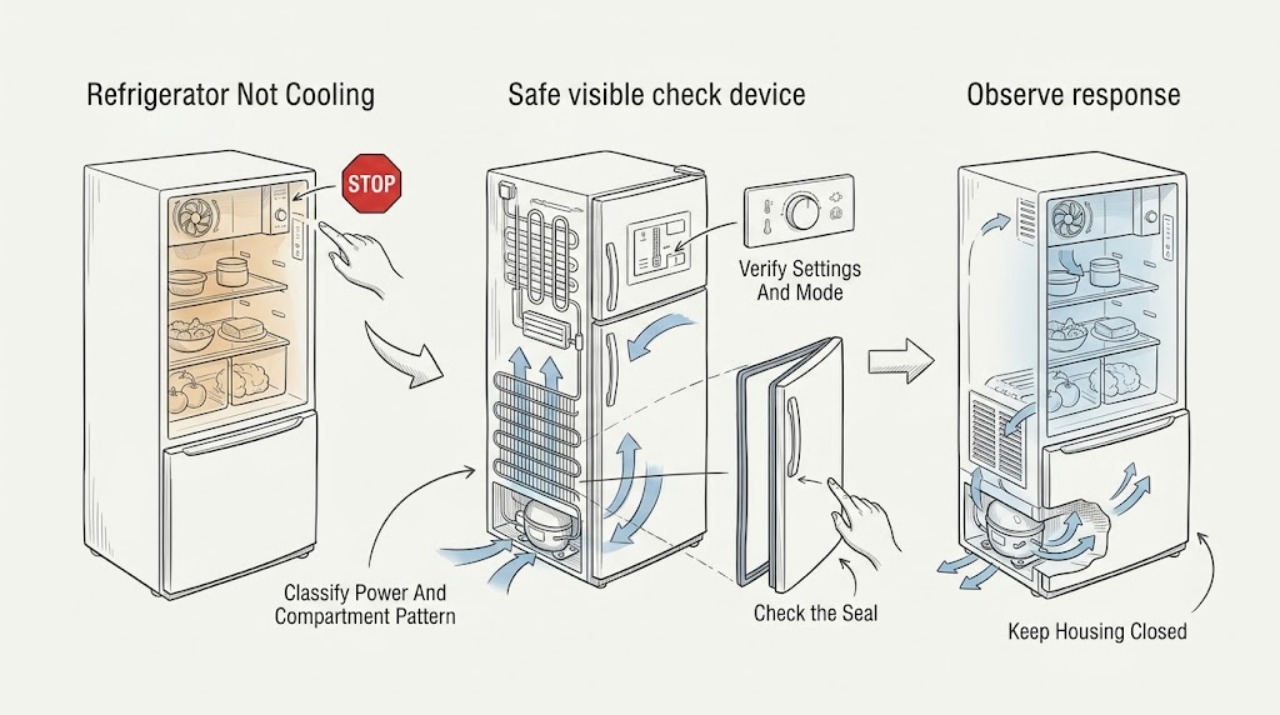
Work through in order
Diagnostic checks
Use only checks that match the exact appliance or system and its official guide.
-
Check 1
Check the refrigerator from normal user-facing points: interior light, display, compressor or fan sound from outside, and the relative temperature of the fresh-food and freezer sections. Do not open panels or place hands near fans.
Expected result: The appliance is dark or unresponsive; both sections are warm; only the fresh-food section is warm; or the freezer is cold while the refrigerator section is not.
Next step: For no power, use the safe power check. For a powered unit, record both compartment temperatures and continue with settings, vents, doors, and installation checks before seeking service.
Stop if: Do not remove an evaporator cover, reach into a fan, apply external power, or diagnose a compressor by sound alone.
Why this matters
Why: No response suggests shared power. Both sections warm makes shared cooling, airflow, or control problems more likely. One warm section makes internal airflow, frost, damper, sensor, or seal conditions more plausible, but does not identify a part.
-
Check 2
Read the refrigerator and freezer settings, display mode, and any temperature or power-outage indicator using the exact owner's manual. Compare the selected values with the model's recommended settings; do not make rapid extreme changes or rely on a code from another model.
Expected result: A control is set warmer than intended, a power-outage or demo-like state is shown, the settings are normal, or the display is unavailable.
Next step: Restore only a documented normal cooling setting and allow the model's stabilization period. If the display remains unavailable or the refrigerator cannot maintain temperature at normal settings, arrange service.
Stop if: Do not enter service mode, force a defrost, repeatedly reset controls, or change settings beyond the exact manual.
Why this matters
Why: An incorrect setting or model-specific mode can reduce cooling without a failed sealed system. A normal setting with a warm compartment shifts attention to airflow, door sealing, environment, or professional diagnosis.
-
Check 3
Inspect visible internal vents, door bins, the ice chute flap if present, door closure, and gaskets. Move food away from vents, remove an obstruction that prevents the door from closing, and clean a gasket with the model-authorized method. Look for frost that blocks airflow; do not chip it or remove panels.
Expected result: Food blocks a vent, the door or gasket has a gap, the ice chute is held open, frost is visible, or the visible airflow and seal appear normal.
Next step: Clear only the visible obstruction, close the chute and doors, clean and reseat the gasket as instructed, and allow time for the temperature to recover. Arrange service for heavy or recurring frost or persistent warmth.
Stop if: Do not use a knife, heat gun, hair dryer, chemical spray, or sharp tool on frost, gasket, vents, or tubing.
Why this matters
Why: Blocked airflow, warm-air leakage, an open ice chute, or frost can make one or both compartments warm. Clear, sealed visible areas make an internal fan, damper, defrost, sensor, or sealed-system issue more likely if temperatures remain high.
-
Check 4
Consider the recent context: installation, outage, door-open period, large warm-food load, hot room, or refrigerator pushed close to the wall. From a safe accessible position, confirm the appliance has the manual-required clearance and that a visible rear vent is not clogged. Do not move a built-in or pull a heavy refrigerator by its cord or water line.
Expected result: The unit is newly installed or recovering from power loss, the room is unusually warm, doors were opened frequently, the rear clearance or visible vent is restricted, or none of these conditions applies.
Next step: Follow the exact manual for installation clearance, remove only visible dust or obstruction that can be reached safely, and allow the documented stabilization period. Do not move the appliance or clean internal coils without model-specific instructions.
Stop if: Do not pull out a built-in refrigerator, disconnect water or power, remove rear panels, or work around a running condenser fan.
Why this matters
Why: Frigidaire says installation, outage recovery, warm environment, door use, and restricted rear airflow can lengthen runtime or delay temperature stabilization. If those conditions are absent and cooling is still poor, a hidden cooling fault is more likely.
-
Check 5
After the safe settings, vent, door, gasket, frost, installation, and environment checks, monitor only from outside. Note whether both sections remain warm, a single section remains warm, the compressor or fan runs continuously without recovery, frost returns, or a hazard is present. Do not restart to reproduce smoke, burning odor, or a breaker trip.
Expected result: Cooling returns after a visible correction, the appliance remains warm after stabilization, temperature loss is isolated to one compartment, or there is smoke, burning odor, hot cord, water near electrical parts, or repeated breaker operation.
Next step: Keep the refrigerator off for a hazard and arrange qualified appliance or electrical service. For persistent non-hazardous warmth, arrange model-specific diagnosis and provide the temperature pattern, settings, frost, door-seal, installation, and runtime observations.
Stop if: Do not open panels, test live circuits, probe sensors, handle refrigerant, or repeatedly reset a tripping breaker.
Why this matters
Why: Recovery after settings, airflow, or seal correction supports a user-visible cause. Persistent warmth after those checks may involve fan, damper, defrost, sensor, control, compressor, or sealed-system work. A hazard makes continued operation unsafe.
Use your observations
Decision map
Find the observation that best matches what you see, then follow the next safe action.
-
PATH 01Safety boundary
What you see
The refrigerator has no interior light, no display, and no response, or shows a recent power-outage indication.
Do this next
Check the accessible dry plug, outlet, and refrigerator breaker or fuse; restore power only when all are undamaged. Allow the model's stabilization period after power returns and arrange service if the breaker trips again or the unit remains dead.
Why this path and its safety boundary
Why it matters: A shared electrical or installation condition is more likely than an isolated cooling component failure.
Safety stop: Do not use an extension cord, repeatedly reset a breaker, pull out a built-in refrigerator, or test live wiring.
-
PATH 02Safety boundary
What you see
The refrigerator has power, but a setting or mode is wrong, vents are blocked, a door or gasket does not seal, the ice chute is open, or frost visibly restricts airflow.
Do this next
Restore the documented setting, clear visible vent and door obstructions, clean the gasket, and allow recovery. Arrange service for heavy or recurring frost, a damaged gasket, or warmth that persists after correction.
Why this path and its safety boundary
Why it matters: A user-visible control, warm-air leak, or airflow restriction is more likely than a confirmed compressor or sealed-system failure.
Safety stop: Do not chip frost, force a damper, remove evaporator covers, or use heat or sharp tools.
-
PATH 03Safety boundary
What you see
The unit is newly installed, recovering from an outage, in a warm environment, loaded with warm food, opened frequently, or has restricted rear clearance or visible vent airflow.
Do this next
Follow the installation and use-and-care manual, restore safe clearance without moving a built-in unit, and allow the documented stabilization period. Escalate if temperature does not recover.
Why this path and its safety boundary
Why it matters: Delayed stabilization or increased heat load is more likely; runtime alone does not prove a failed compressor.
Safety stop: Do not move the appliance by its cord or water line, remove panels, or clean internal coils while powered.
-
PATH 04Safety boundary
What you see
The freezer remains cold but the fresh-food section is warm, or the fresh-food section is cold while the freezer is abnormal, with visible settings and door seals normal.
Do this next
Keep vents clear and monitor both sections using the model's manual. Arrange service if airflow does not recover, frost returns, or the section remains warm after stabilization.
Why this path and its safety boundary
Why it matters: A section-specific airflow, frost, damper, fan, or sensor issue is more plausible than a total loss of refrigeration, but no internal part is confirmed.
Safety stop: Do not access evaporator covers, force fans or dampers, or test sensors live.
-
PATH 05Safety boundary
What you see
Both sections remain warm after normal settings, clear visible vents, good door sealing, reasonable installation and room conditions, and the model's stabilization period.
Do this next
Keep the appliance running only if there is no hazard and food safety can be maintained while arranging prompt service; stop immediately for smoke, burning odor, hot cord, water near electrical parts, or repeated breaker operation.
Why this path and its safety boundary
Why it matters: A shared fan, control, defrost, compressor, condenser-airflow, sensor, or sealed-system fault is more likely and requires professional diagnosis.
Safety stop: Do not remove panels, test live components, handle refrigerant, puncture tubing, or repeatedly restart after a hazard.
Helpful context
Understand the symptom
Check the whole appliance before diagnosing a cooling section
A blank display, no interior light, or no compressor response is a shared power question. If the refrigerator runs but one compartment is warm, record both the fresh-food and freezer temperatures, any frost, and whether air is moving from the visible vents. Do not assume that a warm refrigerator means the compressor has failed. Frigidaire's refrigerator support covers several architectures, so use the exact model manual for controls, vents, display modes, and service behavior.
Settings, vents, doors, and gaskets are the first safe branch
Verify the selected refrigerator and freezer settings against the model guide. Frigidaire's temperature guidance uses 37°F and 0°F as factory suggestions and warns that items touching vents disrupt airflow. Check that food is not blocking vents, nothing prevents a door from closing, and the gasket is clean and sealing. Frost guidance also points to a warped gasket, a blocked ice chute, and blocked airflow as causes of frost that can disturb cooling.
Interpret environment, installation, and runtime together
After a new installation, outage, or large load of warm food, temperatures may need time to stabilize. A hot room, frequent door opening, a refrigerator pushed too close to the wall, or dust on a visible rear vent can increase compressor runtime. Frigidaire also notes that many French-door models use variable-speed compressors that may run continuously except during defrost. Longer runtime is not by itself proof of a failed compressor; lack of cooling after the documented stabilization period is a different result.
Use the pattern across compartments to choose the next branch
If the freezer is cold but the fresh-food compartment is warm, blocked internal airflow, frost, a damper or fan condition, or a door-seal problem is more plausible than a total loss of refrigeration. If both compartments are warm, shared power, condenser airflow, compressor, fan, defrost, sensor, or sealed-system service becomes more likely. This is a decision pattern, not a part diagnosis. Do not remove evaporator covers, test a fan, or force a defrost cycle without exact model instructions.
Know when cooling work is no longer a user check
Persistent warmth after the visible settings, airflow, door, gasket, installation, and environment checks needs qualified diagnosis. Fans, sensors, dampers, defrost components, compressors, controls, and sealed tubing are model-specific and may be energized or difficult to access. Stop operation for smoke, burning odor, a hot or damaged cord, water near electrical parts, repeated breaker trips, or a severe temperature rise that risks food safety. Keep the appliance in a safe state and arrange service.
Safety boundary
Stop conditions
- Do not remove rear or evaporator panels, access fans, dampers, compressors, wiring, defrost parts, or sealed-system tubing.
- Do not perform live electrical tests, force a defrost, apply external power, puncture tubing, or handle refrigerant.
- Do not chip frost with a knife or sharp tool, use a heat gun or hair dryer, or spray chemicals into vents or gaskets.
- Do not pull a built-in refrigerator out, disconnect water or power by its cord, or repeatedly reset a tripping breaker.
- Stop for smoke, burning odor, sparks, a hot or damaged cord, water near electrical parts, repeated breaker operation, or unsafe food temperature and arrange qualified service.
When checks do not resolve it
Need a professional?
Arrange service when a fresh-food or freezer section remains warm after model-authorized settings, visible airflow, door-seal, frost, installation, environment, and stabilization checks, or when both sections stay warm despite normal power. Stop immediately for smoke, burning odor, a hot or damaged cord, water near electrical parts, repeated breaker operation, or a severe temperature rise that threatens food safety; isolate power only from a dry, safe position.
Safety scope: The user may read settings, check normal power from a dry accessible position, clear visible food from vents, inspect door closure and gaskets, note frost, and review installation context. Rear-panel or evaporator access, fan/damper removal, live tests, compressor or wiring work, defrost repair, refrigerant handling, and sealed-system service belong to qualified technicians.
Common questions
FAQ
What should I check first if my Frigidaire refrigerator is not cooling?
Check whether the refrigerator has power, then compare both compartment temperatures. Verify the model's settings, clear food from vents, confirm the doors and gaskets seal, and consider recent installation, outage, warm room, or restricted rear airflow. Allow the model's stabilization period before judging the result.
Why is the freezer cold but the refrigerator section warm?
That pattern makes a section-specific airflow or frost problem, damper or fan condition, or door-seal issue more plausible than a total loss of refrigeration. Clear visible vents, check the gasket and ice chute, and use the exact model guide. Do not remove evaporator covers or test fans live; persistent warmth needs service.
Can a door gasket or blocked vent make a Frigidaire refrigerator warm?
Yes. Frigidaire says blocked vents disrupt airflow, and its frost guidance identifies a warped or poorly sealing gasket and blocked airflow as causes that can disturb temperature. Clear visible obstructions and clean the gasket as the model guide permits. Arrange service for a damaged gasket, heavy frost, or persistent warmth.
Is it normal for a Frigidaire refrigerator compressor to run continuously?
It can depend on the model. Frigidaire says many French-door models use variable-speed compressors designed to run continuously except during defrost, and runtime also changes with door use, room temperature, settings, and rear airflow. Continuous runtime with poor cooling after stabilization is not a complete diagnosis and should be evaluated.
When should I stop using a Frigidaire refrigerator that is not cooling?
Stop for smoke, burning odor, sparks, a hot or damaged cord, water near electrical parts, repeated breaker operation, or a severe temperature rise that threatens food safety. Isolate power only from a dry safe position and arrange qualified service. Do not open panels, test live parts, or handle refrigerant.
Read the exact guide
Official sources
- Refrigerators / Freezer - Frost Build UpFrigidaire · Supports the gasket, ice-chute, temperature, and internal-airflow checks when frost accompanies poor cooling.
- Refrigerators - Why does my refrigerator run most of the time? Is this normal?Frigidaire · Supports the effects of model type, door use, settings, warm rooms, rear airflow, and clearance on runtime; long runtime alone is not a cooling diagnosis.
- Refrigerator No PowerFrigidaire · Supports separating no-power and outage recovery from a warm-but-powered refrigerator and checking a safe plug, outlet, and breaker.
- RefrigeratorsFrigidaire · Supports the model-specific boundary by listing separate guidance for cooling, frost, power, display, filters, water, and other refrigerator architectures.
- Where can I find my model and serial number?Frigidaire · Supports obtaining the exact refrigerator identity needed for settings, manual, installation, and service diagnosis.
- Refrigerator Error Code PF or Power Failure LightFrigidaire · Supports treating a PF or power-failure light as an outage or surge context, not as a universal cooling fault code.
- Refrigerator Clean and Care GuideFrigidaire · Supports safe gasket and accessible-surface cleaning and avoiding excess moisture or inappropriate chemicals near controls and electrical parts.
- Refrigerator Too ColdFrigidaire · Supports using the factory-suggested settings as a reference and clearing food from vents; exact model settings still control.
Community feedback
Share a repair observation
Share a plain-text repair observation. Accepted observations are published automatically; this page may take a moment to update.