
On this page
Start here
Quick answer
Stop the cycle and identify where the water is coming from before running the Gaggenau dishwasher again. Water at the door can result from a projecting dish preventing closure; suds can result from an incompatible detergent such as hand soap; water from the base or a continuously filling appliance needs a stronger stop boundary. In opened Gaggenau manuals, water-protection codes E:3000/E:3100 direct the owner to close the water faucet and contact customer service, while E:3400 (continuous water entering) has the same boundary. A water-supply indication can be model-specific: Gaggenau documents a kinked hose, closed faucet, or blocked connection filter on covered models, with power and water isolated before filter work. Only inspect accessible loading, door, detergent, hose, and drain conditions that the exact E-Nr. manual identifies as user tasks. Do not reach into wet electrical areas, remove the base, disconnect pressurized plumbing, or work on the pump, valve, hose, or water-protection system. If water is near the plug or controls, the cord is damaged, the leak continues, or a protection code appears, close the water supply, isolate power only if safe, leave the dishwasher out of service, and call qualified service.
Before you begin
Safety first
- Close the water faucet and isolate power only when safe. Do not remove the base or panels, disconnect pressurized plumbing, reach into a pump or standing water, bypass water protection, probe live wiring, or order internal parts without model-specific qualified diagnosis.
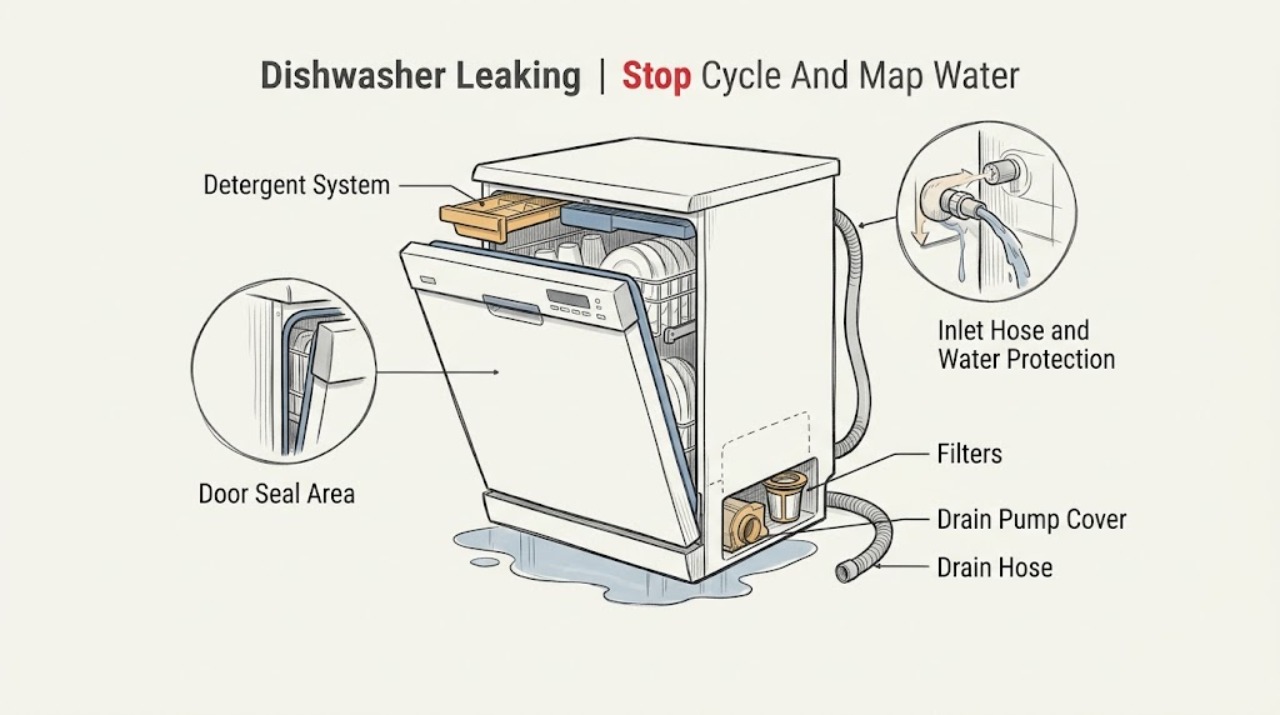
Work through in order
Diagnostic checks
Use only checks that match the exact appliance or system and its official guide.
-
Check 1
Stop the cycle using the normal control, keep clear of wet electrical areas, and note where water first appears: door front, underneath/base, inlet connection, drain connection, or inside the tub. Record whether the machine was filling, washing, draining, or off.
Expected result: The leak is confined to the door/load area, follows filling or draining, appears under the base, or its source cannot be seen safely.
Next step: Close the water faucet for any continuing leak or water near the base, isolate power only if safe, and use the matching branch below. Keep the E-Nr. and timing for service.
Stop if: Do not run another cycle to reproduce a leak, reach under a wet appliance, or remove the toe-kick/base.
Why this matters
Why: Location and cycle phase separate loading/foam issues from inlet, drain, water-protection, or internal faults. Water whose source cannot be safely seen should not be investigated by removing panels.
-
Check 2
With the dishwasher off, inspect the visible door edge, gasket, and rack load. Remove only a projecting dish or item that prevents the door from closing; check that the gasket is seated and visibly intact. Do not remove hinges, panels, or the gasket unless the exact manual identifies that task.
Expected result: A dish projects into the door path, the door does not close evenly, the gasket has a visible gap/damage, or the visible door area is normal.
Next step: Correct only an accessible loading obstruction and observe whether the door now closes normally. If the gasket or door remains abnormal, keep the dishwasher out of service and arrange repair.
Stop if: Do not force the door, bend the gasket, remove hinges, or continue a cycle with a door that cannot seal.
Why this matters
Why: Gaggenau documents projecting dishware as a way steam and water can escape around the door. A damaged or misaligned seal needs service; a normal visible door area makes inlet, foam, drain, or internal causes more relevant.
-
Check 3
Record the detergent and rinse-aid product used and look for excessive suds at the door or tub. Do not add hand soap or any product not designated for household dishwashers, and do not start another cycle while foam is escaping.
Expected result: Liquid hand soap or another incompatible product was used, heavy suds are present, or the detergent is designated for dishwashers and no unusual foam is visible.
Next step: Stop using the incompatible product and follow the exact manual's safe cleanup guidance; do not pour additional chemicals into the tub. Arrange service if the leak continues or the appliance was damaged.
Stop if: Do not use hand soap, run repeated rinse cycles to chase foam, or dismantle the dispenser or tub.
Why this matters
Why: Gaggenau states that liquid hand soap can cause increased frothing and damage the appliance; foam can make a door leak look like a failed seal. No foam makes the load, inlet, drain, or internal paths more relevant.
-
Check 4
If the exact E-Nr. manual permits external inlet inspection, look for a visibly kinked supply hose and confirm the accessible water faucet is open or closed as the model's indication requires. For a water-supply indication on the covered DF480 family, isolate the appliance and water first before any manual-approved filter check, then inspect the connection for leaks.
Expected result: The inlet hose is kinked, the faucet is closed/calcified, a model-accessible connection filter is blocked, or the visible inlet path is normal.
Next step: Correct only a plainly kinked hose or closed faucet when the exact manual directs it, and check for leaks before a single permitted restart. If the leak continues or the connection is wet/damaged, close the faucet and call service.
Stop if: Do not disconnect a pressurized hose, reach behind the appliance, force a filter, or restore power while the connection or floor is wet.
Why this matters
Why: Gaggenau documents these conditions for certain model families, but an inlet arrangement cannot be generalized across all dishwashers. A leak at a connection or an inaccessible filter needs service rather than force.
-
Check 5
Only with power off and the appliance dry enough to handle safely, inspect accessible filters, the visible drain area, drain-hose routing, and any model-documented pump-cover position. Do not reach into standing water or the pump, and do not remove a cover unless the exact manual identifies it as user-accessible.
Expected result: A filter is visibly blocked, the drain hose is kinked, the model's pump cover is loose, a required high loop is absent, or no accessible drain issue is found.
Next step: Follow only the exact E-Nr. manual for cleaning or reseating an accessible filter/pump cover, then check for leaks before one normal cycle. If water remains or the leak returns, keep the faucet closed and arrange service.
Stop if: Do not remove the base, pull the pump apart, use sharp tools, or restart while water is near electrical parts.
Why this matters
Why: Gaggenau links these conditions to drainage faults that can leave water in the appliance or contribute to overflow on covered models. A clean visible path does not rule out an internal pump, hose, valve, or leak.
-
Check 6
Close the water faucet and arrange service for a water-protection indication, continuous filling, a leak from the base or an inaccessible connection, a persistent leak after the permitted external correction, or water near the plug, cord, controls, or wiring.
Expected result: The leak stopped after a documented external correction and no water reached electrical parts, or water continues/returns or a safety indication is present.
Next step: For the second pattern, leave the dishwasher out of service, isolate power only if safe, and contact Gaggenau customer service or a qualified appliance technician with the E-Nr. and leak location.
Stop if: Do not restore water or power to test, remove panels, bypass water protection, probe wiring, or order an internal part from the symptom alone.
Why this matters
Why: A corrected load, foam, or accessible hose condition may be user-resolvable. Continuous water, protection codes, base leaks, and wet electrical areas require professional diagnosis and do not identify a pump, valve, hose, or seal part by themselves.
Use your observations
Decision map
Find the observation that best matches what you see, then follow the next safe action.
-
PATH 01Safety boundary
What you see
Water appears at the front or door edge, and a projecting dish, rack item, misclosure, or visible gasket issue is found without water-protection or continuous-fill symptoms.
Do this next
Remove only the accessible obstruction and check normal closure. Keep the appliance off and call service for a damaged seal, misalignment, or returning leak.
Why this path and its safety boundary
Why it matters: Gaggenau documents projecting dishware as a cause of water escaping around the door; a damaged gasket or door remains a service issue.
Safety stop: Do not force the door, bend the gasket, or run another cycle with an abnormal seal.
-
PATH 02Safety boundary
What you see
Suds are visible and an incompatible detergent, especially liquid hand soap, was used.
Do this next
Stop adding detergent, follow only the exact manual's cleanup guidance, and arrange service if the leak persists or damage is suspected.
Why this path and its safety boundary
Why it matters: Excess frothing is a more plausible immediate cause than a failed door seal; Gaggenau warns that liquid hand soap can increase frothing and damage the appliance.
Safety stop: Do not add chemicals, run repeated cycles, or disassemble the dispenser.
-
PATH 03Safety boundary
What you see
The leak begins during filling, a water-supply indication or E:3000/E:3100/E:3400 appears on a matching manual, or water continuously enters the appliance.
Do this next
Close the water faucet, keep the dishwasher out of service, isolate power only if safe, and contact customer service with the exact E-Nr. and code.
Why this path and its safety boundary
Why it matters: An inlet, water-protection, valve, or internal leak path is more relevant. Gaggenau directs owners to close the faucet and contact service for protection activation or continuous filling.
Safety stop: Do not keep running the cycle, remove the base, disconnect a pressurized hose, or bypass water protection.
-
PATH 04Safety boundary
What you see
Water appears during or after draining, remains in the tub, or the exact model manual identifies a blocked filter, loose pump cover, kinked drain hose, or missing high loop.
Do this next
Follow only the exact manual's safe accessible filter/pump-cover or hose-routing check, then stop and call service if water remains or returns.
Why this path and its safety boundary
Why it matters: A drainage restriction or installation condition is more likely than an inlet leak, but an internal pump or hose fault cannot be ruled out from observation alone.
Safety stop: Do not reach into standing water, remove the base, or force a pump or drain connection.
-
PATH 05Safety boundary
What you see
Water pools under the dishwasher, its source is inaccessible, or water reaches the plug, cord, controls, or other electrical area; the leak persists or no model-specific external cause is found.
Do this next
Close the water faucet, isolate power only if safe, keep the dishwasher out of service, and contact Gaggenau customer service or a qualified appliance technician.
Why this path and its safety boundary
Why it matters: This is a stop-use condition requiring professional diagnosis of the base, hose, pump, valve, wiring, or water-protection system.
Safety stop: Do not touch wet electrical parts, restore water/power to test, remove panels, or attempt an internal repair.
Helpful context
Understand the symptom
Locate the leak before choosing a check
Note whether water appears at the front of the door, under the toe-kick or base, at the inlet connection, at the drain connection, or inside the tub after a cycle. Also record whether the dishwasher was filling, washing, draining, or already off when the water appeared. Gaggenau publishes different dishwasher families and model-linked manuals; use the exact E-Nr. before applying a code meaning or a hose/filter procedure.
Door, loading, and detergent can create visible water
Gaggenau's DF211701 manual says projecting dishes can interfere with door closure and let steam and water escape around the door. It also warns that liquid hand soap can increase frothing and damage the appliance. Check only the visible load, door closure, gasket, and detergent used; do not infer a failed seal or pump from a single front spill and do not add more detergent to compensate for foam.
A water-protection indication is a stop signal
In the opened DF480700F and DF211701 manuals, water-protection indications E:3000 and E:3100 direct the owner to turn off the water faucet and contact customer service. DF480700F also lists E:3400 when water is continuously running into the appliance, with the same instruction. These code paths are model-specific, but they establish the safe direction: stop water entry and do not keep running the dishwasher to see whether the leak disappears.
Supply and drain checks must stay model-bounded
For covered models, Gaggenau describes an inlet hose kink, closed or calcified faucet, and blocked supply or AquaStop filter as possible water-supply causes; it also documents drain-pump-cover, drain-hose, high-loop, and filter conditions for draining faults. These are not a universal layout. Only clean an accessible filter or inspect a visible hose when the exact E-Nr. manual identifies that action, and check every connection for leaks before any permitted restart.
Water near electricity requires a stop-use boundary
Close the water faucet and stop the dishwasher if water is pooling, reaching the plug, cord, controls, or an inaccessible base. Isolate electrical power only if it can be done without touching wet or damaged parts. Do not remove the base or side panels, disconnect a pressurized hose, reach into the pump, bypass water protection, or probe live wiring. Gaggenau manuals direct repairs to customer service or trained specialists when protection systems, continuous filling, damaged cords, or internal faults are involved.
When checks do not resolve it
Need a professional?
Contact Gaggenau customer service or qualified appliance service for a water-protection indication, continuous filling, a base or inaccessible connection leak, a returning leak after permitted external checks, or water near electrical parts. Close the water faucet and isolate power only when safe; do not restore water or power to test.
Safety scope: Close the water faucet and isolate power only when safe. Do not remove the base or panels, disconnect pressurized plumbing, reach into a pump or standing water, bypass water protection, probe live wiring, or order internal parts without model-specific qualified diagnosis.
Have this ready
- Exact Gaggenau E-Nr./model, leak location and cycle phase, complete error code or indicator, detergent used, door/load and gasket observations, inlet/drain observations, whether the water faucet was closed, and any water near electrical parts or cord damage.
Common questions
FAQ
Why is my Gaggenau dishwasher leaking from the door?
Check whether a plate, pan, rack item, or other projecting dish prevents the door from closing. Gaggenau documents that projecting dishware can let steam and water escape around the door. If the gasket is damaged, the door is misaligned, or the leak returns after correcting the load, keep the dishwasher off and arrange service.
What does a Gaggenau dishwasher water-protection code mean?
The meaning is model-specific, but opened Gaggenau manuals direct owners with water-protection indications E:3000 or E:3100 to close the water faucet and contact customer service. Do not keep running the dishwasher or remove its base to investigate.
Can dish soap make a Gaggenau dishwasher leak?
Yes, excessive suds can make water escape. Gaggenau warns that liquid hand soap can cause increased frothing and damage the appliance. Stop the cycle, do not add more chemicals, and follow only the exact manual's cleanup guidance.
Can I clean the Gaggenau dishwasher inlet filter or drain pump myself?
Only if the exact E-Nr. manual identifies the filter or pump cover as an accessible user task and the appliance, water supply, and electrical power can be safely isolated. Do not reach into standing water, disconnect pressurized plumbing, remove the base, or continue if the connection leaks.
Read the exact guide
Official sources
- Use and Care Manual DF211701Gaggenau · Exact DF211701 dishwasher family covered by the manual; code meanings and accessible procedures are model-specific.
- DownloadsGaggenau · Gaggenau appliances, including dishwashers; the E-Nr. is required to retrieve the correct manual.
- Appliance Information - Dishwasher | DF481700/08Gaggenau · Exact DF481700/08 dishwasher support page; used to establish that Gaggenau supplies model-linked manuals and service for distinct dishwasher families.
- Use and Care Manual DF480700FGaggenau · Exact DF480700F dishwasher family covered by the manual; do not transfer codes or plumbing layout to another E-Nr. without confirmation.
Community feedback
Share a repair observation
Share a plain-text repair observation. Accepted observations are published automatically; this page may take a moment to update.