
On this page
Start here
Quick answer
First identify where the frost is: a light, temporary film on the refrigerator's rear wall can be normal on models whose rear panel defrosts automatically, while a thick or returning layer, frost around the door edge, or ice covering food and air paths is not a one-size-fits-all condition. Check the exact Gaggenau model before acting. From a safe, accessible position, make sure the door closes fully, the gasket is clean and intact, packages are not touching the rear wall or blocking vents, and the temperature or special mode has not been set colder than needed. Gaggenau manuals describe automatic rear-wall condensation drainage on some models, a frost-free NoFrost freezer on others, and frost or ice patterns that require model-specific defrosting. If the frost is a removable layer and the matching manual permits user defrosting, switch off and disconnect the appliance as instructed, protect food, let the ice thaw naturally, and wipe up water; never chip ice, use a flame or hairdryer, or pour water into a drain or control area. Frost that returns quickly, covers the freezer, appears with a poor seal, or persists after a documented defrost and door/loading correction points to a door, airflow, sensor, defrost, or sealed-system problem and needs qualified service.
Before you begin
Safety first
- The user may identify the model and frost pattern, check normal door closure and accessible gasket/loading, use documented settings, and perform only the matching manual's safe defrost or visible condensation-channel care with power isolated. Qualified service must handle hidden drains, fans, sensors, heaters, controls, panels, refrigerant, and sealed-system work.
Work through in order
Diagnostic checks
Use only checks that match the exact appliance or system and its official guide.
-
Check 1
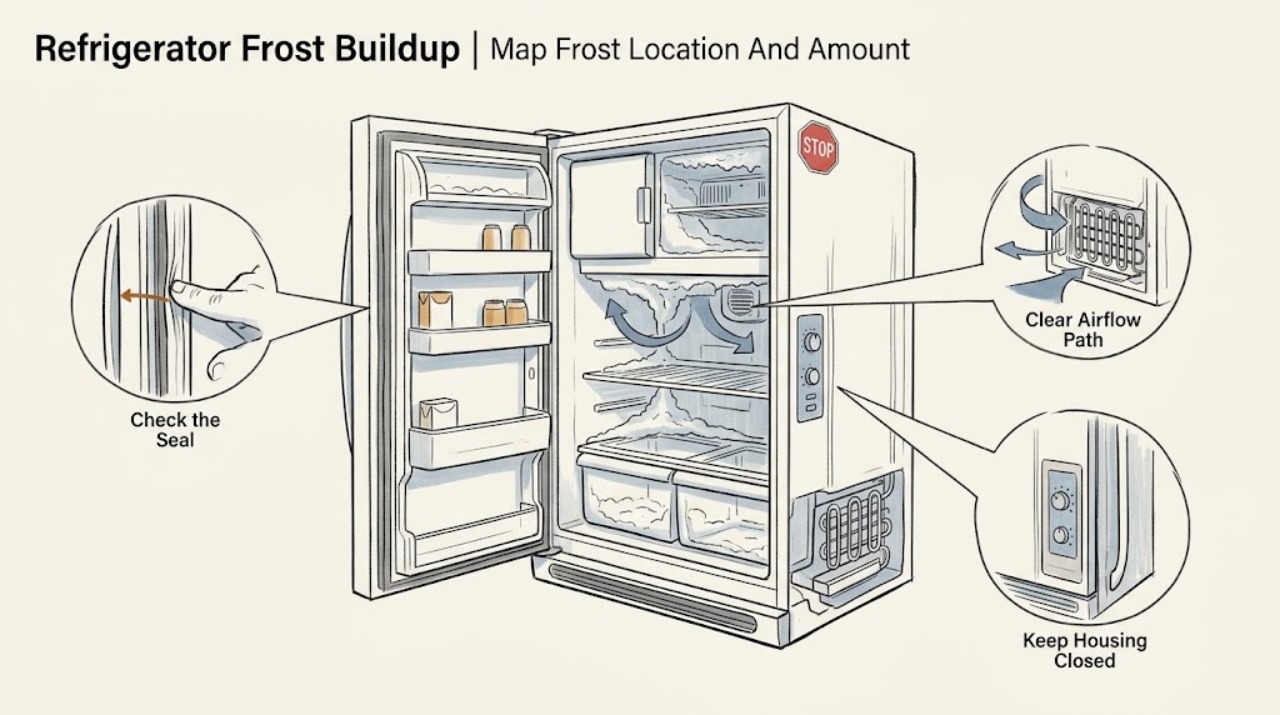
Identify the exact Gaggenau model/E-Nr. and map where frost is forming: a light film on the refrigerator rear wall, a condensation channel/drain area, the freezer door edge, one wall or corner, food surfaces, air outlets, or most of the freezer. Photograph the pattern without removing covers or scraping the ice.
Expected result: The frost is a light rear-wall film, a thick layer or sheet, concentrated at the door edge, around food/vents, or widespread in a freezer documented as NoFrost.
Next step: Use the matching manual to decide whether the compartment is automatic-defrost or user-defrost. Continue with door, loading, and setting checks only if there is no hazard; do not chip or melt frost with an improvised heat source.
Stop if: Do not remove an evaporator or fan cover, scrape the rear panel, insert tools into a drain, or use a flame, heat gun, or hairdryer.
Why this matters
Why: A light rear-wall film can be part of an automatic refrigerator-compartment cycle on some Gaggenau models. Door-edge frost suggests moist-air entry or seal contact; food/vent frost suggests loading or airflow effects; widespread frost in a NoFrost freezer is abnormal enough to need model-specific diagnosis.
-
Check 2
Check that every refrigerator/freezer door closes fully without a package, shelf, drawer, or ice container holding it open. Inspect the accessible gasket for dirt, folds, tears, gaps, or a section that does not contact the cabinet. Clean and dry the gasket only as the exact manual permits; do not force the door or adjust hinges.
Expected result: A door was held open, the gasket is dirty but intact, the gasket/door is damaged or does not seal, or the door and gasket appear normal.
Next step: Remove only a loose loading obstruction, clean/dry an accessible gasket, and monitor the pattern without opening panels. Arrange service for a damaged gasket, door, hinge, or frost that returns around a closed door.
Stop if: Do not bend the gasket, loosen hinges, remove trim, use sealant as a repair, or continue operating if the door cannot close safely.
Why this matters
Why: An open path or poor gasket contact allows humid room air to enter and can create frost at the perimeter or nearby surfaces. A normal visible gasket does not rule out an internal alignment or defrost issue, but it makes simple moisture entry less likely.
-
Check 3
Compare the displayed settings and special modes with the exact model manual. Check that food is not pressed against the rear panel, air outlets, or door seal and that drawers and shelves are not blocking circulation. For a model with a cool-fresh compartment, note whether only that zone is frosting and use a higher setting only if the manual directs it.
Expected result: The setting is unusually cold or a special cooling function is active, food blocks an outlet/rear wall, only a cool-fresh zone frosts, or settings and loading appear normal.
Next step: Make one documented setting correction, move only accessible items away from vents/rear wall, and record whether the pattern changes. If the frost covers the compartment or returns despite normal settings, arrange service.
Stop if: Do not block or remove vents, enter service mode, alter temperature sensors, or use another model's setting sequence.
Why this matters
Why: An extra-cold setting, intensive mode, or food placed in a cold-air path can create localized frost without proving a system failure. Gaggenau's RT28 guidance specifically says to set a higher cool-fresh temperature if frost forms on food. Normal settings and clear loading make door, drainage, defrost, or sealed-system causes more likely.
-
Check 4
Use the exact manual to determine whether the affected area should auto-defrost or requires user defrosting. On an RB280-style refrigerator compartment, inspect only the visible condensation channel and drainage-hole opening and keep them clear with the manual-approved gentle method. If the manual allows a freezer defrost, switch off and disconnect the appliance, protect food, let frost thaw naturally, and wipe water with a soft cloth; do not pour water into the drain or controls.
Expected result: The manual describes normal automatic rear-wall drainage, the visible channel/drain is obstructed, the affected freezer is a user-defrost design, the frost is behind a cover, or the exact architecture is unclear.
Next step: Follow only the matched manual. If the visible path cannot be cleared safely, the layer does not thaw normally, or frost rapidly returns after documented defrosting, keep the appliance off as needed and call qualified service.
Stop if: Do not use sharp tools or heat to remove ice, pour liquid into a drain, remove covers, reach into a fan/evaporator area, or reconnect power while water is near electrical parts.
Why this matters
Why: A blocked visible condensation path can retain moisture in an automatic refrigerator section. A user-defrost freezer can require a documented defrost interval. Frost behind a cover or an unclear model path is not a user-accessible diagnosis and may involve a defrost, fan, sensor, or sealed-system fault.
-
Check 5
Record the exact model, compartment, frost location and thickness, door/gasket result, temperature and mode, loading/airflow result, visible drainage result, time since the last defrost or installation, and whether the frost returns. If frost is widespread, rapidly recurrent, hidden behind a cover, or accompanied by poor cooling, unusual noise, water, or a damaged seal, stop user diagnosis.
Expected result: Frost disappears after a model-documented correction, remains after defrost, returns quickly, appears in a NoFrost freezer, or is accompanied by a cooling or electrical symptom.
Next step: Arrange Gaggenau authorized or qualified appliance service and provide the observation record. Protect perishable food during an unsafe-temperature condition and do not keep forcing operation through heavy frost.
Stop if: Do not order a heater, sensor, fan, gasket, control, or sealed-system part from frost alone; do not remove panels or perform live or refrigerant work.
Why this matters
Why: A corrected loading, setting, door, or visible drainage condition can explain a localized pattern. Persistent or rapid recurrence makes a defrost, fan, sensor, door-alignment, refrigerant/sealed-system, or control fault more likely; the pattern alone cannot identify a part.
Use your observations
Decision map
Find the observation that best matches what you see, then follow the next safe action.
-
PATH 01Safety boundary
What you see
The exact model documents an automatically defrosted refrigerator compartment and the frost is a light, temporary film on the rear wall, with a clear visible condensation path and normal cooling.
Do this next
Keep the condensation channel and drainage opening clear as the matching manual permits, avoid pressing food against the rear wall, and monitor for thickening or recurrence in other areas.
Why this path and its safety boundary
Why it matters: Normal condensation/frost cycling is more likely than a fault; it should not be scraped away.
Safety stop: Do not scrape the rear wall, insert tools into the drainage hole, or apply heat.
-
PATH 02Safety boundary
What you see
Frost is concentrated around a door edge or gasket, the door was held open, packages obstruct closure, or the gasket is dirty, folded, or damaged.
Do this next
Remove only a loose obstruction and clean/dry the accessible gasket. If the gasket/door does not seal or frost returns around a normally closed door, arrange Gaggenau service.
Why this path and its safety boundary
Why it matters: Moist room air entering through the door path is more likely than a primary sealed-system fault, although a damaged door or alignment still needs service.
Safety stop: Do not bend the gasket, adjust hinges, tape the door, or remove trim or panels.
-
PATH 03Safety boundary
What you see
Frost is limited to food, a cool-fresh zone, a rear/air-outlet area, or one loading location, and the exact setting or loading is unusually cold/blocked.
Do this next
Use the exact manual's documented setting adjustment and move accessible food away from vents/rear walls. Monitor once; persistent localized frost with normal settings needs service.
Why this path and its safety boundary
Why it matters: A temperature setting, special mode, or restricted circulation is more likely than a whole-compartment defrost failure.
Safety stop: Do not block/remove vents, alter sensors, or use another model's temperature procedure.
-
PATH 04Safety boundary
What you see
The matching manual identifies a user-defrost compartment, or an automatic refrigerator section has a visibly obstructed condensation channel/drain, with no electrical or sealed-system warning.
Do this next
Disconnect power and protect food before following only the exact manual's thaw/cleaning or visible-channel procedure. If the drain is inaccessible or frost returns rapidly, call service.
Why this path and its safety boundary
Why it matters: A documented defrost interval or visible drainage restriction may explain the frost, but the procedure is model-specific.
Safety stop: Do not pour water into the appliance, chip ice, use improvised heat, or remove evaporator/fan covers.
-
PATH 05Safety boundary
What you see
Frost is widespread, rapidly returns after a documented defrost and door/loading correction, appears in a documented NoFrost freezer, or is behind a cover and accompanied by poor cooling, water, unusual noise, or a damaged seal.
Do this next
Keep the appliance operating only as necessary to protect food and safety, then arrange Gaggenau authorized or qualified appliance service with the model and frost record. Do not continue scraping or testing.
Why this path and its safety boundary
Why it matters: An internal defrost, fan, sensor, control, door-alignment, or sealed-system issue is more likely and cannot be safely separated by user checks.
Safety stop: Do not open panels, bypass sensors, test live wiring, handle refrigerant, or order internal parts from the frost pattern alone.
Helpful context
Understand the symptom
Location tells you whether frost may be normal
On some Gaggenau refrigerator compartments, condensation droplets or a light frost film on the rear panel is part of automatic operation and should drain through the condensation channel. A freezer marketed and documented as NoFrost should remain free of routine ice. Thick frost on food, all around a freezer, at a door edge, or in an air path is a different symptom and needs the exact model's guidance.
Door seal and loading come before parts
Warm moist air entering through a door that is held open, a dirty or damaged gasket, or an obstructed closing path can create recurring frost. Check only accessible conditions: door closure, gasket contact, packages, and visible vents. Do not bend hinges or remove panels to inspect a fan or evaporator.
Defrost only as the matching manual permits
Gaggenau manuals differ: one describes automatic rear-wall drainage and a NoFrost freezer, while another provides a regular freezer-defrost procedure. Do not transplant a defrost method between models. If the manual permits user defrosting, isolate power and protect food first; if frost is behind a cover or returns rapidly, service must diagnose the cause.
Safety boundary
Stop conditions
- Stop user defrosting for water near lights, controls, wiring, or the power connection; isolate power only from a safe location and protect food.
- Do not chip or scrape ice, use a flame, heat gun, hairdryer, or other improvised heat source, or pour hot water into the compartment or drain.
- Do not remove evaporator, fan, rear, drain, or control covers, bypass a door or temperature sensor, or perform live electrical or refrigerant work.
- Do not force doors, bend gaskets, alter hinges, block vents, or use an undocumented model reset or defrost sequence.
- If frost rapidly recurs, covers a documented NoFrost freezer, causes poor cooling/water, or persists after the exact manual's safe correction, arrange qualified service.
Only after diagnosis
Potential parts
- door gasket or door-alignment component
Consider this only if frost is concentrated at a door perimeter and qualified diagnosis confirms poor sealing after accessible loading and gasket cleaning checks.
Confirm the exact Gaggenau model/E-Nr. and manufacturer's fit information; door and gasket designs vary across cooling families. - defrost, fan, sensor, or control assembly
These are service-only possibilities when frost rapidly recurs in a documented automatic/NoFrost compartment after door, setting, loading, and documented defrost checks pass.
Do not select a part from frost alone. Verify the exact model, architecture, diagnosis, and manufacturer's fit information before professional replacement.
When checks do not resolve it
Need a professional?
Safety scope: The user may identify the model and frost pattern, check normal door closure and accessible gasket/loading, use documented settings, and perform only the matching manual's safe defrost or visible condensation-channel care with power isolated. Qualified service must handle hidden drains, fans, sensors, heaters, controls, panels, refrigerant, and sealed-system work.
Common questions
FAQ
Is frost on the rear wall of a Gaggenau refrigerator normal?
Sometimes. The RB280 and RC200 manuals describe condensation or a light frost film on the refrigerator rear panel that defrosts automatically and drains through a condensation channel. Thick, persistent, door-edge, food-covering, or widespread frost is a different symptom; use the exact model manual and arrange service if it returns or cooling changes.
Why is frost forming on food in my Gaggenau cool-fresh compartment?
Check the exact temperature and loading first. The RT28 manual directs a higher cool-fresh temperature when frost forms on food, but settings and compartment features vary by model. Move food away from outlets and the rear wall only if accessible; persistent frost at normal settings needs service.
Does every Gaggenau freezer need defrosting?
No. The RB280 manual describes a fully automatic NoFrost freezer, while the RT28 manual provides a regular freezer-defrost procedure. Confirm the exact model before using any defrost method; never assume a NoFrost or user-defrost procedure applies across Gaggenau families.
Can I use a hairdryer or sharp tool to remove refrigerator frost?
No. Use only the exact manual's safe defrost procedure. When defrosting is permitted, isolate power, protect food, let frost thaw naturally, and wipe water with a soft cloth. Do not chip ice or use improvised heat, and keep water away from lights, controls, and electrical parts.
What does frost around the freezer door usually indicate?
It makes moist-air entry through a door that is held open, obstructed, misaligned, or not sealing normally more likely. Check packages and the accessible gasket without bending or removing anything. If the door closes normally but frost returns, arrange Gaggenau service for alignment, defrost, airflow, or another internal cause.
Read the exact guide
Official sources
- RB280703 instruction for useGaggenau · Official Gaggenau-hosted RB280703 instruction manual; architecture and procedures are model-family specific.
- Gaggenau RT28 User manualGaggenau · Official Gaggenau-hosted RT28 user manual; its temperature and defrost instructions are model-family specific.
- The Gaggenau refrigeratorsGaggenau · Official Gaggenau US product-family page; feature statements apply to the named product families rather than every model.
- Gaggenau RC 200 User manualGaggenau · Official Gaggenau-hosted RC200 user manual; use only as architecture-specific context for RC200-family models.
Community feedback
Share a repair observation
Share a plain-text repair observation. Accepted observations are published automatically; this page may take a moment to update.