
On this page
Start here
Quick answer
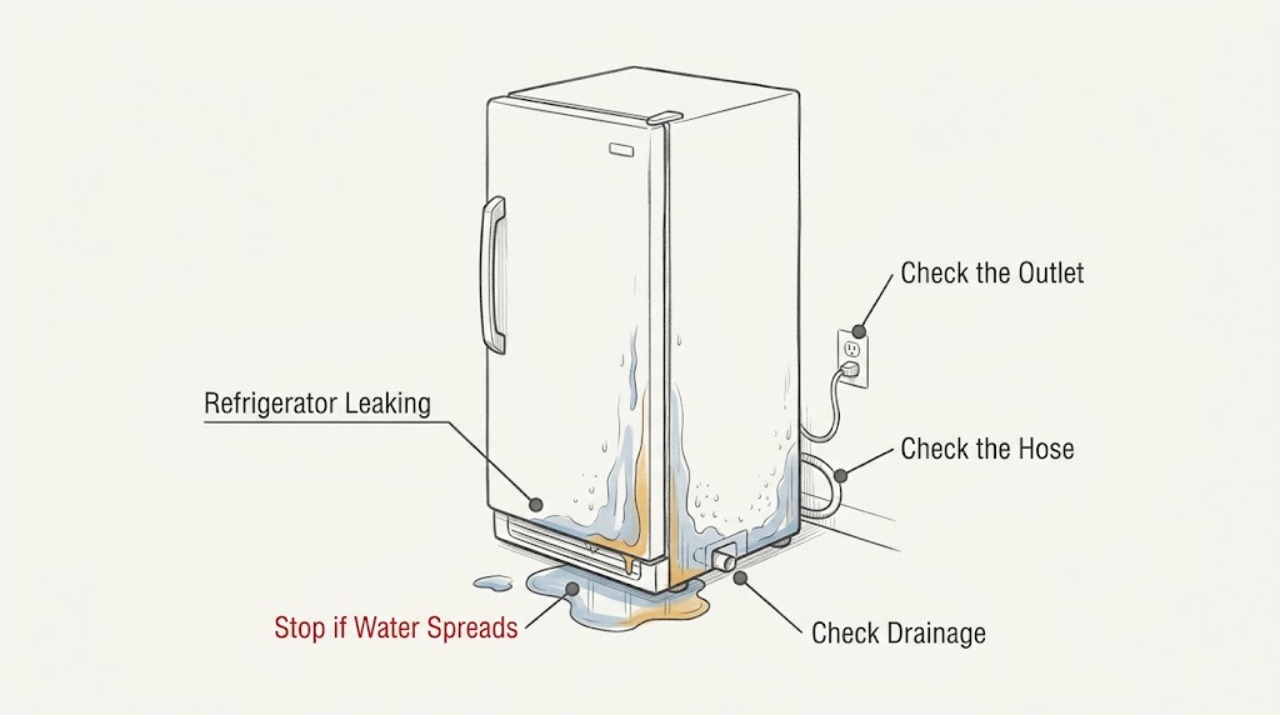
First make the area safe and identify whether the water is coming from an external water connection, the inside rear drain path, the door area, or an unknown location. Gaggenau refrigerator families differ: only models equipped with a water dispenser or ice maker have the corresponding supply hose and connections. Check only accessible connections and the model's documented condensation channel; keep water away from the outlet, controls, and lighting. A damaged hose, water near electrical parts, an active leak that continues after a documented drain clean, or an unexplained leak requires qualified Gaggenau service.
Work through in order
Diagnostic checks
Use only checks that match the exact appliance or system and its official guide.
-
Check 1
Make the immediate area safe, keep hands and feet dry, and note where the first visible water appears. If water is near the plug, outlet, control panel, or lighting, stop using the refrigerator and isolate power only if you can do so without standing in water or touching wet electrical parts.
Expected result: Classify the leak as coming from an external hose or connection, the dispenser or ice-maker area, the inside rear or base, the door perimeter, or an unknown point. Note whether it is a few drops, a growing puddle, or a continuous flow.
Next step: Dry only the floor and accessible exterior surfaces. Continue only with the matching low-risk check below when the leak is away from electrical parts; otherwise keep the appliance isolated and arrange service.
Why this matters
Why: The location separates a water-supply problem from an internal condensation or drainage problem. Water near electrical parts or a continuous unexplained flow is a safety event, not a routine cleaning check.
-
Check 2
If the exact model has a water dispenser or ice maker, inspect the accessible water connection and hose without loosening fittings or removing panels. Locate the shut-off valve and close it if water is actively coming from the supply side.
Expected result: Look for moisture at a connection, a kink, or visible hose damage, and see whether the flow stops after the external water supply is shut off. A refrigerator without a connected dispenser or ice maker should not be assigned this branch.
Next step: Leave the supply off, do not tighten or replace a concealed hose yourself, and give the service provider the E-Nr. and the leak location. If no connected water feature exists, skip to the condensation and door checks.
Why this matters
Why: A leak that stops when the supply is isolated makes the water connection or hose more likely. A damaged hose is not a user repair on the cited Gaggenau manual's connected models; a leak that continues with the supply off points elsewhere.
-
Check 3
For a wet interior base or water below the rear panel, use the exact model manual to see whether a condensation channel and drainage hole are user-cleanable. On the Gaggenau RT 200 guide, remove the accessible pull-out container and carefully clean the channel and hole with a moistened cotton bud; do not push tools into hidden tubing.
Expected result: Check for visible frost or droplets on the rear panel and for standing water in the interior base. After the documented surface clean, observe whether new condensation reaches the drain instead of pooling. Do not pour rinse water into the drain hole or allow liquid into controls or lights.
Next step: Use only the cleaning method and access points in the exact manual, then dry the area and monitor. Do not remove an evaporator cover, disassemble the drain, or use pressurized or heated tools.
Why this matters
Why: A wet base together with a blocked channel or hole is consistent with an internal drainage obstruction. If the base becomes wet again promptly, the channel is inaccessible, or the leak is not related to condensation, the problem needs model-specific service.
-
Check 4
Inspect the door perimeter, gasket, cabinet level, and accessible ventilation grilles. Confirm that the door closes squarely, the gasket is seated, food or drawers are not holding it open, and the exterior and interior ventilation openings are not blocked.
Expected result: Look for condensation concentrated around the door, a visible gasket gap, a cabinet that rocks, or blocked grilles. A door that seals and a clear ventilation path are the expected result after normal adjustment and repositioning.
Next step: Reposition only accessible items and follow the exact installation instructions for leveling or ventilation. If the gasket, hinges, built-in alignment, or grille cannot be corrected without disassembly, stop and call service.
Why this matters
Why: Poor sealing, an out-of-level cabinet, or blocked ventilation can increase condensation and interfere with normal drainage or cooling. These observations do not prove a water-line or sealed-system failure.
-
Check 5
After the safe external checks, record the E-Nr., whether the appliance has a water connection, the leak location, how quickly water returns, and any display or temperature change. Do not remove panels or attempt live electrical, valve, pump, compressor, or refrigerant-circuit tests.
Expected result: A leak that persists with the water supply isolated, returns after the documented drain clean, comes from behind built-in panels, or is accompanied by loss of cooling or an alarm is present. An isolated spill that does not return after drying is a different pattern from an active appliance leak.
Next step: Keep the appliance isolated when water can reach electrical parts, keep the connected water supply off when applicable, and arrange qualified Gaggenau service with the model and observations.
Why this matters
Why: Persistent or inaccessible water suggests a concealed hose, valve, drain, control, or refrigeration issue whose design varies by Gaggenau family and model. Normal operating sounds or a cleared puddle do not by themselves identify the source.
Use your observations
Decision map
Find the observation that best matches what you see, then follow the next safe action.
-
PATH 01Next step
What you see
Water is at an external supply connection or connected hose.
Do this next
Leave the supply off and arrange model-specific service, especially for a damaged hose or concealed connection.
Why this path and its safety boundary
Why it matters: The water connection or hose is more likely than an interior condensation drain. This branch does not apply to models without a connected water feature.
-
PATH 02Next step
What you see
The interior base is wet and water follows the rear condensation path.
Do this next
Perform only the documented gentle surface clean and monitor; call service if water returns or access is not user-authorized.
Why this path and its safety boundary
Why it matters: A blocked condensation channel or drainage hole is more likely than a pressurized water-line leak.
-
PATH 03Next step
What you see
Moisture is concentrated around the door or cabinet rather than a hose or drain.
Do this next
Correct accessible loading and ventilation issues, then follow the model installation guide; escalate if alignment requires disassembly.
Why this path and its safety boundary
Why it matters: Door sealing, leveling, or installation conditions can explain condensation and water accumulation, but not an active leak from behind the cabinet.
-
PATH 04Next step
What you see
The source is unknown, water is near electricity, or the leak persists.
Do this next
Stop use, isolate water and power only from a dry safe position, do not open the appliance, and arrange qualified service.
Why this path and its safety boundary
Why it matters: This pattern may involve a concealed water component, electrical hazard, or refrigeration-related fault and is outside safe user diagnosis.
Helpful context
Understand the symptom
Start with the appliance identity
Gaggenau sells several refrigeration families, including Vario cooling Expressive, Vario 400, and 200 series products. The manufacturer's documentation site asks for the appliance number or E-Nr. before returning the correct manual. Record the E-Nr. from the rating plate before interpreting a hose, drain, alarm, or control behavior.
Water does not always mean a failed water line
On models with automatic defrost, condensation can travel through an internal channel to a drainage hole and evaporation pan. A wet refrigerator base can therefore indicate a blocked drain rather than a supply leak. Conversely, a refrigerator or fridge-freezer with a water dispenser or ice maker may have an external supply connection that needs a separate check.
Keep electrical and refrigerant work out of user checks
Do not use steam or high-pressure cleaning, allow rinsing water into the controls or lighting, remove sealed-system covers, or test energized wiring. If water reaches an outlet or electrical part, stop handling the appliance and isolate power only from a dry, safe position or at the breaker.
When checks do not resolve it
Need a professional?
Stop and arrange qualified Gaggenau service for a damaged or concealed water hose, a leak that continues after the external supply is isolated, recurring water after the exact manual's accessible drain clean, water behind built-in panels, a door or hinge that needs disassembly, or any water near the outlet, controls, or lighting. Do not use steam or high-pressure cleaning, perform live electrical tests, remove sealed-system covers, or puncture or open refrigerant tubing.
Common questions
FAQ
Does every Gaggenau refrigerator have a water line that can leak?
No. Gaggenau sells multiple refrigerator and fridge-freezer families, and the manufacturer describes an internal water dispenser or filtered water feature for certain combinations. Confirm the E-Nr. and the exact manual before assigning a leak to a supply hose.
What does water on the inside bottom of a Gaggenau refrigerator usually indicate?
On models whose manual describes automatic condensation drainage, a blocked condensation channel or drainage hole can leave the base wet. Follow only the exact model's user-accessible cleaning procedure; do not pour water into the drain or probe hidden tubing.
Can I tighten or replace a leaking Gaggenau refrigerator hose myself?
Do not disassemble the water connection or replace a concealed hose as a generic repair. If a connected model has a damaged hose or leak at the supply connection, close the external water supply and arrange service with the E-Nr.; keep power and water away from wet electrical parts.
Read the exact guide
Official sources
- DownloadsGaggenau · Gaggenau owner documentation and E-Nr. manual lookup
- RefrigeratorsGaggenau · Gaggenau US refrigerator product categories and refrigerator families
- Customer ServiceGaggenau · Gaggenau US customer service and qualified appliance support
- Gaggenau Instruction manualGaggenau · Gaggenau connected refrigerator and ice-maker instruction manual
- Gaggenau User manual RT 200 Fridge-freezerGaggenau · Gaggenau RT 200 fridge-freezer user manual
Community feedback
Share a repair observation
Share a plain-text repair observation. Accepted observations are published automatically; this page may take a moment to update.