
On this page
Start here
Quick answer
A Gaggenau refrigerator can make several sounds during ordinary cooling: a drone from the refrigeration unit or fan, bubbling or gurgling as refrigerant moves, clicks from motors, switches or valves, and cracking during automatic defrost. Fast-freezing can also make the appliance sound louder while that mode is active. If cooling is stable and the sound follows a cooling, defrost, door, or fast-freezing event, identify and monitor it rather than guessing a part. A rattle or vibration that changes when an accessible bottle, shelf or container is moved points first to contact or installation/leveling; do not move a built-in appliance just to test it. Persistent grinding or scraping, a new loud sound with poor cooling or abnormal frost, an error display, burning odor, damaged cord, repeated breaker trips, or water near electrical parts is a stop-use and professional-service situation. Use the exact E-Nr. to obtain the matching Gaggenau manual because refrigerator layouts and instructions vary by model; do not remove covers, perform live tests, or work on the sealed refrigeration or electrical system.
Before you begin
Safety first
- Do not remove appliance covers, probe live wiring, force a fan, handle refrigerant or sealed tubing, apply direct heat to ice, bypass controls, or order an internal part without model-confirmed fitment and qualified diagnosis. Isolate power only when safe for a hazard condition.
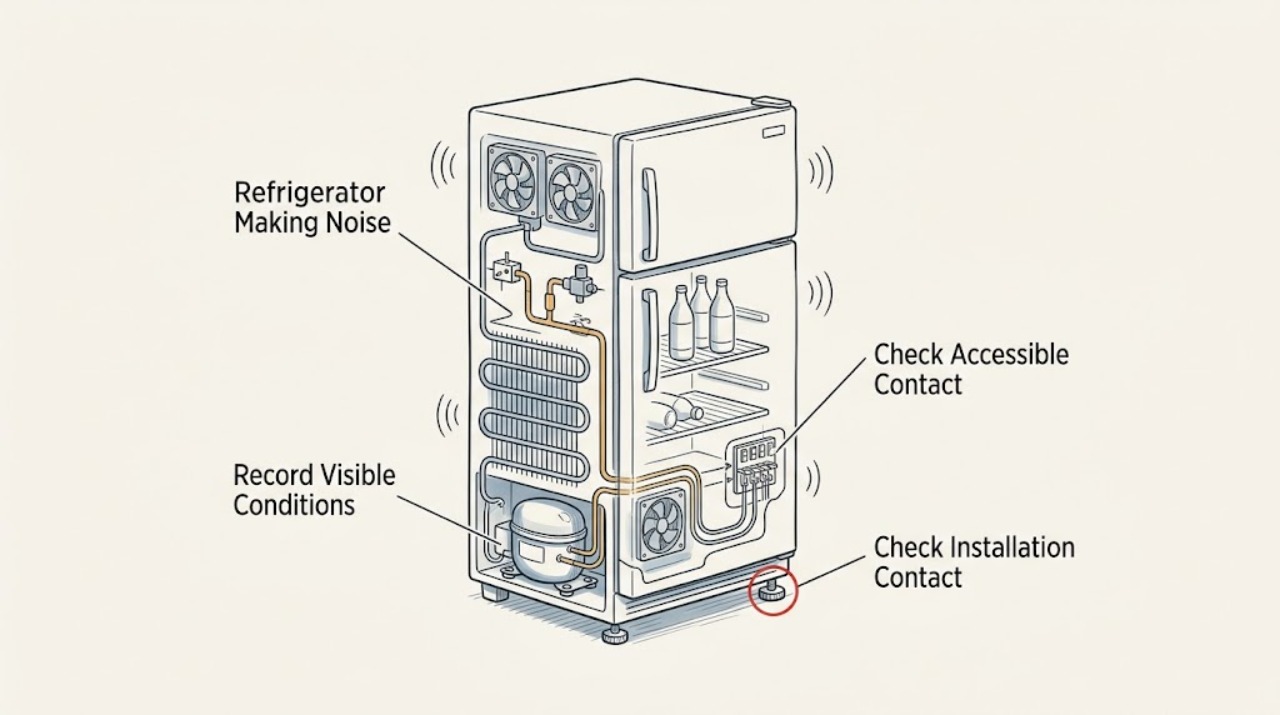
Work through in order
Diagnostic checks
Use only checks that match the exact appliance or system and its official guide.
-
Check 1
From outside the appliance, record whether the noise is a drone, hum, bubbling or gurgling, click, crack, rattle, scrape, or grind. Note its location, duration, whether it follows door opening or closing, automatic defrost, or fast-freezing, and whether it stops between cooling cycles.
Expected result: The sound matches a listed motor, refrigerant-flow, switching, or defrost sound and the timing is intermittent, or it is harsh, continuous, newly loud, or unrelated to a recognizable cycle.
Next step: For a listed intermittent sound with stable cooling, continue with the accessible vibration checks and monitor. For a harsh or persistent sound, document it for service and continue only the external safety checks below.
Stop if: Do not put a hand into a fan opening, remove an interior or rear panel, or run a forced test to reproduce the noise.
Why this matters
Why: The first pattern is consistent with the operating noises documented for Gaggenau refrigerators; the second pattern needs correlation with cooling and safety symptoms before any part is considered.
-
Check 2
With the refrigerator stationary, inspect only accessible removable shelves, bins, trays, and bottles for wobbling or contact. Make sure a bottle or container is not touching a wall, another container, or the cabinet. Do not pull a built-in unit out of its installation.
Expected result: The rattle changes or disappears after a removable item is safely reseated, or it is unchanged with no accessible contact point.
Next step: Reseat the item and monitor one normal cycle. If the sound is unchanged, preserve the sound description and move to temperature, frost, and hazard checks rather than removing panels.
Stop if: Do not reach behind guards, block an air outlet, or dismantle shelves or trim that the model manual does not identify as user-removable.
Why this matters
Why: A change tied to an accessible item makes contact or vibration more likely than an internal part. An unchanged noise means the item check did not establish the cause; it does not prove a compressor or fan failure.
-
Check 3
Without shifting the appliance, look for visible cabinet contact or an installation condition that could transmit vibration. If the refrigerator is freestanding and the exact manual provides a user leveling procedure, follow that procedure only; if it is built-in or moving it would disturb water, power, or ventilation connections, leave leveling to qualified service or the installer.
Expected result: The sound is clearly coupled to visible contact or changes when an external vibration source is removed, or there is no safe, model-documented adjustment available.
Next step: Correct only a plainly accessible, manual-approved adjustment. If the noise remains, or the installation cannot be checked without moving the unit, report the installation and sound pattern to service.
Stop if: Do not drag a built-in refrigerator, disconnect plumbing, remove the compressor cover, or use improvised shims around electrical or ventilation parts.
Why this matters
Why: Gaggenau's noise guidance lists an appliance that is not level, not free-standing as intended, or touching adjacent items as possible noise-prevention issues. A built-in installation cannot be safely generalized from a freestanding instruction.
-
Check 4
Check the display for fast-freezing or another model-documented cooling mode, and look from outside for visibly blocked ventilation openings. Record whether the noise began when that mode was selected or when the refrigerator was heavily loaded. Do not remove an air duct or interior cover.
Expected result: The sound is louder only while fast freezing or another documented mode is active, or ventilation openings are visibly obstructed; otherwise the mode and external airflow look normal.
Next step: End or allow the documented mode to complete and clear only visible obstructions without blocking required clearance. If the noise persists outside the mode or cooling is abnormal, obtain the E-Nr.-specific manual and arrange service.
Stop if: Do not disable a fan, pry off ducting, or continue operating through a hot cabinet, burning odor, or electrical symptom.
Why this matters
Why: Gaggenau documents increased noise during fast freezing and advises removing obstructions from ventilation openings. A noise that remains after the mode ends, or one accompanied by poor cooling, is not explained by that observation alone.
-
Check 5
Read the appliance's displayed temperature and observe whether food remains normally chilled or frozen. Look for visible, unusual frost or ice obstructing an accessible airflow area, but do not chip ice, apply direct heat, or remove a cover. Record any error indication alongside the sound.
Expected result: Cooling is stable with no unusual frost, or the noise coincides with a temperature rise, abnormal frost, or an error indication.
Next step: Monitor a stable, cycle-related sound. For rising temperature, persistent frost, or an error, keep the door closed as practical, use the E-Nr.-specific troubleshooting instructions, and arrange qualified service if the condition remains.
Stop if: Do not use a heat gun, knife, sharp tool, refrigerant service fitting, or live measurement to clear or diagnose the condition.
Why this matters
Why: Stable cooling makes a documented operating sound or vibration branch more plausible. A temperature or frost change makes airflow, defrost, sensor, or refrigeration diagnosis more relevant, but does not identify a replaceable component without the exact model manual.
-
Check 6
Arrange service when the sound is persistent grinding, scraping, or harsh buzzing; when it is accompanied by poor cooling, abnormal frost, an error display, a hot or damaged cord, smoke, burning or chemical odor, water near electrical parts, or repeated breaker trips. Provide the E-Nr., model details, sound timing, temperature symptoms, and any recording.
Expected result: The noise is a brief documented operating sound with stable cooling and no hazard, or it is persistent/abnormal or paired with a cooling, electrical, water, or safety symptom.
Next step: For the second pattern, stop normal use and contact Gaggenau or a qualified appliance service provider. Isolate power only if safe and do not restore it to test after a hazard symptom.
Stop if: Do not open the cabinet, probe live parts, handle refrigerant, bypass a control, or order an internal part without confirmed E-Nr. fitment and professional diagnosis.
Why this matters
Why: The first pattern supports observation after safe external checks. The second requires model-specific professional diagnosis; guessing a fan, compressor, valve, or sealed-system part could be unsafe and incompatible.
Use your observations
Decision map
Find the observation that best matches what you see, then follow the next safe action.
-
PATH 01Safety boundary
What you see
The sound is an intermittent drone, hum, bubbling/gurgling, click, or crack; it follows a cooling, switching, defrost, or documented fast-freezing event; and temperature and safety observations remain normal.
Do this next
Monitor the timing and verify the exact model manual if the sound changes. Seek service if it becomes persistent, harsh, or paired with another symptom.
Why this path and its safety boundary
Why it matters: This pattern is consistent with the operating noises described in Gaggenau's refrigerator instructions and is less suggestive of a failed part than a continuous harsh noise with a cooling change.
Safety stop: Stop for odor, smoke, hot or damaged wiring, water near electrical parts, repeated breaker trips, or loss of cooling.
-
PATH 02Safety boundary
What you see
The noise is a rattle or vibration and changes when an accessible bottle, shelf, bin, or container is safely reseated, or visible cabinet contact is found.
Do this next
Reseat the accessible item or follow only the exact manual's safe freestanding adjustment. Do not move a built-in appliance; use the sound pattern and installation details in a service request if it remains.
Why this path and its safety boundary
Why it matters: Contact or vibration transmission is more likely than an internal refrigeration diagnosis, although a remaining noise still needs evaluation if it is loud or new.
Safety stop: Do not remove panels, disconnect plumbing, or improvise an adjustment around power, ventilation, or sealed-system components.
-
PATH 03Safety boundary
What you see
The sound becomes louder only while fast freezing or another model-documented cooling mode is active and returns to the previous pattern when that mode ends, with stable cooling.
Do this next
Let the documented mode complete and monitor. If the sound persists after the mode or cooling becomes abnormal, use the exact E-Nr.-specific manual and contact service.
Why this path and its safety boundary
Why it matters: Gaggenau's instructions specifically note increased noise during fast freezing, so the mode is a plausible explanation without establishing a part fault.
Safety stop: Do not force a mode, disable airflow, or continue through a burning smell, smoke, excessive heat, or electrical symptom.
-
PATH 04Safety boundary
What you see
The noise is newly loud or continuous and is accompanied by a temperature rise, abnormal frost, an error indication, or failure to maintain cooling.
Do this next
Keep the appliance closed as practical, avoid dismantling or forced defrost, retrieve the E-Nr.-specific manual, and arrange qualified service if the condition does not promptly resolve through a documented user check.
Why this path and its safety boundary
Why it matters: The combined pattern makes airflow, defrost, fan, control, or refrigeration diagnosis more relevant than normal operating noise, but it does not identify a part across Gaggenau models.
Safety stop: Do not chip ice, apply direct heat, probe wiring, open the sealed system, or continue using an appliance with a safety symptom.
-
PATH 05Safety boundary
What you see
The noise occurs with smoke, burning or chemical odor, hot or damaged cord, water near electrical controls, repeated breaker trips, exposed damage, or an apparent loss of cooling that suggests internal refrigeration work.
Do this next
Stop normal operation, isolate power only if safe, keep clear of damaged or wet parts, and contact Gaggenau or an appropriately qualified appliance/electrical service provider.
Why this path and its safety boundary
Why it matters: This is a stop-use condition rather than a noise-identification exercise. Electrical, sealed-system, compressor, fan, or control work requires qualified or authorized service.
Safety stop: Do not restore power to test, remove covers, handle refrigerant, probe live parts, or attempt an internal repair.
Helpful context
Understand the symptom
Classify the sound before treating it as a fault
The opened Gaggenau refrigerator instructions list a recognizable set of operating sounds: droning while the refrigeration unit or fan runs, bubbling, humming or gurgling from refrigerant flow, clicking as motors, switches or solenoid valves operate, and cracking during automatic defrost. A brief change in sound after a door opening, a defrost event, or selection of fast freezing is therefore a different starting point from a harsh sound that is continuous and accompanied by loss of cooling. Record the sound in your own words, where it comes from, when it starts, and whether temperatures remain normal.
Separate vibration and contact noise from internal noise
Before requesting a part, check only what is safely accessible with the refrigerator stationary: a loose removable bin or shelf, a bottle touching another object, a container that wobbles, or visible contact with nearby cabinetry. Gaggenau's instructions also list leveling and free-standing/installation conditions as noise factors. This does not authorize pulling out a built-in appliance or removing a rear panel. If the sound remains after accessible items are secured, describe the unchanged pattern to service instead of attributing it to a compressor or fan.
Use cooling symptoms to change the decision
A sound alone cannot identify a failed motor, fan, valve or compressor. Check the displayed temperature and the food compartment's cooling trend without opening panels. Gaggenau troubleshooting guidance says to allow time for a temperature change to take effect and to remove visible obstructions from ventilation openings; the exact procedure and controls are model-specific. Frost that blocks an airflow path, a temperature that rises, or an error indication moves the case out of simple noise monitoring and into model-specific service diagnosis.
Stop for hazards and leave sealed or electrical work to service
Stop using the refrigerator and isolate it from power only when that can be done safely if there is a burning or chemical odor, smoke, a hot or damaged cord, repeated breaker operation, water close to electrical controls, exposed damage, or a loud noise with loss of cooling. Do not remove covers, probe live wiring, handle refrigerant, cut into tubing, or force a fan. Gaggenau manuals place repairs with trained or authorized specialists and direct owners to customer service for appliance faults. Keep the E-Nr. and the sound recording or description for the service request.
When checks do not resolve it
Need a professional?
Contact Gaggenau or qualified appliance service when a new or persistent harsh noise remains, cooling or frost changes, an error appears, or the cause cannot be resolved by the exact model's safe external checks. Stop using the refrigerator for smoke, burning or chemical odor, a hot or damaged cord, water near electrical parts, exposed damage, repeated breaker trips, or apparent sealed-system failure, and do not restore power to test.
Safety scope: Do not remove appliance covers, probe live wiring, force a fan, handle refrigerant or sealed tubing, apply direct heat to ice, bypass controls, or order an internal part without model-confirmed fitment and qualified diagnosis. Isolate power only when safe for a hazard condition.
Have this ready
- Exact E-Nr. and model information, sound type and location, when it starts and stops, whether fast freezing or defrost was active, temperature and frost observations, accessible contact findings, and any odor, smoke, heat, water, cord, or breaker symptom.
Common questions
FAQ
Is a humming or bubbling sound from a Gaggenau refrigerator normal?
It can be. Gaggenau's opened refrigerator instructions associate droning with the refrigeration unit or fan and bubbling, humming, or gurgling with refrigerant flow. Judge it by timing and by whether cooling remains stable; a new continuous harsh sound or a sound with cooling or safety symptoms needs service.
Why does my Gaggenau refrigerator get louder during fast freezing?
The Gaggenau instructions note that operating noise can increase while fast freezing is active. Confirm that the mode is actually selected for your E-Nr.-specific model and see whether the sound returns to its prior pattern when the mode ends. Persistent noise or poor cooling is not explained by the mode alone.
Can I replace the fan or compressor because my Gaggenau refrigerator is noisy?
Not from the sound alone. The exact refrigerator family, installation, cooling symptoms, and safety observations are needed before selecting a component. Do not remove covers or perform live or sealed-system work; provide the E-Nr. and a sound description to qualified service.
What information should I give Gaggenau service for a noisy refrigerator?
Provide the E-Nr., model information, a description or recording of the sound, its location and timing, whether fast freezing or defrost was involved, temperature or frost changes, and any odor, smoke, heat, water, cord, or breaker symptoms. Gaggenau's download portal uses the appliance number to identify the correct documentation.
Read the exact guide
Official sources
- Gaggenau User manualGaggenau · The Gaggenau refrigerator/freezer model family identified by this manual; use the E-Nr. to confirm applicability.
- Operating instructionsGaggenau · The Gaggenau refrigerator/freezer model family covered by this manual; confirm the appliance E-Nr. before applying model-specific procedures.
- User manual RC 200 RefrigeratorGaggenau · Gaggenau RC 200 refrigerator family covered by the manual; do not transfer its layout or procedure to another E-Nr. without confirmation.
- DownloadsGaggenau · Gaggenau appliances, including refrigerators and freezers.
Community feedback
Share a repair observation
Share a plain-text repair observation. Accepted observations are published automatically; this page may take a moment to update.