
On this page
Start here
Quick answer
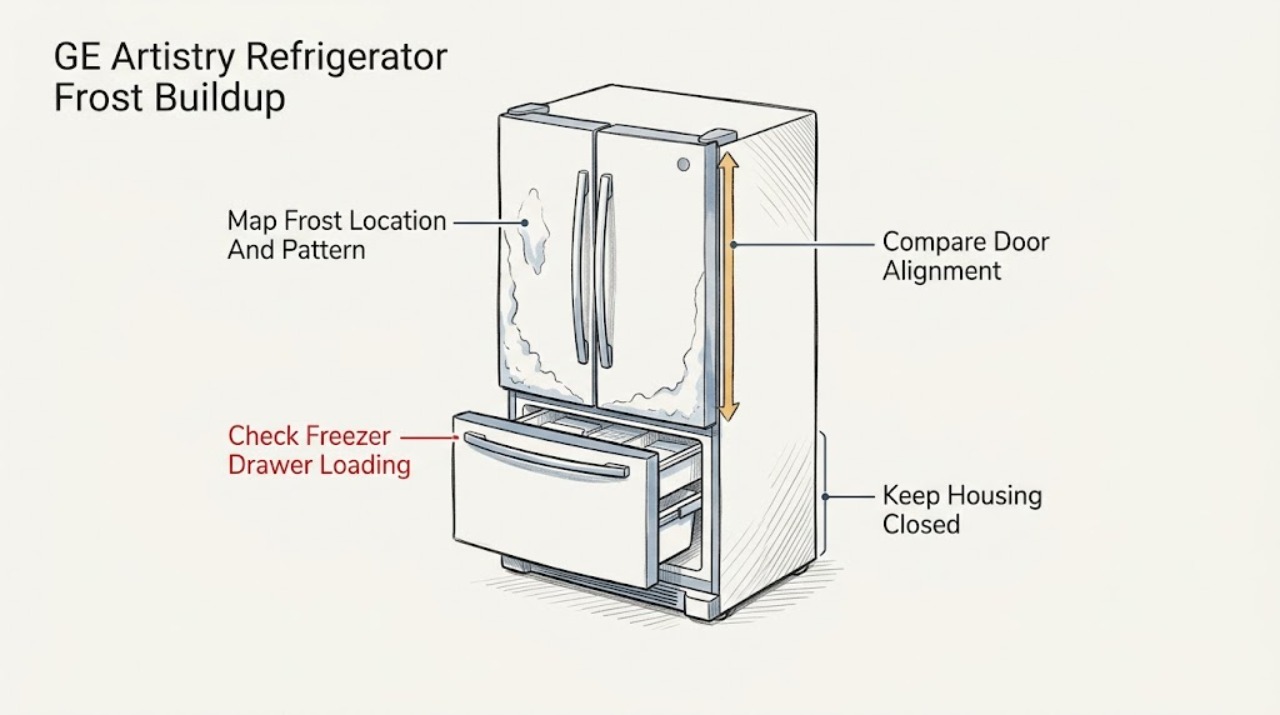
GE's official Owner Center identifies the Artistry ABE20EGEBS as a bottom-freezer refrigerator, while the model page says its defrost type is Frost Guard and it has a Multiflow Air Tower. For frost buildup, first note whether frost is on the freezer drawer, food, rear wall, or around the gasket. Remove only loose visible frost with a dry towel, check that packages and the lower basket are not stopping the drawer from closing, confirm the gasket is seated evenly in its groove, and use the exact manual for temperature and leveling adjustments. GE says frequent or ajar door openings, damaged gaskets, uneven doors, and poor leveling can create frost; automatic-defrost systems normally melt evaporator frost without manual intervention. If frost is heavy, returns after the drawer seals, blocks an internal air path, or would require a panel, heater, fan, sensor, or control diagnosis, stop owner repair and arrange qualified GE service. Do not scrape with sharp tools or use an electrical heat source.
Before you begin
Safety first
- This article covers model identification, accessible package/basket and gasket observation, control/door-use checks, leveling observation, and loose visible-frost removal with a dry towel. Internal defrost parts, evaporator/air-path access, fans, sensors, controls, wiring, liner repair, and live testing require qualified service.
Work through in order
Diagnostic checks
Use only checks that match the exact appliance or system and its official guide.
-
Check 1
Record the complete model and photograph the frost before removing it. Note whether it is on the freezer drawer front/gasket, one corner, packages, the rear wall, the fresh-food compartment, or across the entire freezer; also note whether the freezer drawer feels hard to close or has been opened frequently.
Expected result: Frost is concentrated at the drawer perimeter; a package is frosted; a broad wall is covered; frost is in the fresh-food section; or frost returns rapidly after wiping.
Next step: Follow the matching branch below and use the ABE20EGEBS manual only if that is the actual model; otherwise locate the manual for the complete Artistry model.
Stop if: Do not remove a liner, evaporator cover, air tower, fan cover, or control panel to identify the frost source.
Why this matters
Why: A perimeter pattern supports warm-air entry through the drawer, gasket, alignment, or leveling. Frost on a package or rear wall can follow placement and door-opening conditions. Broad or fast-returning frost makes internal airflow or defrost trouble more likely, but does not identify a part.
-
Check 2
With the freezer drawer open, check that no package protrudes above the basket or presses against the drawer front, and verify that the lower basket is fully seated in its slides. Close the drawer gently and confirm it reaches the frame without a visible gap.
Expected result: A package blocks closure; the basket is not seated; the drawer closes flush; or the drawer catches before the gasket contacts the frame.
Next step: Rearrange or remove only the obstructing package and reseat the accessible basket as the model manual shows, then monitor the same gasket area. If the drawer still does not seal, continue to the gasket/alignment check.
Stop if: Do not force the drawer, bend the basket, remove slides, or adjust hardware not covered by the exact manual.
Why this matters
Why: GE says packages can prevent a bottom-freezer drawer from closing and that a lower basket must be fully seated. A closure gap allows warm, moist room air into the freezer and can create frost.
-
Check 3
Inspect the accessible freezer-drawer gasket around the entire perimeter. Check for cuts, tears, folds, a section pulled out of its groove, or an uneven gap between gasket and cabinet. Observe whether the refrigerator is level and whether the drawer closes on its own as described by the installation instructions.
Expected result: The gasket is damaged or out of its groove; the gap is wider at one side; the drawer is uneven; or the gasket contacts evenly all around.
Next step: For a gasket visibly out of its groove, follow the exact model instructions to seat it without tearing it. For damage, door alignment, or leveling beyond the accessible instruction, arrange service and monitor frost.
Stop if: Do not cut, glue, heat aggressively, or replace the gasket using a part number from another GE refrigerator.
Why this matters
Why: GE says a gasket should touch the frame evenly and that uneven doors or poor leveling can cause sealing problems and frost. A damaged gasket needs model-specific replacement; a visually even seal makes a hidden airflow or defrost issue more likely if frost persists.
-
Check 4
Check the refrigerator and freezer controls against the complete Artistry model manual. Note any recent change, a control at the coldest setting, frequent or prolonged door openings, and whether the door was left slightly ajar. Adjust only the documented control one increment at a time, then keep openings brief while monitoring.
Expected result: A control is at an unusually cold setting; the temperature was recently changed; the door is often open; or settings and door use are normal.
Next step: Return the control to the model-documented setting and allow the manual's stabilization period. If frost remains or returns, continue to safe frost removal and service escalation.
Stop if: Do not copy a control number, diagnostic setting, or defrost sequence from another Artistry or GE model.
Why this matters
Why: GE lists a cold control setting and frequent or long openings among conditions associated with frost or abnormal temperature. Correct settings and normal door use make a seal, airflow, or internal defrost fault more likely.
-
Check 5
If frost is loose and accessible on shelves, packages, or the drawer surface, remove it with a dry towel and dry any moisture. Do not try to reach frost behind a liner or air cover. Keep food from blocking visible vents and do not place food against the rear wall if the model manual marks that area as an air path.
Expected result: The visible frost clears and does not return; frost is bonded behind a cover; frost returns in the same spot; or the air path is blocked by food.
Next step: Monitor one normal operating period after the external correction. If frost returns, preserve the pattern and arrange service rather than escalating the DIY method.
Stop if: Never use an ice pick, knife, metal scraper, hair dryer, heat gun, or electrical device to remove frost.
Why this matters
Why: A one-time surface frost event can follow door openings or placement. Frost that is inaccessible or quickly returns after the drawer seals and settings are corrected makes an internal defrost or airflow issue more likely.
-
Check 6
After the drawer seal, settings, and visible frost checks, monitor whether the refrigerator completes normal cooling/defrost behavior. Note heavy frost on an inaccessible rear wall, a blocked internal air path, unusual fan or compressor behavior, frost returning across a broad area, or frost accompanied by temperature problems.
Expected result: Frost stays gone; a broad sheet returns; cooling becomes uneven; the freezer is warm; or a fan, sensor, heater, or control would need inspection.
Next step: Stop owner diagnosis for broad or recurring frost and provide the technician with model, photos, location, door-seal results, settings, and timing.
Stop if: Do not remove the evaporator cover, test a heater or sensor, force a fan, or access live wiring.
Why this matters
Why: GE explains that automatic defrost melts evaporator frost and routes abnormal heavy frost, ice accumulation, or overly frequent defrosting to a technician. A broad recurring pattern is not proof of one failed part.
-
Check 7
If frost persists after one external correction of loading, drawer seal, settings, and visible surface frost, stop owner troubleshooting. Provide the complete model and serial information, frost photos, exact location, freezer temperature observations, gasket/drawer findings, control settings, and whether the problem began after installation, moving, or service.
Expected result: Frost is heavy or fast-returning; the gasket is damaged; the drawer will not align; frost covers an inaccessible air path; or a defrost, fan, sensor, control, or sealed-system fault is suspected.
Next step: Arrange qualified GE service and keep the appliance operating only if it is safe; protect food and follow the exact manual if the freezer temperature is unsafe.
Stop if: Do not open panels, puncture the liner, bypass a sensor or control, or order a defrost heater, fan, gasket, or board from the frost symptom alone.
Why this matters
Why: These symptoms require model-specific diagnosis. GE Artistry's verified ABE20EGEBS model has a bottom-freezer configuration and distinct temperature/airflow hardware, but that does not select a universal replacement part for every Artistry refrigerator.
Use your observations
Decision map
Find the observation that best matches what you see, then follow the next safe action.
-
PATH 01Safety boundary
What you see
Frost is concentrated around the freezer drawer front or gasket and a package, basket, gap, fold, or uneven seal is visible.
Do this next
Clear the obstruction, seat the accessible basket/gasket as the exact manual allows, and monitor after the frost is wiped away.
Why this path and its safety boundary
Why it matters: Warm humid air entering through the drawer seal is more likely than a primary internal defrost fault.
Safety stop: Do not force the drawer or adjust hinges/slides beyond the model instructions.
-
PATH 02Safety boundary
What you see
Frost is on packages or shelves after frequent/long door openings, a slightly ajar drawer, or food touching a cold rear/air path, with no persistent perimeter gap.
Do this next
Reduce openings, move food away from the documented air path, remove loose frost with a towel, and monitor.
Why this path and its safety boundary
Why it matters: Moisture entering during use or local cold-air placement is more likely; the pattern should improve when the door seals and loading changes.
Safety stop: Do not scrape bonded frost or block/force an air vent.
-
PATH 03Safety boundary
What you see
The control was recently changed or set unusually cold, and frost is limited rather than rapidly covering an inaccessible wall.
Do this next
Return the control one increment at a time to the exact manual's setting and allow stabilization before judging the result.
Why this path and its safety boundary
Why it matters: A model setting or recent adjustment is more likely than a failed defrost component.
Safety stop: Do not copy numeric settings from another GE or Artistry model.
-
PATH 04Safety boundary
What you see
A broad frost sheet or heavy ice returns after the drawer seals, settings, loading, and visible frost checks are correct.
Do this next
Arrange qualified GE service with photos and timing; do not open the freezer liner.
Why this path and its safety boundary
Why it matters: An internal automatic-defrost, airflow, sensor, fan, or control problem is more likely; no universal Artistry part can be inferred.
Safety stop: Do not use heat or sharp tools, test live parts, or force an internal fan or damper.
-
PATH 05Safety boundary
What you see
Frost is in the fresh-food compartment, or the appliance does not match the verified ABE20EGEBS bottom-freezer architecture.
Do this next
Locate the exact model manual and limit checks to its documented settings, gasket, vents, and safe defrost guidance; use service for inaccessible frost.
Why this path and its safety boundary
Why it matters: The generic freezer-drawer checks may not apply. A different Artistry model can have a different air path, sensor layout, or defrost behavior.
Safety stop: Do not apply bottom-freezer drawer measurements or component assumptions to another refrigerator style.
-
PATH 06Safety boundary
What you see
The gasket or liner is damaged, water reaches electrical parts, the cord is damaged, the drawer cannot be safely moved, or defrost work would require panel access.
Do this next
Stop using the appliance if safe to do so, disconnect only from a dry reachable point, and arrange qualified appliance or electrical service.
Why this path and its safety boundary
Why it matters: This is a safety/service boundary, not a frost-removal task.
Safety stop: Do not touch wet electrical parts, puncture the liner, or continue troubleshooting while energized.
Helpful context
Understand the symptom
The Artistry identity matters before you use a frost guide
The verified GE Artistry refrigerator example is model ABE20EGEBS, a bottom-freezer design. Its official page identifies a freezer drawer, Frost Guard defrost type, electronic temperature controls, three electronic sensors, and a Multiflow Air Tower. The article topic does not include a complete model, so use those details to identify the product line—not to assume every Artistry-labeled refrigerator has the same parts or control sequence.
Frost location separates air leakage from internal defrost trouble
Frost concentrated around the drawer gasket or front edge usually makes an air leak, package obstruction, alignment, or leveling issue more likely. Frost on packages or the back wall can follow door openings or cold-air placement. A thick sheet that returns quickly after the drawer seals and temperature is corrected is more consistent with an internal defrost or airflow fault, but the symptom cannot identify a heater, fan, sensor, or control.
Defrost safely and keep the boundary external
GE's automatic-defrost guidance says frost on the evaporator is melted during the normal cycle. For owner checks, use only a dry towel for loose visible frost and follow the exact model manual. Do not puncture the liner, scrape hidden ice, remove panels, or use heat or live electrical testing; those actions can damage refrigeration tubing or expose electrical hazards.
Safety boundary
Stop conditions
- Do not use an ice pick, knife, metal or sharp-edged tool, hair dryer, heat gun, or electrical device to remove frost or reach an internal air path.
- Do not remove the freezer liner, evaporator cover, air tower, fan, heater, sensor, control, wiring, drawer slides, or gasket hardware unless the exact manual explicitly covers the procedure and the appliance is safely disconnected.
- Stop for a damaged liner or cord, water near electrical parts, burning odor, arcing, repeated breaker trips, or any need for live testing; obtain qualified appliance/electrical service.
- If loading, seal, leveling, setting, and safe visible-frost checks do not stop recurring frost, protect food and arrange qualified GE service.
When checks do not resolve it
Need a professional?
Arrange qualified GE Artistry refrigerator service when frost is heavy or rapidly returns, persists after the freezer drawer and gasket seal are corrected, blocks an inaccessible air path, appears in a different compartment than the verified model guidance, or requires defrost, fan, sensor, control, liner, sealed-system, or wiring access.
Safety scope: This article covers model identification, accessible package/basket and gasket observation, control/door-use checks, leveling observation, and loose visible-frost removal with a dry towel. Internal defrost parts, evaporator/air-path access, fans, sensors, controls, wiring, liner repair, and live testing require qualified service.
Common questions
FAQ
Why is my GE Artistry refrigerator building up frost?
Start with the verified bottom-freezer layout and locate the frost. GE says frequent or ajar door openings, packages that stop the drawer, gasket damage, uneven doors, and poor leveling can allow frost. Correct one external cause at a time and monitor; broad or fast-returning frost after those checks needs service.
How do I check the freezer drawer seal on a GE Artistry refrigerator?
Check that no package blocks the drawer, the lower basket is seated in its slides, the gasket is fully in its groove, and the gasket contacts the frame evenly. GE also recommends checking door alignment and leveling. Do not remove slides or adjust hardware beyond the exact model instructions.
Can I scrape the frost from my GE Artistry refrigerator?
Remove only loose, visible frost with a dry towel. Do not use a knife, ice pick, metal scraper, hair dryer, heat gun, or electrical defrost device, and do not remove a liner or evaporator cover. GE describes automatic defrosting and routes heavy or recurring ice to service.
What temperature setting should I use to stop frost on a GE Artistry refrigerator?
Use the complete model's Owner's Manual. GE's frost guidance says to turn the control warmer, but the correct control position and adjustment depend on the model. Change one documented setting at a time and allow the manual's stabilization period before judging the frost.
Why does frost return after I clean it from the freezer?
If the drawer seal, loading, door use, and control setting are correct, quickly returning frost makes an internal airflow or automatic-defrost issue more likely. GE says heavy frost, ice accumulation, or overly frequent defrosting needs a technician. Do not remove panels to test a heater, fan, sensor, or control.
When should I call service for GE Artistry refrigerator frost buildup?
Call service when frost is heavy or fast-returning, covers an inaccessible air path, continues after the drawer seals and settings are corrected, or the gasket, liner, fan, sensor, heater, control, or wiring would need inspection. Provide the exact model, photos, frost location, and timing.
Read the exact guide
Official sources
- GE Appliances Refrigerators Bottom Freezer Owner's Manual and Installation InstructionsGE Appliances · Official manual linked from the ABE20EGEBS GE product page; it covers a bottom-freezer GE model family and must be confirmed against the complete appliance model.
- GE Artistry Series 20.3 Cu. Ft. Bottom-Freezer Refrigerator - ABE20EGEBSGE Appliances · Official GE Appliances product page for the named ABE20EGEBS Artistry model; its bottom-freezer layout and listed features must not be generalized to unverified models.
- Troubleshooting for ABE20EGEBSGE Appliances · Official GE Owner Center page for the named Artistry ABE20EGEBS model; linked articles and manuals must be checked against the exact model.
- Bottom Freezer Refrigerator - Freezer Drawer Not Sealing ProperlyGE Appliances · Official GE bottom-freezer guidance; applies to the matching drawer architecture and not to unrelated refrigerator styles.
- Refrigerator - Automatic Defrost SystemGE Appliances · Official GE explanation for full-sized automatic-defrost refrigerators; exact system type and timing vary by model.
- Refrigerator - Frost in FreezerGE Appliances · Official GE refrigerator support article; exact freezer-drawer configuration and adjustment instructions remain model-dependent.
Community feedback
Share a repair observation
Share a plain-text repair observation. Accepted observations are published automatically; this page may take a moment to update.