
On this page
Start here
Quick answer
First identify where the water starts: under the refrigerator or at the rear connection, inside the fresh-food compartment, under the freezer, around an optional icemaker, or only below a dispenser on a different equipped model. The opened GE Artistry product page describes a bottom-freezer refrigerator with no dispenser and an optional icemaker, so do not assume every Artistry unit has the same water path. Wipe the area dry, protect the plug and outlet from water, and inspect only visible doors, gaskets, shelves, tubing, and connections. If an icemaker is installed and is leaking or flooding, turn it off; if flooding continues, shut off its water supply as GE directs. A loose or split household water line is a plumbing branch, while a drain, valve, internal tube, or recurring leak needs qualified service. Stop immediately for water near electrical parts, a hot or damaged cord or outlet, smoke, burning odor, sparks, repeated breaker trips, or a leak that cannot be contained. Do not remove panels, open the sealed system, pull a built-in appliance, or perform live electrical tests.
Before you begin
Safety first
- Do not touch wet electrical parts, remove panels, reach into a powered icemaker, open the sealed refrigeration system, loosen pressurized tubing, pull a built-in appliance, or perform live electrical tests. Stop for water near electrical parts, smoke, burning odor, sparks, abnormal heat, damaged wiring, repeated breaker trips, or uncontrolled flooding.
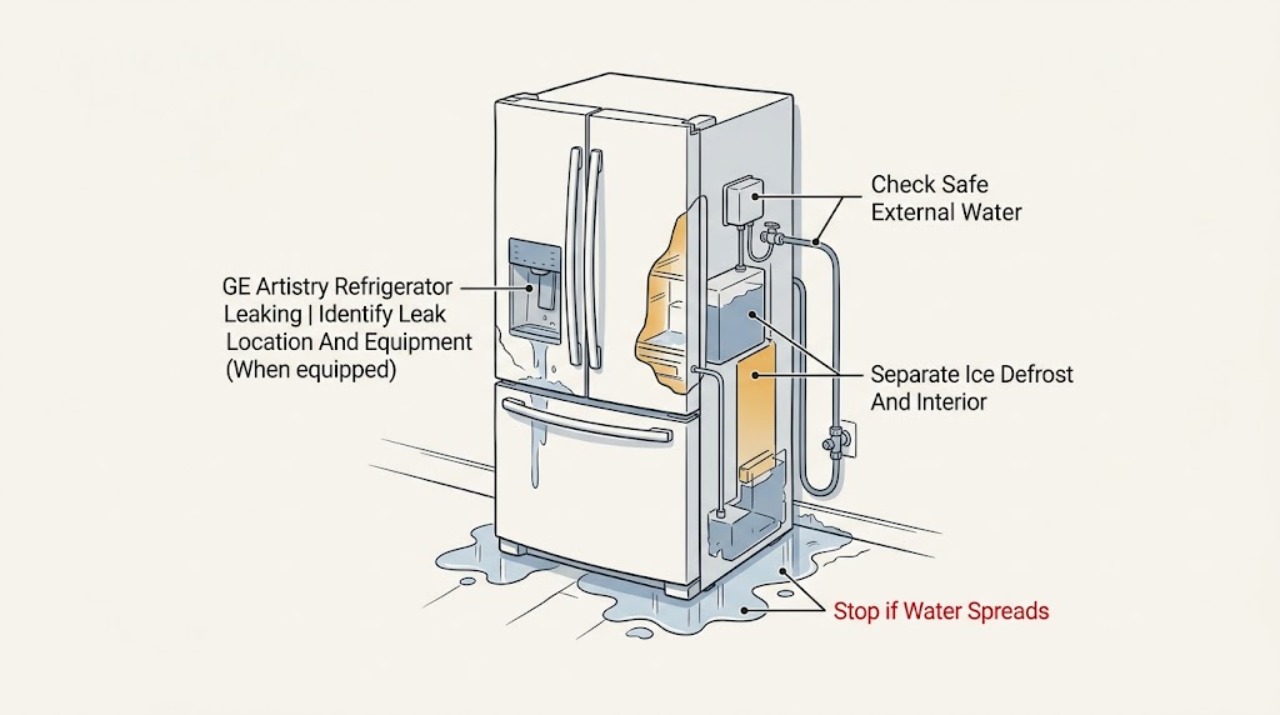
Work through in order
Diagnostic checks
Use only checks that match the exact appliance or system and its official guide.
-
Check 1
Record the exact GE Artistry model and serial information from the label near the upper refrigerator compartment or from the paperwork. Confirm whether an icemaker, water filter, dispenser, or water line is actually installed. Wipe the visible water dry, place an absorbent towel beneath the area, and observe without removing panels where the first new drop appears.
Expected result: Water starts at the rear or floor connection; under the freezer; under fresh-food drawers; around an icemaker or fill tube; at a dispenser; or no new water appears after drying.
Next step: Continue with the branch matching the equipment and location. If identifying the label requires moving a built-in or wet appliance, stop and arrange model-specific support.
Stop if: Do not assume the Artistry product family has one universal water circuit, and do not use a knife or sharp probe to find a hidden leak.
Why this matters
Why: The earliest wet point chooses the diagnostic path. A model with no dispenser or no icemaker cannot have a leak from those components. A dry cabinet with no recurrence may have been a spill or condensation event, but it is not proof that an intermittent leak is repaired.
-
Check 2
From a dry, safe position, inspect the accessible plug, cord, outlet, floor, and visible water tubing for wetness, heat, damage, a loose fitting, or a split line. If the leak is clearly from an icemaker water path, turn the icemaker off before using the model's accessible water shutoff. If the house shutoff or connection is inaccessible, do not move the refrigerator yourself.
Expected result: Water is near the outlet or cord; the outlet or cord is hot or damaged; a household line is loose or split; an icemaker continues flooding; or the visible supply and electrical area are dry and sound.
Next step: Stop for any electrical hazard. For a visible household plumbing leak, shut off water only if the valve is safely accessible and use a qualified plumber. For an icemaker leak, follow the model-specific shutoff path and arrange service if water continues.
Stop if: Do not touch wet electrical parts, repeatedly reset a breaker, pull the refrigerator by its cord or tubing, loosen pressurized fittings, or use an extension cord.
Why this matters
Why: Water near electrical parts is an immediate safety branch. GE treats a copper or plastic household line as a possible plumbing issue and directs the user to a plumber when that line itself leaks. An icemaker that continues flooding after being turned off needs its water supply stopped and service, not repeated cycling.
-
Check 3
For water inside the refrigerator, inspect only the visible fresh-food drawer area, freezer floor, door gasket, and drain openings described by the exact manual. Note whether there is ice on the freezer floor, water under fresh-food drawers, frost or condensation, or a door or package that is not closing. Do not remove an evaporator cover or pour hot water into an unknown drain.
Expected result: Water or ice is under fresh-food drawers; ice or water is on the freezer floor; a door is held open; water appears only after defrost or heavy humidity; or the interior remains dry while water returns outside.
Next step: Document the location and arrange service for water under drawers, a recurring freezer-floor leak, or any drain that requires internal access. Correct only a visible door or package obstruction and monitor once after drying.
Stop if: Do not chip ice, insert wire into a drain, remove covers, or continue using the refrigerator when water reaches electrical parts.
Why this matters
Why: GE associates water under fresh-food drawers with a possible water-storage tank or tubing leak and says service is recommended when that tank leaks. Ice under the freezer or vegetable pans can indicate a clogged defrost drain, while an open door or humid air can create moisture without a supply-line leak. An outside recurrence with a dry interior points toward a supply or drain path elsewhere.
-
Check 4
If the exact Artistry model has an installed icemaker, observe only the visible ice bucket, fill-tube area, and accessible supply connection while the icemaker is off. Check for water entering the bucket or floor, a visibly loose fitting, or a split accessible line. Do not touch the ejector mechanism or heater while plugged in, and do not add an icemaker diagnosis to a model that is only icemaker-ready.
Expected result: The icemaker is absent; the leak stops when the icemaker is off; water continues with the icemaker off; a fitting or fill line is visibly leaking; or the icemaker area is dry.
Next step: Keep a leaking icemaker off and shut off its water supply if flooding continues, then arrange qualified service. For a visible household line leak, use plumbing service. Do not order an icemaker or valve for an icemaker-ready model without confirming installation and diagnosis.
Stop if: Do not force the feeler arm, reach into moving or heated parts, remove the fill tube, or make live electrical tests.
Why this matters
Why: A leak that stops when the installed icemaker is disabled makes its fill line, valve, or mechanism more relevant. Continued flooding with the icemaker off requires the water supply to be shut off. A dry icemaker area moves the diagnosis to drain, door, condensation, or another water path.
-
Check 5
Only if the exact Artistry configuration has a water dispenser, dry the grille or drip tray and observe the spout after one normal fill. Note whether drops stop shortly after the glass is removed or continue long afterward, and whether water also appears under drawers or on the floor. If the model has no dispenser, skip this check.
Expected result: Only a few drops occur immediately after dispensing; the drip continues long after the glass is removed; the grille tray is full; or water appears elsewhere in the cabinet or on the floor.
Next step: Wipe the model-equipped drip tray and monitor normal drips. Arrange service for persistent dispenser dripping, a wet internal tank, or any floor leak; do not assume an Artistry model has a dispenser.
Stop if: Do not remove the dispenser panel, disconnect tubing, or continue dispensing if water is reaching electrical controls.
Why this matters
Why: GE says a few drops after dispensing can result from water-line pressure and condensation, while continued dripping long after removal may need service. Water elsewhere is not explained by normal spout dripping and requires its own source check.
-
Check 6
After the one applicable external correction—such as removing a visible door obstruction, turning off a leaking icemaker, or wiping a drip tray—make one normal observation and record the model, equipment fitted, first wet point, water amount, timing, and whether the leak returns. Keep the refrigerator closed as much as practical while waiting for service.
Expected result: No water returns; the leak returns from the same point; water continues with the icemaker off; the supply line or valve remains wet; or an electrical or flooding hazard appears.
Next step: Arrange qualified GE appliance service for an internal drain, valve, tank, tubing, door, or icemaker fault, and a plumber for a leaking household water line. Provide the model and source record rather than ordering a part from the puddle alone.
Stop if: Stop immediately for water near electrical parts, smoke, burning odor, sparks, abnormal heat, damaged wiring, repeated breaker trips, or uncontrolled flooding.
Why this matters
Why: A stable dry result supports a spill, condensation, or visible door issue but does not identify an internal repair. A repeated source, a continuing valve or line leak, or water despite an icemaker shutoff points beyond safe owner checks.
Use your observations
Decision map
Find the observation that best matches what you see, then follow the next safe action.
-
PATH 01Safety boundary
What you see
An icemaker is installed, water is entering the bucket or floor, and the leak is associated with its fill cycle or continues after the icemaker is switched off.
Do this next
Keep the icemaker off, shut off its water supply from a safe accessible valve, protect electrical areas from water, and arrange qualified appliance service.
Why this path and its safety boundary
Why it matters: The installed icemaker, fill line, water valve, or its connection is more likely than a simple condensation event. GE directs owners to turn the icemaker off first and shut off its water supply if flooding continues.
Safety stop: Do not reach into the ejector or heater, remove the fill tube, or live-test the valve.
-
PATH 02Safety boundary
What you see
The earliest wet point is a visible copper or plastic household supply line, the refrigerator water connection, or a water valve, rather than the cabinet interior.
Do this next
Shut off water only from a safe accessible valve; use a qualified plumber for the household line and qualified appliance service for a refrigerator valve or fill-line fault.
Why this path and its safety boundary
Why it matters: A plumbing connection, supply line, or valve leak is more likely than a defrost drain. GE distinguishes a leaking household copper line as a plumbing issue and a refrigerator valve or fill line as an appliance-water issue.
Safety stop: Do not loosen fittings under pressure, pull the refrigerator over its tubing, or continue if water can reach the outlet or cord.
-
PATH 03Safety boundary
What you see
Water or ice is under fresh-food drawers or on the freezer floor, while the external supply area is dry.
Do this next
Keep the area dry, check only visible door and loading conditions, and arrange qualified service for a recurring leak or any drain, tank, tubing, or internal access.
Why this path and its safety boundary
Why it matters: GE associates water under fresh-food drawers with a possible storage-tank or tubing leak and identifies ice under freezer or vegetable pans as a possible clogged defrost drain; the location requires model-specific diagnosis.
Safety stop: Do not chip ice, insert tools into a drain, remove the evaporator cover, or operate with water near electrical parts.
-
PATH 04Safety boundary
What you see
The configuration has a dispenser and only a few drops appear immediately after dispensing, or moisture follows a door opening without a returning puddle.
Do this next
Wipe the equipped drip tray or surface and monitor once. Escalate if dripping continues long after dispensing, returns when no dispensing occurs, or spreads to the cabinet or floor.
Why this path and its safety boundary
Why it matters: GE says a few post-dispense drops can be normal from line pressure and condensation. Moisture from an open door or humidity can also dissipate, but a persistent drip or water elsewhere is not explained by this branch.
Safety stop: Do not assume this branch on a no-dispenser model or ignore water near electrical controls.
-
PATH 05Safety boundary
What you see
The leak returns after drying and a visible correction, the source cannot be seen without removing a panel, or water is near electrical parts, a hot or damaged cord, smoke, sparks, or repeated breaker trips.
Do this next
Stop using the refrigerator and arrange qualified GE appliance service; use a qualified plumber for a confirmed household water-line leak. Provide the exact model and first-wet-point record.
Why this path and its safety boundary
Why it matters: An internal drain, valve, tank, tubing, door, or control-area fault may be present, and hazard signs make further operation unsafe. The puddle does not identify a compatible replacement part.
Safety stop: Do not open panels, probe live circuits, bypass an icemaker, repeatedly reset protection, or restart uncontrolled flooding.
Helpful context
Understand the symptom
Trace the first wet point, not just the puddle
Water can travel along a shelf, liner, tubing, or floor before it reaches the front. GE Artistry is a bottom-freezer refrigerator family, but the opened Artistry product example is non-dispenser and only prepared for an optional icemaker. A floor leak on an icemaker-equipped model, water under fresh-food drawers, and condensation on a door are different paths. Record the exact model, whether an icemaker is installed, and the highest or earliest wet point before moving anything.
Separate normal moisture from an active leak
A few drops after dispensing can be normal on models that have a dispenser, but GE says dripping that continues long after the glass is removed may need service. Moisture from a door left open or humid air is not the same as a steadily returning puddle. Water under drawers, at the freezer floor, around an icemaker, or at a supply fitting should be treated as a source-specific leak rather than dried and ignored.
Keep water and electricity separated
Do not touch wet plugs, outlets, wiring, or controls. If water is near electrical parts, isolate the appliance only from a safe, dry position and obtain qualified help. For an icemaker leak, turn the icemaker off before shutting off its water supply. Do not remove covers, reach into a powered icemaker, pull a built-in appliance, or use a tool to clear an internal drain unless the exact manual expressly authorizes that user procedure.
When checks do not resolve it
Need a professional?
Arrange qualified GE appliance service for a recurring leak, water under drawers or on the freezer floor, a leaking valve, tank, fill line, drain, door area, or icemaker, or any diagnosis requiring internal access. Use a qualified plumber for a leaking household water line. Stop immediately for water near electrical parts, smoke, burning odor, sparks, abnormal heat, damaged power parts, repeated breaker trips, or uncontrolled flooding.
Safety scope: Do not touch wet electrical parts, remove panels, reach into a powered icemaker, open the sealed refrigeration system, loosen pressurized tubing, pull a built-in appliance, or perform live electrical tests. Stop for water near electrical parts, smoke, burning odor, sparks, abnormal heat, damaged wiring, repeated breaker trips, or uncontrolled flooding.
Have this ready
- Exact GE Artistry model and serial information, whether an icemaker, dispenser, filter, and water line are installed, first wet point, whether the leak occurs during dispensing or icemaker filling, whether shutting off the icemaker changed it, water quantity and timing, and any electrical hazard.
Common questions
FAQ
Do all GE Artistry refrigerators have an icemaker or dispenser that could leak?
No. The opened GE Artistry product example is a bottom-freezer, non-dispenser refrigerator equipped for an optional icemaker. Confirm the exact model and installed accessories before following an icemaker or dispenser leak path.
What should I do first if the GE Artistry icemaker is flooding?
Turn the icemaker off. If it continues flooding, GE says to turn off the water supply to the icemaker. Keep water away from electrical parts and arrange qualified service rather than opening the mechanism.
Is water under the fresh-food drawers a normal GE Artistry leak?
No. GE says water or ice under refrigerator drawers may indicate a leaking water-storage tank or tubing and recommends service when the tank is leaking. It can also be a model-specific drain or condensation issue, so record the first wet point.
Read the exact guide
Official sources
- Refrigerator - Water Leaking Onto The FloorGE Appliances · GE refrigerators with water valves, household supply lines, and icemaker fill lines; apply only when the Artistry configuration has that equipment
- Refrigerator - Dripping or Leaking Water from DispenserGE Appliances · GE refrigerator configurations equipped with a water dispenser
- Refrigerator Icemaker Leaking or FloodingGE Appliances · GE refrigerator models equipped with an automatic icemaker
- Refrigerator - Icemaker Leaking or Dripping WaterGE Appliances · GE refrigerators with an icemaker, fill line, water valve, or defrost drain; use the exact Artistry model to determine which are present
- GE Artistry™ Series 20.3 Cu. Ft. Bottom-Freezer Refrigerator - ABE20EGEBSGE Appliances · GE Artistry ABE20EGEBS product configuration; use the exact model for other Artistry variants
- Refrigerator - Water Under the Fresh Food DrawersGE Appliances · GE refrigerator configurations with fresh-food drawers and water storage or tubing
- Refrigerators Bottom Freezer Owner's Manual and Installation InstructionsGE Appliances · Opened GE bottom-freezer manual; exact model controls and water equipment remain controlling
Community feedback
Share a repair observation
Share a plain-text repair observation. Accepted observations are published automatically; this page may take a moment to update.