
On this page
Start here
Quick answer
A GE Artistry refrigerator can normally hum or pulsate as the compressor runs, change fan speed after door openings, click during control or defrost events, gurgle as refrigerant or drain water moves, or make a short whoosh after a door closes. GE identifies these as normal refrigerator sounds; an exact Artistry example, model ABE20EGEBS, is a bottom-freezer refrigerator whose Owner Center links to the model manual. First note when and where the sound occurs, check only that shelves, bins, bottles, and the cabinet are stable from ordinary access, and treat an installed icemaker separately. A scraping or repeated fan-blade impact sound, a new loud rattle, a noise accompanied by warming, burning odor, water near electricity, or a damaged cord needs service; do not remove panels, reach into a fan or icemaker, or perform live electrical or sealed-system work.
Before you begin
Safety first
- This article supports listening, documentation, and ordinary-access checks only. Do not open panels, reach into moving or energized parts, test live circuits, handle refrigerant, or move a loaded refrigerator.
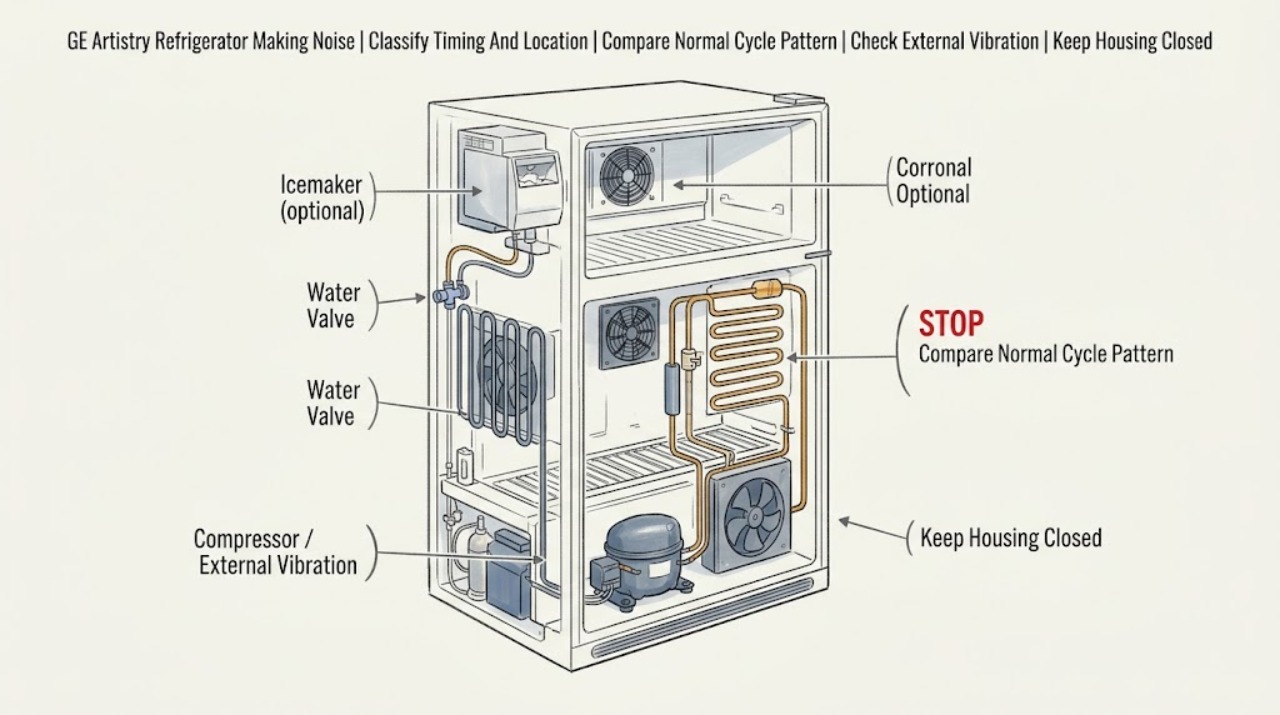
Work through in order
Diagnostic checks
Use only checks that match the exact appliance or system and its official guide.
-
Check 1
From outside the cabinet, listen briefly and write down the sound character, exact location, duration, and trigger; note whether it occurs at startup, while the compressor is running, after a door closes, during defrost, or at a repeating interval.
Expected result: Classify it as hum or pulsation, airflow or whoosh, click or pop, gurgle or drip, short buzz, loose rattle, scraping or grinding, or an electrical-looking buzz; record whether cooling and interior lights remain normal.
Next step: Use the sound log in the next checks and provide an audio or video recording to service if the pattern is abnormal; do not place hands or tools inside the appliance to localize it.
Stop if: Stop listening and keep clear if there is smoke, a burning odor, arcing, a hot or damaged cord, water near an outlet, or an exposed moving part; use the safety boundary below and arrange urgent service.
Why this matters
Why: Cycle-linked hum, airflow, clicks, gurgling, and defrost water sounds fit GE's normal-sound descriptions more closely than a continuous impact or scraping sound. A sound tied to a freezer fan area, worsening over time, or paired with poor cooling is more likely to need diagnosis.
-
Check 2
Compare the recorded pattern with the GE normal-sounds list and the exact model's Owner Center or manual, using the model label rather than assuming that every Artistry refrigerator has the same layout or accessories.
Expected result: Check whether the sound matches compressor hum or pulsation, fan-speed change, control or defrost click, refrigerant gurgle, door-pressure gurgle, defrost drip or sizzle, or a confirmed icemaker fill/drop event.
Next step: If the exact model is ABE20EGEBS, use the linked GE Artistry Owner Center resources for that model; otherwise record the complete model number and request model-specific guidance before accessing any panel.
Stop if: Do not use a different refrigerator's manual, sound recording, or accessory instructions to justify disassembly or a part replacement.
Why this matters
Why: A close match that is brief or cycle-linked is usually a normal operating sound when temperatures are maintained. A new sound that is not on the list, or one that has changed from the appliance's prior pattern, cannot be cleared by the generic list.
-
Check 3
With doors closed and the appliance unloaded only as convenient, check from ordinary access that the cabinet is stable and that bottles, bins, shelves, magnets, or nearby objects are not touching or rattling against the cabinet; do not rock or pull a loaded refrigerator.
Expected result: Record whether the rattle changes when a loose item is moved, whether the cabinet rocks, whether a door or drawer contacts surrounding trim, or whether the same noise continues with all accessible items still.
Next step: Secure or reposition only loose accessible items and observe one normal cooling cycle; if the cabinet is unstable, the floor or leveling arrangement needs professional or model-specific attention rather than forceful movement.
Stop if: Do not tip, slide, unload by yourself, remove a rear or bottom cover, or reach beneath the refrigerator while it is connected to power.
Why this matters
Why: A sound that changes when an accessible item or surrounding contact is corrected supports an external vibration. A persistent rattle from underneath or inside, especially one that sounds like a fan blade impact, is not established as a harmless shelf vibration.
-
Check 4
Only if the exact GE Artistry model has an installed icemaker, observe from outside whether a short hum or buzz occurs during filling or when cubes fall; check that the icemaker's user control is intentionally on and that the water supply is intentionally connected.
Expected result: Record a brief fill or cube-drop sound, a buzz that repeats while water is unavailable, no icemaker activity, or a noise unrelated to any installed icemaker; do not open a cover or reach toward the ice-making mechanism.
Next step: If water is not connected, turn the icemaker off using the exact model's user control and arrange connection or service; if the supply is connected but the noise persists, provide the timing and model number to a technician.
Stop if: Do not force an ice tray, raise or manipulate an unknown mechanism, disconnect water tubing, or test a valve or wiring while energized.
Why this matters
Why: GE describes fill hum or valve buzz and ice dropping as normal on equipped models, but repeated buzzing with the icemaker on and water off can indicate an attempted fill. A noise unrelated to an installed icemaker should not be assigned to the water valve by guesswork.
-
Check 5
Without changing temperature controls or opening panels, check whether the refrigerator and freezer are maintaining their usual temperatures and whether frost, door-seal, or repeated cycling symptoms appeared with the noise.
Expected result: Record normal cooling, extended running after a warm load or frequent openings, warming in one or both compartments, increasing frost, a door that is not sealing, or a sound that starts and stops with cooling demand.
Next step: Keep doors closed as practical, protect perishable food if temperatures are rising, and arrange qualified refrigerator service with the sound log, model number, and cooling observations.
Stop if: Do not remove evaporator or condenser covers, adjust sealed-system components, handle refrigerant, or perform electrical tests.
Why this matters
Why: Long compressor operation can be normal after a large load, frequent openings, or hot weather, but a new noise combined with warming or frost is not explained by sound alone. A performance change raises the priority of professional diagnosis of airflow, fan, control, or sealed-system causes.
-
Check 6
Inspect only the visible cord, plug, outlet area, and floor from a dry, safe position; do not touch wet electrical parts or move the refrigerator to reach the rear.
Expected result: Look for a burning smell, smoke, sparks, a hot or cracked cord or plug, repeated breaker trips, water approaching the outlet or cord, or an exposed moving or electrical part.
Next step: If the outlet and plug are dry and safely reachable without moving the appliance, switch off or unplug it; otherwise keep clear, isolate the area, and contact qualified appliance or electrical service. Preserve food and document the condition only if safe.
Stop if: Do not reset a repeatedly tripping breaker, bypass a fuse, open the cabinet, reach into a fan or icemaker, or continue operation after smoke, arcing, burning odor, or water near electricity.
Why this matters
Why: These are safety conditions, not noise diagnoses. A refrigerator with water near electricity or signs of electrical damage can create shock or fire risk; internal fan, compressor, control, and sealed-system work is outside ordinary user checks.
Use your observations
Decision map
Find the observation that best matches what you see, then follow the next safe action.
-
PATH 01Safety boundary
What you see
The sound is a hum or pulsation, airflow change, click, pop, gurgle, drip, or brief whoosh that follows compressor, fan, door, or defrost activity, and cooling remains normal.
Do this next
Record the pattern and monitor it through ordinary cycles; use the exact model manual if the sound changes or becomes persistent.
Why this path and its safety boundary
Why it matters: This pattern is consistent with GE's listed normal operating sounds rather than proof of a failed part.
Safety stop: Arrange service if the sound becomes a new impact, scraping or grinding noise, or is joined by warming, leaks, odor, or electrical symptoms.
-
PATH 02Safety boundary
What you see
The rattle changes or stops when a loose accessible container, shelf item, drawer contact, or nearby object is corrected, and the cabinet is otherwise stable.
Do this next
Secure only the accessible item and observe; if the cabinet rocks or requires moving or leveling a loaded appliance, request model-specific or qualified help.
Why this path and its safety boundary
Why it matters: An external vibration is more likely than an internal motor or sealed-system fault, although recurrence from underneath still needs assessment.
Safety stop: Do not pull, tip, or place hands under the refrigerator to chase a vibration.
-
PATH 03Safety boundary
What you see
The exact model has an installed icemaker and a short periodic buzz or vibration occurs while the icemaker is on but its water supply is not connected or is shut off.
Do this next
Use the exact model's user control to turn the icemaker off until water is available, then seek model-specific service if the sound continues with the icemaker off.
Why this path and its safety boundary
Why it matters: GE identifies this as an icemaker fill attempt rather than a compressor noise; the interval and controls vary by model.
Safety stop: Do not remove the icemaker cover or manipulate the fill valve, wiring, or tubing.
-
PATH 04Safety boundary
What you see
The sound resembles a blade striking something, scraping, grinding, or a persistent internal rattle, particularly from the freezer, and it does not match an accessible item or normal cycle event.
Do this next
Stop disassembly and arrange qualified appliance service; supply the model number, location, timing, recording, and whether cooling changed.
Why this path and its safety boundary
Why it matters: GE specifically says a freezer sound like a fan blade hitting something is not normal; an internal fan, obstruction, motor, or other component needs diagnosis.
Safety stop: Do not remove panels, reach into a fan, chip ice, or operate exposed moving parts.
-
PATH 05Safety boundary
What you see
A new or worsening noise occurs with warming, increasing frost, a door-seal problem, repeated abnormal cycling, or loss of expected cooling.
Do this next
Protect food as needed and arrange qualified refrigerator service rather than changing controls or opening the cabinet.
Why this path and its safety boundary
Why it matters: The sound cannot be classified as normal in isolation; airflow, fan, control, or sealed-system diagnosis may be required.
Safety stop: Do not handle refrigerant, test live circuits, or continue using the appliance if electrical or water hazards are present.
-
PATH 06Safety boundary
What you see
Noise is accompanied by smoke, arcing, burning odor, a hot or damaged cord, repeated breaker trips, or water near electrical parts.
Do this next
Keep clear and contact qualified appliance or electrical service; disconnect only from a dry, safely reachable point without moving the refrigerator.
Why this path and its safety boundary
Why it matters: This is a safety stop, not a user-level noise diagnosis.
Safety stop: Do not reset breakers repeatedly, touch wet electrical parts, move the appliance, or open panels.
Helpful context
Understand the symptom
Start with the sound pattern, not a guessed part
Record whether the sound is a steady hum, a brief click, a whoosh immediately after a door closes, gurgling, a drip or sizzle during defrost, a periodic buzz, a vibration, or scraping and grinding. Also note whether it comes from the freezer, fresh-food compartment, door, underneath, or the surrounding cabinet. The sound's timing and location are more useful than assuming every GE Artistry refrigerator has the same fan, dispenser, or icemaker arrangement. GE's ABE20EGEBS Owner Center confirms one Artistry configuration—a 20.3 cu. ft. bottom-freezer model made in 2013–2014—so use its manual only when the appliance identification matches.
Sounds that often follow a normal cooling cycle
GE's refrigerator guidance describes a compressor hum or pulsating sound, fan-speed changes after door openings, control or defrost clicks, refrigerant boiling or gurgling, water dripping into the drain pan, and hissing or sizzling as defrost water reaches the heater. A short gurgle after closing a door can come from the drain-tube trap or pressure equalization. A refrigerator may also run for long periods after frequent openings, a large warm load, or in hot weather. These patterns are less concerning when cooling performance is normal and the sound is brief or cycle-linked.
Separate cabinet vibration and optional icemaker sounds
A rattle that changes when a shelf, bin, bottle, or nearby object is moved can be an external vibration rather than a sealed-system failure. From safe access, confirm the cabinet is not rocking and that loose items are not touching the walls or each other; do not tilt or move a loaded refrigerator. If the exact model has an installed icemaker, a short fill hum, valve buzz, or cubes dropping into the bin may be expected. GE says an icemaker left on without a connected water supply can buzz or vibrate repeatedly; use the model's normal on/off control and keep it off until the water connection is properly available.
When the noise is a service symptom
A freezer sound that resembles a fan blade striking something is not a normal sound in GE's guidance. Treat a new scraping, grinding, repeated hard knocking, or persistent electrical-sounding buzz as abnormal—especially if the freezer or fresh-food compartment is warming, frost is increasing, a door no longer seals, or the sound started after movement or a repair. Do not remove the rear cover, evaporator cover, fan guard, or control panel to investigate. A technician can identify a fan obstruction, vibration, motor, water valve, compressor, or other system issue without exposing you to moving parts, mains electricity, or refrigerant work.
Safety boundary
Stop conditions
- Do not remove rear, bottom, evaporator, fan, or control panels to chase a noise.
- Do not reach into a fan, icemaker, compressor area, or other moving or energized mechanism.
- Do not test live wiring, bypass a control or safety device, handle refrigerant, or open a sealed system.
- Stop immediately for smoke, arcing, burning odor, a hot or damaged cord or plug, repeated breaker trips, or water near an outlet or electrical part.
- Do not chip ice, force an ice tray, disconnect hidden water tubing, tip a loaded refrigerator, or move it alone.
When checks do not resolve it
Need a professional?
Arrange qualified appliance service when a sound resembles a fan blade impact, scraping, grinding, or repeated hard knocking; when an accessible vibration does not resolve; when an installed icemaker or water valve continues buzzing after the exact user control is used; when noise is paired with warming, frost, a door-seal change, or abnormal cycling; or whenever electrical, water, moving-part, or sealed-system access would be required.
Safety scope: This article supports listening, documentation, and ordinary-access checks only. Do not open panels, reach into moving or energized parts, test live circuits, handle refrigerant, or move a loaded refrigerator.
Common questions
FAQ
Is a humming sound normal on a GE Artistry refrigerator?
Often. Compressor hum or pulsation and changing fan speed are listed by GE as normal refrigerator sounds when they follow ordinary cooling activity and temperatures remain normal. A new scraping, grinding, or impact sound needs service.
Why does the refrigerator gurgle after I close the door?
GE says a short gurgle after door closure can come from water in the drain-tube trap or pressure equalization. It is less concerning when it is brief, repeatable, and not accompanied by a leak or cooling loss.
Why is my refrigerator buzzing every few minutes?
If the exact model has an icemaker, GE says repeated buzzing can occur when it tries to fill while its water supply is off. Use the model's user control to turn the icemaker off until water is available; do not open the icemaker or test its valve.
What does a scraping sound from the freezer mean?
GE specifically treats a freezer sound like a fan blade hitting something as abnormal. Keep hands and tools out of the freezer mechanism, document the timing, and arrange qualified service rather than removing the cover.
Can a GE refrigerator run for a long time and still be normal?
Yes. GE explains that modern refrigerators may run much of the time, especially after a warm load, frequent door openings, or hot weather. Long run time alone is not a noise diagnosis; warming, frost, or a new noise raises the priority of service.
Should I unplug a noisy refrigerator?
For an ordinary noise with normal cooling, do not move the refrigerator just to unplug it. If there is smoke, arcing, a burning odor, a hot or damaged cord, or water near electricity, keep clear and disconnect only from a dry, safely reachable point without moving the appliance; otherwise call qualified service.
Read the exact guide
Official sources
- Refrigerator - Unusual NoisesGE Appliances · GE Appliances general refrigerator unusual-noise guidance; the exact fan, condenser, filter, and icemaker arrangement is model-dependent.
- Troubleshooting for ABE20EGEBS | GE AppliancesGE Appliances · Official GE Appliances Owner Center page for model ABE20EGEBS, identified there as a GE Artistry Series 20.3 Cu. Ft. Bottom-Freezer Refrigerator; do not generalize its architecture or accessories to an unidentified Artistry model.
- Refrigerator or Freezer - Normal Run TimeGE Appliances · GE Appliances general refrigerator and freezer run-time guidance; it does not diagnose a particular noise or model.
- Refrigerator - Intermittent Buzzing or Vibrating NoiseGE Appliances · GE Appliances guidance for refrigerator models equipped with an icemaker or water valve; it does not establish that an unidentified GE Artistry model has either accessory.
- Refrigerator - Normal Sounds and Noises MadeGE Appliances · GE Appliances general refrigerator guidance; exact sound behavior and accessories remain model-dependent.
Community feedback
Share a repair observation
Share a plain-text repair observation. Accepted observations are published automatically; this page may take a moment to update.