
On this page
Start here
Quick answer
First locate the frost: a little frost on food packages after opening the freezer or adding warm food can be normal, but heavy frost on a wall, around a door or drawer, or across the compartment is not expected on a frost-free model. Check for packages, shelves, baskets, or shipping material preventing the freezer from closing; inspect that the gasket touches the frame evenly and that the door or drawer is aligned and fully seated. Frequent openings, high humidity, and warm uncovered food can add moisture. Correct only those visible causes, wipe accessible frost with a dry towel, and follow the exact Café model manual for temperature and defrost instructions. Do not use sharp tools, electrical heating devices, or cabinet-level disassembly. If frost returns after the door seal and loading checks, the freezer fan is not running, cooling is affected, or the frost pattern is concentrated on one wall, stop troubleshooting and arrange qualified refrigerator service.
Before you begin
Safety first
- The user may identify the exact model, inspect visible loading and gasket contact, restore normal closure, clear accessible obstructions, and follow the model's de-energized care instructions. Qualified personnel must handle panels, fans, heaters, sensors, controls, drains, wiring, refrigerant, and any repair near water or electricity.
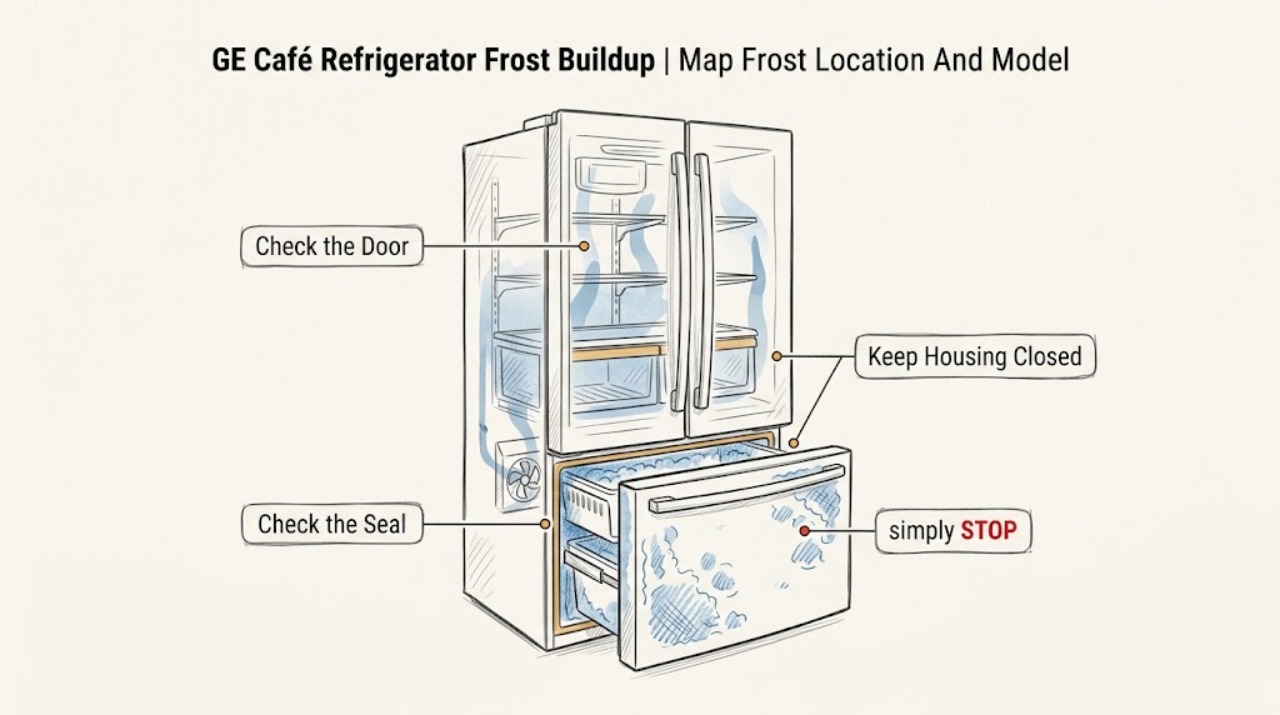
Work through in order
Diagnostic checks
Use only checks that match the exact appliance or system and its official guide.
-
Check 1
Identify the exact Café model and configuration, then photograph or note where frost appears: on packages, the rear wall, ceiling, door or drawer edge, shelves, or the fresh-food section. Record whether the frost is light and temporary, heavy across the compartment, or concentrated on one wall, and whether food temperatures or cooling have changed.
Expected result: Only package surfaces have light crystals; frost is on a wall or gasket; one wall is much heavier; frost is in a fresh-food area; or cooling is weak or food is warming.
Next step: Use the package, door-seal, airflow, or persistent-fault branch that matches the pattern and retrieve the exact Owner's Manual from the model support page.
Stop if: Stop if food is warming rapidly, water reaches electrical components, there is smoke or burning odor, or the appliance has exposed or damaged wiring.
Why this matters
Why: Package crystals can be a normal moisture effect. Wall or edge frost points toward air entry or a freezer-side issue; an unusual one-wall pattern or cooling loss raises the need for service. The exact model determines whether manual defrost is normal.
-
Check 2
With the freezer open and power left undisturbed, move only visible packages, shelves, bins, or baskets that prevent closure. For a bottom drawer, confirm the lower basket is fully seated; for a door, check that it touches the frame evenly. Verify shipping material has been removed on a recent installation.
Expected result: A package or shelf was holding the door open; the basket was not seated; shipping material remained; the door closes evenly after correction; or a gap remains.
Next step: Correct only the visible loading or seating issue, close the door fully, and monitor whether new frost stops over the next few days. Use the exact installation instructions for alignment or leveling.
Stop if: Do not force a drawer, bend a hinge, remove a door, or continue if the gasket or frame is damaged.
Why this matters
Why: An obstruction or unseated drawer can admit warm humid air and explain local frost. A remaining gap or uneven contact makes alignment or gasket sealing more likely.
-
Check 3
Inspect the accessible gasket around the freezer door or drawer for cuts, tears, splits, loose sections, wrinkles, or frost that prevents contact. Check that containers and warm food are covered, reduce unnecessary door openings, and note whether the room is unusually humid. Clean the gasket only as the exact manual permits and keep the sealing surface dry.
Expected result: The gasket is damaged or pulled out; contact is uneven; frost is preventing closure; the room is humid or the door is opened often; warm uncovered food was recently added; or the gasket appears intact and contact is even.
Next step: Restore a clean, even seal and normal loading. Replace a confirmed damaged gasket only with the exact model-matched part or arrange service; do not infer a heater or sensor failure from frost alone.
Stop if: Do not use a sharp object, heat source, solvent, or cabinet disassembly to reshape or thaw the gasket.
Why this matters
Why: A damaged or poorly contacting gasket, repeated openings, humidity, or warm uncovered food can explain excess moisture and frost. An intact seal after these loading changes makes an internal airflow or defrost issue more likely if frost returns.
-
Check 4
Confirm packages are not pressed against the freezer rear wall or blocking vents. Read the exact Café manual to determine whether the refrigerator is frost-free or manual-defrost and to find the documented temperature and defrost procedure. If cleaning or maintenance is allowed, switch the refrigerator off and unplug it first; remove only accessible frost as directed, without using a sharp tool or electrical heating device.
Expected result: Rear packages or vents are blocked; the model is frost-free; the model is manual-defrost; visible frost clears after the documented procedure; or frost is hidden behind a panel or returns quickly.
Next step: Restore clear airflow and follow the model-specific manual once. Arrange service for hidden frost, a non-running fan, a frost-free refrigerator that refreezes, or any procedure requiring panels.
Stop if: Do not remove evaporator covers, probe wiring, use heat, scrape ice, or pour liquid into the compartment.
Why this matters
Why: Blocked airflow or a manual-defrost schedule can account for some frost. On a frost-free model, persistent or hidden frost points toward defrost, fan, drain, seal, or control diagnosis; quick recurrence is not a reason to repeat unsafe defrosting.
-
Check 5
After the visible loading, seal, humidity, and model-specific care checks, monitor the refrigerator without opening panels. If heavy frost returns, the freezer fan is not running, the frost pattern is one-sided, the refrigerator is defrosting too often, or cooling is impaired, record the pattern and arrange qualified refrigerator service.
Expected result: Frost returns after a few days; a freezer fan is silent or airflow is abnormal; frost is concentrated on one wall; the appliance is warm; water leaks during or after defrost; or the issue does not recur after correcting the seal and loading.
Next step: Keep food protected and provide the technician the exact model, frost location, seal observations, cooling status, and documented steps. Do not select a replacement component from the symptom alone.
Stop if: Stop immediately for smoke, burning odor, exposed wiring, water near electricity, abnormal heat, or any need to access energized or refrigerant components.
Why this matters
Why: Recurring heavy frost or a non-running fan on a frost-free model can involve the defrost heater, sensor, control, fan, drain, seal, or another internal condition. A successful correction of loading or sealing makes those internal causes less likely.
Use your observations
Decision map
Find the observation that best matches what you see, then follow the next safe action.
-
PATH 01Safety boundary
What you see
Frost is limited to package surfaces or followed a recent warm-food load or frequent door opening, with no wall blanket and normal cooling.
Do this next
Cover warm or moist food, reduce unnecessary openings, keep packages clear of the seal, and observe for a few days.
Why this path and its safety boundary
Why it matters: Moisture from food or warm humid air is more likely than a refrigerator fault.
Safety stop: Escalate if frost spreads to walls or door edges, cooling changes, or heavy accumulation persists.
-
PATH 02Safety boundary
What you see
Frost is concentrated at the freezer opening and a package, basket, drawer, shipping material, uneven gasket, or visible gap prevents a consistent seal.
Do this next
Correct the visible obstruction or basket seating, restore normal closure, and use the model installation instructions for alignment or leveling.
Why this path and its safety boundary
Why it matters: Warm air entry through incomplete closure is more likely than an automatic-defrost component.
Safety stop: Do not force the door or drawer, remove hinges, or continue with a torn gasket or damaged frame.
-
PATH 03Safety boundary
What you see
Packages rest against the rear wall or vents, frost forms where airflow is restricted, and the door seal appears even.
Do this next
Restore the clearances specified by the manual and monitor. If frost returns with normal loading, use the persistent-frost branch.
Why this path and its safety boundary
Why it matters: A local airflow or loading condition can create frost without proving a fan or defrost failure.
Safety stop: Do not remove internal covers or attempt to reach a fan.
-
PATH 04Safety boundary
What you see
A frost-free Café refrigerator develops heavy or rapidly returning frost, the freezer fan is not running, frost is concentrated on one wall, or cooling is impaired after seal and loading checks.
Do this next
Keep the unit closed to protect food and arrange qualified refrigerator service with the model and frost pattern.
Why this path and its safety boundary
Why it matters: A defrost, fan, drain, control, seal, or other internal fault is more likely and cannot be safely identified from frost alone.
Safety stop: Do not scrape, heat, remove panels, test wiring, or repeatedly force a manual defrost.
-
PATH 05Safety boundary
What you see
The exact manual identifies a manual-defrost or cycle-defrost model, or frost is accompanied by water near electricity, smoke, burning odor, abnormal heat, or damaged wiring.
Do this next
Follow only the exact manual's de-energized defrost instructions; for a hazard, stop using the appliance and arrange qualified appliance or electrical service.
Why this path and its safety boundary
Why it matters: Some frost can be expected on manual-defrost models, but the manual controls the defrost threshold and procedure. Electrical or water hazards override routine frost troubleshooting.
Safety stop: Do not use electrical devices or sharp tools for defrosting, and do not operate with water near electrical parts.
Helpful context
Understand the symptom
Separate package frost from a freezer-wall problem
A few crystals inside a package or on its outside can occur when food freezes or when warm humid air enters during an opening. Frost that blankets shelves, forms on a freezer wall, builds around a door or drawer, or returns soon after removal is a different symptom. On a frost-free Café refrigerator, wall ice is not expected. Record where it appears, whether one side is much heavier, whether food is warm, and whether the refrigerator is manual-defrost or frost-free according to the exact model information.
The door seal is the first physical checkpoint
Warm room air entering through a door or drawer gap adds moisture that freezes. Packages, shelves, bins, a lower basket, or leftover shipping material can hold a Café freezer open. A gasket that is cut, torn, pulled out of its retainer, or uneven against the frame can do the same. A bottom-freezer drawer also needs its basket fully seated and its gasket seated in the groove. These checks narrow an air-leak problem but do not prove a gasket is the only cause.
Do not turn a frost complaint into a sealed-system repair
Automatic defrost melts evaporator frost on a model-dependent schedule; the compressor and fans stop during that cycle, and melted water drains to a pan. A recurring heavy frost pattern, a freezer fan that is not running, a blocked airflow path, or frost concentrated on one wall can indicate a fault beyond user checks. Turn power off and unplug before cleaning or maintenance, follow only the exact manual's defrost instructions, and leave fans, heaters, sensors, wiring, drain access, and sealed-system work to qualified service.
Safety boundary
Stop conditions
- Stop immediately for smoke, burning odor, sparks, abnormal heat, exposed wiring, water near electrical parts, or a hot, loose, or damaged power connection; isolate power only from a safe dry location.
- Turn the refrigerator off and unplug it before cleaning or maintenance, as the exact manual requires; do not perform cabinet-level work or live electrical checks.
- Do not use sharp or pointed tools, electrical heating devices, or direct heat to remove frost, and do not pour water into the freezer.
- Do not remove evaporator covers, access fans, heaters, sensors, drains, wiring, or sealed-system components.
- If frost returns on a frost-free model, cooling is impaired, or a fan is not running, protect food and arrange qualified service rather than guessing at a part.
When checks do not resolve it
Need a professional?
Arrange qualified GE Café refrigerator service when heavy frost returns after visible loading, closure, gasket, humidity, airflow, and model-specific care checks; a frost-free freezer fan is not running; frost is concentrated on one wall; the refrigerator is warming; defrosting occurs too often; a gasket, drain, heater, sensor, control, or internal panel requires diagnosis; or the exact model procedure is unavailable. Stop immediately for smoke, burning odor, sparks, abnormal heat, exposed wiring, water near electricity, or a damaged power connection. Provide the exact model and serial information, configuration, frost location and thickness trend, door or drawer closure, gasket condition, recent warm-food or installation history, cooling status, and safe checks performed.
Safety scope: The user may identify the exact model, inspect visible loading and gasket contact, restore normal closure, clear accessible obstructions, and follow the model's de-energized care instructions. Qualified personnel must handle panels, fans, heaters, sensors, controls, drains, wiring, refrigerant, and any repair near water or electricity.
Common questions
FAQ
Is frost on food in a GE Café freezer always a problem?
No. GE says frost or ice crystals on packages can occur when food freezes or warm humid air enters during a door opening. Heavy frost on a frost-free freezer wall, door edge, or compartment is a different symptom and should be investigated.
What should I check first for GE Café freezer frost buildup?
Check that packages, shelves, baskets, or shipping materials are not preventing the door or drawer from closing. Confirm the gasket contacts the frame evenly and that a bottom-freezer basket is fully seated. Then reduce unnecessary openings and warm uncovered food.
Why is frost heavier on one wall of my Café refrigerator?
A one-sided or unusual frost pattern can indicate more than a loading or humidity issue, especially on a frost-free model. GE directs owners to service when heavy frost persists or the pattern is unusual; do not remove the evaporator cover to investigate.
Can I scrape the frost off my GE Café refrigerator?
Use only the exact model manual's procedure. GE says to unplug before maintenance or cleaning, and its automatic-defrost guidance does not make cabinet access a user repair. Do not use sharp or pointed tools or electrical heating devices; recurring frost requires service.
When does frost buildup require refrigerator service?
Arrange service when frost returns after closure, gasket, loading, humidity, airflow, and model-specific care checks; the freezer fan is not running; cooling is impaired; defrosting occurs too often; or the frost is heavy or concentrated on one wall. Stop immediately for smoke, burning odor, abnormal heat, exposed wiring, or water near electricity.
Read the exact guide
Official sources
- Top Freezer Refrigerator - Adjusting or Replacing the Door GasketsGE Appliances · Opened GE top-freezer gasket guidance used for general gasket conditions; the assigned Café refrigerator may use another door style, so exact-model instructions control.
- Refrigerator & Freezer - Ice on Freezer WallGE Appliances · Applies to frost-free GE refrigerators and freezers; exact freezer layout and fan arrangement vary by model.
- Refrigerator - Frost in FreezerGE Appliances · Applies to GE refrigerators with freezer compartments; exact controls, door styles, and installation procedures vary by model.
- Refrigerator - Frost or Ice Crystals on Food in FreezerGE Appliances · Applies to GE refrigerator freezer compartments; normality depends on location, amount, model defrost type, and persistence.
- Bottom Freezer Refrigerator - Freezer Drawer Not Sealing ProperlyGE Appliances · Applies only to GE French-door and bottom-freezer refrigerator drawer configurations; Café drawer layouts vary by model.
- User Manual & Care for CDB36LP2RS1GE Appliances · Opened Café built-in bottom-freezer model support page used to establish the Café refrigerator family and the need for exact-model instructions; the assigned topic does not specify one model.
- Refrigerator - Automatic Defrost SystemGE Appliances · Applies to full-sized GE refrigerators with automatic defrost; cycle timing and controls vary by model.
Community feedback
Share a repair observation
Share a plain-text repair observation. Accepted observations are published automatically; this page may take a moment to update.